In 1917 Schiefer & Sons Aeroplane Co built the RS, designed by N B Robbins. A Pursuit trainer based somewhat on French V-strutted Nieuport design, it first flew on 9 December 1917.
The sole example was bought for a reported $11,000 and tested by the Army, but rejected as not being as good as Orenco or Thomas-Morse.
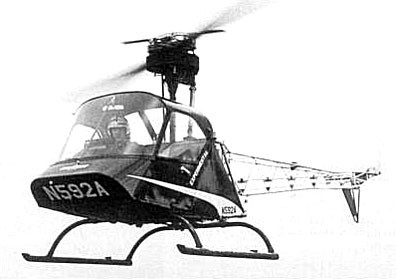
The 1963 Scheutzow Helicopter Flexhub was described “test-bed” version of Model B N564A, the blades were set on rubber bushings instead of conventional ball- and roller-bearings..
Webb Scheutzow formed Scheutzow Helicopter Corp in the early 1960s by to build a light helicopter with special rotorhead (blades carried on rubber bushings). The Bee side-by-side two-seater flew 1968 and three prototypes were built.
USA Scheutzow Helicopter Corp, Berea OH., USA, was formed the early 1960s by Webb Scheutzow to build a light helicopter with special rotorhead (blades carried on rubber bushings). Bee side-by-side two-seater flew 1966. Ceased development 1977.
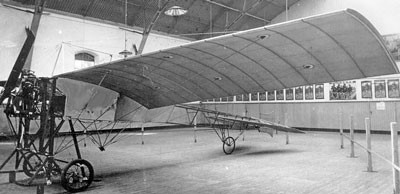
The Emile de Schepper and Hubert Hagens “Helpman I” monoplane was exhibited in the bicycle school of Fongers in Groningen (Netherlands) in May 1911. It had an open fuselage aft of the pilot seat and triangular-section fuselage and was powered by a 5-cylinder Anzani, rated at 50 hp. The monoplane was designed and built by Emile de Schepper and Hubert Hagens. Hagens was the mechanician of the famous Belgian flyer Jan Olieslagers and Emile de Schepper was the son of the Belgian E. J. de Schepper, who was a wealthy billiard manufacturer in Helpman (a separate village then, now a part of the town Groningen), hence the name “Helpman I”.
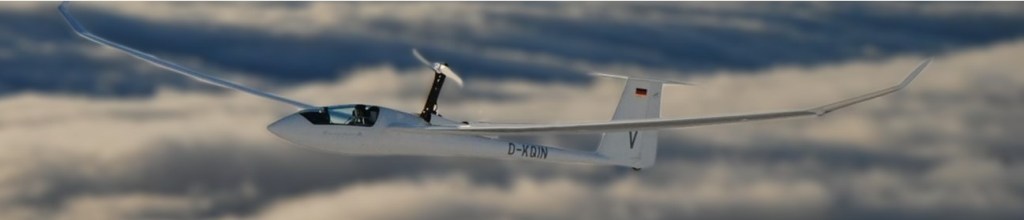
The Open Class Quintur 23 m wingspan is a very thin, high aspect ratio wing, with a maximum of 250 liters of water ballast, allowing for a potential wing loading between 39 and 58 kg/m².
Lange Aviation and Professor Loek Boermans were involved in the conception and design of the wings, with nine exact interacting wing airfoils that provide laminar flow over 95% of the lower and 75% of the upper wing surfaces and are based on a super-elliptical wing geometry. The concept of the outer wing panel with winglets were from Professor Mark Maughmer.
Structural design, ballasting and the patented, extremely light control design were provided by Lange Aviation.
A self-launch optimized fuselage has been designed for the Quintus, providing not only aerodynamic improvements but also details such as bug wiper “garages”. A forward-opening canopy makes getting in and out comfortable. Cockpit blends in either visual carbon or carbon-kevlar hybrid fibre, Alcantara lining, and engraved flap position indicator.
The Quintur M engine start-up is straightforward and automatic. To engage the engine, the pilot only needs to switch on the ignition and press the start button once the engine has been fully extracted. The engine’s start setup is always optimized by a microprocessor to match the current environment.
After switching off the ignition on the Ilec engine control unit, the control unit automatically stops and fixes propeller in the correct upright position and the engine gets retracted.
A rudder-integrated tail wheel supports precise steering for taxiing.
Wing span: 23m / 75.46 ft Wing area: 14.7 m² / 158.23 ft² Aspect ratio: 36 Fuselage length: 7.82 m / 25.66 ft Empty weight: 500 kg / 1102 lb Max. all-up weight: 850 kg / 1874 lb Wing loading: 38.8 – 57.8 kg/m² / 7.95 – 11.84 lb/ft² Max. permitted speed: 270 km/h / 146 kts / 168 mph