A development of Donnet-Leveque Type A as single engined recce seaplane
Era
Schreck, Hydravions FBA
France
Louis Schreck, the South American representative for Delaunay-Belleville automobiles, returned to France in 1909. He joined Hanriot at Juvissey and in 1911, jointly with engineer named Gaudard, designed D’Artois flying-boat.
Formed Hydravions Schreck FBA, and aided by British capital acquired Donnet-Leveque/Denhaut flying-boat patents, and was associated with that company until it was acquired by Bernard in 1934.
FBA 16 was side-by-side two-seat flying-boat; FBA 17 a utility type which established a seaplane height record in December 1923. A development was brought by US Coast Guard in 1931. In the later 1930s Schreck was carrying out flying-boat repairs and subcontract work.
Schreck Diapason I
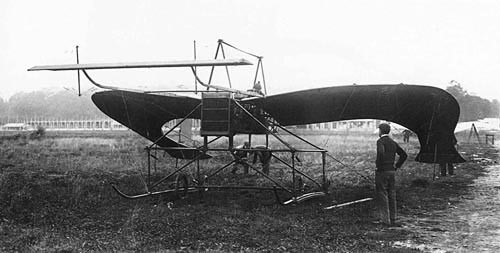
The Diapason (French for tuning-fork of which it resembled), was monoplane of 1910 in a form where the wing was swept back in a wide curve. The photo clearly shows a hefty radiator at the front of the small fuselage, from which may be concluded that one is looking at the 50 hp water-cooled Chenu-powered version. This engine was placed directly in front driving the pusher propeller at the back of the short central nacelle via a long shaft. In this version the entire nacelle is uncovered.
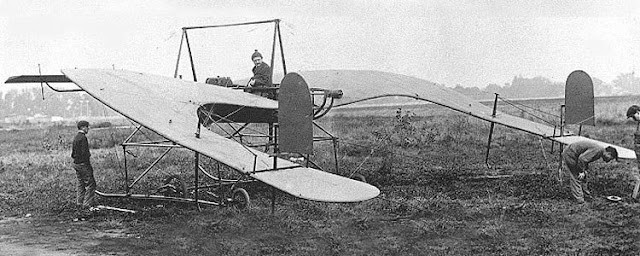
Span: 39’4″
Length: 46′
Weight: 880 lb
Schönleber Metallbau Vento
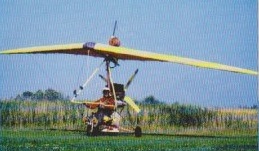
The wing and trike are made by Schönleber.
Empty weight: 160 kg
Wing span: 9.5 m
Wing area: 13 sq.m
Fuel capacity: 60 lt
Certification: Vz
Engine: Rotax 582, 65 hp
MAUW: 400 kg
Seats: 2
Max speed: 120 kph
Cruise speed: 95 kph
Minimum speed: 50 kph
Climb rate: 3.2 m/s
Fuel consumption: 12 lt/hr
Price (1998): 34 145 DM
Schönleber Metallbau Lotus
Hang glider
Lotus 16
Wing area: 16 m²
Wing span: 10.6 m
Hang glider weight: 33 kg
Minimum pilot weight: 60 kg
Maximum pilot weight: 92 kg
Packed length: 6 m
Packed length short: 4 m
Number of battens: 32
Nose angle: 126°
Schönleber Metallbau Focus
A 1983 hang glider.
Focus 16
Wing area: 16 m²
Wing span: 10.6 m
Hang glider weight: 31 kg
Minimum pilot weight: 50 kg
Maximum pilot weight: 125 kg
Packed length: 6 m
Packed length short: 3.9 m
Number of battens: 32
Nose angle: 126°
Focus 17
Wing area: 17 m²
Focus 18
Wing area: 18 m²
Wing span: 10.9 m
Hang glider weight: 36 kg
Minimum pilot weight: 70 kg
Maximum pilot weight: 200 kg
Packed length: 6.2 m
Packed length short: 3.9 m
Number of battens: 32
Nose angle: 126°
Schönleber Metallbau GmbH
1998:
Tremmelhausen
D-93186 Oettendorf/Regensburg
Germany
Schönleber makes wings for other manufacturers as well as Schönleber trikes.
Scholz Schwingenflieger
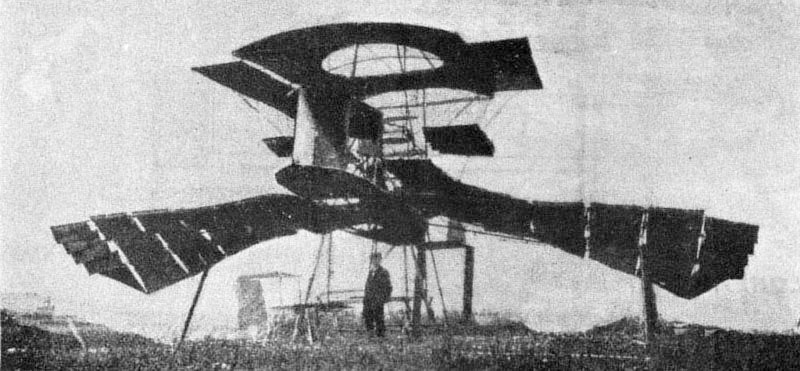
This big, strange ornithopter was designed by architect Bruno Scholz of Schulzendorf near Berlin after 12 years of studies of birds. It was “modelled after real birds” and the frame was made of bamboo sticks with multiple-slatted wings covered canvas. The apparatus measured from head to tail 17 meters, the wing span was 14 meters and the height 6 meters. The bird’s body held a cockpit for two passengers, two engines, each of 8 hp, and a centrifuge (fan?) which would help to lift it. It was built at great expense in 1909/10, but after it had been found to be complete failure it was reportedly smashed by hand by its builder.
Schoettler I
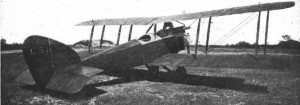
In 1923, the British magazine Flight reported what it termed the first successful flight of an aircraft constructed in China. This conventional biplane was designed by a German engineer, Leopold Carl Ferdinand Friedrich Schoettler. Its engine, instruments, wheels and dope for fabric covering were imported from Europe. All else was locally sourced. Work on it began in the summer of 1922.
The Schoettler I was a conventional European style two seat tractor biplane, with equal span two bay wings. These were mounted with 2° of dihedral and 597 mm, almost 2 ft, of stagger. The gap between the upper and lower planes was 1,676 mm (66 in), maintained by parallel pairs of aerofoil section struts and wire bracing. The unswept wings had a constant chord of 1,600 mm (63 in) with blunt wing tips and ailerons on both upper and lower planes. The Schoettler’s empennage was also conventional.
The fuselage was likewise a standard rectangular section wooden girder structure, fabric covered except around the engine and a wood upper decking around the open, tandem cockpits for pilot and for the observer, who sat under the wing trailing edge. It tapered to a knife-edge at the tail. At the front the 160 hp (119 kW) Mercedes water-cooled upright inline engine was enclosed in a rectangular cross-section metal cowling which tapered vertically, exposing the upper cylinders, to a two-blade propeller. At the rear of the housing an external radiator, with shutters for engine temperature control, projected on each side. The Schoettler had a conventional fixed undercarriage, with the mainwheels on a rigid axle mounted on V-struts.
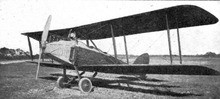
A first flight date was not reported, but this was on or before 23 July 1923 when the Schoettler was test flown by an ex-RAF pilot, W.E. Holland. The latter reported good handling and an excellent, 360°, field of view for the observer noting the aircraft’s potential for development. More recent articles claim the first flight by a Chinese built aircraft was that of the indigenously-designed Xianyi Rosamonde (or Dashatou Rosamonde) on 12 July 1923, though without mention of the Schoettler; the two aircraft were evidently close contemporaries.
Powerplant: 1 × Mercedes, 120 kW (160 hp)
Propeller: 2-bladed
Wingspan: 12.04 m (39 ft 6 in)
Wing area: 37.324 m2 (401.75 sq ft)
Length: 8.3503 m (27 ft 4.75 in)
Height: 3.12 m (10 ft 3 in)
Empty weight: 741 kg (1,634 lb)
Gross weight: 1,160 kg (2,558 lb)
Wing loading: 31 kg/m2 (6.3 lb/sq ft)
Power/mass: 0.063 hp/lb (103 W/kg)
Maximum speed: 206 km/h (128 mph, 111 kn) at 1,000 ft (305 m)
Cruise speed: 158 km/h (98 mph, 85 kn)
Stall speed: 72 km/h (45 mph, 39 kn)
Endurance: 4.5 h
Capacity: Two
Schoettler, Leopold Carl Ferdinand Friedrich
In late 1923 Flight reported on what was claimed to be the first successful aircraft constructed in China. It was designed by the German engineer Leopold Carl Ferdinand Friedrich Schoettler (born April 7, 1881, in Bruchhausen-Vilsen, Germany; died September 27, 1948) but the only major components imported from Europe were the engine, instruments, wheels and dope for the fabric covering; everything else was locally produced from local materials by workers without aviation experience or modern machinery.

