USSR
A. Y.Shcherbakov was the leader of a design group which developed the twin-engined high-wing monoplane Shch-2 light transport, used for such duties as liaison, transport and supply of partisan forces late in Second World War. After war adopted by Aeroflot. Robust structure, with fixed landing gear and large double freight doors, made the Shch-2 adaptable for a wide variety of transport duties.
Era
Bakewell Wing-Foot
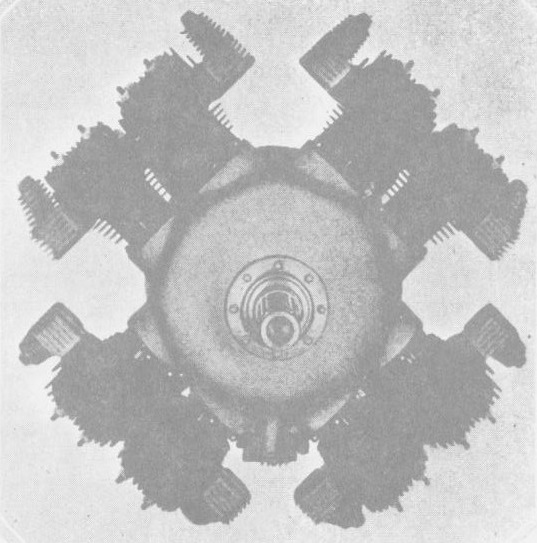
The Bakewell Wing-Foot was a new design, constructed to be inherently balanced, permitting higher motor speeds. Gear ratios could be furnished as required.
The motor is equipped with ball bearings throughout except the connecting rod crank pin bearing which is roller, and the wrist pin connecting rod bearing is bronze.
It was found that his motor does not have a vibration point up to 4700 rpm.
The crankshafts are of three piece construction. Cylinder barrels are nitralloy steel with the bore hardened. Rocker arms being enclosed in the crankcase are continually lubricated.
Valves are operated with a single cam for each cylinder, each cam shaft being mounted on two ball bearings. Each crankshaft is mounted on three ball bearings and the propeller shaft, being straight through the motor, is mounted also on three ball bearings.
All oil lines are cast integral with the gear case sections and the oiling system is operated with two hardened gear pumps; one pump removing the oil from the sump and replacing it in the supply tank, the second taking its supply from the tank and forcing it into the propeller shaft where the oil is distributed from this point by a force fed splash systm.
The motor was covered by “Patents applied for” on many features.
Accessories available at extra cost were starter ($250), exhaust stacks ($80), and exhaust manifold (250).
Type: Geared V, radial
Commercial Rating: 160 hp at 2800 rpm motor speed, 1800 rpm prop.
Displacement: 456 cu.in
Compression ratio: 6-1
Bore: 4 in
Stroke: 4 1/2 in
Length: 32 in
Diameter: 34 in
Weight: approx. 400 lb
Fuel consumption: not more than .55 lb/hp/hr
Oil consumption: not more than .020 lb/hp/hr
Lubrication: Force feed with splash distribution
Ignition: Scintilla
Carburation: Stromberg dual
Spark plugs: 2 per cylinder
Price: $3500 less hub and starter
Shaw-Palmer-Bakewell Co
409 E. Third St
Los Angeles
California
USA
Circa 1920s engine builder
Shaw Twin-Ez
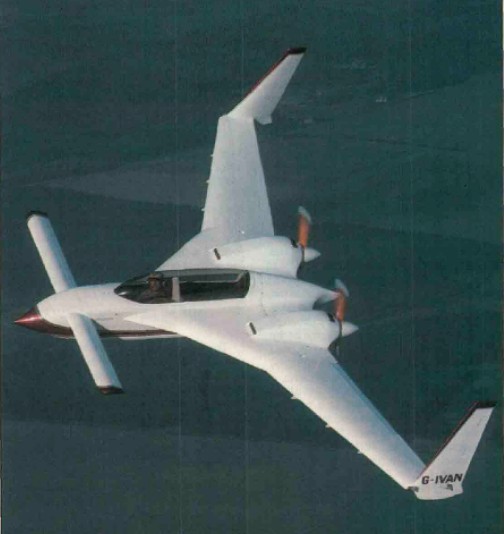
Built by Ivan Shaw, Barnsley, South Yorkshire, England. G-IVAN began in 1980 as a VariEze and completed in 1981, was later converted to a Long-EZ, and then to a twin engined pusher (first flight 29 June 1989). The main undercarriage gear retracts into the fuselage where the O-200 used to fit.
The Twin-EZ was developed and built by Mr. Ivan Shaw, a British science school teacher. The Twin-EZ started life as a homebuilt Rutan VariEze certified in 1978. When Shaw considered transforming his aircraft into a twin-pusher (initially referred to as the Twin Speed) in 1981, he planned to use two 50 hp Lotus rotary engines. According to him, twin pusher engines and a retractable undercarriage should boost the Long-EZ’s cruise speed to 200 m.p.h. and increase range to 2,000 n.m., offering 50 m.p.g. fuel economy. Shaw, a self-confessed “eyeball engineer” who aimed to fly his home-built late in 1985 when a pair of Lotus microlight engines would become available.
Shaw claimed a pair of 50 h.p. Lotus engines weighed 701 lb. less than either of the other units and burned 20 per cent less fuel. He built a bracket which allowed the pair to be attached to the standard engine mount on the rear fuselage, each engine sitting just 31 in. from the fuselage centre line. Electrical systems could be run from either engine, offering “complete redundancy”.
Shaw’s other modification was to fit a fully retractable undercarriage. This carried a 301 lb. weight penalty over the fixed undercarriage, but reduced drag and so offered the prospect of the major speed increase Shaw was predicting. Empty weight was predicted to be 800 lb. and the first flight was to be made within six weeks of engine delivery.
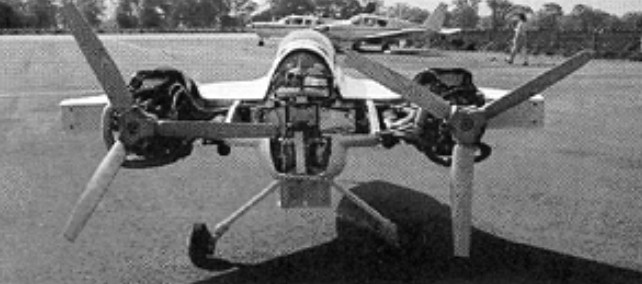
However, development of the Lotus engine type was stopped, and therefore none was ever installed on the Twin-EZ. For Shaw, who had worked with Lotus and Rutan on the Microlight aircraft, Colin Chapman’s untimely death also signified the end of all aviation activity for Lotus, engines included. As a result Shaw decided to modify the aircraft with larger Long-EZ wings to accommodate two 77 hp Hewland HAE75 three-cylinder two-stroke reciprocating engines, installed in a pusher configuration. In this form, the Twin-EZ was first flown on June 29, 1989, and was demonstrated days later at the UK Popular Flying Association’s annual rally at Cranfield Airport.
The Twin-EZ was soon used as test-bed for the Norton-Wankle NR642 rotary engines, each unit being mounted pusher-style at the wing trailing edge. The Norton rotary engine had already been tested in 1987 in an Aviation Composites Mercury, a local derivative of the Microlight developed at Scaled Composites. The advantages of the rotary Norton over the Hewland engine were said to be a lengthy overhaul interval and increased power. The Norton engine developed 90 h.p. compared with the Hewland’s 75 h.p., and was claimed to be extremely light for its power output owing to constructional simplicity.
At Gamston in the 1980’s Ivan Shaw was air testing the twin conversion and it was damaged whilst stored there.
Ownership later changed to Anthony Malcolm Aldridge of Crostwight, North Walsham, and the aircraft was stored.
Type: twin-pusher two-seat sportsplane
Engines: 2 x Hewland HAE75, 77 hp
2 x 90 hp Norton rotary
MTOW: 499kg
Cruise speed: 280 mph
Vmca: 57 kt
Serial No: c/n 39; s/n PFA 074-10502
Crew/passengers: 2
Shaw Aerial Velocipede

California lighthouse keeper Shaw’s “aerial row boat” consisted of two cartridge-shaped balloons of oiled silk, kept in position by ash frames. The buoyant power was barely sufficient to lift the apparatus and one’s weight. The conical ends pointed in opposite directions, and the two balloons were kept a few feet apart by strong connecting pieces of ash. Between the ash pieces was arranged a seat and footrest. This apparatus would support one in the air and locomotion was by oars. It was reportedly successfully tested in New York’s Central Park sometime during the 1860s.
Shaw 1915 Flying Boat

A sportplane, the Shaw flying boat was rather different from other American flying boats in design, as well as construction. Typical was the very short fuselage of the hull, formed as a gliding airfoil, but in its bow was a three-cylinder, two-stroke, water-cooled, 90hp Johnson covered with an aluminium top. Just behind the motor was the radiator, and behind that two tandem cockpits with dual-controls, then the pusher prop operated by a long shaft and chain.

Wings were linen-covered wooden frames with two spars, the front one of which as a layer of ash between two layers of spruce. Leading edges were made of five layers, four spruce and one ash, all secured by steel wire. Wood struts had a streamlined cross-section and were made from three layers of ash and two of spruce. Only the upper wing had ailerons.
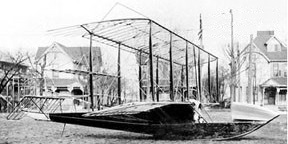
Tail section was rather compact and set at an angle to avoid trailing in the water. The lifting tailplane had an elevator in two parts, a stabilizer in three parts, and a balanced rudder. All were covered with linen. Both the lower wings and the tail section were attached to the fuselage with steel pipes, and on both sides of the fuselage a section of the lower wing was uncovered to provide a handy downward view.
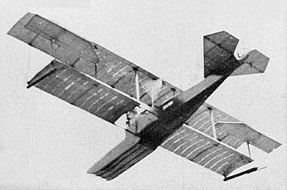
Fuselage was an ash and spruce frame covered with mahogany three-ply having a center layer of linen, and the deck’s bow was covered with linen. Fuselage length was about 6 meters and had a hollow V-bottom with one step. Behind that step the bottom was flat.

Shaw Comet
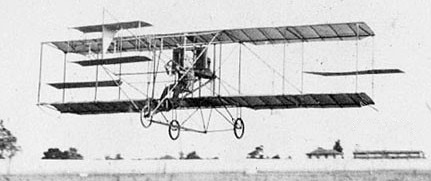
1915
Shavrov SH-1 / SH-2
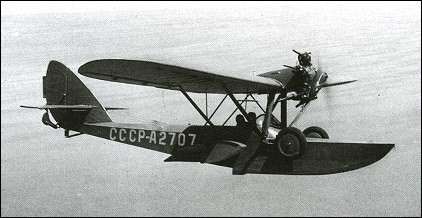
The Shavrov Sh-2 was developed from the small amphibian Sh-1 prototype design and performed its first flight on November 11, 1930, made from land. The Sh-1 remained a prototype.
The first Soviet mass-produced flying boat, the small, wooden Shavrov Sh-2 was a development of the Sh-1, with a more powerful engine and increased size.
The Sh-2 could carry two crew members as well as one passenger and during wintertime, the aircraft could be equipped with skis. The small lower wing served as attachment for the stabilizing floats. It was a light, simple and reliable design.
The Sh-2 passed State Acceptance trials for operation from water and land on June 12–17, 1934, without problems. Series productions was initiated on 1 April 1934, and ended two years later. However, due to its successful design and the popularity among its pilots, production was restarted in 1939. Total production was up to at least 700 aircraft, several hundred of those being built after 1939, possibly up to 1950.
The Sh-2 served throughout the Soviet Union as a utility transport, for liaison, and as a trainer, and for many years was used on fishery protection duties and frontier patrol work. They supported Arctic operations.
Sixteen were built under the designation Sh-2S as air ambulances carrying one or two stretcher patients.
In 1939 Aeroflot built additional Sh-2s from available spares and later the type was reinstated in production. As well as use for the civil roles indicated, the Sh-2 was flown by the V-VS as a general-purpose aircraft.
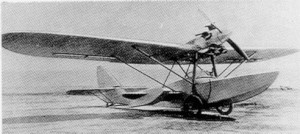
A number of later machines had a glazed crew cabin and other refinements, becoming redesignated Sh-2bis most had improved M-11L engines.

The aircraft was in service until 1964 and set a number of records among flying boats and seaplanes.
On 28 August 1942, the Finns captured two Sh-2s and pressed them into service in the liaison role, as well as carrying the Commander of the Finnish Air Force, until 1944.
One plane was constructed by cadets of Egorevsky aviation school of civil aircraft in the USSR, under the direction of teachers, during 1984-86. The plane was sold and delivered to the USA in the 1990s.
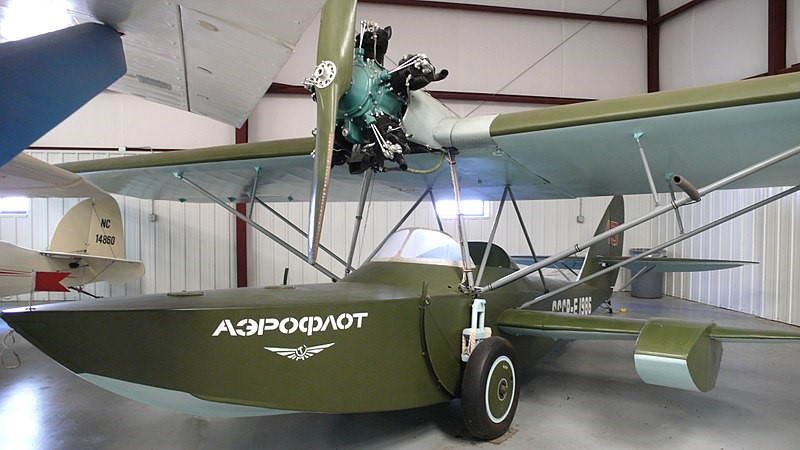
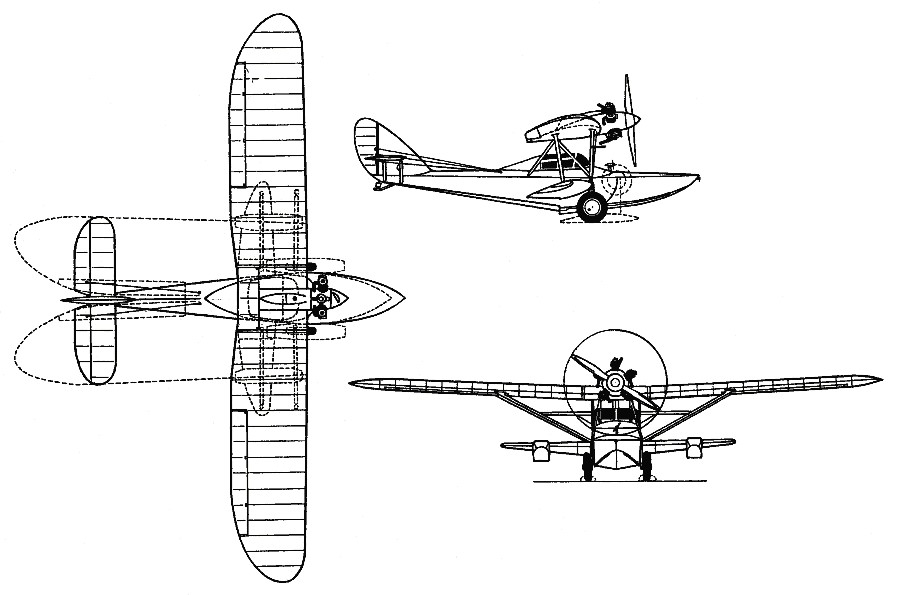
Shavrov SH-2
Engine: 1 × Shvetsov M-11A, 75 kW (100 hp)
Propeller: 2-bladed fixed-pitch
Wingspan upper: 13.0 m / 42 ft 8 in
Wingspan lower: 5.4 m / 17 ft 9 in
Wing area: 24.75 m² / 266 ft²
Length: 8.20 m (26 ft 11 in)
Height: 2.80 m (9 ft 2 in)
Empty weight: 680 kg (1,500 lb)
Max. takeoff weight: 937 kg / 2,065 lb Payload: 257 kg (567 lb)
Maximum speed: 140 km/h (87 mph, 76 kn)
Range: 400 km (250 mi, 220 nmi)
Service ceiling: 3,500 m (11,500 ft)
Crew: 1 pilot
Capacity 2 passengers / 257 kg / 567 lb
Sharp Tartan
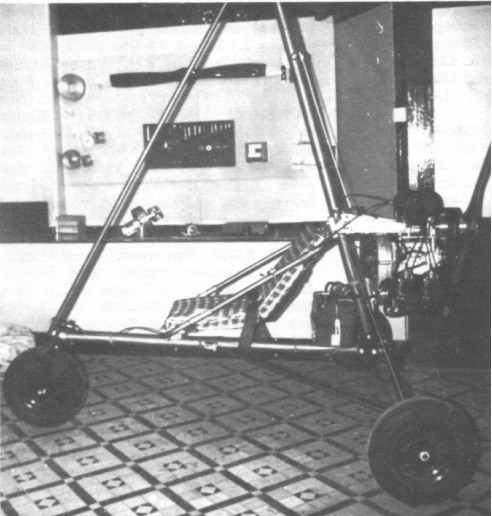
Single seat single engined flex wing aircraft with weight shift control. Rogallo wing with keel pocket. Pilot suspended below wing in trike unit, using bar to control pitch and yaw/roll by altering relative positions of trike unit and wing. Wing braced from above by kingpost and cables, from below by cables; floating cross tube construction with 70% double surface. Undercarriage has three wheels in tricycle formation; no suspension on any wheels. Push right go left nosewheel steering independent from yaw control. No brakes. Aluminium tube trike unit, with optional pod. Engine mounted below wing driving pusher propeller.
By 1982 four Tartan trike units have been made; three with 330 cc Robin engines and one with a 250.
The Tartan, so named because of its distinctive seat covering, is most commonly flown with an Airwave Nimrod wing and was largely inspired by the Ultrasports Tripacer. It is a beefier structure using heavier gauge tube, a cast engine bearer and solid plastic tubing inserts, to prevent bolts crushing the tubing.
While the Tartan is a thoroughly conventional trike unit, a high proportion is made in house not just the tubework but also the engine bearers, propeller, silencer and reduction drive.
Engine: Robin EC34PM
Propeller diameter and pitch 54×30 inch, 1.37×0.76m
Toothed belt reduction, ratio 2.3/1
Fuel capacity 2.4 US gal, 2.0 Imp gal, 9.1 litre
Length overall 11.8ft, 3.60m
Wing span 32.8ft, 10.0m
Nose angle 120 deg
Total wing area 165 sq.ft, 15.3 sq.m
Wing aspect ratio 6.5/1
Nosewheel diameter overall 16 inch, 41 cm
Main wheels diameter overall 16 inch, 41 cm
Max climb rate at sea level 650 ft/min, 13 m/s
Engine: Robin EC25PS
Propeller diameter and pitch 54×27 inch, 1.37×0.69m
Toothed belt reduction, ratio 2.3/1
Fuel capacity 2.4 US gal, 2.0 Imp gal, 9.1 litre
Length overall 11.8ft, 3.60m
Wing span 32.8ft, 10.0m
Nose angle 120 deg
Total wing area 165 sq.ft, 15.3 sq.m
Wing aspect ratio 6.5/1
Nosewheel diameter overall 16 inch, 41 cm
Main wheels diameter overall 16 inch, 41 cm
Sharp & Sons
By the spring of 1983, Sharp & Sons was widely known as the maker of probably the best engineered reduction drives in the UK, as well as a source of props, engine bearers and any other awkward part that no one else is willing to cast or machine.
1982: Sharp & Sons, 104 6 Green Road, Colne, Lancashire BB8 8AJ, Great Britain.

