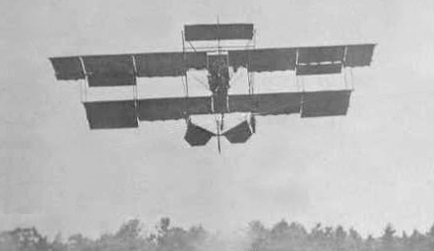
A single place, open biplane was constructed by Tod Shriver & (?) Dietz at Mineola NY., USA, circa 1910. There is a possible, but unresolved, connection with Dietz Paraplane in design or construction.
Shriver-02.jpg
A single place, open biplane was constructed by Tod Shriver & (?) Dietz at Mineola NY., USA, circa 1910. There is a possible, but unresolved, connection with Dietz Paraplane in design or construction.
Shriver-02.jpg
Tod Shriver & (?) Dietz
Mineola NY.
USA
Built a biplane circa 1910.
Showa Hikoki Kogyo Kabushiki Kaisha
Before and during Second World War built the Douglas DC-3 under license. After war was first Japanese aircraft manufacturing company to resume operations, under U.S. Government contracts. Aided in manufacture of NAMC YS-11 Japanese-designed transport.
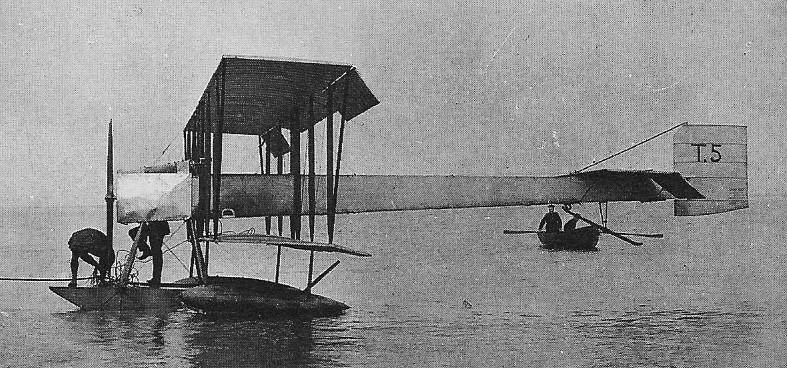
The Short S.45 — also known as the Short T.5 after its naval serial number — was a training biplane built for Britain’s Royal Navy by Short Brothers in 1912. It was the forerunner of another three identical aircraft (designated S.48, S.49, and S.50 by Shorts) delivered to the Royal Navy and Royal Flying Corps during 1912 and 1913. The Royal Naval Air Service was still operating the type when World War I broke out in 1914.
The design was similar to that of the Short S.36, a sporting biplane built for Frank McClean which he lent to the Navy Flying School, Eastchurch. Cdr Charles Rumney Samson and Capt Eugene Gerrard test-flew the aircraft early in 1912. The pleasing performance of the S.36 led to an order by the Admiralty for two aircraft of similar configuration, but differed in the engine fitted. in March that year. Shorts delivered these as the S.41 and the S.45.
The S.45 was an unequal-span two-bay biplane with a fuselage of square-cross section with the two seats in tandem in open cockpits . The wire-braced wings were unstaggered, and the fuselage was mounted partway between them. Ailerons were fitted only to the upper wing. The tail was cruciform in shape and the undercarriage was designed to be interchangeable to allow the S.45 to be flown as a seaplane or landplane. The machine was powered by a single rotary engine in the nose, turning a two-blade propeller. In seaplane configuration, the undercarriage consisted of a single broad pontoon mounted beneath the fuselage, with airbags on short struts under each wing. A third airbag was later fitted under the tail to keep it out of the water while the aircraft was under tow.
The S.45 flew for the first time on 24 May 1912 as a landplane with Lt Spencer Grey at the controls, and was accepted for Navy service with the serial number T.5 (“T” signifying “tractor”). Together with the S.41, the aircraft participated in the Naval Review at Portsmouth in July. It was soon joined in service by the S.48 (serial 413), which Capt Gerrard delivered to the Central Flying School at Upavon on 10 October. Although evaluated by Capt John Salmond as underpowered, it flew regularly until damaged beyond repair in a landing accident on 3 December when it stalled on approach.
Meanwhile, the S.45 underwent considerable modification, including a new engine cowling, a built-up coaming around the cockpits, revised ailerons, and upper wings of greater span. The wing extensions were braced with a kingpost and wires. Its serial was changed from “T.5” to simply “5” when army and navy aircraft serials were merged into one system in late 1912. In 1913, the S.45 was stationed at Carlingnose, near Rosyth, where it suffered a landing accident and capsized on 4 October.
At the start of 1913, the Central Flying School received two further examples of the type: Capt Gerrard delivered the S.50 (serial 424) on 17 February and the S.49 (serial 423) on 22 February. Not long after, these aircraft disappeared from the records when their serial numbers were reassigned to two Royal Aircraft Factory B.E.8s. Eventually, stripped of their engines and identities, the War Office declared the two airframes to be surplus to requirements, and transferred them to the Admiralty in August 1914. In Royal Naval Air Service hands, the aircraft were re-engined with 100-hp (75-kW) Clerget rotary engines and assigned serial numbers 1268 and 1279. The RNAS operated them at the Navy Flying School and they remained in service at the outbreak of World War I.
S.45
Powerplant: 1 × Gnome Gamma, 70 hp (52 kW)
Wingspan: 42 ft 0 in (12.80 m)
Wing area: 450 sq ft (42 m2)
Length: 35 ft 6 in (10.82 m)
Empty weight: 1,080 lb (490 kg)
Gross weight: 1,500 lb (680 kg)
Maximum speed: 60 mph (97 km/h, 52 kn)
Endurance: 5 hr
Crew: two, pilot and instructor
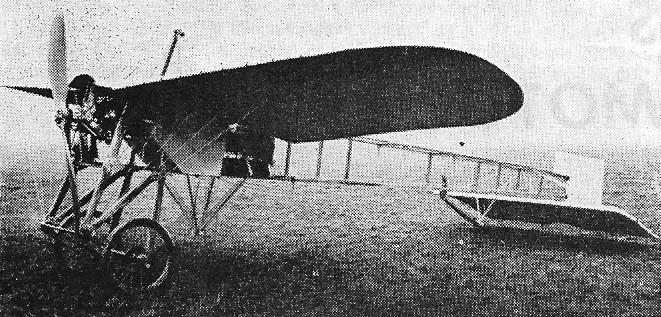
The single-seat Short Monoplane was designed and built at Eastchurch in 1911.
Looking like the earlier Bleriot types, the Short brothers stressed their monoplane to withstand hard use.
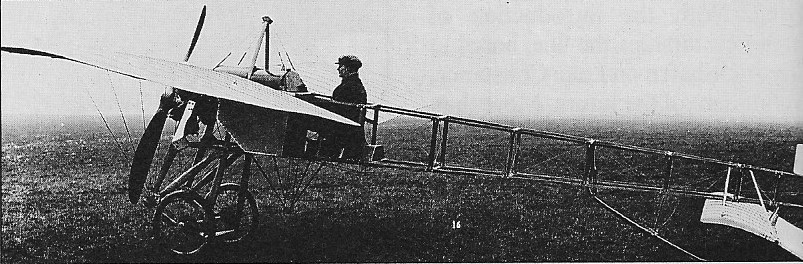
Commander C.R. Samson, RN, undertook the first flights in February 1912.
Engine: Gnome, 50 hp
Propeller: two blade Chauviere
Span: 29 ft 3 in
Length: 25 ft
Max speed: 60-65 mph

The R31 class of British rigid airships was constructed in the closing months of World War I and comprised two aircraft, His Majesty’s Airship R31 and R32. They were designed by the Royal Corps of Naval Constructors – with assistance from a Herr Müller who had defected to Britain and previously worked for the Schütte-Lanz airship company – and built by Short Brothers at the Cardington airship sheds. The airship frame was made from spruce plywood laminated into girder sections, weatherproofed with varnish, and also fireproofed. These enclosed 21 gas bags. R31 was the largest British airship to fly before the end of the war, and the class remains the largest mobile wooden structures ever built.
As the airships were intended for fleet protection operations, they were to be fitted with defensive machine guns on top of the envelope, at the stern and in the gondolas. A 12-pounder gun was to be fitted in a special position centrally below the airship for use against U-boats. In the event, this armament was only fitted to R31, as R32 was only completed after the armistice with Germany. It had also been intended to fit a bomb load of two 520 lb (240 kg) bombs and four 230 lb (100 kg) bombs. but with the end of hostilities these were never installed on either airship.
R31 made its first trial flight, lasting two hours, in July 1918 under the command of Squadron Leader W.C. Hinks. A top speed of 70 mph (110 km/h) was achieved, well above the expected 50–55 mph (80–89 km/h) and faster than any other airship then in service. It was originally powered by six 275 hp (205 kW) Rolls-Royce Eagle engines, but in view of the performance and to reduce fuel consumption one was removed, reducing the maximum speed to a still satisfactory 65 mph (105 km/h); similarly the R32 was built with six engines and later converted to a five-engine configuration.
The airship was finally commissioned on 6 November 1918, just before the armistice with Germany, after having spent four hours in the air. It set off, again under the command of Squadron Leader Hincks, for the airship base at East Fortune in Scotland. On the journey she encountered bad weather and it was feared that some of the plywood girders were failing, so she diverted to the airship base at Howden in the East Riding of Yorkshire for examination and repair. Unfortunately, the sheds had not been repaired since the R27 had caught fire three months earlier and the roof leaked badly. This caused the glue holding the plywood together to deteriorate; as a result the airship became unairworthy and was beyond repair. In February 1919 it was dismantled. The covering was removed and returned to Cardington while the frames were sold for £200; these were broken up and sold for firewood but due to the fireproofing treatment they had received they would not burn.

After being formally accepted by the Royal Navy, R32 made its first trial flight on 3 September 1919 and then on 6 September went to RNAS Pulham, Norfolk, which at the time was a centre for training and experimentation. On 10 September in formation with the R33 she made a flight over the Netherlands, Belgium and Northern France and back to Pulham. In October 1919 the R32 with the rest of the airship fleet was formally handed over to the Royal Air Force. The ship was flown from Cardington on September 16th 1919 with Major Elmsley in charge. George Meager reports that a week later he was on board as navigator when the R32 flew across to Amsterdam – he recalls another crew member named Scroggs on this flight. He took a further two flights a month later naming Flt Lt Ivor Cecil Little as the Captain and Scroggs as First Officer. The airship was used by the National Physical Laboratory for structural testing. On 20 March 1920 it was flown to Howden to be refurbished and used for crew training by the American party who had come to accept the R38 (ZR-2). When the metal-framed R80 became available, the use of the by now obsolete wooden-framed R32 stopped and, to save money, it was decommissioned and used to assess the effect of a gas-bag bursting. Once the covering had been removed and the engines taken away, cell No.18 was overpressurised until the expansion caused the bracing and structure to fail. The frame was subsequently dismantled.

Powerplant: 5 × Rolls-Royce Eagle, 275 hp (205 kW) each
Volume: 1,547,000 cu ft (43,976 m3)
Length: 615 ft 0 in (187.5 m)
Diameter: 65 ft 6 in (19.97 m)
Useful lift: 36,960 lb (16,800 kg)
Maximum speed: 65 mph (104 km/h, 56 kn)
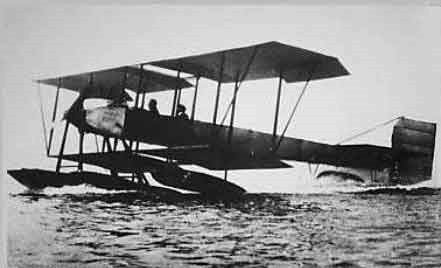
The original version of the S.41 was converted to a landplane and flown by Cdr R. Samson – also the pilot of its maiden flight – during the Army manoeuvres of September 1912. Built at Eastchurch, Isle of Sheppey.
With its floats restored, it started flying from the temporary seaplane station at Carlingnose on October 2nd 1912. In January 1913 it underwent an overhaul during which the centre section gap was covered.
In September 1913 it was overhauled again and the aircraft emerged completely different in shape, fitted with folding wings of greater span and a new rudder. In 1914 it was refitted with a 140 hp Gnôme and assigned to the Eastchurch flying school. In 1915 the S.41 was sent to the Aegean theatre and in 1916 was spotted at Inbros.
It was not included in the March 1916 list of naval aircraft and may have been destroyed prior to that month.
Engine: 100 hp Gnome
Max speed: 60 mph
Endurance: 5 hr


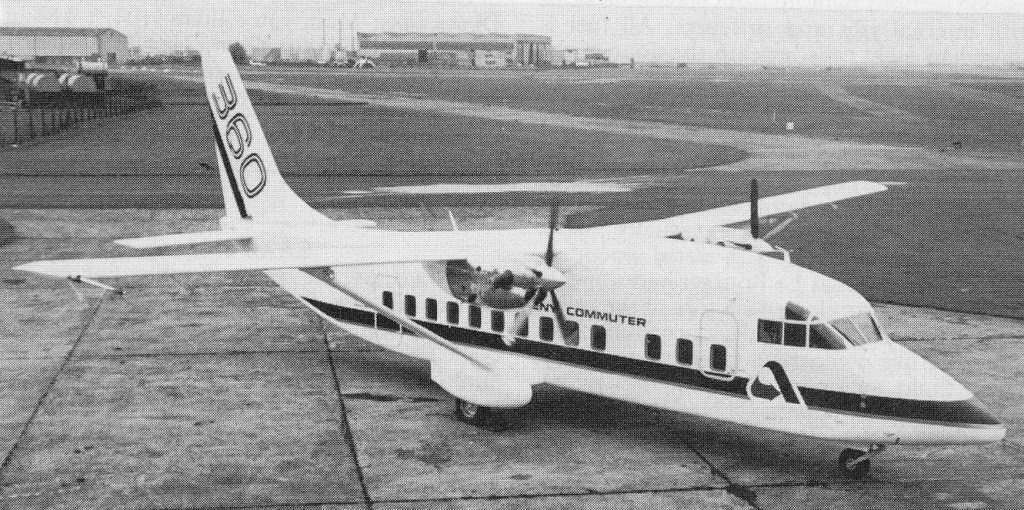
The 360 is a growth development of the 330 with more power, and a three foot stretch ahead of the wing and a redesigned rear fuselage and tail surfaces. An extra six seats (in two rows) were accommodated by stretching the cabin and deleting the 330’s rear loading ramp, and the tail arrangement was changed to a conventional single fin.
The prototype 360 flew on 1 June 1981 and the type entered service in December 1982. First introduced with Pratt & Whitney Canada PT6A-45R engines, the Shorts 360-300 version has 1,424 shp (1062 kW) PT6A-67R turboprops with six-bladed propellers and other refinements to produce about 18 per cent more thrust at take-off.
164 examples were sold up until 1991.
SD3.60
Engines: 2 x P&W PT6-65AR, 1403 shp
Props: Hartzell 5-blade, 111-in
Seats: 36
Length: 70.9 ft
Height: 23.7 ft
Wingspan: 74.7 ft
Wing area: 453 sq.ft
Wing aspect ratio: 12.3
Maximum ramp weight: 25,800 lb
Maximum takeoff weight: 25,700 lb
Standard empty weight: 16,600 lb
Maximum useful load: 9200 lb
Maximum landing weight: 25,400 lb
Wing loading: 56.7 lbs/sq.ft
Power loading: 9.7 lbs/hp
Maximum usable fuel: 3840 lb
Best rate of climb: 1010 fpm
Service ceiling: 20,000 ft
Maximum speed: 211 kt
Normal cruise @ 7,000ft: 160 kt
Fuel flow @ normal cruise: 975 pph
Endurance at normal cruise: 3.4 hr
Stalling speed clean: 94 kt
Stalling speed gear/flaps down: 78 kt
Turbulent-air penetration speed: 158 kt
Short 360-300
Engines: 2 x Pratt & Whitney PT6A-67R turboprops, 1062kW / 1,424 shp
Prop: 6 blade
Max take-off weight: 12290 kg / 27095 lb
Wingspan: 22.8 m / 75 ft 10 in
Length: 21.58 m / 71 ft 10 in
Height: 7.27 m / 24 ft 10 in
Wing area: 42.18 sq.m / 454.02 sq ft
Cruise speed: 400 km/h / 249 mph
Range w/max.payload: 745 km / 463 miles

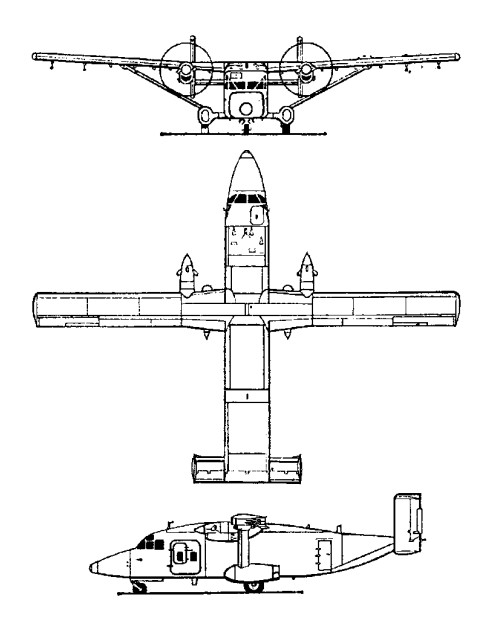
The prototype of the Shorts SD3-30 30-passenger unpressurized commuter airliner; later redesignated Shorts 330, was derived from the smaller Skyvan, with a fuselage stretched to accommodate 30 passengers while retaining the Skyvan’s twin tail fin, but including a semi-retractable undercarriage.
The Short SD3-30 prototype (G-BSBH), a 30-passenger airliner powered by twin turboprop engines, was flown for the first time at Belfast, Northern Ireland on 22 August 1974, and the first entered service with the Canadian airline Time Air on 24 August 1976, although the first order had been placed by Command Airways of Pouglikeepsie, New York.
Versions available included the standard 330-200, the Sherpa civil freighter, and the 330-UTT utility tactical transport.
The USAF operated 18 twin-turboprop Sherpa/330-UTT from Zweibrucken in West Germany, providing a distribution service for high-priority spares in Europe. Designated C-23A, the aircraft were ordered in March 1984 to fulfil the European Distribution System Aircraft (EDSA) requirement. Two Sherpas were delivered in November 1984, and the remaining 16 by the end of 1985.
The C-23A is a freighter version of the Shorts 330-200, retaining many features of the civilian model including the forward freight door. An hydraulically operated rear cargo door/ramp is incorporated in the Sherpa, thus allowing through loading. Up to seven C08 or four LD3 cargo containers or two half-ton vehicles can be accommodated, and utility passenger operations may also be undertaken. The C-23A first flew on August 6, 1984, and is powered by two 893kW Pratt & Whitney Canada PYT6A-45R turboprops.
Designated C-23B, the first of 10 Shorts Super Sherpas for the US Army National Guard made its first flight in 1990. The aircraft are similar to the 18 C-23A Sherpas used by the US Air Force, but have more powerful Pratt & Whitney Canada PT6A-65AR turboprops, strengthened wings, five-bladed propellers and air-operable rear freight doors for supply dropping.
Lacking the rear loading ramp of the Sherpa, the Shorts 330-UTT (Utility Tactical Trans¬port) can carry a maximum payload of 3,630kg. Typical loads include 33 troops, 30 paratroops, or 15 stretchers. Range with 30 fully armed troops is greater than 1,100km. Two inward opening rear side doors are provided for para¬dropping. Customers for the 330-UTT include the Royal Thai Army and Royal Thai Police.
Nearly 100 had been delivered by 1990, and a total of 141 Short 330s were built before production ended in 1992.
SD3-30
Engines: 2 x P&WAC PT6A-45, 1120 hp
Seats: 33
Wing loading: 48.6 lb/sq.ft
Pwr loading: 9.8 lb/hp
Max TO wt: 22,000 lb
Operating wt: 14,230 lb
Equipped useful load: 7770 lb
Payload max fuel: 3930 lb
Range max fuel/cruise: 690 nm/3.5 hr
Range max fuel / range: 785 nm/ 5.5 hr
Service ceiling: 18,500 ft
Max cruise: 190 kt
Max range cruise: 144 kt
Vmc: 77 kt
Stall: 73-89 kt
1.3 Vso: 95 kt
ROC: 1130 fpm
SE ROC: 210 fpm @ 101 kt
SE Service ceiling: 9500 ft
Min field length: 3650 ft
Fuel cap: 3840 lb
SD3.30
Engines: 2 x P&W PT6A-45A, 1156 shp
Props: Hartzell 5-blade, 111-in
Seats: 30
Length: 58 ft
Height: 16.2 ft
Wingspan: 78.6 ft
Wing area: 453 sq.ft
Wing aspect ratio: 12.3
Maximum ramp weight: 22,500 lb
Maximum takeoff weight: 22,400 lb
Standard empty weight: 14,700 lb
Maximum useful load: 7800 lb
Zero-fuel weight: 21,140 lb
Maximum landing weight: 22,100 lb
Wing loading: 49.5 lbs/sq.ft
Power loading: 9.7 lbs/hp
Maximum usable fuel: 3840 lb
Best rate of climb: 1070 fpm
Certificated ceiling: 19,000 ft
Maximum single-engine rate of climb: 210 fpm @ 105 kt
Single-engine climb gradient: 120 ft/nm
Single-engine ceiling: 6750 ft
Maximum speed: 204 kt
Normal cruise @ 10,000ft: 197 kt
Fuel flow @ normal cruise: 890 pph
Endurance at normal cruise: 3.9 hr
Stalling speed clean: 89 kt
Stalling speed gear/flaps down: 74 kt
Turbulent-air penetration speed: 157 kt
330/UTT
Engine: 2 x P&WAC PT6A turboprop
Installed pwr: 1785 kW
Span: 22.8 m
Length: 17.7 m
Wing area: 42.1 sq.m
Empty wt: 6445 kg
MTOW: 11,160 kg
Payload: 3630 kg
Cruise speed: 372 kph
Initial ROC: 360 m / min
Ceiling: 6100 m
T/O run: 415 m
Ldg run: 235 m
Fuel internal: 2546 lt
Range/payload: 1390 km with 2330 kg
Capacity: 33 pax
C-23A Sherpa
Engine: 2 x P&WAC PT6A
Installed pwr: 1785 kW
Span: 22.8 m
Length: 17.7 m
Wing area: 42.1 sq.m
MTOW: 10,390 kg
Payload: 3175 kg
Cruise speed: 350 kph
Initial ROC: 360 m / min
Ceiling: 6100 m
T/O run (to 15m): 1036 m
Ldg run (from 15m): 1225 m
Fuel internal: 2032 lt
Range/payload: 1240 km with 2270 kg
Capacity: 33 pax
C-23A
Engines: 2 x Pratt Whitney PT6A-45R turboprops, 900kW
Max take-off weight: 10390 kg / 22906 lb
Loaded weight: 6680 kg / 14727 lb
Payload: 3175kg / 7000 lb
Wingspan: 22.76 m / 75 ft 8 in
Length: 17.69 m / 58 ft 0 in
Height: 4.95 m / 16 ft 3 in
Wing area: 42.1 sq.m / 453.16 sq ft
Cruise speed: 352 km/h / 219 mph
Ceiling: 6000 m / 19700 ft
Range w/max.payload: 370-1240 km / 230 – 771 miles
Crew: 3