Italy
Formed early 1962. In October 1963 flew XY prototype light helicopter, further developed with financial and technical assistance of shareholder SIAI-Marchetti. SH-4 (flown 1963 in XY prototype form and 1965 as SH-4) was first helicopter of all-Italian design and construction to receive both Italian and U.S. certification. By late 1960s serious production had begun as SIAI-Marchetti/Silvercraft SH-4, but under name Silvercraft alone deliveries began 1970. Production ceased 1977, as single example of SH-200 two-seater first appeared.
Era
Silvaire Aircraft Co
At end of Second World War production tooling for Model 8 Silvaire was moved by Luscombe Airplane Corporation to Dallas, Texas. In 1949 Luscombe company was brought by Temco Aircraft Corporation which built about 50 Silvaires. In 1955 the above-named company acquired rights and equipment for Model 8 Silvaire, inaugurated production at Fort Collins, Colorado, and flew first aircraft off line September 1956.
In 1962 Alaska International Corp acquired from Silvaire Aircraft Company all rights to the Luscombe Silvaire two-seat all-metal light aircraft.
Sikorsky SB-1 Defiant
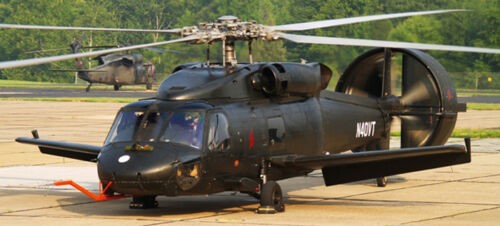
Sikorsky and development partner Boeing inched closer to the first flight of the SB-1 “Defiant” compound helicopter prototype this week, receiving FAA registration number N100FV and officially designating it the “S-100,” serial number MSN 0001. The SB-1 is Sikorsky’s entry into the Pentagon’s Future Vertical Lift (FVL) competition, a program that ultimately could result in deliveries of as many as 4,000 aircraft by 2030 under a contract potentially worth $100 billion and including significant foreign military sales.
First flight was anticipated by the end of this summer, but it appears that will now slip somewhat as it took Sikorsky longer than anticipated to work through a variety of technical issues, including main rotor blades and fashioning solutions to complex transmission issues related to power distribution between the main rotors and the thruster.
The SB-1 uses the same technology Sikorsky developed for its X2 and S-97 demonstration aircraft. A second S-97 recently resumed test flying after the first aircraft was substantially damaged during a hard landing a year ago at Sikorsky’s West Palm Beach, Florida test facility.
The SB-1 is slated to compete against Bell’s V-280 third-generation tiltrotor. It features an all-composite fuselage with seating for 12 fully kitted troops and a crew of four, a rigid coaxial main rotor system, an aft thruster with a clutch, and full fly-by-wire flight controls.
The SB-1 will initially be powered by a pair of Honeywell T-55 engines but will later be upgraded to the winner of the Future Affordable Turbine Engine (FATE) competition. The aircraft is expected to have a cruising speed of 250 knots.
Sikorsky S-97 Raider
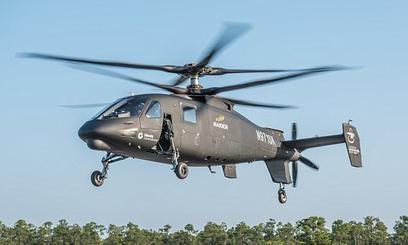
The Sikorsky S-97 Raider is a high-speed scout and attack compound helicopter based on the Advancing Blade Concept (ABC) with a coaxial rotor system. Sikorsky planned to offer it for the United States Army’s Armed Aerial Scout program, along with other possible uses.
First proposed in response to a Request for Information for the Armed Aerial Scout (AAS) program in March 2010, the S-97 was formally launched on 20 October 2010. It was intended as a contender for a United States Army’s requirement to replace the Bell OH-58D Kiowa Warrior. Other military roles are possible, the U.S. Special Operations Command having expressed interest in the S-97 as a replacement for the MH-6 Little Bird, and the possibility of adapting it for civilian applications also exists.
Sikorsky plans to build two prototypes of the S-97 as demonstrators. One prototype (P1) will be used for flight testing, while the second (P2) is planned for use as a demonstrator.
Sikorsky started construction of the two prototypes in October 2012. In September 2013, Sikorsky began final assembly of the first S-97 following delivery of the single-piece, all-composite fuselage by Aurora Flight Sciences. In February 2014, construction of the first S-97 prototype was one-quarter complete. Simulated bird strikes testing had been conducted on the fuselage at speeds of up to 235 kn (435 km/h; 270 mph), the S-97’s expected maximum flight speed. Drop tests were also performed to ensure the fuel tanks’ safety in the event of a crash.
Sikorsky targeted the S-97 for the AAS program, aiming for the helicopter to fly before the Army down-selected. Sikorsky invested $150 million and its 54 suppliers (who provide 90% of the parts) spent the remainder of a total of $200 million on two prototypes; production models aim to meet the program’s $15 million unit cost target. However, the Army ended the AAS program in late 2013. Budget projections for FY 2015 included retiring the U.S. Army’s OH-58 Kiowa fleet and transferring AH-64 Apache attack helicopters from U.S. Army Reserve and U.S. Army National Guard to the active Army to perform the aerial scout role. Sikorsky suggested the possibility of buying the S-97 to replace lost Apache for armed helicopter needs. Sikorsky proposes S-97 as FVL-CS1; the light scout helicopter.
The S-97 design includes variable speed rigid coaxial main rotors and a variable-pitch pusher propeller, making the S-97 a compound helicopter. Like the X2, it has fly-by-wire control and dynamic anti-vibration actuators to cancel out shaking. The main rotors have hingeless hubs and stiff blades, to improve low-speed handling and efficiency of hover. At high speeds, the close spacing of the hubs reduces drag. The stiff blades allow each rotor to have low lift on the retreating side of its rotor disk (reducing drag), whereas each rotor on a conventional coaxial rotor with “floppy” blades needs nearly equal lift distribution. The propeller relieves the rotor of propulsion, further reducing drag.
Maneuverability is improved compared with earlier helicopters because of the ability to tilt the coaxial rotors together or tilt each one differently, and because of the variable pitch propulsor and active elevons. At low speed the S-97 yaws by differential torque of the upper and lower rotor, at high speed it uses rudders.
The S-97 is capable of carrying up to six passengers, in addition to a flight crew of two in a side-by-side cockpit. However, the production S-97 is projected to be capable of flying with either one or two pilots, or autonomously. Space for a targeting sensor has been reserved, however not installed in the prototype aircraft.
Based on the technology from the Sikorsky X2 demonstrator, the prototype S-97s is powered by a General Electric YT706 turboshaft (the same engine used on the MH-60M Black Hawk). Compared to the OH-58D Kiowa, the S-97 has significantly increased performance goals, such as cruising speeds upwards of 200 knots while carrying weapons, turning at three times the force of gravity at 220kt, and a high hover efficiency (Figure of merit). Sikorsky also aims for an operating cost of $1,400 per flight hour.
Its avionics were powered on in June 2014, with rollout on 2 October 2014. The first flight of the S-97 occurred on 22 May 2015. It flew for 1 hour instead of the planned 30 minutes, completing three takeoffs and landings; forward, rearward and sideward. For this initial flight, the Raider was flown with its triplex fly-by-wire flight control system in backup degraded mode so as to focus on basic airworthiness in the low-speed regime. This begins a year-long flight test program of about 100 flight-hours to expand the flight envelope to meet Sikorsky’s key targets of 220-knot cruise speed carrying weapons, hover at 6,000 feet on a 95F day and 3g maneuverability at speed. Toward the end of Phase 1 testing, software will be upgraded to Block 2, bringing in the propulsor and articulating tail to increase speed and enable the full flight envelope. The second prototype (P2) was displayed to the public in October 2015. After two flight hours and a few months of testbench validation of the propulsion drivetrain, P1 is scheduled for higher speed some time in 2016.
On 3 August 2017, an S-97 prototype suffered what Sikorsky described as a hard landing at their flight test facility in West Palm Beach, Florida; both airline transport pilots received minor injuries. The NTSB factual report on the incident stated that the helicopter lifted into a low hover and immediately experienced excessive roll oscillations which lead to intermeshing of the counter-rotating coaxial rotor system, and a hard landing. Damage to the helicopter included collapsed landing gear, structural cabin damage, and dynamic component damage, including rotor blade tip separation of all rotor blades. Video of the accident sequence showed aircraft roll oscillations exceeding 60–degree angle of bank during the course of 5 seconds, during which the upper and lower rotors collided at the 1 o’clock position.
On 25 June 2019, the S-97 returned to flight testing and reached a speed of 190 knots.
Sikorsky and partner Boeing are to use the S-97’s technology and design process as a basis to develop the SB-1 Defiant, a high-speed rigid rotor co-axial rotorcraft, for the army’s Joint Multi-Role Technology Demonstrator (JMR TD) program.
Powerplant: 1 × General Electric YT706, 2,600 shp (1,900 kW)
Main rotor diameter: 1 (2 coaxial) × 34 ft (10 m)
Propeller: 1 x 6-bladed variable-pitch, clutchable pusher propeller (7 ft (2.1 m) diameter)
Length: 35 ft (11 m)
Gross weight: 8,945 lb (4,057 kg)
Max takeoff weight: 11,000 lb (4,990 kg)
Cruise speed: 250 mph (410 km/h, 220 kn) (with external weapons)
Never exceed speed: 280 mph (440 km/h, 240 kn)
Range: 350 mi (570 km, 310 nmi)
Endurance: 2 h 40 min
Service ceiling: 10,000 ft (3,000 m) at 95 °F (35 °C)
Crew: 0–2 pilots
Capacity: 6 troops
Armament: .50 cal gun with 500 rounds
Sikorsky UN-4

The 1927 two-place Sikorsky UN-4 (ATC 2-23) were modified Curtiss JN-4D fuselage with a Sikorsky-Gluhareff high-lift wing. A number were built, including C2044 and 5469.
Powered by a 90hp Curtiss OX-5 engine, the wing was adapted for other types, as well—Travel Air, Standard, etc.
Sikorsky Standard

The 1930s Sikorsky Standard was a Standard J-1 rebuilt with a Sikorsky high-lift parasol wing.
A two or three-seater, NX802W was built with a Stearman-built fuselage.


Sikorsky S-44 / PBS
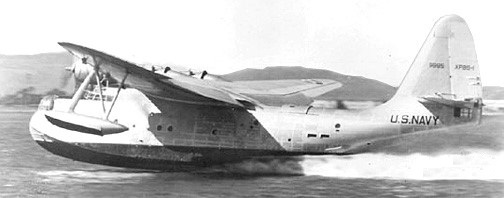
After a two-year construction period the Sikorsky XPBS-1 (Model S-44) 9995 first flew on 23 August 1937. Initial testing with 1050 hp engines revealed a top speed of 227 mph. Stability problems traced to turbulence generated by the wings resulted in the addition of dihedral to the horizontal stabilisers. After being delivered to the Navy in October 1937, the XPBS-1 began competitive trials with the Consolidated XPBY2-1 in mid-1938. Consolidated won a construction order and the XPBS-1 was assigned to Patrol Wing 5 at NAS Norfolk, Virginia, to evaluate long-range patrol-bomber operations until shortly after the US entered World War II. In the spring of 1942 the aircraft was reassigned to VR-2 out of California for transport duties between the West Coast and Hawaiian Islands. On 30 June 1942, while returning from Pearl Harbor, the XPBS-1 struck a log in San Francisco Bay and sank. All on board escaped safely, the passengers including Admiral Chester W. Nimitz, Commander of the Pacific Fleet.
Major elements of the design went into the VS-44A.
Engines: four 1200hp P&W Wasp
Wingspan: 124’0″
Length 76’2″
Max speed: 227 mph
Stall: 64 mph
Range: 4030 mi
Ceiling: 20,800′
Sikorsky XP2S-1

The only Sikorsky XP2S-1 built, A8642 in 1932, was powered by tandem pusher/tractor engines in an interwing nacelle. The engines were two 400hp P&W R-985A or 550hp R-1340s.
Engines: two 400hp P&W R-985A
Wingspan: 56’0″
Length: 44’1″
Ceiling: 13,900′
Seat: 4
Sikorsky XSS-1 / XSS-2
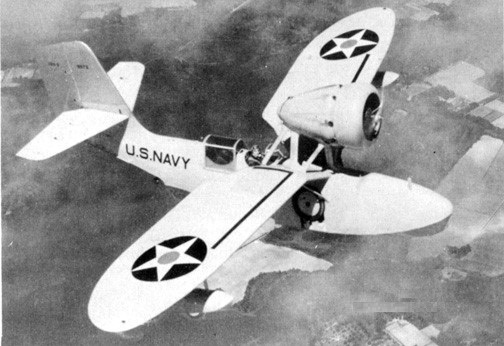
The 1933 Sikorsky SS (Model X1200) was a scout-observation experiment for carrier duty.

Only one was built, 8972, originally XSS-1, then modified as XSS-2.
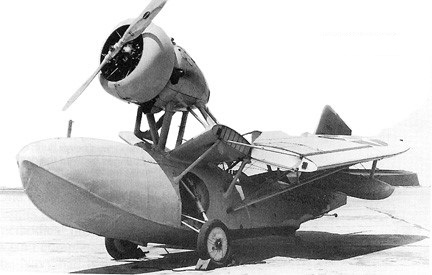
Engine: 550hp P&W R-1340D
Wingspan: 42’0″
Length: 32’0″
Max speed: 159 mph
Ceiling: 22,600′
Seats: 2
Sikorsky Helicopter No.2 / S-2
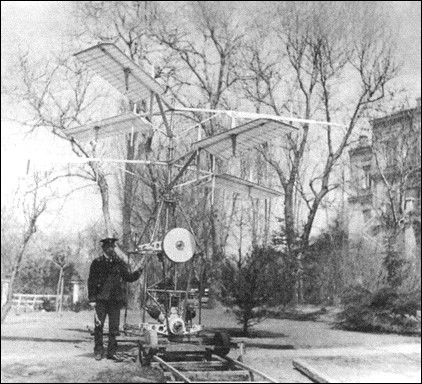
The Sikorsky Helicopter No.2 of 1910 was also known as the S-2; an identification later designated. Powered by the same Anzani 3-cylinder of 25 hp as in the No.1. Developing lift force using contra-rotating three-bladed rotors, reportedly it could almost lift itself.

