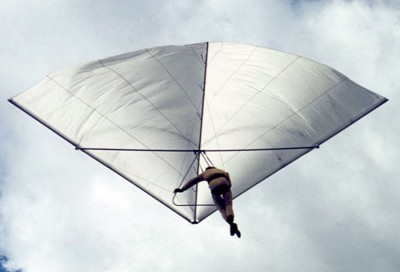
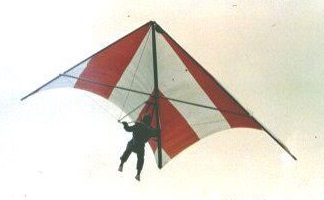
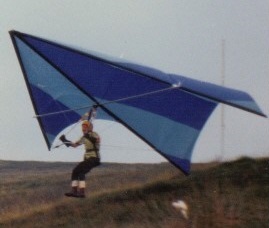
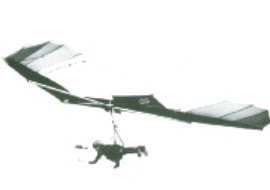
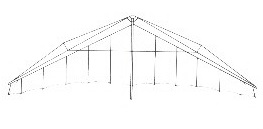
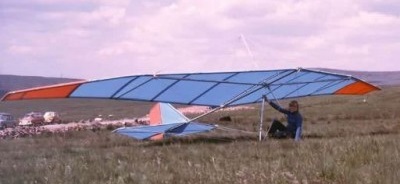
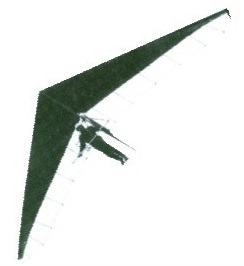
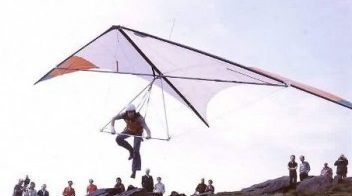
Made in 1973, the Skyhook 3A model became a successful glider and continued to be offered into 1974. The earlier models could be purchased in kit or completed glider form and extra rigging wires, A frames etc. are available to update them to later specifications.
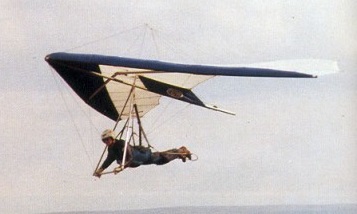
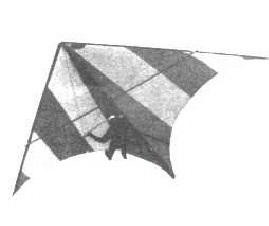
A 1979 hang glider, the Silhouette is a fourth generation machine of which quite a number were sold. Some controversy has arisen concerning the safety of this machine and it was due to be tested on the BHGA test rig.
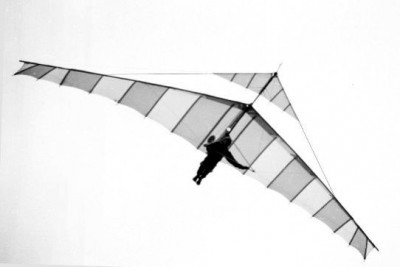
Made in 1978 the Skyhook Sailwings Safari had 18 months of intensive flying before being put in production.
For light winds the medium Safari has an excellent min sink performance. It also has the penetration for strong winds and positive, predictable handling with quick response. The reflexed preformed battens in every seam make the whole wing pitch positive without the need for locked up tips, etc. Vertical dive recovery is positive. The Safari is a real cross country machine which easily makes use of thermals and handles the strong turbulence which often goes with them. This machine is for the experienced pilot who demands the best performance but still wants outstandingly good handling.
Safari (small) Weight: 52 lb Leading edge: 20 ft 7 in Span: 35 ft 8 in Keel 12 ft 5 in Root chord: 9 ft 8 in
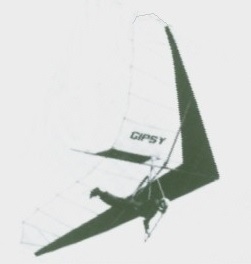
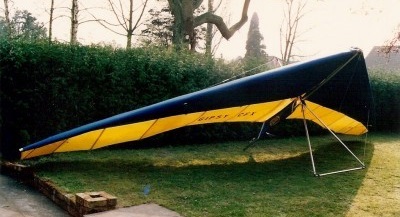
The Gipsy was a 1983 single surface hang glider, described as so easy to rig and fly. The only thing hard was lifting her off the ground to put the nose pin in as it was rather heavy. This glider is easy to self launch without a wire man even in strong winds.
The 1986 Gipsy and Gypsy SS were produced in three sizes to cover most pilot weights. The machine was a fourth generation floating crosstube lightweight intermediate and was an ideal first glider for the new pilot. All sizes gained C of A in 1987.
The 1987 Gipsy CFX is a light weight double surface intermediate glider. The handling is quick, light and beautifully co-ordinated with no hidden vices. The machine was supplied in two sizes.
1987 Gipsy CFX
The 1987 Gipsy CFX was described as as sweat as ever to fly. Control is great soaring and at low level sand dunes. They are well put together.
Gipsy CFX
The Gipsy CFX beautiful handling glider but don’t be tempted to tighten sail to much using the outer attachment points as handling degrades dramatically and PIO becomes an issue. Keep the tune soft and the Gipsy is a gem of a glide.
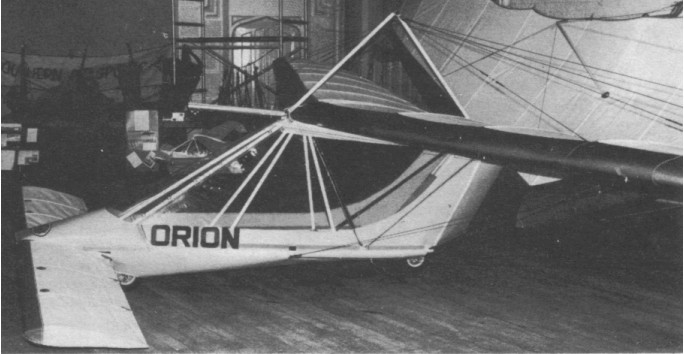
Single seat single engined high wing mono¬plane with two axis control. Wing has swept back leading and trailing edges, and tapering chord; no tail, canard wing. Pitch control by fully flying canard; yaw/roll control by angled ¬pivot tip rudders; control inputs through stick for pitch and yaw/roll. Wing braced from above by kingpost and cables, from below by cables; wing profile Clark Y derived; 100% double surface. Undercarriage has three wheels in tricycle formation; no suspension on nosewheel and suspension (type to be decided) on main wheels. Push right go right nose¬wheel steering independent from yaw control. Brakes on main wheels.
Aluminium tube and fabric fuselage, totally enclosed. Engine mounted below wing driving pusher propeller. Windscreen made from rigid plastic sheet, side windows from Mylar film. Bainbridge Dacron used for flying surfaces.
Designer Len Gabriels has aimed to create a machine which will appeal to hang gliding and sailplane enthusiasts as well as microlighters, and in its initial form the machine is unpowered.
As first shown at the British Hang Gliding Association’s annual general meeting in March 1983, the Orion is a fully enclosed hang glider/sailplane with pitch control by weight shift moving a fully flying canard. Combined roll and yaw control is provided by tip rudders mounted under the ends of the wing and with their pivots angled at 45O to the vertical, so that they provide roll at the same time as yaw. Both may be deployed simul¬taneously, to provide air braking.
This unpowered version of the Orion uses two wheels in tandem without suspension or brakes and is basically intended as a foot¬-launched aircraft. Powered versions, howev¬er, will have a tricycle layout with the weight shift pitch control being replaced by a stick. Pedals will steer the nosewheel but will not be connected to the yaw/roll control. Retention of the weight shift pitch control will be an option.
The wing is based on a Clark Y section, though as it is to some degree a flex wing, it will probably not behave entirely as a Clark Y in the air.
As a hang glider, in April 1983, test flights in unpowered form were about to begin.
Length overall 12.0 ft, 3.66 m Wing span 42.0 ft, 12.80 m Chord at root 5.0ft, 1.52m Chord at tip 3.0ft, 0.91m Canard span 12.0 ft, 3.66 m Canard chord 2.0 ft, 0.61 m Total wing area 176 sq.ft, 16.4 sq.m Main wing area 152 sq.ft, 14.1 sq.m Canard area 24sq.ft, 2.2sq.m Wing aspect ratio 9.5/1 Empty weight 154 lb, 70 kg
A single seat single engined flex wing aircraft with conventional three axis control. Rogallo wing. Undercarriage has three wheels in tricycle formation; no suspension on any wheels. Push right go right nosewheel steer¬ing connected to yaw control. No brakes. Aluminium tube trike unit, without pod. Engine mounted below wing driving pusher propeller.
This experimental machine is an attempt to mate three axis controls to a Rogallo wing. It uses the same power pack as the TR1 MkII trike unit, plus a modified Sabre wing. The trike unit is fixed to the wing structure rather than being sus¬pended from it, and the wing is mounted much lower than the normal hang point of a trike. No test flights have been carried out on this aircraft by 1982.
Engine: Engine: Solo 210 cc, 12 hp at 5500 rpm Propeller diameter 50 inch, 1.28m V belt reduction, ratio 2.5/1 Max static thrust > 100 lb, 45 kg
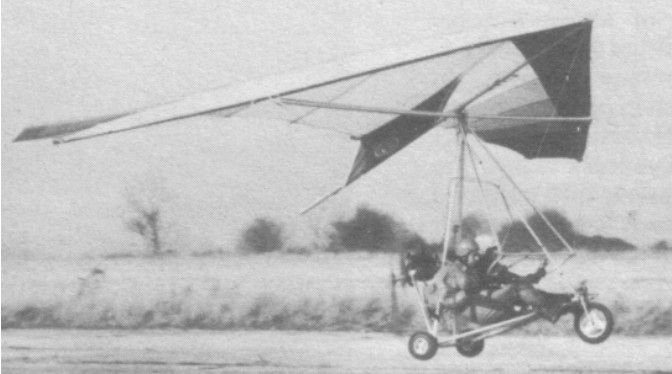
The Skyhook Sailwings TR2 Mk.I/Cutlass CD is a side by side two seat twin engined flex wing aircraft with weight shift control. Rogallo wing with keel pocket. Pilot suspended below wing in trike unit, using bar to control pitch and yaw/roll by altering relative positions of trike unit and wing. Wing braced from above by kingpost and cables, from below by cables, fixed cross tube construction with 30% dou-ble surface not enclosing cross tube; pre¬formed ribs. Undercarriage has three wheels in tricycle formation; no suspension on any wheels. Push right go left nosewheel steering independent from yaw control. Brake on nosewheel. Aluminium tube trike unit, with¬out pod. Engines mounted below wing driving pusher propellers. Trike unit and wing use aluminium tube to British HT30TF specifica¬tion, bright polished and sleeved at stress points. Wing rigged with plastic coated stain¬less steel wires; wing material is Bainbridge Dacron.
At the beginning of 1981, Len Gabriels was seeking an engine powerful enough to turn his TR1 Mk.I trike unit into a two seater. He was not satisfied with the reliability of any of the larger engines then available, so he decided instead to build a power pack using two of the 210cc Solo engines.
Rather than use two engines to drive one large propeller, he doubled up the drive system as well, creating a power pack with two contra rotating propellers driven from concentric shafts, each by its own engine an reduction drive. The safety attractions of such duplication are obvious, as the aircraft can at least maintain height after an engine failure.
The rest of the trike unit needed little alteration beyond the inclusion of a dual seat and a nosewheel brake. Allied to the Cutlass CD wing, the TR2 proved itself to be a viable training machine, but was dropped from production at the end of 1982 in favour of the TR2 Mk.II.
The Skyhook Sailwings TR2 Mk.I (Single Seat Special)/Cutlass CD is a single seat twin engined flex wing aircraft with weight shift control. Rogallo wing with keel pocket. Pilot suspended below wing in trike unit, using bar to control pitch and yaw/roll by altering relative positions of trike unit and wing. Wing braced from above by kingpost and cables, from below by cables; fixed cross tube construction with 30% double surface not enclosing cross tube; pre¬formed ribs. Undercarriage has three wheels in tricycle formation; no suspension on any wheels. Push right go left nosewheel steering independent from yaw control. Optional brake on nosewheel. Aluminium tube trike unit, with optional pod. Engines mounted below wing driving pusher propellers. Trike unit and wing use aluminium tube to British HT30TF specification, bright polished and sleeved at stress points. Wing rigged with plastic coated stainless steel wires; wing mate¬rial is Bainbridge Dacron.
Although the TR2 Mk I was intended as a two seater trike unit, it was also offered in single seat form a simple conversion, as with the TRI Mk.l. Like the TR2 Mk 1 from which it is derived, this variant is now discontinued. The Skyhook Sailwings TR2 Mk.II/Cutlass CD is a side by side two seat single engined flex wing aircraft with weight shift control. Rogallo wing with keel pocket. Pilot suspended below wing in trike unit, using bar to control pitch and yaw/roll by altering relative positions of trike unit and wing. Wing braced from above by kingpost and cables, from below by cables; fixed cross tube construction with 30% dou-ble surface not enclosing cross tube; pre¬formed ribs. Undercarriage has three wheels in tricycle formation; no suspension on any wheels. Push right go left nosewheel steering independent from yaw control. Brake on nosewheel. Aluminium tube trike unit without pod. Engine mounted below wing driving pusher propeller. Trike unit and wing use aluminium tube to British HT30TF specifica¬tion, bright polished and sleeved at stress points. Wing rigged with plastic coated stain¬less steel wires; wing material is Bainbridge Dacron.
The TR2 Mk.II was the 1982 two seat trike unit from Skyhook Sailwings and is identical in all respects to the Mk.I except that the twin engined power pack is replaced by a Hunting HS525A twin-¬cylinder engine, with conventional reduction drive and propeller.
TR2 Mk.I/Cutlass CD Engines: 2 x Solo 210 cc, 12 hp each at 5500 rpm Two propellers diameter and pitch 50 x 30 inch, 1.28 x 0.76 m V belt reduc¬tion, ratio 2.7/1 Max static thrust 200 lb, 91 kg Power per unit area 0.12 hp/sq.ft, 1.3hp/sq.m Fuel capacity 3.6 US gal, 3.0 Imp gal, 13.6 litre Length overall 12.7 ft, 3.87 m Total wing area 198 sq.ft, 18.4 sq.m Nosewheel diameter overall 12 inch, 305 mm Main wheels diameter overall 12 inch, 305 mm Empty weight 2251b, 102kg Max take off weight 640 lb, 290kg Payload 392 lb, 178kg Max wing loading 3.23 lb/sq.ft, 15.8 kg/sq.m Max power loading 26.7 lb/hp, 11.9kg/hp Load factors; >+3.75 ultimate Max level speed >60mph, >97kph Economic cruising speed 40 mph, 64 kph Stalling speed 32 mph, 51 kph Max climb rate at sea level 200 ft/min, 1.0m/s Min sink rate 500ft/min at 32mph, 2.5 m/s at 51 kph Take off distance 150 ft, 45 m
TR2 Mk.I (Single Seat Special)/Cutlass CD Engines: 2 x Solo 210 cc, 12 hp each at 5500 rpm Two propellers diameter and pitch 50 x 30 inch, 1.28 x 0.76 m V belt reduc¬tion, ratio 2.7/1 Max static thrust 200 lb, 91 kg Power per unit area 0.12 hp/sq.ft, 1.3hp/sq.m Fuel capacity 3.6 US gal, 3.0 Imp gal, 13.6 litre Length overall 12.7 ft, 3.87 m Total wing area 198 sq.ft, 18.4 sq.m Nosewheel diameter overall 12 inch, 305 mm Main wheels diameter overall 12 inch, 305 mm Empty weight 220 lb, 100kg Max take off weight 640 lb, 290kg Payload 392 lb, 178kg Max wing loading 3.23 lb/sq.ft, 15.8 kg/sq.m Max power loading 26.7 lb/hp, 11.9kg/hp Load factors; >+3.75 ultimate
Skyhook Sailwings TR2 Mk.II/Cutlass CD Engine: Hunting HS525A Propeller diameter and pitch 54 x 36 inch, 1.37 x 0.91 m Length overall 12.7 ft, 3.87 m Total wing area 198 sq.ft, 18.4 sq.m Nosewheel diameter overall 12 inch, 305 mm Main wheels diameter overall 12 inch, 305 mm