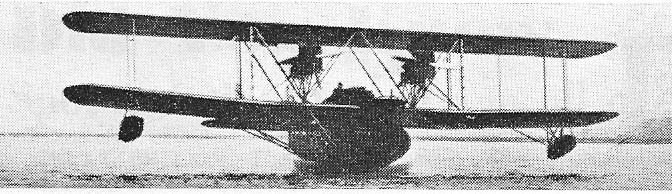
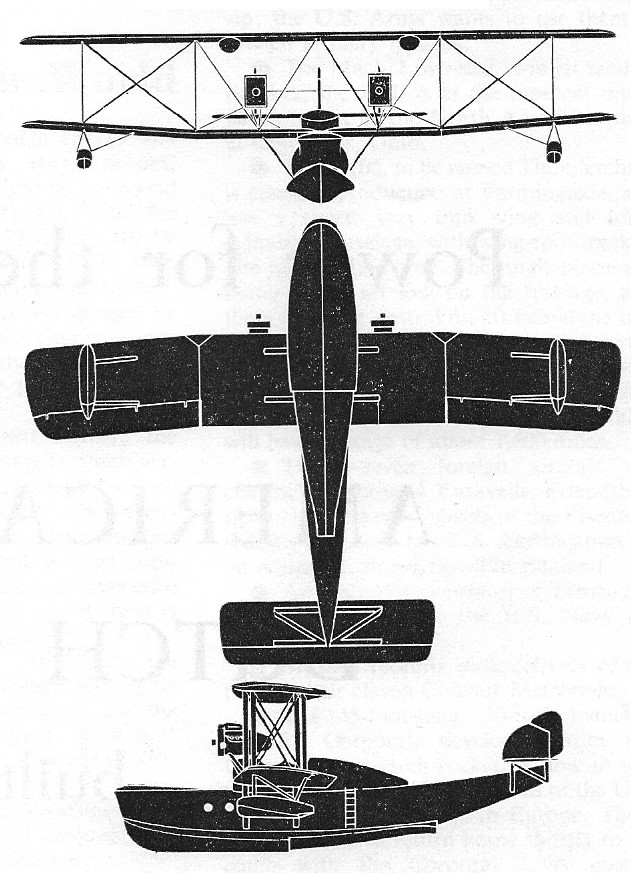
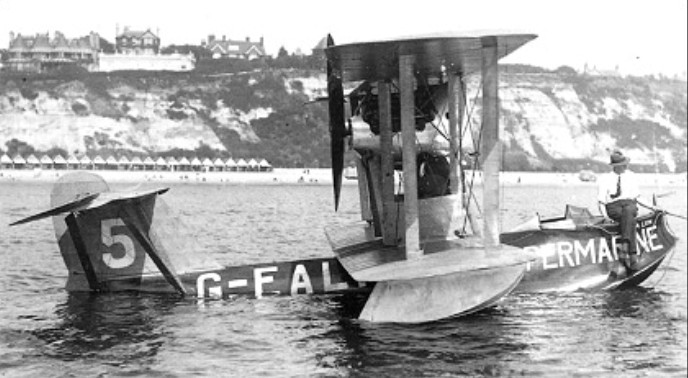
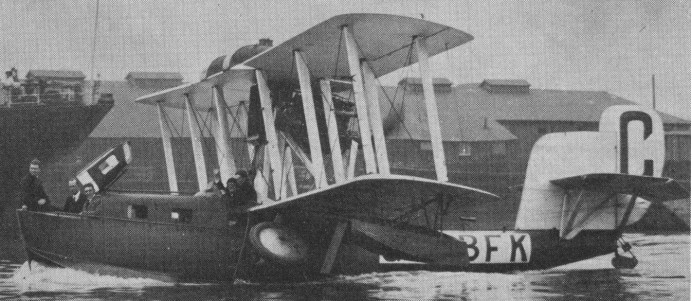
Supermarine Southampton

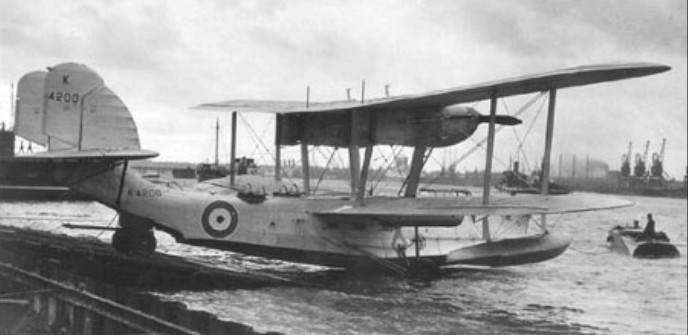
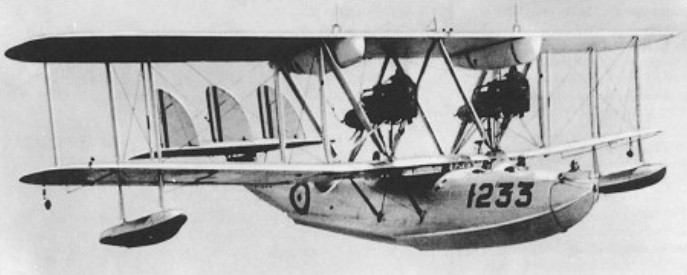
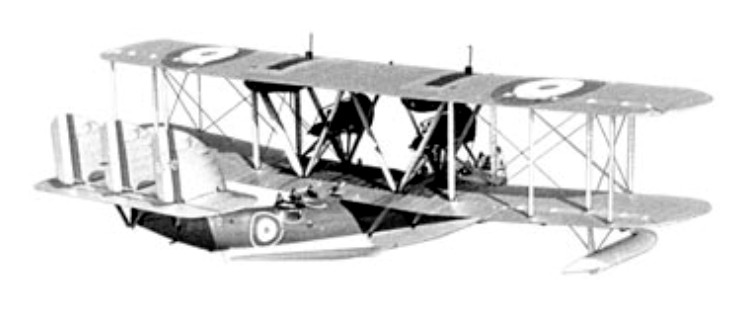
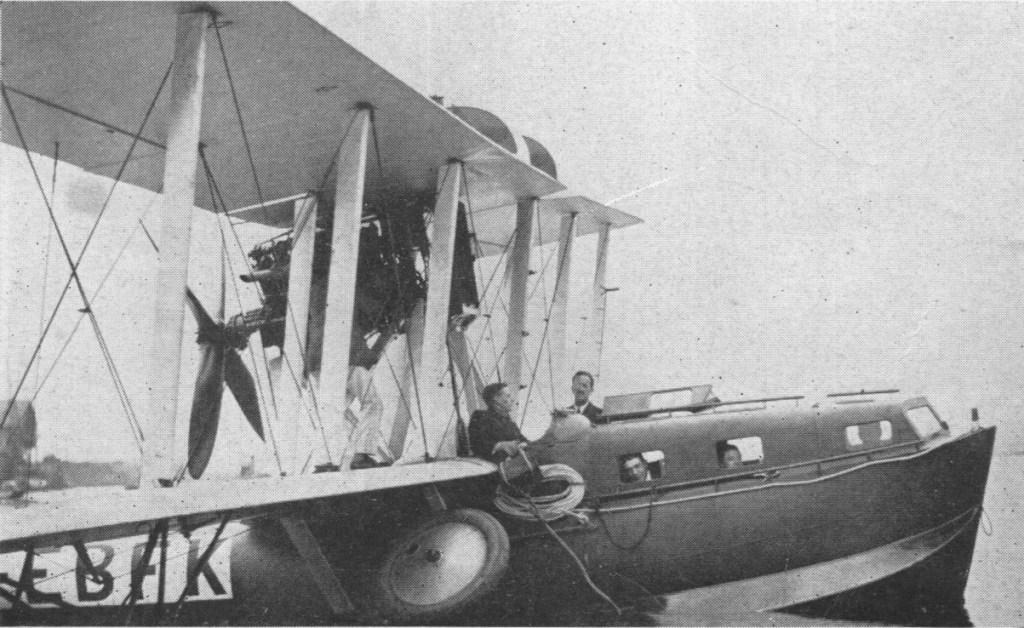
By the mid-twenties the RAF was desperate to replace their First World War vintage Felixstowe flying boats and had almost given up the search when R J Mitchell’s development of his civilian Swan design was offered. It proved an immediate success and established not only the name of the designer but that of the company in military circles.

The first eighteen Southamptons delivered were Mk Is with wooden hulls. However a lengthy marine research programme had convinced the Royal Air Force of the superior qualities of metal over wood and so the final forty-eight were delivered as Southampton MkIIs with metal hulls and powered by two 335kW Napier Lion V engines. In a programme begun in 1929 all surviving wooden-hulled Southamptons were re-built with metal hulls.

Southamptons first entered service in August 1925 and quickly became famous for long-distance formation flights, ‘showing the flag’ in many parts of the world. The most notable was a 43500km (27000 mile) cruise of the Far East Flight’s four Southamptons from Felixstowe to Singapore via the Mediterranean and India in 1927 and 1928.

The Southampton flying-boat was one of the most successful ever used by the Royal Air Force. With a reputation for reliability, its service life of eleven years was surpassed only by that of the Sunderland.

Gallery

Southampton Mk II
Engines: 2 x Napier Lion VA W-12, 373kW
Max take-off weight: 6895 kg / 15201 lb
Empty weight: 4082 kg / 8999 lb
Wingspan: 22.86 m / 75 ft 0 in
Length: 15.58 m / 51 ft 1 in
Height: 6.82 m / 22 ft 5 in
Wing area: 134.61 sq.m / 1448.93 sq ft
Max. speed: 174 km/h / 108 mph
Ceiling: 4265 m / 14000 ft
Range: 1500 km / 932 miles
Armament: 3 x 7.7mm machine-guns
Bombload: 500kg

Supermarine Swan

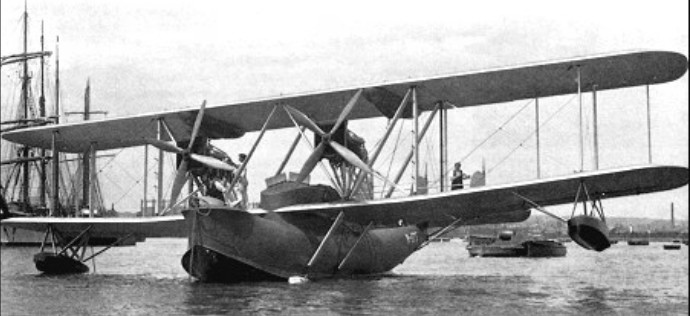
Shortly after World War I, Supermarine received two Air Ministry contracts to Specification 21/22, one in 1921 for a five-seat military seaplane and the other in 1922 for a commercial seaplane, the former named Scylla and the latter Swan.

The aircraft were equal-span, two-bay biplanes with monoplane tail units and triple fins and rudders. The raised cockpit seated the two-crew side-by-side.

The Scylla N174 emerged as a monoplane, but was apparently converted to triplane configuration in 1923, when it carried out taxi trials at Felixstowe. There is no evidence that it ever flew.

Swan

The Swan N175 was completed as planned in 1924, but as a maritime reconnaissance flying-boat biplane. After completing its flight trials, it was converted to civilian use. An Air Ministry Specification R18/24 was issued for a development, later built by Supermarine as the first Southampton.

Engine: 2 x 2 x 450hp Napier Lion IIB
Max take-off weight: 5820 kg / 12831 lb
Wingspan: 20.90 m / 69 ft 7 in
Length: 17.06 m / 56 ft 12 in
Height: 7.95 m / 26 ft 1 in
Max. speed: 175 km/h / 109 mph
Ceiling: 3089 m / 10150 ft
Range: 1400 km / 870 miles
Crew: 2
Passengers: 10

Supermarine Sea Lion

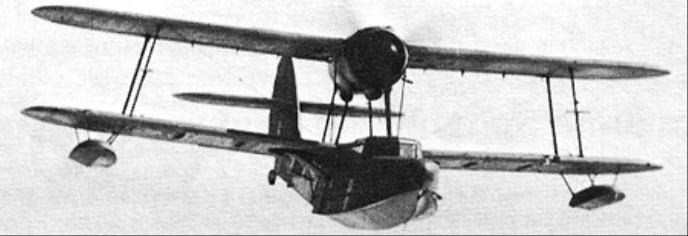
R.J. Mitchell joined Supermarine in 1917 and was responsible for a racing design, the Sea Lion was developed from the Baby, an earlier aircraft designed to meet an Admiralty experimental requirement to compete in the 1919 Schneider Trophy race, but was badly damaged by an underwater obstruction.

Mitchell went on to redesign the Sea Lion (II) biplane flying boat (itself a derivative of the Sea King fighter), powered by a strut-mounted single pusher engine. The new Sea Lion won the 1922 Schneider race in Naples at 145.62 mph. The Sea Lion (III) was fitted with an uprated engine for the 1923 event at Cowes, but only managed third place. Mitchell was well aware of the need to decrease drag and moved on to design the S.IV.

Sea Lion II
Crew: 1
Engine: 1 x 450hp Napier Lion V12
Max take-off weight: 1425 kg / 3142 lb
Wingspan: 9.75 m / 32 ft 0 in
Length: 7.54 m / 25 ft 9 in
Max. speed: 233 km/h / 145 mph

Supermarine Sea Otter

The Sea Otter amphibious biplane was designed to replace the Walrus on reconnaissance and general duties, including air-sea rescue. It was produced before World War II and went into service with the RAF and FAA during the war. A total of 290 was built. After the war a number were modified for civil use with the normal military equipment removed. Power was provided by one 637kW Bristol Mercury 30 radial, giving a maximum level speed of 241km/h.

Engine: 1 x Bristol Mercury XXX, 638kW / 843 hp
Max take-off weight: 4530 kg / 9987 lb
Empty weight: 3080 kg / 6790 lb
Wing loading: 16.4 lb/sq.ft / 80.0 kg/sq.m
Wingspan: 14.02 m / 46 ft 0 in
Length: 12.01 m / 39 ft 5 in
Height: 4.93 m / 16 ft 2 in
Wing area: 56.67 sq.m / 609.99 sq ft
Max. speed: 130 kt / 241 km/h / 150 mph
Cruise speed: 87 kt / 161 km/h / 100 mph
Ceiling: 4875 m / 16000 ft
Range: 900-1160 km / 559 – 721 miles
Armament: 3 x .303in / 7.7mm machine-gun
Crew: 2
Payload: 2 pax

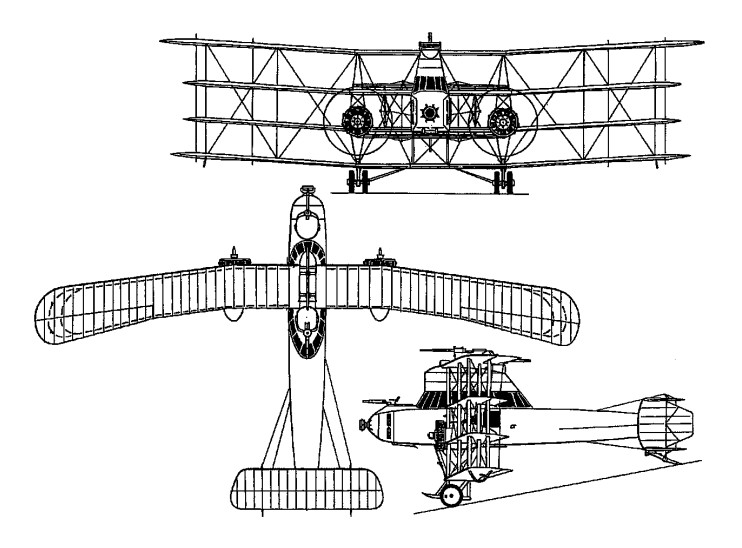
Supermarine P.B.31 NightHawk / Pemberton-Billing P.B.31E

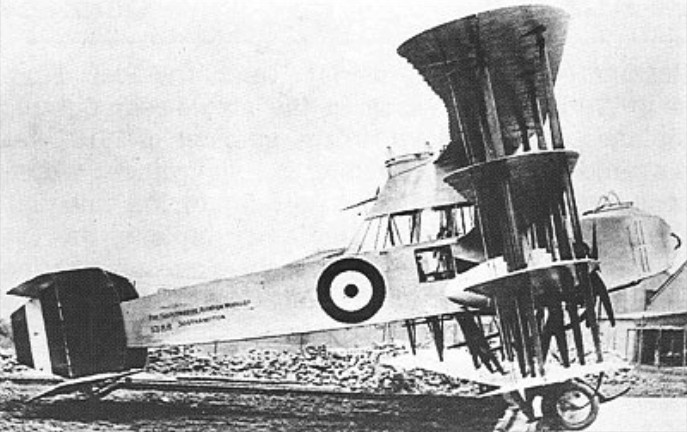
When Pemberton-Billing Ltd changed its name to Supermarine Aviation in December 1916, work on a further airship fighter, the P.B.31E, had reached an advanced stage and the first prototype of this quadruplane was to fly shortly afterwards, in February 1917.

Fundamentally an extrapolation of the P.B.29E, and unofficially known as Night Hawk, the P.B.31E was designed to have a maximum endurance in excess of 18 hours to enable it to lie in wait for intruding airships.

A three-bay narrow chord quadruplane powered by two 100hp Anzani nine-cylinder radials, the P.B.31E carried a searchlight in the extreme nose. The four wings had considerable sweepback of their outer sections. The intended armament comprised a one-and-a-half pounder Davis gun on a traversing mounting in a forward position level with the top wing, a 7.7mm machine gun being located in a second position immediately aft and a similar weapon occupying a forward fuselage position.

Shortly after the start of flight trials, the shortcomings of the concept were finally appreciated, and, on 23 July 1917, the first prototype was scrapped and the second incomplete prototype abandoned.

Engines: two 100hp Anzani nine-cylinder radials
Max take-off weight: 2788 kg / 6147 lb
Empty weight: 1668 kg / 3677 lb
Wingspan: 18.29 m / 60 ft 0 in
Length: 11.24 m / 37 ft 11 in
Height: 5.40 m / 18 ft 9 in
Wing area: 89.37 sq.m / 961.97 sq ft
Max. speed: 121 km/h / 75 mph
Fuel capacity: 1016 kg / 2240 lb

Pemberton-Billing (Supermarine) P.B.31E

Supermarine Baby

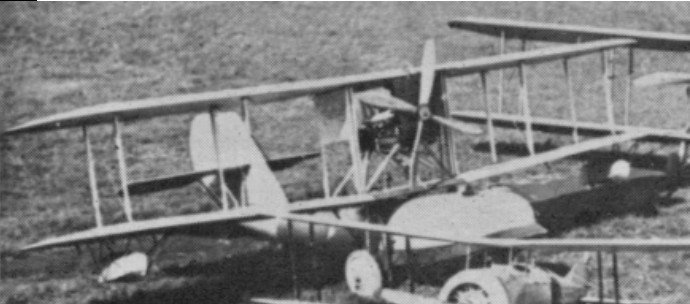
Towards the end of the first World War, the marauding German Brandenburg fighter seaplanes had become a nuisance to Allied patrol airships and flying boats which were guarding coastal convoys and Naval flotillas from U boats. These were beyond the effective range from shore bases of fighters, and the need for a small fighter flying boat to counter this menace was recognised by Supermarine which built the Baby in 1918 for just this purpose. It had the strength in its hull which twin float seaplanes lacked and it seemed full of promise, particularly in the open waters of the North Sea in times when engines lacked reliability. It was too late to see war service, but the design led to the successful Sea Lion series and, eventually, to the Walrus.

Supermarine Aviation Works / Pemberton-Billing Ltd

Noel Pemberton-Billing, a wealthy yacht-broker, gun-runner and aircraft manufacturer (he established the Supermarine company, described as ‘tall, slick, monocled and iron-jawed’ by contemporary society columnists, learned to fly in 24 hours to win a £500 wager with Frederick Handley Page and subsequently served with the Royal Naval Air Service, from which his ‘tem¬pestuous temperament’ earned him an early retirement, though not before he had helped to organize the first aerial attack on the Zeppelin sheds on Lake Constance.

Noel Pemberton Billing began aeronautical experiments in 1908 with a primitive monoplane. Acquiring a factory at Woolston, Southampton, in 1913, he began to design and build marine aircraft, his P.B.1 biplane flying-boat being exhibited at the 1914 Olympia Show, but not flown.

Pemberton-Billing Ltd registered June 1914.

At outbreak of First World War in 1914 designed, built and flew P.B.9 single-seat scout biplane in nine days. The P.B.29E night patrol quadruplane of 1915, built in seven weeks from beginning of design, paved the way for the improved version, the 1915 P.B.31E Nighthawk anti-airship fighter with many ingenious features, including searchlight and recoilless gun. By the time this had flown the company had been renamed Supermarine Aviation Works.

Other designs were a twin-float seaplane and Baby single-seat fighter flying-boat, the latter flying in February 1918. Company’s postwar Schneider Trophy Sea Lion racing flying-boats were developed from Baby, but advanced S.4 racer of 1925 was a twin-float seaplane, though still of wooden construction. The S.5 and S.6 seaplanes, which followed, were renowned for racewinning and record-breaking, but especially as forerunners of Second World War Spitfire, designed by Reginald Mitchell (1895-1937), who had joined company in 1916. Well-known maritime aircraft included the Admiralty (AD) type built by Supermarine (and Pemberton-Billing) in First World War, and Seal/Seagull/Scarab/Sheldrake series developed during 1920s and 1930s.
When the company was absorbed by Vickers in 1928 it was already famous for large multi-engined flying-boats, particularly Southampton, distinguished in RAF service from 1925, especially for long cruises.

Supermarine became Vicker-Supermarine in 1929.

Successors were much-refined Scapa of 1932 and Stranraer of 1935, and the Walrus and Sea Otter earned their place in FAA history during Second World War. The Supermarine Spitfire first flew March5, 1936. Well over 20,000 were built by various makers. Basic change came when the Rolls-Royce was replaced by the Griffon engine. Seafire was naval development (over 2,500 built). Spiteful and Seafang were late piston-engined types with new wing, from which the jet-propelled Attacker was developed to enter service in 1951. Swept-wing Swift was unsuccessful as fighter, and twin-jet Scimitar of 1958 concluded fighter line.