In 1971 Ralph Taylor built a two place cabin low wing monoplane, registered N2554, with retractable undercarriage.
Engine: Lycoming 180 hp
Max speed: 210 mph
Cruise speed: 197 mph
Seats: 2
In 1971 Ralph Taylor built a two place cabin low wing monoplane, registered N2554, with retractable undercarriage.
Engine: Lycoming 180 hp
Max speed: 210 mph
Cruise speed: 197 mph
Seats: 2
In 1936 L A Taylor of Longview TX built a single place, enclosed cockpit monoplane. Registered N13990, power was from a 65hp Velie.
Longview TX
USA
Circa 1936 built a monoplane
In 1935 Truman F Taylor built the Territory of Taylor, single place, open cockpit biplane, registered N9409, powered by a 60hp LeBlond.
Honolulu HI.
USA
Circa 1935 built the Territory of Taylor biplane
A two-seat cabin monoplane of all-metal construction with a high lattice girder with diagonal surface bracing.
Built at Hamsey Green, UK, by designer R.Taylor in 1936. Only one was built of three planned. The designer died in the crash of the prototype in 7 January 1937 on its first flight.
c/n TE.2 G-AEPX prototype built with Cirrus Minor I engine.
c/n TE.3 G-AEPY single seat, not built
c/n TE.4 G-AEPZ two-seater, not built
c/n G-AERA not built
In 1931 (H B) Taylor Automobile Works built the Thunderbird home-built NX12219 with an experimental license for “new type ailerons and flaps”.
A single place open cockpit monoplane, powered by a 30hp Szekely, by 1935 it had been repowered with an Anzani engine.
On 8/2/41 it was sold to the New Mexico Highlands University National Defense Training Branch, and the registration was cancelled in 1948.
(H B) Taylor Automobile Works
1119 11th St
Las Vegas NM.
USA
Circa 1931 built the Thunderbird

In 1909 Mr. George Taylor, secretary of the Aerial League, took a biplane,18ft long, with 4ft planes, and box-kite tail balance, to Narrabeen, NSW, Australian-built glider. The trials at gliding were held, Mr. Taylor himself acting as demonstrator. The scene of the flights was at Narrabeen Heads, in the presence of about one hundred visitors, the wide stretch of sand rendering any possible fall a matter of some safety. At the beginning of the experiments the wind came from the south-east at 10 miles an hour. The machine was carried to a sand knoll, and brought face on to the wind. Messrs. Schultz, Le Clerc, and Gibbons, of Narrabeen, required all their strength to hold it down. For the preliminary flights the corners were held by guide ropes 15ft in length to prevent the machine from getting out of control before the experimentor was properly tuned to automatic balancing.
At the commencement of the latest flights the wind came from the north-east at a pace of only three knots, hardly sufficient to give the necessary lift to the machine. A few attempts were made, but they wore too short and too close to the ground. The wind, however, increased in volume, and at 6 o’clock a 15-knot breeze was coming from the north-east. As the machine was wheeled face on, it shot up with Mr. Taylor to a height of 25ft, and soared the full length of the course. The demonstrator, by means of the-elevating plane, brought the machine rather sharply to the ground at the water’s edge. Tho second flight was even more successful, the machine during its course actually poising for about 10 seconds, owing to its being tilted at an angle that for a short time allowed the wind to counterbalance the soaring tendency.
At the signal to let go the machine was well lifted by the wind, and by careful manipulation on the part of Mr. Taylor it shot towards the ocean 98 yards away in a series of curves from 3ft to 15ft above the ground, dragging its guides, who, however, pulled it to the ground at the water’s edge. Twenty-nine successful flights were made by Mr. Taylor and Mr. Hallstrom, an enthusiastic member of the Aerial League. As the afternoon wore on the flights improved on account of the wind freshening to 15 miles an hour, and coming directly from the east so much so that the last flight of the day was notable.
At “let go” the wind immediately lifted the machine to the full length of the guide ropes, and dragged the operators so fast to the ocean that two let go; the machine now soared to-wards the ocean, and at the water’s edge the remaining guide ropes were loosened, the machine making a leap upwards. Mr. Taylor by careful manoeuvring, kept the machine well under control, and dived it in the sea some little distance from the heads. The machine will be fitted with steering gear and other improvements for further flights. Mr. Taylor’s monoplane is now having its powerful engine fitted to it at Gibson and Son’s motor works at Balmain, and he hopes to have it in the air during Christmas week. If the flights are as successful as anticipated the machine will be placed at the disposal of the military authorities during the Kitchener camp and review.

The ornithopter designed by Vladimir Tatlin from 1929 to 1932 and Tatlin built three versions of his machine. The word Letatlin is formed from the verb letat (fly), associated with the name of its creator, Tatlin. In the Stalin years, Tatlin, one of the major artists of the constructivist movement of the Soviet revolutionary years, designed his ornithopter inspired from birds.
Tatlin had carried out a trial flight that hadn’t worked out.
The ornithopter designed by Tatlin from 1929 to 1932 had disappeared. It had been more or less abandoned for twenty years in a warehouse belonging to the Molino Russian Federation Central Air force museum, next to Star City, the Youri-Gagarin cosmonaut training center fifty kilometers away from Moscow. It was the KSEVT, team, the space culture center in Slovenia, that by chance came across the machine in a precarious state during a protocol visit to the Monino museum in 2014. In February 2014, they were taken to the historical part of the Monino museum where one can see pioneers’ flying machines, since the Russians went into aeronautics very early. Miha Turšič, director of KSEVT until 2016, member of the collective Postgravityart, spotted the Letatlin in the corridors of the Monino museum in April 2014.
While the group was in discussion, Miha Turšič went ahead, getting a bit lost in the aisles of the museum, and suddenly I found myself face to face with a machine that looked like a plane but wasn’t one. He knew of the Letatlin and there it was right in front of him. We immediately asked if they knew what they had there, one of the most iconic works of 20th century art. They told us: “Yes, it’s an old Russian artist who built sort of flying machines rather like Leonardo de Vinci.” They had no idea of the importance of the piece. They considered it as best as an experimental flying machine that had never flown. Tatlin was mentioned, but with no context.
It was Letatlin n°3 that was found. It would have reached Monino in 1996 after being damaged on the way back from a presentation in an exhibition in Athens and was left there, abandoned in the context of complicated years following the collapse of the USSR.

The Molino Air force museum had just retrieved it a year earlier from the museum storeroom where it lay in bits in a corner, deteriorated, really damaged, and they had reassembled it to hang it in their museum.

It was obvious that a renovation was necessary for the Letatlin. The Monino museum and the Tretiakov gallery finally found an agreement for its renovation. Turšič went to Moscow at the end of December 2017 to meet the curator of the museum and saw it displayed in the 20th century art collection.
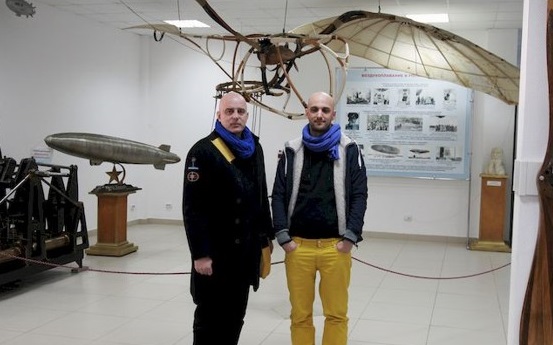
The Letatlin finally found the perfect place for its presentation to the public.

