Motorboat builder Alphonse Tellier (one of his craft towed Voisin’s float glider in 1905) built his first aircraft, for Emile Dubonnet, in 1909-1910, but went into liquidation in 1911. Re-formed upon outbreak of First World War, Tellier’s company built floats and hulls for other marine aircraft before flying prototype of T2 flying-boat in June 1916. This soon crashed, but with new funds from Dubonnet Tellier evolved the T3 two-seat bomber flying-boat of 1917 and its cannon-armed derivative, the TC6. Most were built by Nieuport and other manufacturers. Final products were the unsuccessful twin-engined T5 flying-boat and tri-motor T7. In August 1918 the company was absorbed by Nieuport, with Tellier as its marine aircraft designer.
Era
Telfer 1909 Multiplane
A Multiplane built in 1909. No specs or data in 1909 Jane’s, only that “the top plane is used as a horizontal rudder”.
Telfer
Richmond VA.
USA
Circa 1909 built a Multiplane
Tekniske Silhouette
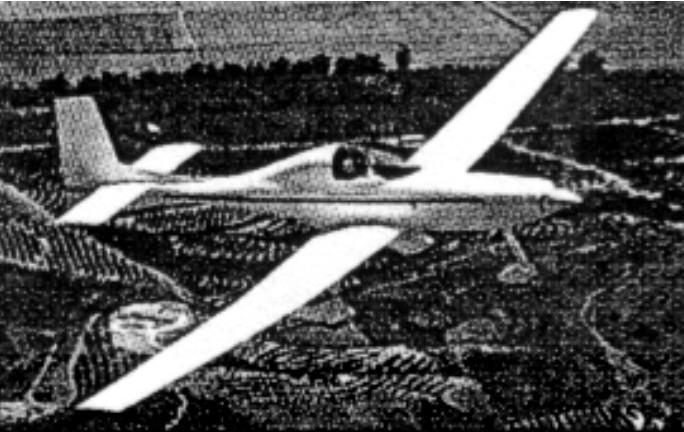
A 9 ft wing extension converts to a motor-glider. Available from Lunds Tekniske.
Engine: Rotax 447, 40 hp
Height: 6.66 ft
Length: 19.25 ft
Wing span: 32 ft
Wing area: 76 sq.ft
Fuel cap: 12 USG
Weight empty: 576 lbs
Gross: 825 lbs
Speed max: 125 mph
Cruise: 120 mph
Range: 460 sm
Stall: 50 mph
ROC: 800 fpm
Take-off dist: 800 ft
Landing dist: 800 ft
Service ceiling: 10,000 ft
Seats: 1
Landing gear: nose wheel
Tekniske
1995: PO Box 463, 8601 Mo, Norway.
Powered glider / LSA builder
Teichfuss Nibio
The Teichfuss Nibio (the German-speaking Teichfuss’s spelling of the Italian Nibbio or English: Kite) was an Italian single seat glider, designed by Luigi Teichfuss.
The original Nibio, the Nibio I was designed as a primary glider and was built in the Royal Aircraft factory at Pavullo nel Frignano Airport during 1929. Apart from its span of 12.5 m (41 ft 0 in), empty weight of 145 kg (320 lb) and all-up weight of 220 kg (485 lb) very little information on it exists. Some launches were made by aerotow, behind an Aviatik from Taliedo. The Nibio II, sometimes known as the Nibio II Freccia Nera (English: Black Arrow) followed the next year with a new wing. Its greater span, increased by 900 mm (35 in), provided an increase in aspect ratio. Despite its longer wing the Nibio II was 20 kg (44 lb) lighter.
The Nibio II was a high-wing monoplane with its wing braced by a single faired strut on each side, joining the lower fuselage to the outer end of the central panel at about one third span. This central panel was rectangular in plan and was without dihedral. The outer panels were straight tapered to blunt tips, the wing becoming thinner and thus acquiring dihedral though retaining a horizontal upper surface. Ailerons occupied the whole trailing edges of these outer panels; there were no inboard flaps or air brakes.
Its wood framed, plywood skinned fuselage was hexagonal in cross section, tapering markedly on its underside towards the tail. The wing was mounted on a pedestal which sloped away aft into the upper fuselage. The pilot’s cockpit, open behind a small windscreen, was immediately ahead of the pedestal and below the wing leading edge. The tail surfaces were straight tapered and straight tipped, with the tailplane mounted on the fuselage. The rudder extended down to the keel, operating within a small cut-out between the elevators and protected from the ground by a small underfin which served as a tail bumper. There was a short landing skid running from near the nose to just aft of the wing strut.
Only one of each version was ever built.
Nibio I
Wingspan: 12.5 m (41 ft 0 in)
Empty weight: 145 kg (320 lb)
All-up weight: 220 kg (485 lb)
Nibio II Freccia Nera
Wingspan: 13.40 m (44 ft 0 in)
Wing area: 12.60 m2 (135.6 sq ft)
Aspect ratio: 14.2
Airfoil: Göttingen 535 and NACA M6
Length: 6.20 m (20 ft 4 in)
Height: 1.3 m (4 ft 3 in)
Empty weight: 125 kg (276 lb)
Gross weight: 210 kg (463 lb)
Wing loading: 16.7 kg/m2 (3.4 lb/sq ft)
Maximum glide ratio: estimated 19:1
Rate of sink: 0.8 m/s (160 ft/min) minimum
Capacity: One
Teichfuss Balilla
The Teichfuss Balilla was an Italian single seat primary glider, designed by Luigi Teichfuss.
In 1939 Luigi Teichfuss designed an improved version of the Nibio I, the Balilla. It was a simple, low cost, robust, high wing, strut braced monoplane with an unswept, constant chord, elliptically tipped wing. Mounted with dihedral, this was supported over the fuselage on a narrow pedestal and braced on each side by a parallel pair of faired lift struts from the lower fuselage to the wings at about half span.
Its fuselage was wood framed, flat sided and plywood skinned. Its cockpit, open but with a small windscreen, was immediately ahead of the wing leading edge; there were no instruments. The Balilla’s tail surfaces were all straight edged: the tailplane, single strut braced from below, had a sharply swept leading edge and carried elevators with angled tips and a cut-out for rudder movement. The vertical tail was tapered with a squared tip; the rudder reached to the keel, where it was protected by a wire loop tail bumper. Elevators and the rudder lacked aerodynamic balances. A conventional skid, running from the nose to below the wing trailing edge formed the undercarriage.
The Ballila first flew in 1939. Ten were built, serving all the gliding schools of the R.U.N.A. It could be winch launched and was straightforward to fly, training novice pilots to their B-certificate.
Wingspan: 12.50 m (41 ft 0 in)
Wing area: 16.6 m2 (179 sq ft)
Aspect ratio: 9.4
Airfoil: Göttingen 535
Length: 6.38 m (20 ft 11 in)
Height: 1.48 m (4 ft 10 in)
Empty weight: 126 kg (278 lb)
Gross weight: 211 kg (465 lb)
Maximum glide ratio: estimated 17:1
Rate of sink: 0.85 m/s (167 ft/min) minimum
Wing loading: 11.6 kg/m2 (2.4 lb/sq ft)
Seats: One
Teichfuss Aerocicloplano
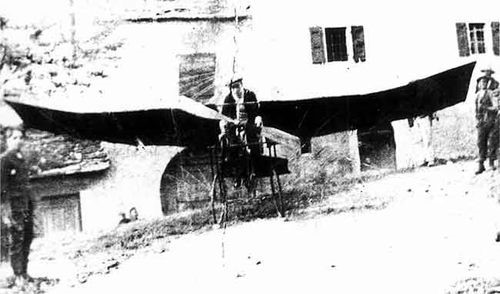
Designed and built by cycling champion Luigi Teichfuss in 1907. Span was 10 m, empty weight 90 kg. It was unsuccessful.
Tefft Contester A-1
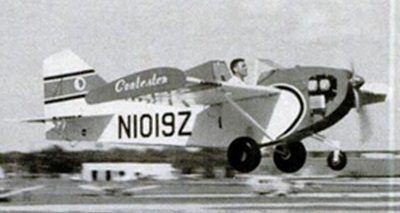
Built to compete in the 1962 EAA design competion, the Contester N1019Z of Leon Tefft of Chicago was disqualified on a technicality.
Engine: Continental A-75, 75hp
Wingspan: 18’6″
Length: 14’6″
Useful load: 290 l
Max speed: 125 mph
Cruise speed: 120 mph
Stall: 80 mph
Range: 350 mi
Seats: 1
Tefft, Leon
Chicago IL.
USA
Circa 1962 built the Contester A-1

