A 1928 three place cabin, high wing monoplane. Powered by three converted motorcycle engines, the cantilever wing aircraft was registered NX88E.
Era
Terrier / Airworthy Airplane Co
Chicago IL.
USA
Circa 1928 built a monoplane
Terrell & Larson 1929 Curtiss Pursuit
This as a rebuilt war-surplus 1918 JN-4 purchased from a C Sanders on 31 July 1928. Registered N471 c/n TL-100sub, it was overhauled and modified to some extent and, as the “sub” c/n indicates, reregistered in the pairs’ honor.
The registration was cancelled on 7 May 1930.
Engine: Curtiss OX-5, 90hp
Terrell & Larson
E E Terrell & B Larsen
3145 Cuthbert St
Oakland CA.
USA
Circa 1929 built the Curtiss Pursuit from a JN-4
Terle 1930 monoplane
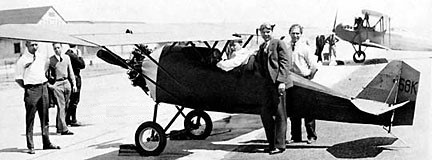
Built by printer Joseph Terle over a period of 10 years in his backyard and flown in 1930, the aircraft (registered N68K) was reported in a news brief as flown by Bert Acosta, who pronounced it the “best plane he ever flew.”
Engine: Salmson
Seats: 1
Terle, Joseph
Joseph Terle
Long Island NY.
USA
Circa 1930 built a monoplane
Termite Aircraft Termite
First flown on 10 February 1957 (N7939A), the Termite open cockpit, high wing monoplane was marketed as plans for home-builders.
The original motor was a 36hp Aeronca E-113C.
Reportedly 20 were under construction by 1961.
Engine: Continental, 40hp
Wingspan: 23’6″
Length: 15’1″
Useful load: 225 lb
Max speed: 95 mph
Cruise speed: 85 mph
Stall: 38 mph
Range: 150 mi
Seats: 1
Termite Aircraft
fdr: Wilbur L Smith
Bloomington IL.
USA
Circa 1957 built the Termite monoplane
Teodorescu 1911 monoplane
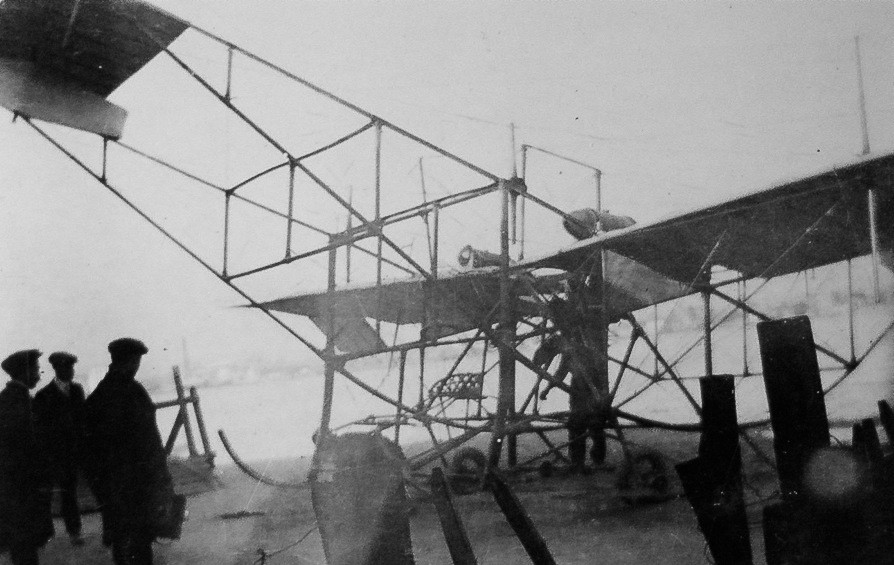
The Romanian inventor Ioan Teodorescu (French style name Jean Théodoresco) built a big high wing pusher monoplane, which flew successfully during September – November 1911 at Issy-les-Moulineux, France. Development was halted at that time, because Teodorescu ran out of funds.
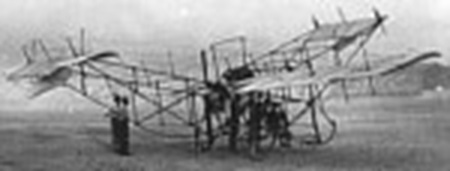
Designed by Teodorescu and built by Raymond, Lecoq, Rossi.
Span: 38’8″
Length: 37’9″
Tennessee Propellers Scout
Tennessee Propellers of Normandy, Tennessee, is a company better known for their wooden maple laminate aircraft propellers, but the company also acted as the exclusive distributor for the Zenoah G-25 and G-50 line of engines. To compliment these product lines they developed the Scout powered parachute which is powered by the 45 hp (34 kW) G-50 driving a Tennessee propeller.
The Scout was designed to comply with the US FAR 103 Ultralight Vehicles rules, including the category’s maximum empty weight of 254 lb (115 kg). The aircraft has a standard empty weight of 225 lb (102 kg). It features a parachute-style high-wing, single-place accommodation, tricycle landing gear and a single G-50 engine in pusher configuration. The 50 hp (37 kW) Rotax 503 engine was a factory option.
The aircraft carriage is built from powder coated welded 6061-T6 aluminum tubing and is a highly simplified design compared to other powered parachutes. In flight steering is accomplished via foot pedals that actuate the canopy brakes, creating roll and yaw. On the ground the same foot pedals control the nosewheel steering. The main landing gear incorporates fiberglass spring rod suspension. Standard equipment factory provided included a large canopy-stowage bag, electric engine starting, flight instruments and a four-point pilot harness.
The Scout was supplied as a complete ready-to-fly aircraft, introduced in 1999, but is no longer available. Unit cost in 2001 was US$10,000.
Engine: 1 × Zenoah G-50, 45 hp (34 kW)
Wing area: 400 sq ft (37 sq.m)
Empty weight: 225 lb (102 kg)
Gross weight: 485 lb (220 kg)
Fuel capacity: 5 U.S. gallons (19 L; 4.2 imp gal)
Cruise speed: 25 mph (40 km/h; 22 kn)
Rate of climb: 400 ft/min (2.0 m/s)
Wing loading: 1.21 lb/sq ft (5.9 kg/sq.m)
Crew: one

