Madison WI.
USA
Airplane builder in 1963.
Madison WI.
USA
Airplane builder in 1963.
The Sport Trainer was built by Edgar B Todd in 1933. A two place, open cockpit monoplane, it was registered N12574 c/n 5 and powered by a 65hp Velie engine.
The Light Express was built by Edgar B Todd in 1927 as a three-section parasol monoplane with a Clark-Y airfoil. A single seater, the baggage compartment was convertible into a passenger seat.
Only one was built.
Engine: Curtiss OX-5, 90hp
Wingspan: 40’0″
Length: 22’4″
Useful load: 330 lb
Max speed: 120 mph
Cruise speed: 110 mph
Stall: 55 mph
Range: 700 mi
Seats: 1-2
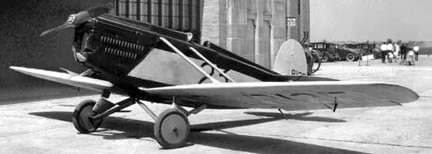
The Edgar B Todd Cirrus Special, or Todd-Alexander Racer NR12E flew in the 1930 Cirrus Derby. Piloted by E B Todd, it was forced out with motor trouble.
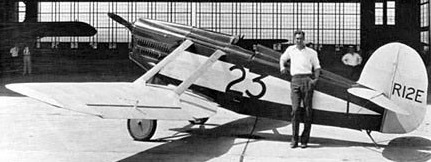
Power was from a 100hp Chevrolet D-333, replaced by a 110hp Cirrus for racing.
Speed: 165 mph
Seats: 1
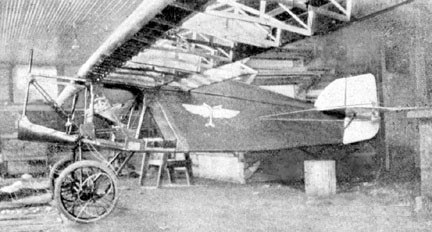
Built by Edgar B Todd while attending high school at Midwest WY. Dubbed Goodship Midwest or Midwest Light Plane, the propeller was hand-made in the school’s carpentry shop.
Engine: Lawrance A-3, 28hp
Wingspan: 24’0″
Length: 15’2″
Range: 300mi
Seats: 1
Douglas WY.
USA
1929:
Pueblo CO.
USA
Airplane builder
Henryk Toczołowski and Józef Wulf designed the TW-12 in 1929-30 but had to build the structure slowly in their spare time. They were both members of the P.W.S. Aero Club and eventually got permission to use the P.W.S. workshops but the TW-12 was not ready for flight until the second half of 1933. There is uncertainty about the date of the first flight, which one source gives as 29 September 1933 and another as 29 November 1933.
The TW-12 was an all-wood aircraft, with a cantilever, one piece low wing which was trapezoidal in plan. It was built around twin spars and covered in a mixture of plywood and fabric.
It was powered by a 60–66 kW (80–88 hp) five cylinder Armstrong-Siddeley Genet radial engine. The fuselage, with rectangular section structure and rounded decking, was plywood covered. The TW-12 had two open, tandem cockpits fitted with dual control. Its landing gear was fixed and conventional.
Early flight testing revealed some handling problems, particularly at low speeds in the landing approach. After some modifications the TW-12 went to the I.B.T.L. at Warsaw for official airworthiness tests , which led again to concerns about the low speed handling and also about the low fuel capacity (8.8 imp gal (40 l; 10.6 US gal)). In the summer of 1935 the TW-12 was allowed to fly as a single-seater, with the forward cockpit covered over and with a rudder of increased area.
On its release from the I.B.T.L., the WT-12 was scheduled to take part in the P.W.S. Club rally on 28 July 1935 at their home base at Biała Podlaska. According to one account, Antoni Uszacki decided to take advantage of a strong tail wind to fly it from Warsaw to Lviv, some 370 km (230 mi) away. Despite the limited fuel capacity (40 l (8.8 imp gal; 11 US gal), he arrived safely though with a dry tank .The club began to use the TW-12 as a trainer but its career was soon cut short by a landing crash with Tadeusz Arcinowski at the controls.
Another account states that Uszacki flew it at the rally but only achieved last (6th) place, and that Arcinowski flew it soon afterwards from Warsaw to Lviv but crashed on landing.
two seat version
Engine: 1 × Armstrong-Siddeley Genet, 60–66 kW (80–88 hp)
Wingspan: 10.5 m (34 ft 5 in)
Wing area: 14.5 sq.m (156 sq ft)
Length: 6.5 m (21 ft 4 in)
Height: 2.2 m (7 ft 3 in)
Empty weight: 285 kg (628 lb)
Max takeoff weight: 500 kg (1,102 lb)
Fuel capacity: 8.8 imp gal (40 l; 10.6 US gal)
Maximum speed: 170 km/h (106 mph; 92 kn) at sea level
Cruise speed: 155–150 km/h (96–93 mph; 84–81 kn)
Service ceiling: 2,900 m (9,500 ft)
Rate of climb: 2.8–2.2 m/s (550–430 ft/min)
Landing speed: 70 km/h (43 mph)
Crew: One pilot
Capacity: One pupil
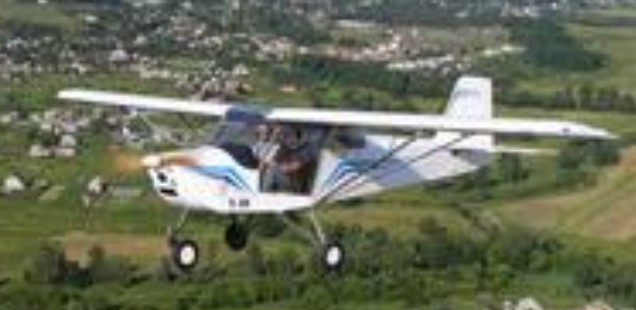
T-10 is a very light multipurpose aircraft, intended for pilot training, crop spraying, and aerial patroing. The airplane’s fugelage frame work has truss structure, made of stainless steel. The wing (double spar, all wooden) and horizontal empennage are foldable along the fuselage, which facilitates the airplane’s assembly, disassembly, transportation and storage.
T-10 tricycle non-retractable landing gear, enables it to operate from ground, grass and paved runways. As additional option it can be equipped with a Cobra recovery system. The T-10 Frigate as a ready-to-fly airplane 2009 Price: 42500 euro or as a kit (21 600 euro).
Stall: 33 kt / 39 mph / 62 kmh
Cruise: 81 kt / 93 mph / 150 kmh
VNE: 103 kt / 118 mph / 190 kmh
Empty Weight: 315 kg / 694 lbs
MTOW Weight: 550 kg / 1213 lbs
Climb Ratio: 1200 ft/min / 6,2 m/s
Glide Ratio: 11
Take-off distance (50ft obstacle): 360 ft / 110 m
Landing distance (50ft obstacle): 230 ft / 70 m
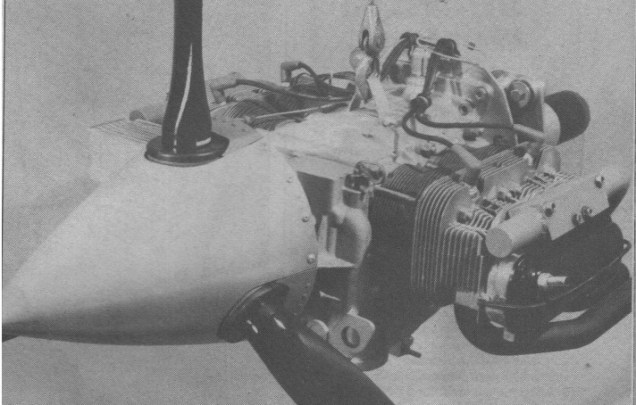
An aircraft conversion for the automotive VW Type IV Porsche 914 engine, normally used aboard the VW 411, VW 412, late-model VW buses and the Porsche 914. This conversion offers an oil filter, oil cooler, starter, alternator and vibration-type mounts.
The prototype Porsche engine is a standard-displacement 1800cc VW 412 powerplant. Parts are available to increase the CID, plus a Posa carburetor of the fuel-injection type to replace the 29mm injector. Also, you can obtain plans for modifying the intake manifold slightly.
1800cc engine
Bore: 93mm
Stroke: 66mm
CID: 1793cc
Compression: 8.21
Firing Order: 1-4-3-2
Min. Octane Fuel: 90
Dry Weight: 1951 lb
Fuel Consumption: 4 gph
Alternator Output: 7 amps
SAE hp at rpm: 108 at 3800rpm
Torque ft/lb at rpm: 108 at 3800
Ignition System: 1 magneto
Fuel Induction: 1 injector
1980: TM Designs, Department HA, Box 3163, Charlotte, NC 28299, USA.
Engine builder

