The 1909 Tucek Type I 1-seater monoplane was designed and built by Tucek in Czechia (Austro-Hungarian Empire).
Span: 29’10”
Length: 24’7″
Weight: 772 lb
The 1909 Tucek Type I 1-seater monoplane was designed and built by Tucek in Czechia (Austro-Hungarian Empire).
Span: 29’10”
Length: 24’7″
Weight: 772 lb
USA
Builds under licence from Thorp Aircraft Company the Model 211, a developed version of the Thorp Sky Skooter lightplane. Eight built by Spring 1965; suspended 1966.
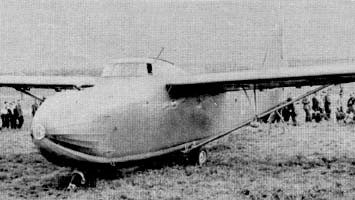
Designed by Pavel Tsybin to a 1944 specification, the Ts-25 was of a high-wing design, with a box-shaped fuselage featuring a hinged nose for ease of loading the aircraft’s cargo. The aircraft had a fixed tricycle landing gear, with skids to aid in landing, and was of steel-tube-braced wooden construction with the nose covered in fabric. The fuselage was otherwise covered in plywood; the wing was tapered, with its spar being steel-tube strut braced. The intended load of the aircraft consisted of a jeep-type vehicle and a 57 mm (2.2 in) anti-tank gun.
Following flight tests that completed in 1948, the Ts-25 was accepted for production;[1] it is regarded as the first domestically produced glider to be built in significant quantities for the Soviet Airborne Forces (VDV). It was first publicly displayed at the 1948 Tushino Air Display. Eventually up to 480 of the aircraft were built at the Chkalovsk manufacturing plant between 1948 and 1954. Some were used by the VDV in training maneuvers. One was modified with 25 passenger seats for evaluation for potential civilian use on routes including Moscow, Gorki, and Novosibirsk. Two were supplied to the Czechoslovak Air Force in 1952 and given the desigation NK-25; the Yakovlev Yak-14 was preferred by the Czechs.
In 1950 two Ts-25s, towed by Ilyushin Il-12 transports, were used to resupply Polar Station SP-2.
Variants
Ts-25
Main production version, 480 built.
Ts-25M
Powered version; one built. Powered by two Shvetsov M-11FR-1 radial engines each producing 165 hp (123 kW).
NK-25
Czech designation for Ts-25.
Wingspan: 24.38 m (79 ft 11.875 in)
Length: 16.15 m (52 ft 11.8 in)
Height: 5 m (16 ft 5 in)
Wing area: 75.0 m2 (807 sq ft)
Empty weight: 1,787 kg (3,940 lb)
Max takeoff weight: 4,200 kg (9,259 lb)
Maximum speed: 230 km/h (140 mph, 120 kn) in tow
Landing speed: 90 km/h (56 mph; 49 kn)
Crew: two pilots
Capacity: 25 troops or 2,500 kg (5,500 lb) cargo
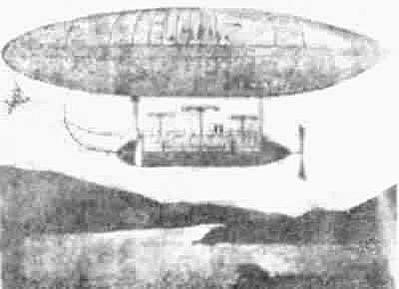
LTA/HTA dirigible designed by Australian-born and raised Chinese revolutionary Tse Tsan-tai – sometimes identified as being the first person of Chinese descent to fly an airship, although it is not clear as to whether the actual craft was ever completed. Even so, had it been, it almost certainly would not have been able to fly. An extract from the July 1907 issue of “Aeronautics” describes the invention thus: “A syndicate is being formed in Hong-kong to build an airship designed in 1894 by a Chinaman, Tse Tsan Tai. It is to be built of aluminum, and will be enclosed in an aluminum shell to protect it from the enemy’s projectiles. The envelope is to be cigar-shaped. Tse Tsan Tai’s principle is that airships should depend upon their fan-propellers for advancing, receding, ascending and descending. The gas-envelope is to be used only as a buoy. For the vertical movement, therefore, there are to be horizontal propellers on the deck regulated by clockwork. The steering will not be by exposed planes and rudders, but by concealed steel wings, which can be thrown out at the stern on the pressure of an electric button.”
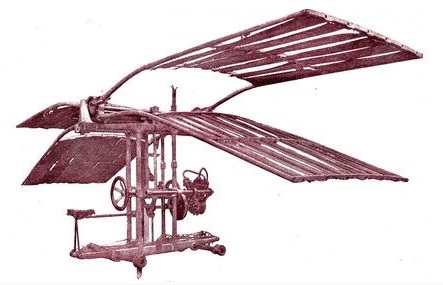
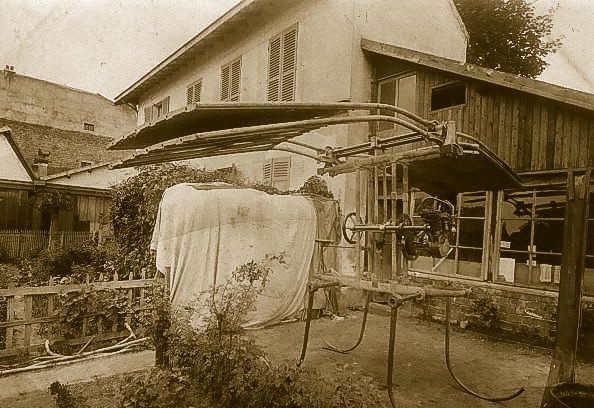
The 1908 Orthoptère of Spiridon Tsapenko [Спиридон Цапенко] and Joseph Michel Ambroise Farcot. The two photos taken by Branger on July 21, 1908 show a small scale version built as a pre-study for a full-size higher powered machine. This trial version had a 12 hp Farcot engine of 20 kg in weight, bringing the total weight of the machine to 150 kg.
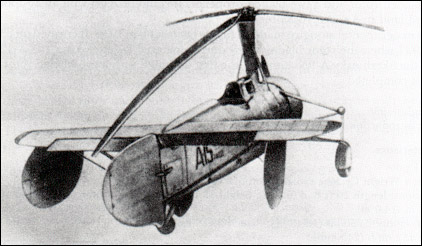
Intended as fastest autogyro of day, two-seat wingless machine using A-12 and A-14 technology and with usual welded KhMA structure. Scheibe fins on braced tailplane with elevators and direct-control rotor. Main gears with vertical shock struts carried on triangulared outriggers each side of fuselage. Pilot with synchronized ShKAS and observer with twin ShKAS and AFA-13 reconnaissance camera. Chief designer M.L.Mil, construction manager A.A.Kuznetsov. Completed April 1937 and taxi tests began by Chyernavskii and Ivanov, but A-12 crash caused further work to be halted. No reason to doubt airworthiness of A-15 but effectively terminated Soviet autogyro development. Autogyros picked up again at Kharkov, Kuibyshev and Riga 30 years later.
A-15
Engine: 1 x M-25V
Rotor diameter: 18.0m
Length: 8.6m
Height: 4.1m
Weight empty: 1695kg
Fuel+oil: 385+40kg
Weight loaded: 2560kg
Est. max speed: 260km/h
Min speed: 50km/h
Ceiling: 6400m
Take-off run: 35-60m
Landing run: 0m
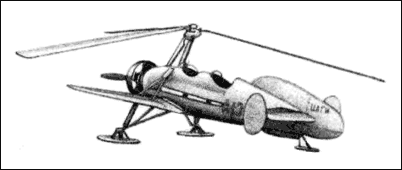
Two-seat liaison machine developed from A-6 and A-8. Direct-control inclined rotor with folding blades, folding dihedralled wings and twin-finned tail, internal engine starter and clutch-in drive for rotor before take-off. First flown on skis March 1936.
A-13
Engine: 1 x M-11
Rotor diameter: 11.5m
Wing area: 5.6sq.m
Weight empty: 540kg
Fuel+oil: 50kg
Weight loaded: 802kg
Max speed: 151km/h
Min speed: 45km/h
Ceiling: 3000m
Endurance: 2h
Range: 250km
Take-off run: 40m
Landing run: 0m
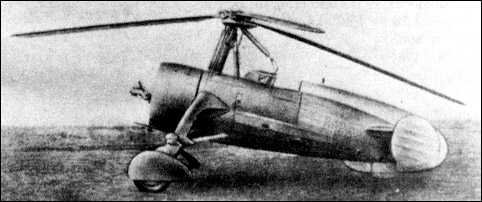
The 6th Brigade under Skrzhinskii designed A-10 six-seat transport autogyro with M-22 in 1934 but dropped this in favour of high-speed wingless machine with fully controllable rotor. Design in parallel with small A-14 which flew first and assisted perfection of A-12 wingless autogyro. Direct-control rotor derived from A-7, with similar engine drive before takeoff. Roll control by rotor only, tail with central rudder (extension of fuselage) and two Scheibe fins on strut-braced tailplane with elevators. Shavrov loosely describes fuselage and engine as I-16 (fighter); in fact steel tube with fabric, and engine cowl with gills. Two-position Hamilton prop, single-seat cockpit, very strong main gears with oleo struts and wide-track spatted wheels with toe brakes. Cautious taxiing and hops 10 May 1936 by A.P.Charnyavskii, eventually 17h 55min in 43 flights until rotor blade came off 23 May 1937 killing I.Kozyrev. Cause never found but ascribed fatique; almost halted autogyro work.
A-12
Engine: 1 x 670hp Wright Cyclone (later M-25)
Rotor diameter: 14.0m
Length: 6.3m
Weight empty: 1343kg
Fuel+oil: 165+17kg
Weight loaded: 1687kg
Max speed: 245km/h
Min speed: 52km/h
Ceiling: 5570m
Endurance: 1.5h
Take-off run: 25m
Landing run: 5-10m
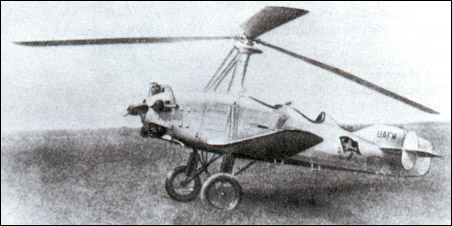
First flown 29 June 1934, this was virtually an A-6 with two major alterations: wings had 5 degree dihedral instead of upturned tips, and as well as ailerons direct rotor control of roll was provided, even during autorotation (and found to be vastly superior to ailerons except at max speed). Other changes included auxiliary fins on tailplane and first air/oil shock struts in Soviet Union.
A-8
Engine: 1 x M-11
Rotor diameter: 11.0m
Wing area: 5.8sq.m
Length: 6.3m
Height: 3.2m
Weight empty: 595kg
Fuel/oil: 67kg
Weight loaded: 837kg
Max speed: 142km/h
Min speed: 48km/h
Ceiling: 2560m
Endurance: 2.5h
Take-off run: 50m
Landing run: 0m
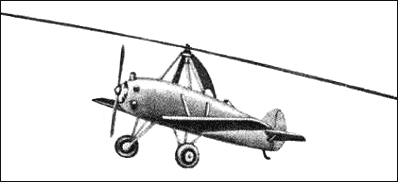
Light autogyro designed by Kuznetsov. First rotary-wing machine with folding blades, and also folding wings. Construction as before except balloon tyres instead of shock struts. Flown Ts.A.Korsinshchikov aerly 1933 and from start showed outstandingly good flying qualities, far better than A-4 on which all official attention was polarized. Following various research programmes in winter 1933, one of which was testing V (butterfly) tail.
A-6
Engine: 1 x M-11
Rotor diameter: 11.0m
Wing area: 5.9sq.m
Length: 6.3m
Height: 3.2m
Weight empty: 562kg
Fuel/oil: 67kg
Weight loaded: 815kg
Max speed: 142km/h
Min speed: 53km/h
Ceiling: 2000m
Endurance: 2.5h
Take-off run: 50m
Landing run: 0m

