Tupolev Tu-88 / Tu-16

Tu-16 Badger D

The prototype flown under OKB designation Tu-88 on 27 April 1952 was overweight and Andrei Tupolev delayed production until a second prototype flew in 1953 with uprated AM-3A turbojets and 5,500kg weight reduction. The maximum speed increased to 992km/h at a cost. The maximum IAS of only 700km/h at low altitude was achieved instead of the originally required M0.9

Tupolev Tu-16 Article

Deliveries began in 1954 and nine Tu-16 took part in the May Day 1954 flypast over Moscow, and 54 in the Aviation Day flypast 1955.

The Tu-88 entered service service in 1954/55 as the Tu-16 series in for a number of missile-carrier and reconnaissance roles. NATO code name ‘Badger’, the Tu 16 was notable in having only two engines, mounted on the sides of the fuselage inside the roots of the swept wing. The mid-set wings, sweptback at 40 deg 30 sec on the inner sections and at 37 deg 30 sec on the outer panels, and with slight anhedral. Bogie main landing gears fold backwards into compartments in streamlined fairings on the trailing edge.

By the 1960s at least 2,000 aircraft in this family had been delivered and 11 main versions have been identified for use as bombers, missile carriers, anti ship attack aircraft, reconnaissance aircraft and EW/ECM platforms. The Long Range Aviation force had almost 600 still in service in 1984, while the AV MF (Naval Aviation) still used some 300. There have been many updates of systems and equipment, and the EW/ECM versions are all rebuilds of free fall bombers.

The first (“Badger A”) version had blind-bombing radar and glazed nose, and a few were supplied to Egypt and Iraq. The ‘Badger A’ pioneered inflight refuelling using a looped hose between wingtips. The B carried two “Kennel” cruise missiles on underwing pylons and served the AV-MF (Navy) and Indonesian AF. C carried the large Kipper” stand-off missile on the centreline, with panoramic’ nose radar for ship search and missile guidance. D is a maritime reconnaissance type, with comprehensive radars and ECM. E is a photo and multi-sensor reconnaissance type, F is an E with major new ECM and ESM installations, and G is an updated B which launched many missiles against Israel in 1973.

Total production exceeded 2,000, and production (without Soviet aid) continued in China in the 1980s as the Xian H-6.

H-6

Armament: in most variants, six 23 mm NFI-23 cannon in radar-directed manned tail turret and remote-aimed upper dorsal and rear ventral barbettes; versions without nose radar usually have seventh NR-23 fixed firing ahead on right side of nose. Internal weapon bay for load of 19,800 lb (9000 kg), with certain versions equipped to launch missiles. Payload: 8377 lb (3800 kg) bombs or 2 stand-off missiles.
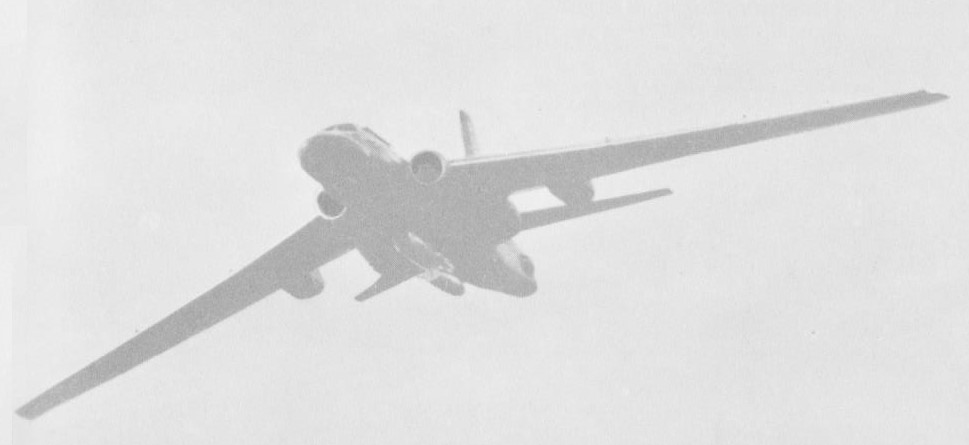
Operated with SovAir in strategic bombing role (Badger-A and -B), and with SovNavAir in ELINT, ECM, photographic and electronic recce, and anti-shipping roles (Badger-C to -H, Badger-J- to -K).

Gallery

Engines: 2 x AM-3M, 19,290 lb (8750 kgp) thrust
Wingspan: 111 ft 6 in
Length: 118 ft
Height: 35 ft 6 in
Wing area: 1820 sq.ft
MTOW: 175,000 lb approx.
Fuel capacity: 10,000 gal approx
Max speed, clean at 35,000 ft: 587 mph (945 km/h)
Initial climb, clean, about 4,100 ft (1250 m)/min
Service ceiling 42,650 ft (13,000 m)
Range with maximum weapon load, no missiles: 3,000 miles (4,800 km)
Extreme reconnaissance range, about 4,500 miles (7250 km)
Armament: 4 x 23mm guns
Bombload: 10,000 lb approx.

Type: multi role bomber/ reconnaissance/ECM aircraft
Crew: 6
Engine: two 9500 kg (20,943 lb) thrust Mikulin RD 3M turbojets
Max speed: 1000 km/h (621 mph) at 6000 m (19,685 ft)
Service ceiling: about 14000 m (45,930 ft)
Range with 3790 kg (8,355 lb) bombload: 4800 km (2985 miles)
Empty wt: 37200 kg (82,010 lb)
MTOW: 72000 kg (158,730 lb)
Wing span: 32.93 m (108 ft 0.5 in)
Length: 34.80 m (114 ft 2 in)
Height: 10.80 m (35 ft 6 in)
Wing area: 164.65 sq.m (1,772.3 sq ft)
Armament: three power turrets each armed with two 23 mm cannon, and usually one 23 mm cannon fixed firing ahead
Internal bombload: 9000 kg (19,841 lb)

Engines: 2 x AM-3M, 93.1kN
Max take-off weight: 72000-79000 kg / 158734 – 174166 lb
Empty weight: 37200 kg / 82012 lb
Wingspan: 32.9 m / 108 ft 11 in
Length: 34.8 m / 114 ft 2 in
Height: 10.9 m / 36 ft 9 in
Wing area: 164.7 sq.m / 1772.81 sq ft
Max. speed: 1050 km/h / 652 mph
Cruise speed: 850 km/h / 528 mph
Ceiling: 13000 m / 42650 ft
Range: 5800 km / 3604 miles
Range w/max.fuel: 7200 km / 4474 miles
Crew: 6
Armament: 7 x 23mm cannons
Bombload: 3000-9000kg

Tupolev Tu-16

Tupolev Tu-98

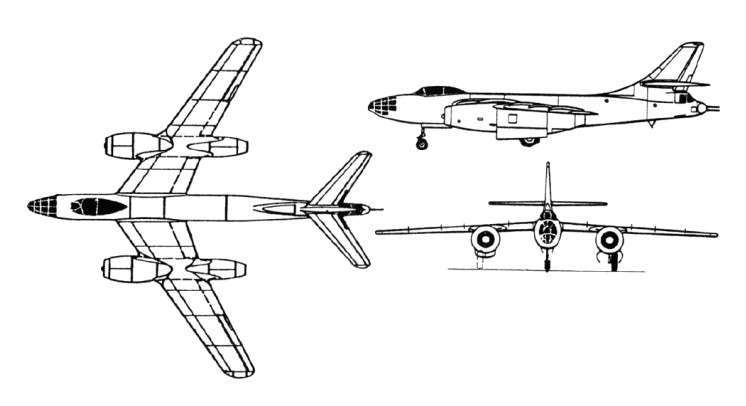
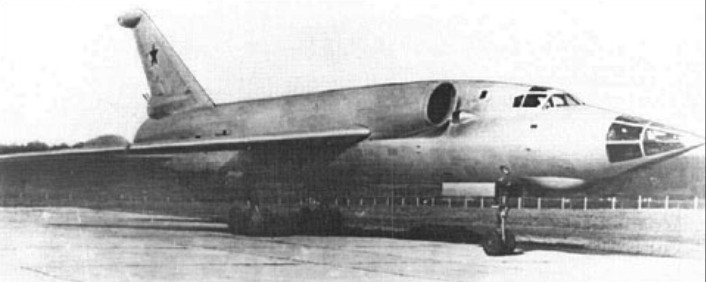
Tupolev’s progress in the development of aircraft design rarely came about by huge technical leaps; rather it was a progressive, but time-consuming, step by step advancement. Thus when work began on the Tu-98 at the beginning of 1954, it was not intended for production; instead it was a bridge to evaluate the problems of supersonic flight, and a stepping stone to the Tu-105 and the Tu-128 programmes which would follow later.

Chief designer on the project was Dmitri Markov. He based the wing design on that of the earlier Tu-16, but cleaned it up and moved the engines back into the fuselage, with two large air intakes located just behind and on either side of the cockpit. The engines selected were Lyulka’s AL-7Fs, which developed 10,000kg static thrust, and were fitted with afterburners. With a maximum takeoff weight of 39,000kg, the Tu-98 was close in size to the Tu-16, but the extra power, and particularly the afterburners, gave it the extra energy to go through the sound barrier.

The first aircraft was completed by early 1956, and, as usual, after road transfer, it was reassembled at Zhukovski and made ready for flight. The first flight was made in spring 1956. A second aircraft joined the first in the state trials. Performance was measured at a maximum speed of 1238km/h (with afterburners on) at 12,000m.

Engine: 2 x AL-7F turbofans, 6850-8000kg
Max take-off weight: 39000 kg / 85981 lb
Wingspan: 17.27 m / 57 ft 8 in
Length: 32.06 m / 105 ft 2 in
Height: 8.63 m / 28 ft 4 in
Wing area: 87.5 sq.m / 941.84 sq ft
Max. speed: 1238 km/h / 769 mph
Ceiling: 12750 m / 41850 ft
Range: 2440 km / 1516 miles
Crew: 3

Tupolev Tu-98

Tupolev Tu-91

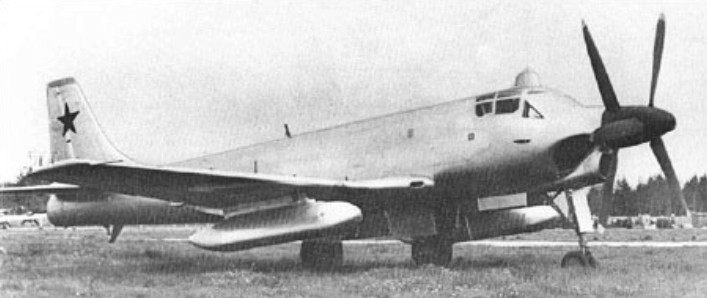
At the end of the 1940s, the Soviet government took a decision to expand the Voenno Morskoi Plot (VMF, the Navy). It was decided to include an aircraft carrier fleet, and development of aircraft suitable for carriers was a part of the programme. Tupolev was given the task of designing a strike aircraft for the new fleet.

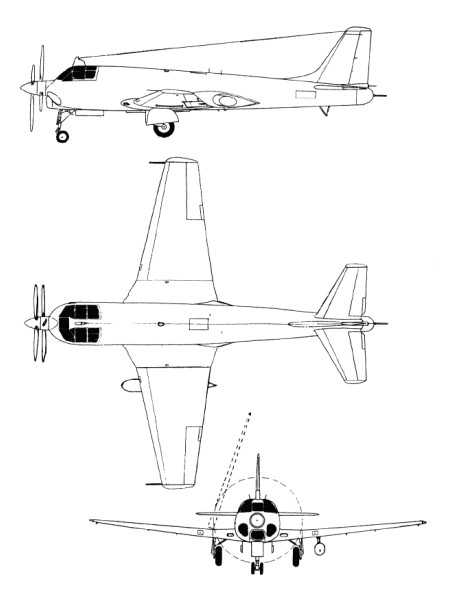
Vladimir Chizhevski was appointed chief designer. His team developed a two-seat low-wing monoplane, with a straight wing and with the engine located in the centre fuselage driving a long propeller shaft, which ran through the middle of the cockpit, and drove, through gears, two contra-rotating three-blade propellers.

Josef Stalin died in March 1953, and the new leaders cut back the VMF expansion plans and thus the requirements for carrier-borne aircraft was cancelled. The naval chiefs, however, still saw a need for a strike aircraft, and Tupolev was asked instead to prepare a land-based aircraft for the role. This time Chizhevski was requested to design a dive bomber for attacking naval surface and submarine vessels; instead of carriers, it had to be capable of operating from runways of limited length.

The Tu-91 required only relatively minor changes to meet the revised needs. The folding wings were now unnecessary and, with the arrestor hook, were removed and were replaced with conventional wings.

The test programme began in autumn 1954 and went well. Both the factory tests and the state tests gave good results, and the aircraft was approved for production. Only the politicians remained to give their approval.
In the summer of 1956, the latest examples of military aviation were unveiled to a group of high level officials, including the new General Secretary of the Communist Party, Nikita Khrushchev. Among all the gleaming examples of power and speed was the straight-winged Tu-91, one of very few propeller aircraft present and looking awkward in comparison with its neighbours. ‘What’s that?’ Khrushchev asked a naval officer attending the aircraft. Confused momentarily by being addressed by Khrushchev, the officer, instead of replying that the aircraft could deliver firepower equal or greater than that of a heavy cruiser, answered that it could do the job of a cruiser. The jovial Khrushchev then asked: ‘So why do we need cruisers?’

The career of the Tu-91 was over. Although Tupolev used all his connections and experience it was impossible to gain support from those under the leader.

Engine: 1 x TV-2M turboprop, 7650hp
Max take-off weight: 14400 kg / 31747 lb
Wingspan: 16.4 m / 54 ft 10 in
Length: 17.7 m / 58 ft 1 in
Height: 5.06 m / 17 ft 7 in
Wing area: 47.48 sq.m / 511.07 sq ft
Max. speed: 800 km/h / 497 mph
Ceiling: 11000 m / 36100 ft
Range: 2350 km / 1460 miles
Crew: 2

Tupolev Tu-91

Tupolev Tu-81 / Tu-14

The work done on the Tu-72, -73, -74, -78 and –79 projects were all stages in the development of Soviet jet bombers. Next step was the Tu-81, which would later enter service with the VMS (Voenno Morskie Sili = Navy) as the Tu-14.

Sergei Yeger was again programme leader, but the Tu-81 went back to the twin-engined Tu-72 rather than stay with the three-engined designs of the Tu-73, -74, -78 and –79. This came about because of Klimov’s improved Nene/RD-45, the VK-1, which offered an increase in power from the 2,270kg static thrust of the Rolls-Royce Nene and the RD-45 to 2,740kg, which, combined with a lower empty weight, allowed the third engine to be omitted.

Work on the design and construction began in July 1944. Tupolev and Yeger aimed to keep the aircraft as light as possible, so an uncomplicated result was achieved. Still showing some considerable resemblances to the Tu-72, the Tu-81 was a mid-winged twin-jet bomber still without wing sweep. It was completed in factory N 156 in 1948, and its first flight was made on 13 October 1949. State tests were completed by autumn 1950, and the aircraft was approved for production under the military designation Tu-14T for a VMS role as a torpedo carrier.

Test results showed the Tu-14T as having a performance of 860km/h, a range of 3,000km, and a service ceiling of 11,200m. Some eighty-seven aircraft were built in Irkutsk between 1950 and 1952, and the first examples entered service in 1951. They were armed with two fixed-fire NK-23 cannons and two machine-guns mounted on a tail turret. It served in a patrol role, with the ability to bomb naval targets.
Entering Soviet service in 1951, the NATO code name ‘Bosun’.

Tupolev Tu-14 (Tu-81)
Crew: 3
Engines: 2 x VK-1, 26.5kN
Max take-off weight: 24000 kg / 52911 lb
Empty weight: 10000 kg / 22046 lb
Wingspan: 21.7 m / 71 ft 2 in
Length: 21.9 m / 72 ft 10 in
Height: 6.0 m / 20 ft 8 in
Wing area: 67.4 sq.m / 725.49 sq ft
Max. speed: 861 km/h / 535 mph
Cruise speed: 800 km/h / 497 mph
Ceiling: 11200 m / 36750 ft
Range w/max.fuel: 4800 km / 2983 miles
Range w/max.payload: 3000 km / 1864 miles
Armament: 4 x 23mm cannons
Bombload: 1000kg

Tupolev Tu-82 / Tu-22

Continuing his development of jet bombers, the next Tupolev aircraft was the light twin-engined Tu-82, which was the first Soviet bomber to feature swept wings.

Sergei Yeger continued as project leader, and he incorporated a wing with a sweep of 35 degrees. The Tu-82 also had the fin swept at an angle of 40 degrees. Engines were two Nene derivative VK-1s of 2,740kg.

The Tu-82 was provisionally given the designation Tu-22 by the VVS. This was not used for long, although there are photographs available to show that it was painted on the aircraft for a while. Later the Tu-22 designation would be used again (and again).

Conceived as a test and development aircraft for the purpose of determining the flight qualities of large swept-wing aircraft, only the single example constructed at the design works was built. Construction began at the end of 1947, and the aircraft was completed at the beginning of 1949. It made its first flight from Zhukovski on 24 March 1949.

Its performance was good. Maximum speed was established to be 934km/h, service ceiling was an excellent 14,000m, and range 2,750km. A relatively small aircraft, the Tu-82 had an empty weight of just 9,526kg, compared to the more than 14,000kg of the three-engine jets of the family. Its normal take-off weight was 13,000kg, but it had little difficulty in performance when this was increased to 18,000kg. A production version of the Tu-82 was planned, the slightly bigger Tu-86, but the programme was cancelled.

Engines: 2 x 2270kg RD-45F turbojets
Max take-off weight: 18340 kg / 40433 lb
Empty weight: 9520 kg / 20988 lb
Wingspan: 17.81 m / 58 ft 5 in
Length: 17.57 m / 58 ft 8 in
Height: 6.2 m / 20 ft 4 in
Wing area: 45.0 sq.m / 484.38 sq ft
Max. speed: 934 km/h / 580 mph at 13,125 ft (4000 m)
Ceiling: 11400 m / 37400 ft
Range: 2395 km / 1488 miles
Bombload: 1000kg
Crew: 3

Tupolev 82 / Tu-22

Tupolev Tu-79 / Tu-89

The Tu-78 and Tu-79 were essentially the Tu-73 but with Soviet licence-built 5952-lb (2700-kg) Rolls-Royce engines. The two Nenes were now called the RD-45, and the Derwent, the RD-500. The prototype was built at factory N 156 with Sergei Yeger in charge. It made its first flight on 17 April 1948 and its state tests were completed by December. It was approved for serial production under the VVS designation Tu-20, but this was not actually carried out because of the shortage of production facilities. The Tu-20 designation would be used again later.
The Tu-79 was a long-range reconnaissance aircraft originally designated Tu-73R. By then, 1949, Klimov had developed the Nene/RD-45 to produce 2,700kg thrust, and the Tu-79 was to have been fitted with two of these VK-1 engines in place of the lower powered RD-45s. The VVS allocated the designation Tu-22 to planned production. Although this one was never actually built, the Tu-22 designation would also be used later.

Tu-79
Engines: 2 x VK-1 turbojets
Max speed: 535 mph (861 km/h) at 16,405 ft (5000 m)

Tupolev Tu-12 / Tu-77

The Tu-12 was the last derivative of the Tu-2, better known as the Tu-77, really as a follow-on of the ANT numbering sequence. The VVS gave it the designation Tu-12. The Tu-12 was the Soviet Union’s first jet bomber. Tupolev intended it as an interim measure to develop later aircraft and to train crews in the handling of larger jet aircraft. Sergei Yeger, working under Tupolev’s supervision, led the programme. He took the basic Tu-2 fuselage, wings and tailplane, and adapted them only for the higher speeds of a jet. It was one of very few jets of the 1940s to feature a twin tail. The undercarriage was changed from a tailwheeler to a tricycle, and under the wings were fitted Rolls-Royce Derwent engines; for several years after the war, the British government allowed engines, and some other aviation components, to be sold to the USSR. Although Soviet designers were hurriedly developing jet engines, by the time of the Tu-12 in 1947 even MiG-15s were using either Rolls-Royce engines or licence-built copies of them. Only Lyulka’s jet engines were of Soviet design and manufacture, and these at that time had hardly half the power of the Nenes fitted on the Tu-12, which gave a static thrust of 2,270kp/5,0041b. The first Tu-12 was built at factory N156, the new title for the former KOSOS TsAGI works attached to the design offices. It was completed in May 1947, and after transfer to Zhukovski and reassembly, Aleksei Pereliot flew it on its first flight on 27 June. There were no major difficulties found in the test programme. For an interim aircraft its performance was reasonable: maximum speed was 783kph/487mph, range was 2,200km/l,367 miles, and its service ceiling was ll,300m/37,075feet. The VVS accepted the prototype Tu-12, and production began at factory N23 in Moscow with an order for five. However, only three were completed. These were completed by 1950, and were used by the Air Force in a training role for a short while. One was used as a flight test aircraft by the LII for experimental work with rocket engines, which were mounted on a pylon above the centre fuselage.

Engine: 2 x Rolls-Royce Nene I turbojets, 5000-lb (2272-kg)
Max take-off weight: 15720 kg / 34657 lb
Empty weight: 8993 kg / 19826 lb
Wingspan: 18.86 m / 62 ft 11 in
Length: 15.75 m / 52 ft 8 in
Height: 4.19 m / 14 ft 9 in
Wing area: 48.8 sq.m / 525.28 sq ft
Max. speed: 783 km/h / 487 mph
Ceiling: 11360 m / 37250 ft
Range: 2200 km / 1367 miles
Crew: 4

Tupolev 77 / Tu-12

Tupolev Tu-75

Next in the extended B-29/Tu-4 family was a military transport, basically a version of the Tu-70. Its design was very similar to its civilian counterpart. Again Dmitri Markov had gone for a low-wing, four-engined transport, with the wings, undercarriage and tailplane virtually identical to those of the B-29/Tu-4; only the wing’s centre section had any major differences in order to fit a low- rather than a mid-wing arrangement. The fuselage was also almost a direct copy of the Tu-70 in length, cockpit and cross-section, but its military purpose resulted in some differences. These included the interior: rather than a luxury passenger cabin, the Tu-75 had a pressurised cargo hold with an underbody loading ramp which swung downwards on hinges to allow ramp access for its planned military cargoes. These could include vehicles such as jeeps or small tracked armoured personnel carriers. General cargo could be loaded or unloaded using a hoist which was mounted in the aircraft beside the loading ramp. Ahead of its time, even aero engines could be carried in the hold. Alternatively, 100 fully equipped paratroops could be carried, and could exit the aircraft while in flight.

Like the Tu-70, powerplants were those of the B-29, but this time Shvetsov’s copy, the ASh-73K, was used, with each engine giving 2,300hp. It was armed with three pairs of machine-guns, one on the upper fuselage, one below and one in the tail.

Work began on the Tu-75 in 1947, and the prototype was built at factory N 156. Its first flight was made on 22 January 1950. Although the aircraft was not put into production, it was another step on the road to the VVS building up its strategic transport and bomber capability.

Tupolev Tu-75

Tupolev Tu-72 / Tu-73

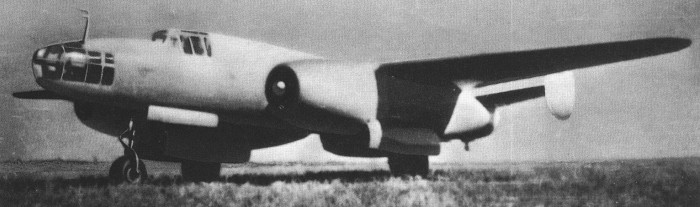
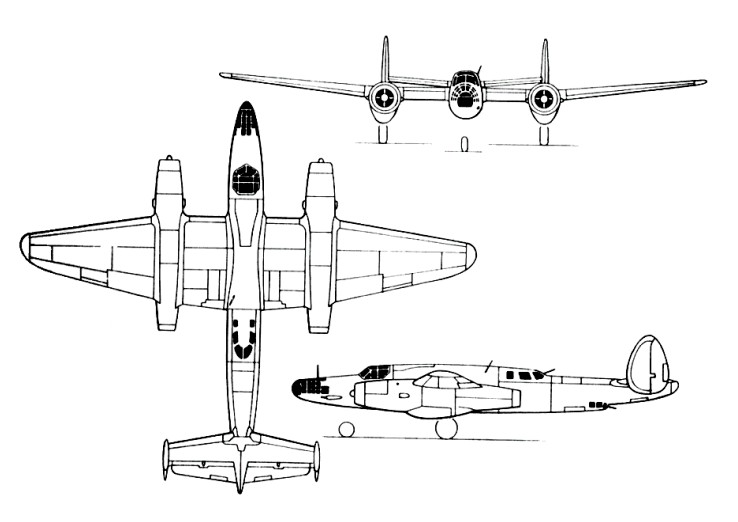
Tu-73

The bureau developed the Tu-72 as a contender for the Soviet air force’s main light bomber requirement, which was ultimately met by the cheaper Il-28. It was to be a mid-winged, twin-engined aircraft without sweep, and the engines were due to be hung under the wings. Rolls-Royce Nenes were the chosen powerplants, but Air Force worries over the adequacy of two engines to power an aircraft of this size and weight led Tupolev to design a similar, but slightly larger aircraft, the Tu-73, with a third engine, this time a 3500-lb / 1600kg Rolls-Royce Derwent, fitted in the tail but with an S-shaped duct air intake noticeable at the front of the fin. While design work of both aircraft continued in parallel, it was the three-engined Tu-73 that was actually built.

Its first flight was made on 29 December 1947. It went well. During state tests, its performance was measured as top speed 870km/h, range 2,800km, and service ceiling 11,500m.

The Tu-74 (or Tu-73R) was a proposed photo-reconnaissance version which was not developed.

The Tu-78 and Tu-79 were essentially the Tu-73 but with Soviet licence-built Rolls-Royce engines.

Tu-73
Engines: 2 x 2270kg Rolls Royce Nene I and 1 x 1589kg Derwent V turbojet
Max take-off weight: 24200 kg / 53352 lb
Empty weight: 14340 kg / 31614 lb
Wingspan: 21.71 m / 71 ft 3 in
Length: 20.32 m / 67 ft 8 in
Wing area: 67.36 sq.m / 725.06 sq ft
Max. speed: 872 km/h / 542 mph
Range: 2810 km / 1746 miles
Armament: 6 x 23mm cannon
Bombload: 3000kg

Tupolev Tu-73

Tupolev Tu-70

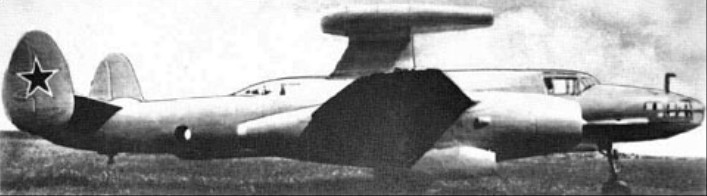
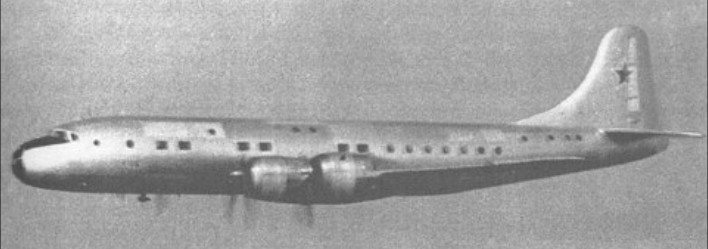
The Tu-70, NATO code name ‘Cart’, was a one-off long range airliner development from the Boeing B-29/Tupolev Tu-4. The prototype, incorporating a B-29 landing gear, tail unit and engines, first flew on 27 November 1946, designed for crew of eight and 48 VIP passengers, but used with crew of six and 72 passengers as staff transport for air force. A new nose with conventional cockpit/flight deck instead of low-drag Superfortress-style nose was built.

Engines: 4 x ASh-73TK, 1770hp
Max take-off weight: 51400 kg / 113318 lb
Empty weight: 38290 kg / 84415 lb
Wingspan: 43.05 m / 141 ft 3 in
Length: 35.61 m / 117 ft 10 in
Height: 9.75 m / 32 ft 0 in
Wing area: 161.7 sq.m / 1740.52 sq ft
Max. speed: 560 km/h / 348 mph
Range: 4900 km / 3045 miles
Crew: 6
Passengers: 48

Tupolev Tu-70