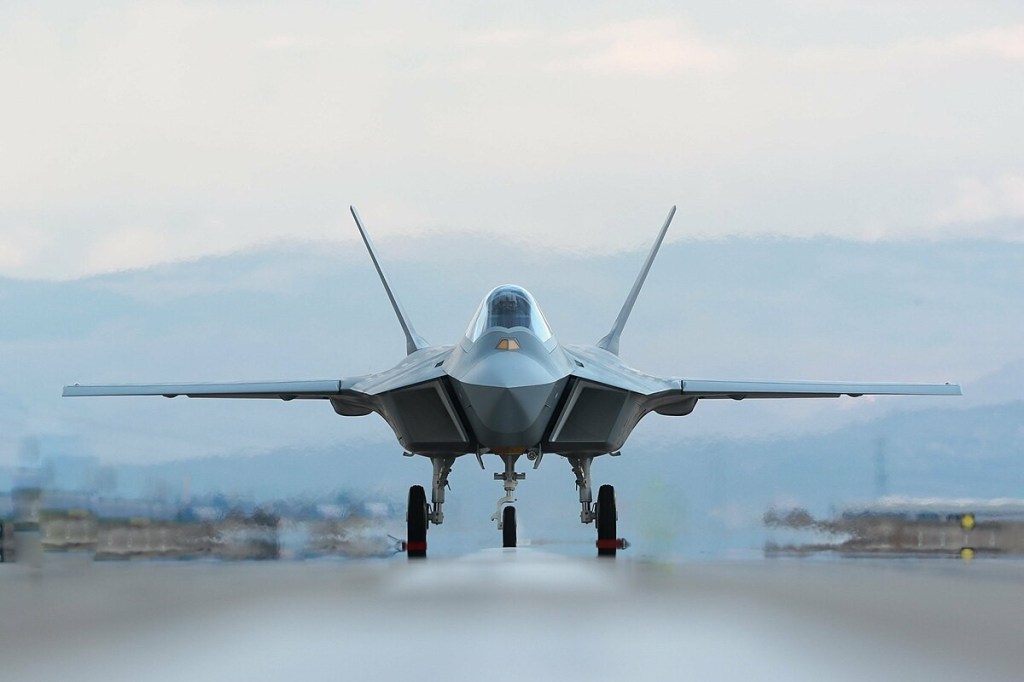
The Kaan program, initiated in 2016 with an investment of $1.18 billion, was designed to replace Türkiye’s aging F-16 fleet. Developed with international collaboration from partners such as BAE Systems and Rolls-Royce, the program prioritizes local production and technology ownership. The aircraft incorporates advanced design features, including supercruise capability and reduced radar cross-section, alongside a suite of indigenous munitions such as the Gökdoğan and Bozdoğan air-to-air missiles. The program emphasizes network-enabled warfare capabilities and interoperability with UAVs and other air force assets.
The Kaan, developed by Turkish Aerospace Industries (TAI), is a fifth-generation twin-engine stealth fighter designed for air superiority and multirole operations. It is equipped with advanced AESA radar capable of detecting targets over 100 kilometers away, internal weapon bays to reduce radar visibility, and a payload capacity of more than 6,000 kilograms. Initial models are powered by General Electric F110 engines, with plans to integrate domestically developed engines in later versions. The Kaan is designed to operate with other platforms in the Turkish Air Force, including the F-35A.
The TAI TF Kaan, a fifth-generation stealth fighter jet, achieved its maiden flight on February 21, 2024, with a second successful flight on May 6, 2024.
Engines: General Electric F110 Wingspan: 14 m Length: 21 m Height: 6 m Speed: Mach 1.8 Operating altitude: 55,000 ft Combat range: of approx 1,100 km
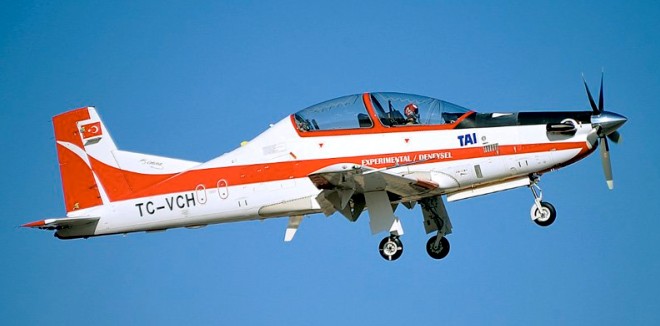
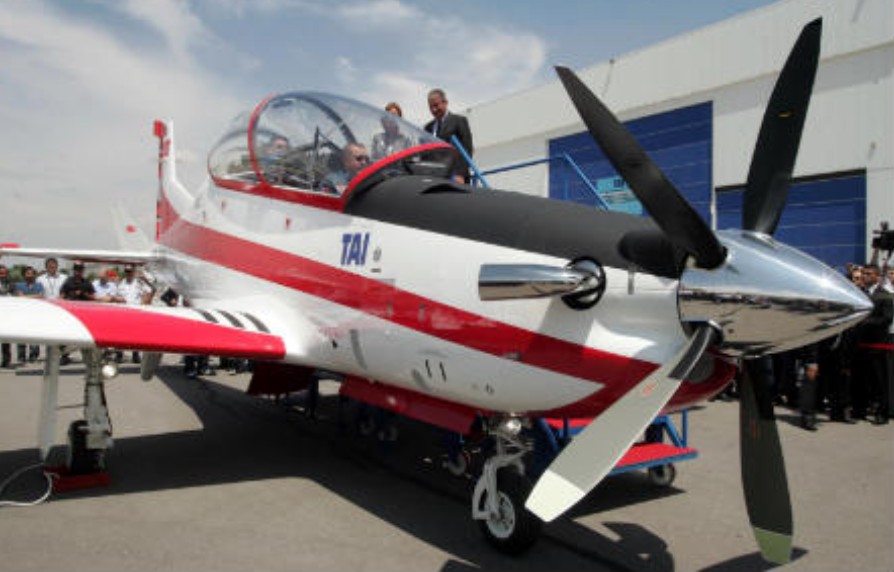
The TAI Hürkuş (Free Bird) is a tandem two-seat, low wing, single engine, turboprop aircraft developed by Turkish Aerospace Industries (TAI) as a new basic trainer and ground attack aircraft for the Turkish Armed Forces.
The aircraft is named after Vecihi Hürkuş, a Turkish aviation pioneer and the first Turkish airplane manufacturer.
The TAI Hürkuş Development Program started with an agreement signed between Turkish Undersecretariat for Defense Industries (Savunma Sanayii Müsteşarlığı (SSM)) and TAI in March 2006. Under the agreement the company was to design, manufacture and complete the civil certification the aircraft to European Aviation Safety Agency CS 23 standards.
HÜRKUŞ Within the framework of the program; two aircraft configurations were to be developed.
HÜRKUŞ-A: Basic version which is to be certified with EASA according to CS-23 requirements. HÜRKUŞ-B: Advanced version with integrated avionics (including HUD, MFDs, and Mission Computer).
By June 2012 the Hürkuş program had consumed one million man-hours with the work of 140 engineers. About a quarter of the Turkish engineers who have worked on Hürkuş are female, as well as two of the three project heads.
The Hürkuş was to be equipped for inverted, day and night flying as well as basic pilot training, instrument flying, navigation training, weapons and formation training. The aircraft has good visibility from both cockpits with a 50 degree down-view angle from the rear cockpit, cabin pressurization (nominal 4.16 psid), Martin-Baker Mk T-16 N 0/0 ejection seats, an on-board oxygen generation system (OBOGS), an Environmental Control System (Vapor Cycle Cooling), an anti-G system, high shock absorbing landing gear for training missions, and Hands On Throttle and Stick (HOTAS). Microtecnica of Turin, Italy was been selected to provide the aircraft’s environmental control system. The Hürkuş has been designed for a 35-year service life with a TAI designed wing airfoil.
The Hürkuş development program has been subject to delays. In 2007 it was forecast that the first prototype would fly in late-2009 with first delivery, upon completion of the certification process, forecast for 2011. On 27 June 2012, the Hürkuş was officially rolled out at a ceremony held at TAI’s Kazan premises. The forecast date for the first flight was then delayed until later in 2012 and actually occurred on 29 August 2013 when the aircraft flew from the Ankara Akıncı Air Base on a 33-minute flight. The first flight was performed with landing gear down and to a height of 9500 ft.
Stability and control checks in different flight configurations have been conducted in the following flight tests. Landing gear up-down tests, cockpit pressurized tests and system functions pre-checks have been performed. The aircraft has reached 12.500 ft height and 158 knots speed currently.
At an SSIK’s meeting, held on Sept. 26, 2013, in order to meet the 15 new-generation trainer aircraft requirement of TurAF, contract negotiations regarding the serial production of HÜRKUŞ was started with TAI. The negotiations regarding HÜRKUŞ-B contract was on the signing.
Two prototypes were built. Entering service in 2015, 15 were built.
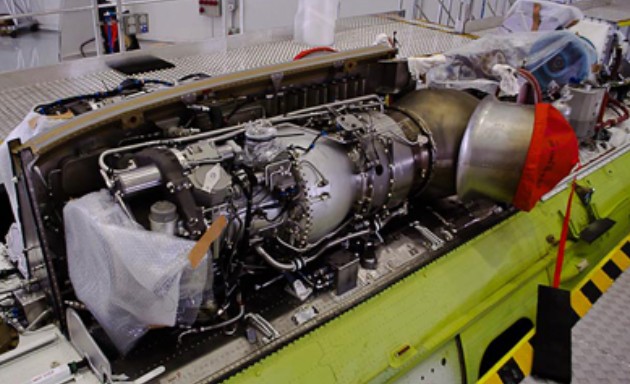
Hürkuş Engine: 1 × Pratt & Whitney Canada PT6A-68T turboprop, 1,200 kW (1,600 shp) Propellers: 5-bladed Hartzell Propeller HC-B5MA-3 Wingspan: 9.96 m (32 ft 8 in) Length: 11.17 m (36 ft 8 in) Height: 3.70 m (12 ft 2 in) Maximum speed: 574 km/h (357 mph; 310 kn) Cruising speed: 463 km/h (288 mph; 250 kn) Stall speed: 143 km/h (89 mph; 77 kn) Range: 1,478 km (918 mi; 798 nmi) at 15000 ft (4572 m) Endurance: 4.25 hours at 15000 ft (4572 m) Service ceiling: 10,577 m (34,701 ft) Rate of climb: 22 m/s (4,300 ft/min) Total Take-Off Distance (@ sea level): 1605 ft (489 m) Total Landing Distance (@ sea level): 1945 ft (593 m) g limits: +7/-3.5 Hardpoints: 4 Seats: 2
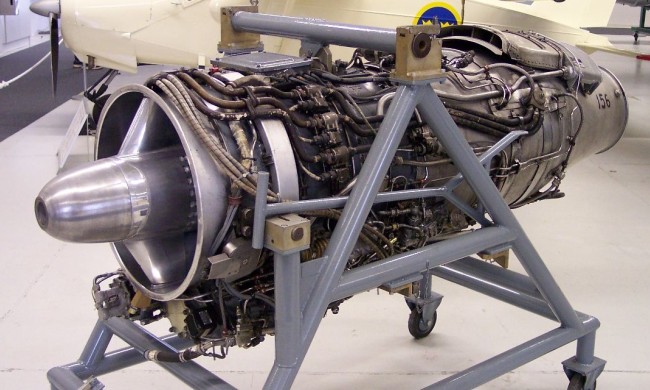
The Turbomeca Gabizo was a small turbojet engine produced by Turbomeca and first run in 1954. The components were designed to take the stresses of high-speed fighter aircraft with some variants featuring afterburner.
Applications: Fouga CM.171 Makalu Dassault Étendard II SNCASO Trident
Specifications: Gabizo Type: Turbojet Length: 86 in (218.4 cm) Diameter: 26.5 in (67.3 cm) Dry weight: 560 lb (254.0 kg) Compressor: Single stage axial plus single-stage centrifugal Combustors: Single annular combustion chamber Turbine: Single-stage Maximum thrust: 2,426 lbf (10.78 kN)(maximum thrust) 1,940 lbf (8.62 kN)(maximum continuous thrust) Overall pressure ratio: 5.1:1 Specific fuel consumption: 1.04 Thrust-to-weight ratio: 4.332 lbf/lb (0.042 kN/kg)
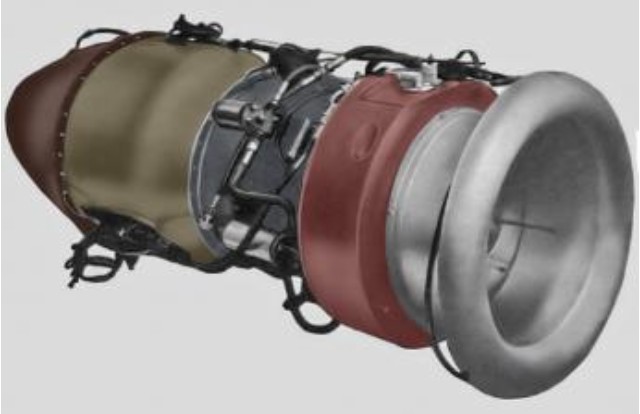
The Turbomeca Aubisque was a small turbofan engine designed and produced by Turbomeca andfirst run in 1961. Its only application was the Saab 105 military trainer aircraft as the RM9.
The engine is named after the Col d’Aubisque in the Pyrenees mountains, in line with company tradition.
The earlier Turbomeca Marboré turbojet was originally intended for the Saab 105, but when Saab needed more thrust than the Marboré produced, Turbomeca offered the Aubisque turbofan. Basically a turbofan version of the Turbomeca Bastan turboprop, the Aubisque went into the production for the Saab 105. About 300 were produced. They were in service for 30 years until replaced in the mid-90’s, by the Williams FJ44 turbofan, for the remaining Swedish Air Force Saab 105s.
Aubisque Type: Low-bypass turbofan Length: 2,067 mm (81.4 in) Diameter: 564 mm (22.2 in) Dry weight: 243 kg (535.7 lb) Compressor: Geared fan stage + single stage axial + single stage centrifugal Combustors: Annular chamber Turbine: Two stage Maximum thrust: 6.9 kN (1,543 lbf) at 32,500 rpm Overall pressure ratio: 6.9:1 Fuel consumption: 420 kg (925.9 lb)/hr Thrust-to-weight ratio: 0.062 kN/kg (2.88 lbf/lb)
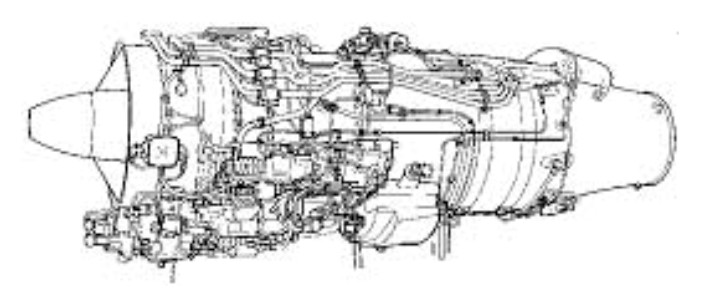
The Turbomeca Aspin was a small French turbofan engine produced by Turbomeca and first run in 1951. This geared turbofan design was the first turbofan to fly, powering the Fouga Gemeaux test-bed aircraft on 2 January 1952.
Fixed inner cone, annular turbine nozzle and outer pipe wherein the jet efflux and by passed secondary air mix. Annular air entry containing one row of variable-incidence entry vanes, a single stage compressor fan and one row of fixed straightening vanes. Fan is driven by compressor shaft through coupling and reduction gear. After fan the air is divided into primary and secondary flows, the former passing to the power section and the latter by-passing that section in an annular casing to the tailpipe where it mixes with the primary jet efflux.
A single-stage centrifugal compressor, with single-sided impeller, and the combustion chamber is annular type, with rotary fuel injection. The turbine is two-stage axial flow turbine, and the jet pipe has a fixed inner cone, annular turbine nozzle and outer pipe wherein the jet efflux and by passed secondary air mix.
Single throttle lever determine the fuel flow and position of variable incidence vanes. Egine speed controled by centrifugal governor. For rapid manoeuvrability a push button operates and electro-hydraulic servo-motor with over-rides manual control and at maximum rotation speed the throttle lever can be used solely to control the entry vanes to obtain rapid variation of thrust without having to oercome the inertia of the rotating assembly.
Throttle at “starter” setting only controls fuel delivery. Entry vanes are closed and engine speed governor is ineffective. Normal starter spins rotating assembly. When engine reaches a rotating speed of 70 per cent. of maximum governor and vane become operative.
Variants: Aspin I 200 kg (440 lb) thrust
Aspin II 350 kg (770 lb) thrust
Specifications: Aspin I Type: Geared turbofan Maximum thrust: 200 kg (441 lb) Diameter: 600 mm / 23.6 in Length: 1210 mm / 47.5 in Weight with accessories: 127 kg / 279 lb Fuel burn: 0.628 kg/kg (0.628 lb/lb) trust/hr
The Turbomeca Artouste is an early French turboshaft engine, first run in 1947. Originally conceived as an auxiliary power unit (APU), it was soon adapted to aircraft propulsion, and found a niche as a powerplant for turboshaft-driven helicopters in the 1950s.
Artoustes were licence-built by Bristol Siddeley in the UK, Hindustan Aeronautics Limited in India, and developed by Continental CAE in the USA as the Continental T51. Power is typically in the 300 kW (400 hp) range.
Continental T51 Licence production and development of the Artouste in the United States
Turbomeca Marcadau A turboprop variant, the Marcadau was a development of the Artouste II, producing 1300 kW (402 hp) through a 2.3:1 reduction gearbox.
Applications: Artouste – Aérospatiale Alouette II Aérospatiale Alouette III Aerospatiale Lama Aerotécnica AC-14 Atlas XH-1 Alpha IAR 316 IAR 317 Handley Page Victor – as APU Hawker Siddeley Trident – as APU Piasecki VZ-8 Airgeep Vickers VC10 – as APU SNCASO Farfadet
Marcadau – Morane-Saulnier Epervier
Specifications: Artouste IIC Type: Turboshaft Length: 1,440 mm (56.7 in) Diameter: 545 mm (21.5 in) – height, 390 mm (15.4 in) – width Dry weight: 115 kg (253.5 lb) – dry Compressor: Single stage centrifugal Combustors: Annular combustion chamber Turbine: Three stage turbine Fuel type: Aviation kerosene to AIR 3405 Oil system: Oil grade AIR 3512, pressure lubrication Maximum power output: 500 hp (372.85 kW) at 34,000 rpm for take-off Fuel consumption: 153 kg (337.3 lb)/hour at maximum continuous power Power-to-weight ratio: 3.24 kW/kg (1.972 hp/lb)
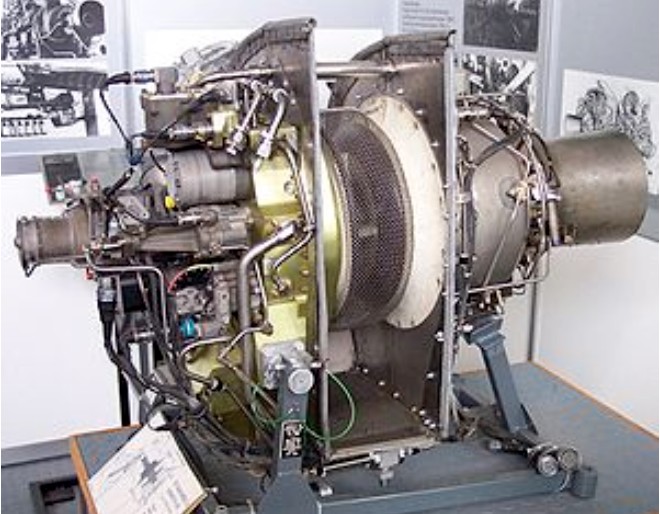
The Turbomeca Arriel is a series of French turboshaft engines that first ran in 1974. Weighing 109 kg (240 lb), the Arriel 1 has a power output of 520 kW (700 hp). 10,000 examples had been produced by 2012.
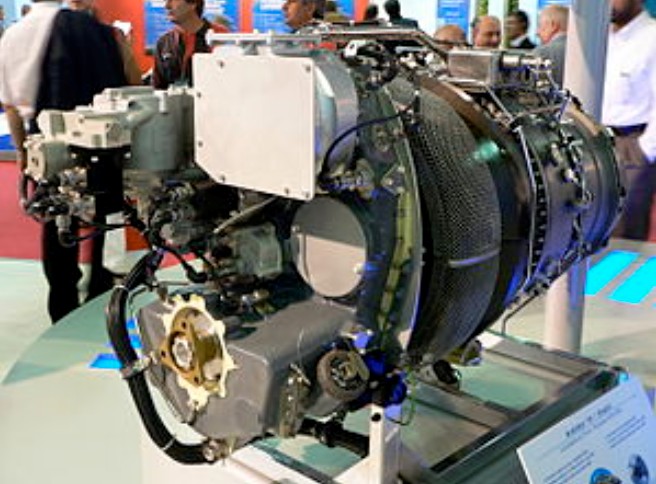
Arriel IB
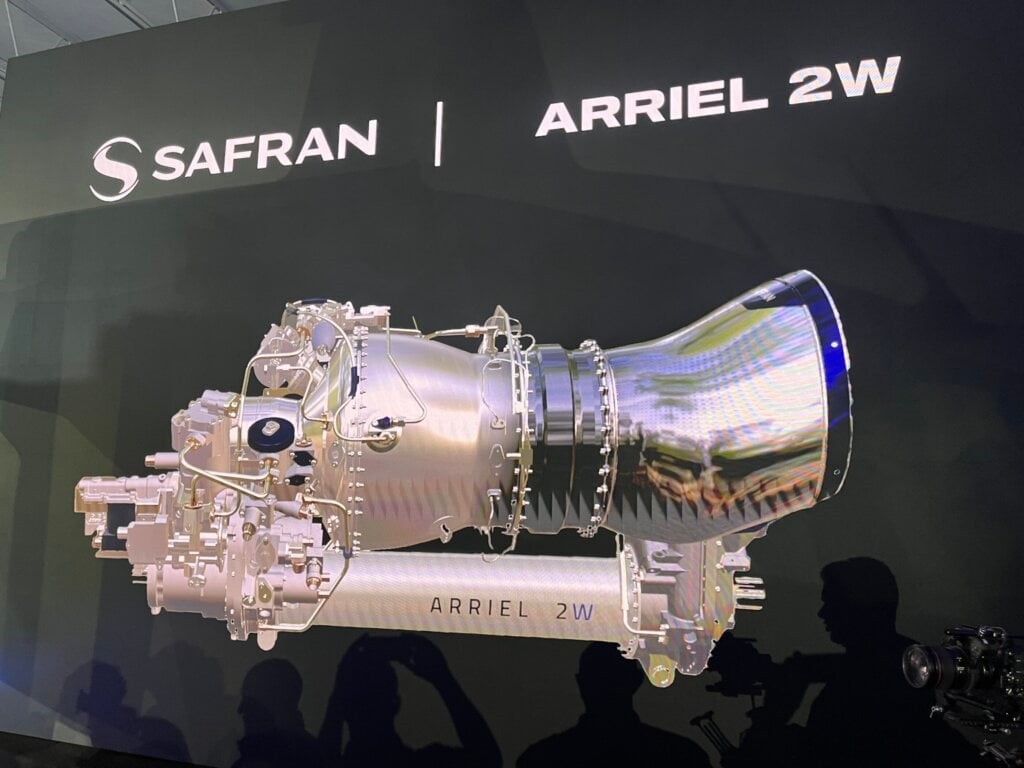
The Robinson R88 is powered by a Safran Arriel 2W engine — marking a first partnership between Robinson and Safran.
The Turbomeca Arrius is one of a family of turboshaft engines for helicopter use, first produced in 1981. As of 2012, some 2,700 units had been sold. Power ranges between 357 kW (479 shp) and 530 kW (716 shp) for different versions. Following Turbomeca tradition, the Arrius was named after a Pyrenean peak (pic d’Arrius), located in the Ossau Valley near Pau.
In 1961, Turbomeca granted a manufacturing license for the Artouste turboshaft engine to equip the Indian Chetak and Cheetah helicopters. The development of the Shakti/Ardiden 1H project was initiated in 1999 by HAL and Turbomeca to power the HAL Dhruv helicopter. However, several factors including the US embargo following India’s 1998 nuclear tests forced the project to run behind schedule. Hence, early models of the Dhruv used the less powerful Turbomeca TM 333-2B2 engine as a contingency. The first test flight of the Dhruv with the new Shakti engine took place on 16 August 2007. By late 2007, HAL started fitting the Shakti engines for Dhruvs produced from then.
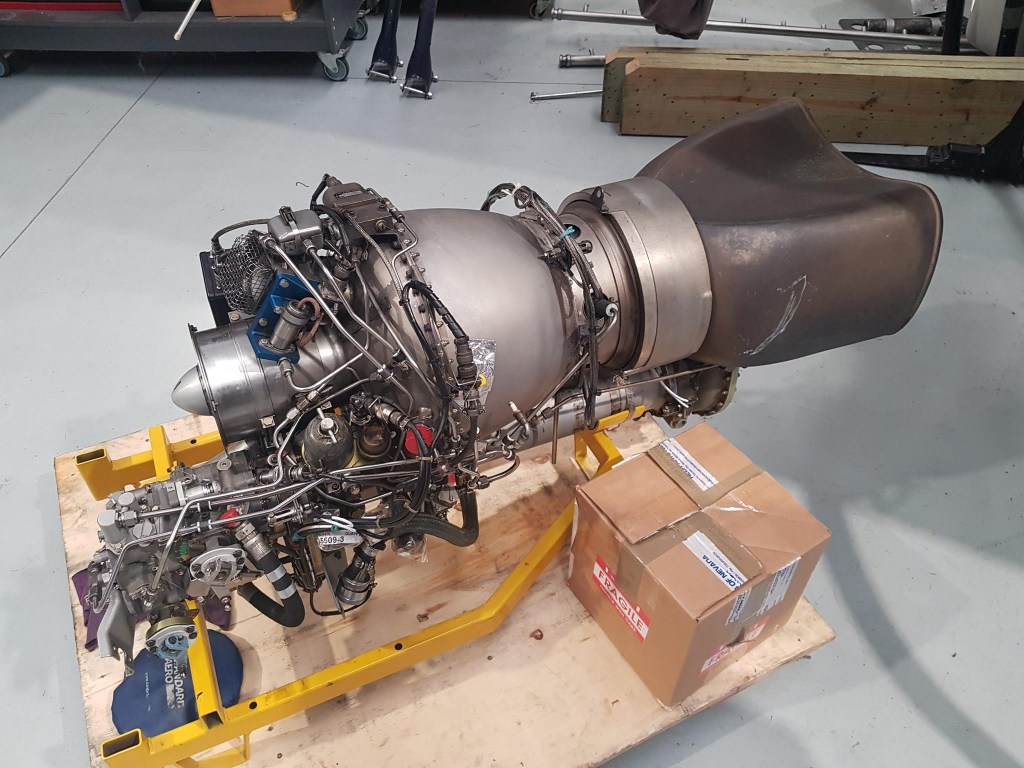
The Ardiden 1H series engines have a radial air intake and a two-stage centrifugal compressor driven by a single stage axial gas generator turbine. Airflow is directed through a reverse flow annular combustion chamber, through the gas generator turbine and then through and a two-stage axial free power turbine. Output power is transmitted to a front-mounted reduction gearbox by a shaft concentrically mounted within the gas generator rotor assembly. The accessory gearbox, also mounted at the front end, is driven by the gas generator. Control is by means of a dual-channel digital engine electronic control unit (DECU).
By December 2013, 280 had been built at a unit cost of US$1.73 million.
Variants: Ardiden 1H Certified by EASA in December 2007.
Ardiden 1H1 (Shakti) Certified by EASA in March 2009. powering the HAL Dhruv, LCH
Ardiden 3G powering the Ka-62, Z15
Applications: HAL Dhruv HAL Light Combat Helicopter Kamov Ka-62 – Ardiden 3G
Specifications: Type: Turboshaft Length: 1,250 mm (49 in) Diameter: Dry weight: 205 kg (452 lb) Compressor: Two centrifugal compressor stages, coupled to a single-stage high-pressure turbine. Maximum power output: 1,032 kW (1384 shp)