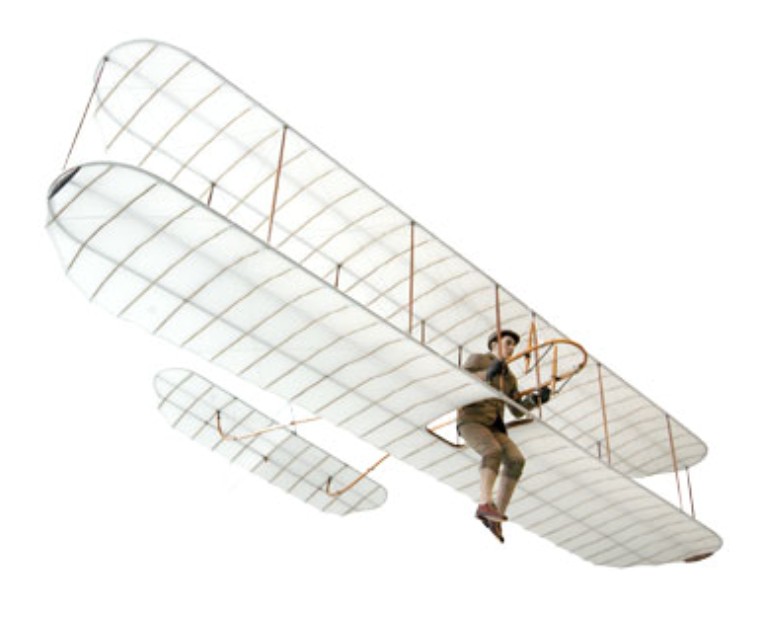
In 1910 TWK Clarke and Co., a Kingston-on-Thames manufacturer of aircraft, accessories and flying models, produced a range of four biplane gliders. This machine, based on a configuration evolved by the American pioneer Octave Chanute, was the third largest of the range and resembled the Wright brothers’ aircraft in general construction. It could be bought as a kit for 10 guineas (£10.50) or completely assembled and covered for £34. The machine was flown as a hang-glider with the pilot resting his armpits on the padded cushions, while the two control levers, connected in unison, operated the rudder when moved from side to side and the one-piece elevator when moved backwards or forwards. Banking in turns was achieved by the pilot swinging his body and legs towards the inside of the anticipated turn.
Gliding and hang-gliding are now popular leisure pastimes, but at the time T.W.K. Clarke built this glider, powered and controlled flight had yet take place. Gliders were used by many pioneers to perfect their skill at flying and also the machines they were building.
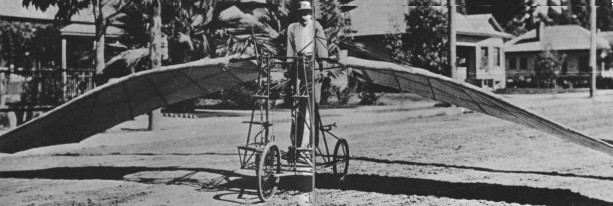
American Harry LaVerne Twining built himself a man powered ornithopter, likely with the assistance of Warren Samuel Eaton. Completed around the summer of 1909 and first appearing in the October 1909 issue of Aeronautics it was tested late in 1909.
It consisted of a tricycle to which articulated 8.2 m (27 ft) wings, operated by foot stirrups, were attached. The Los Angeles Daily Times dubbed it ‘Twining’s Flip Flop’ and assured worried readers that Twining did not intend to rise far from the ground at first, which was just as well because the flip flop was a complete flop, flapping furiously along a Los Angeles street but barely rising an inch.
As President of the Aero Club of California, Twining entered his second ornithopter into the 1910 Los Angeles International Air Meet at Dominguez Field.
The 1930 20th Century Sky King, also noted as Sport, was a two-place tandem, high-wing monoplane described as having a monocoque construction fuselage and roughly triangular in cross-section, the vertex being toward the ground.
1929: 20th Century Aircraft Corp (pres; Fred Arnoldi) Ravena NY. USA
The company was set up by the Ravena Board of Trade in mid-Sep 1929 and Fred Arnoldi, who left Curtiss Co, appointed to head it. Intention was to build three types to be known as “Sky Kings”. The first was shipped to NYC for display at the American Legion Aviation Show in Feb 1930, a second ship was partially completed and a third started. Then a brief article in a local newspaper on 1/2/31 reported that the factory closed and moved to Amsterdam.
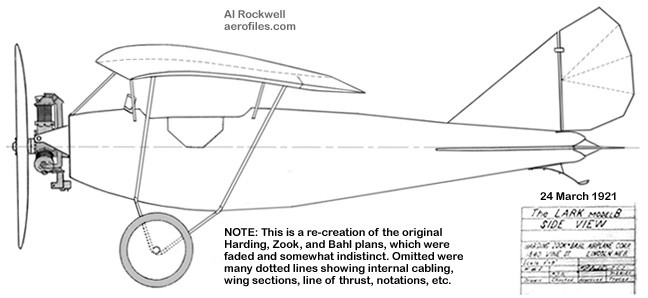
This Lark was built in 1921 by the Harding, Zook, & Bahl Airplane Co of Lincoln, Nebraska. The original design having been worked out by E.G. Bahl. It featured a layered wood-strip monocoque fuselage with only four bulkheads.
A Frankensteinian creation (NC5003?) reportedly from pieces of two Curtiss JN-4s, a Thomas-Morse S4C, and other wrecks, won an efficiency trophy at the 1921 Omaha Air Races. Sold in 1922 and moved to Richards Field, Kansas City, where it was badly damaged in a landing accident.
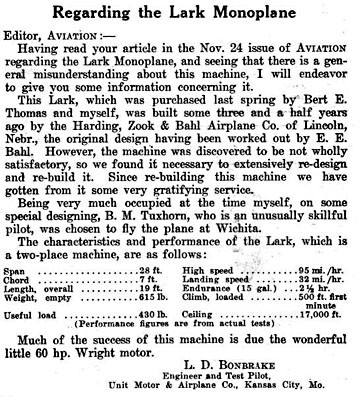
The Lark was purchased in the spring of 1924 by Bert E. Thomas and L.DeweyBonbrake, to what extent is uncertain.
The machine was re-designed and rebuilt by Thomas and Bonbrake, with a Wright 60 hp engine, to improve flight characteristics. B.M, Tuxhorn was chosen to fly the plane at Wichita.
Purchased by Blaine Tuxhorn in 1924, redesigned by L D Bonbrake and rebuilt with 60hp Wright-Gale L-4, and reregistered as Tuxhorn Lark, again in 1929 as Bonbrake Parasol.
It became the Bonbrake Parasol in 1928, said to not have flown very well in its original form, but the basic design evolved into the Inland Sport.
Recent documentation found by John M Jarratt puts this Lark back at square one, and we start over. The airplane appearing as [NC5003] is a far cry from the one pictured in the 1/8/22 Denver Post, and its lengthy article about the Harding, Zook & Bahl operation indicate much of the data above describes another plane (that “wood-strip monocoque fuselage” certainly does not fit the picture), but which one is yet to be solved.
Specs mentioned in the news item: 65hp 2-cylinder Rockwell (Hugh M Rockwell—SEE Rockwell Corp entry); load: 607# v: 90/x/25; $2,500 planned market price. Empty wt: 650#. The article also mentions prior production at Lincoln, and that a "considerable number had been sold in the US, Canada, and Mexico" and they will "turn out 100 Lark monoplanes within a year." (2/28/02)
Trying to sort out this mess, we proceed another step further (or is it backwards?). From research by John M Jarratt and Vincent J Berinati, it seems that prototypical Bahl Lark was parts of the fuselage of surplus Standard J-1 [NC2119] mated with the wing of a Thomas-Morse something. Later on its meandering path it was reregistered as [NC1940], which shows in regs as a Standard J-1 because of its fuselage’s original c/n, but might have been Tuxhorn Lark at the time. (3/14/02)
Abstracts from NASM show that this ship had nothing to do with Bahl, Bonebrake, or Tuxhorn, but was a Nicholas-Beazley Standard J-1 remodeled with a monoplane wing and new tail by Joseph C Freeze, Kansas City KS. (— John M Jarratt 7/18/02)
The 1925 Tuxhorn Air Liner was an open cockpit and cabin biplane powered by a 400hp Liberty 12 engine. The Air Liner featured an oversized, steerable tailwheel, and the pilot and one passenger in an open cockpit behind cabin.
The one built was used as a carrier between Omaha NB and Little Rock AR.
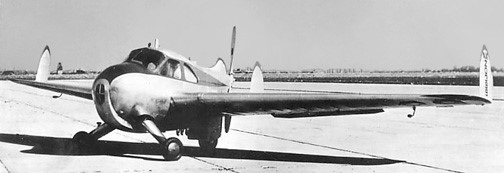
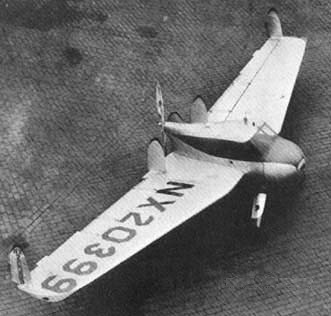
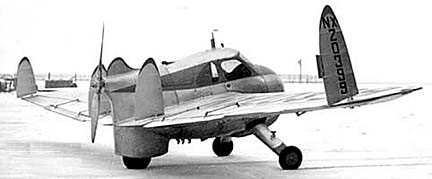
Designed by Thomas Hoff the H-70 two-place derivative of the Stearman-Hammond Y was a tailless (except for wingtip rudders), flying-wing with rudders mounted at the trailing edge and trailing-edge flap-type controllers, was originally built by Management & Research under a DoC program contract for lightplane development. Registered NX20399 and powered by a 95hp Menasco B-4 pusher engine, the one built did fly, although difficult to turn, but crashed in testing on 27 January 1938.
Tuscar H-71 NX20399
It was rebuilt by Tuscar as the H-71 and flown at Floyd Bennett Field for about 60 hours before crashing to finality in August 1945.