XT 24 Paraglider circa 1998. Wing area: 25.6 sq.m Certification: DHV 2 Pilot weight: 60-85 kg No. of cells: 53 Wing span: 11.2 m Aspect ratio: 5 Min sink: 1.1 m/s Max speed: 51 kph Price (1998) 40900 OS
XT 26 Paraglider circa 1998. Wing area: 26.9 sq.m Certification: DHV 2 GH Pilot weight: 80-105 kg No. of cells: 53 Wing span: 11.8 m Aspect ratio: 5 Min sink: 1.1 m/s Max speed: 51 kph Price (1998) 41900 OS
XT 28 Paraglider circa 1998. Wing area: 28.2 sq.m Certification: DHV 2 GH Pilot weight: 100-120 kg No. of cells: 53 Wing span: 12.5 m Aspect ratio: 5 Min sink: 1.1 m/s Max speed: 51 kph Price (1998) 42900 OS
Level 60 Paraglider circa 1998. Wing area: 25.5 sq.m Certification: DHV 1-2 Pilot weight: 64-90 kg No. of cells: 37 Wing span: 10.9 m Aspect ratio: 4.7 Min sink: 1.3 m/s Max speed: 45 kph Price (1998) 31900 OS
Level 80 Paraglider circa 1998. Wing area: 27.6 sq.m Certification: DHV 1-2 Pilot weight: 85-110 kg No. of cells: 39 Wing span: 11.7 m Aspect ratio: 4.9 Min sink: 1.3 m/s Max speed: 45 kph Price (1998) 32900 OS
Crazy 26 Paraglider circa 1998. Wing area: 25.4 sq.m Pilot weight: 65-90 kg No. of cells: 100 Wing span: 12.8 m Aspect ratio: 6.5 Min sink: 1 m/s Max speed: 59 kph Price (1998) 59900 OS
Crazy 30 Paraglider circa 1998. Wing area: 30.1 sq.m Pilot weight: 90-115 kg No. of cells: 100 Wing span: 13.7 m Aspect ratio: 6.5 Min sink: 1 m/s Max speed: 59 kph Price (1998) 59900 OS
Basic L Paraglider circa 1998. Wing area: 28.3 sq.m Pilot weight: 75-100 kg No. of cells: 72 Wing span: 12 m Aspect ratio: 4.8 Min sink: 1.2 m/s Max speed: 49 kph Price (1998) 38600 OS
Basic M Paraglider circa 1998. Wing area: 26.9 sq.m Pilot weight: 65-85 kg No. of cells: 72 Wing span: 11.4 m Aspect ratio: 4.8 Min sink: 1.2 m/s Max speed: 49 kph Price (1998) 38600 OS
Basic XL Paraglider circa 1998. Wing area: 31.42 sq.m Pilot weight: 95-130 kg No. of cells: 72 Wing span: 12.6 m Aspect ratio: 4.8 Min sink: 1.2 m/s Max speed: 49 kph Price (1998) 38600 OS
After losing a court action concerning constructor liability, Comet Unique went into liquidation and reappeared as Unique Paragliders (1998). Not the first time Ernst Steeger’s company has changed its name.
The Union Pfeil-Doppeldecker was designed by Josef Sablatnig and/or Walter Höhndorf, and/or Karl Bomhard, characterized by the swept-back wings with unusual upturned lower wing tips, and built in Berlin-Teltow. It won four prizes at the Wiener International Flag-Meeting 1913, fitted with a 120 hp Austro-Daimler engine. Previous and later versions with other engines were successful in several meetings and set altitude records.
The 1931 Union Aircraft Co Rotorplane was designed by Isaac C Popper with four conical rotors in an open frame replaced the wings and were driven by two additional 28hp Indian (motorcycle) engines. An experiment based on the Magnus Effect to create lift.
Power was by a 90hp ACE (Cirrus).
The two-place aircraft was registered NX772N c/n M-1 and although the designer claimed it had double the lifting power of conventional wings and could land a half the speed, there is no record of actual flight.
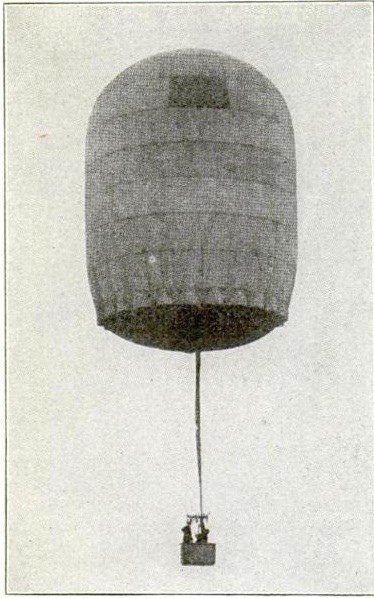
A 1902 design by Captain Eric Unge, patented in the UK. The body of the balloon consisted of plane, cylindrical and conical surfaces, made by long and wide pieces of cloth, so that the lengths of the joints and the corresponding leakage was reduced about 75 per cent. The other inventive features included an outer envelope that would reduce the heating of the gas by the sun. The balloon’s envelope, in an emergency, could also function as a parachute. And indeed it did, when the gas exploded during its second flight (the first being a 24-hour flight from Sweden far into Russia) and Unge and his passenger were unhurt in the following crash.
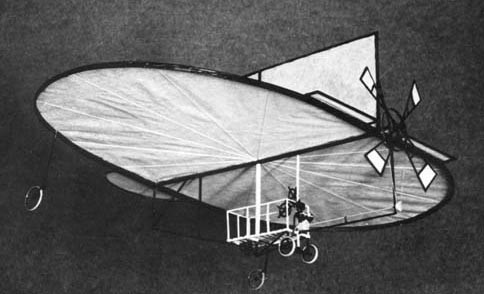
Elmer, George and John Underwood of Stettler, Alberta set to work inventing a flying of their own. The result was a craft with elliptically shaped wings. The Flying Wing was composed of long strips of fir and wire that were covered with cloth. Above the wing was a large fin, with a rudder at the back and an elevator attached to the tail. Under the large wing was a platform where the pilot sat. Motorcycle wheels were placed under the platform and bicycle wheels placed on each wing to hold it steady for take-offs and landings.
The platform also contained a place to house the motorcycle motor once they were able to afford one. In the meantime, the Underwoods displayed their creation at Stettler’s exhibition in July 1907, and tested the machine on their farm.
Tying the aircraft to a fencepost, the brothers placed sacks of wheat on the platform to replicate the weight of a pilot, and launched the plane like a kite. The test went well, and for the next trial, John took the place of the wheat to “fly” the machine for 15 minutes. Their enterprise was then put away until the next year, when the Underwoods finally obtained their motorcycle engine.
Attached to the front of the wing was a large bamboo and canvas propeller, powered by the motorcycle motor. Unfortunately, the brothers found that the engine was too small to get the craft airborne, so they hitched the plane to the fence post once again, using it like a kite, until the Flying Wing was destroyed one day by high winds. Their effort was eventually abandoned, since they lacked the resources to continue.