Unruh-Albright Special II

The Unruh-Albright Special II construction was begun in 1937 by Marion Unruh, but it was not until after he had retired from USAF in 1959 that it was finished, in 1966. Registered N8635E, the open cockpit biplane first flew on 27 June 1966.

Engine: 75hp Continental A-75
Wingspan (upper): 15’0″ (lower): 13’0″
Length: 15’5″
Useful load: 300 lb
Max speed: 150 mph
Cruise speed: 120 mph
Stall: 70 mph
Seats: 1

University of Louvain la Neuve Two Seat hang glider

The club of the University of Louvain la Neuve (Belgium), wanted to make a two-seater hang-glider in 1979. They became interested in the Flexiform Skyline which had a non-profiled sail, which greatly facilitated the sewing work.

Based on photos, they extrapolated their two-seater to scale to be 23sq.m, with a wingspan of 13m. It was desided to truncate the tips of wings at 11m.

To avoid the pilot weight + passenger weight risk of distorting the leading edges, they put triple deflectors.
With triple deflectors and no need to use big tubes, 44×1,25mm resulted in 28kgs weight.

A keel pocket in two parts was sewn in, including 30cms in front of the mast.

For maneuverability it has a trapezoid with a control bar of 1.80 m.

To build a wing that will allow to do all the centering tests without redoing them cables the idea was to use a trapezoidal top in the form of a rail to change the centering between two tests over a length of 30cms, and attach the cables with cable ties, which will only be crimped ‘Once the flight tests are completed!

It flew several hundred hours with several pilots without problems or accidents. It was even ranked 1st in a two-seater competition at the Icare Cup.
University of Toronto UTAIS Ornithopter No.1

The UTAIS Ornithopter No.1, which “flew” in 2006 was designed by the University of Toronto. The light No.1 used a small motor to power its flapping wings. Realizing that a motor wasn’t enough to flap it off the ground, the designers also fitted the airplane with a jet engine booster to launch it into the air. The University claimed that most of the thrust was coming from the wings.

When the No.1 did its first test flight, it jumped off the runway for 14 seconds after the jet booster activated, traveled awkwardly for a third of a kilometer, nosed down, and crashed. The University claimed the test was a success.

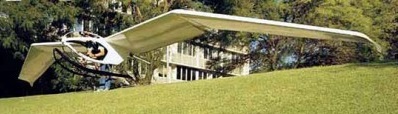
University Of Pretoria Exulans

Designed by three engineers from the University of Pretoria, Exulan I is inspired by the shape of albatrosses and pteranodons.

The 1989 Exulans (named after the scientific name for albatros) used some wingtip pivot shift for pitch control, in combination with elevons to overcome the inherent inefficiency of elevons for pitch alone. It was tested successfuly but no commercial version was released.

Designer Joachim Huyssens and his team were working on a second prototype since 2004.

Wing area: 12 m²
Wing span: 12 m
Length: 3 m
Minimum pilot weight: 65 kg
Maximum pilot weight: 150 kg
Minimum speed: 150 km/h
Maximum speed: 40 km/h