Velocity Aircraft

Velocity Aircraft Inc., was formed in 1984 by Danny Maher in Sebastian, Florida, to develop and market a new 4-seat canard aircraft, based upon the successful Long-EZ design. After the prototype flew in July 1985, several kits were sold and close contact was maintained with initial builders to get valuable feedback in areas where the design could be (and subsequently was) improved. The Velocity received rave reviews by all of the flying press, and the 173 “LW” (long wing) model went on to further enhance the Velocity design.

1988:
Velocity Aircraft
200 W. Airport Dr
Sebastian
Florida 32958
USA
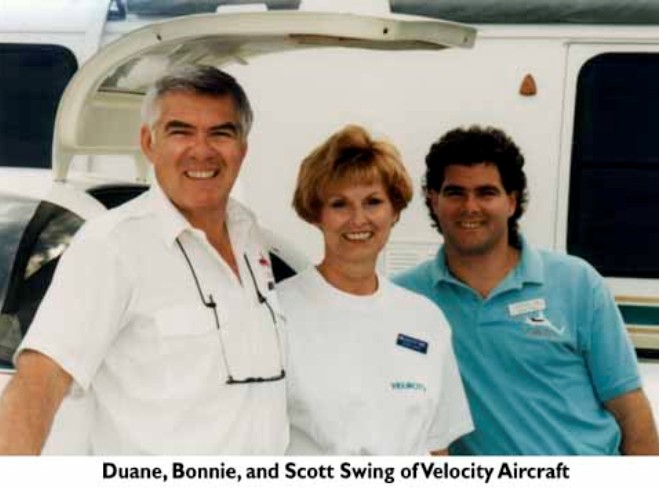
One of Danny Maher’s first kits was purchased by Duane Swing and his son Scott Swing, of Dayton, Ohio. After building their first Velocity, the Swings decided to make a retractable gear option available for the kit. In doing so, the Swings had developed a close relationship with Dan Maher. Thus, when Dan decided to sell the business, he first called the Swings. The Swings liked the proven and stable Velocity design so much that they bought the company assets from Dan in 1992 and moved their families to Sebastian.
The Swings immediately established a marketing program to promote the original standard Velocity, while taking the business much further. New avenues were explored to enhance the existing Velocity designs, ranging from the addition of pre-molded kit parts to the gull-wing door, introduced in 1995.
1996-8: 200 W. Airport Dr, Sebastian, FL 32958, USA.
In 2008 Velocity Aircraft announced it had been purchased and would become a subsidiary of the Rocket Racing Group. Duane Swing simply wanted to retire.

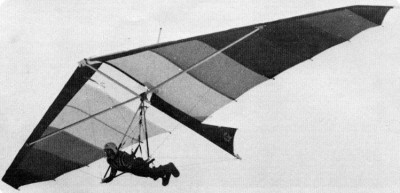
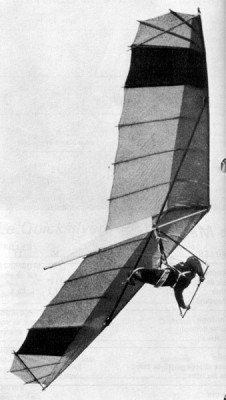
Veliplane-Sofrec Strato

A 1978 hang glider regarded as difficult to fly, but it was an incredible construction for the time, sail stretched like a drum, slats shaped, and twisting at the wing tip.

Strato 17
Wing area: 16.3 m²
Wing span: 9.2 m
Aspect ratio: 5.19
Minimum pilot weight: 55 kg
Maximum pilot weight: 75 kg
Packed length: 4.88 m
Number of battens: 8
Nose angle: 123°

Strato 18
Wing area: 17.3 m²
Wing span: 9.2 m
Aspect ratio: 4.89
Minimum pilot weight: 70 kg
Maximum pilot weight: 90 kg
Packed length: 4.88 m
Number of battens: 8
Nose angle: 123°

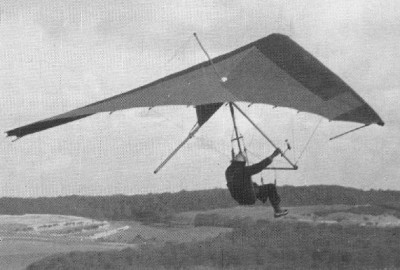
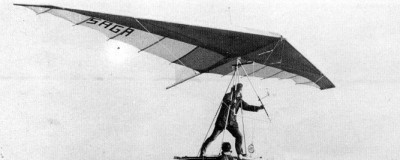
Veliplane-Sofrec Starga

A 1979 hang glider for advanced pilots.

Starga 150
Wing area: 15 m²
Wing span: 9.14 m
Aspect ratio: 5.5
Hang glider weight: 22 kg
Maximum pilot weight: 65 kg
Packed length: 4.85 m
Number of battens: 12
Nose angle: 140°

Starga 165
Wing area: 16.5 m²
Wing span: 9.4 m
Aspect ratio: 6.5
Hang glider weight: 26 kg
Maximum pilot weight: 80 kg
Packed length: 4.85 m
Number of battens: 12
Nose angle: 140°

Starga 175
Wing area: 17.5 m²
Wing span: 10.40 m
Aspect ratio: 6.2
Hang glider weight: 26 kg
Maximum pilot weight: 100 kg
Packed length: 4.85 m
Number of battens: 12
Nose angle: 140°

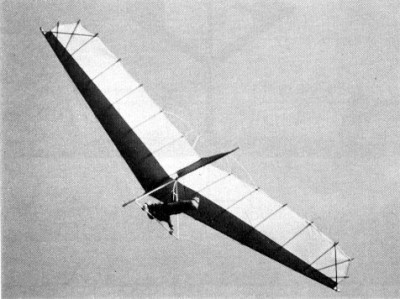
Veliplane-Sofrec Spad

A 1980 hang glider with a 140 ° angle, shaped slats, double sail at 30%, a floating transverse and a sliding umbrella, the speed range is not very large. The finish is good, the assembly is fast although the umbrella sometimes tends to get stuck on the keel. For safety, Véliplane provided 4 booster cords.

The sail was later manufactured by EOLE2000 in its Salins-Les-Bains facility.

A Swordfish, version of the Spad without transverse, was abandoned.

Spad 140
Wing area: 17.6 m²
Wing span: 10.5 m
Aspect ratio: 6.3
Hang glider weight: 27 kg
Minimum pilot weight: 65 kg
Maximum pilot weight: 90 kg
Packed length: 5.6 m
Nose angle: 127°

Velie

1902: (Willard L) Velie Carriage Co.

1908: Velie Motor Co.

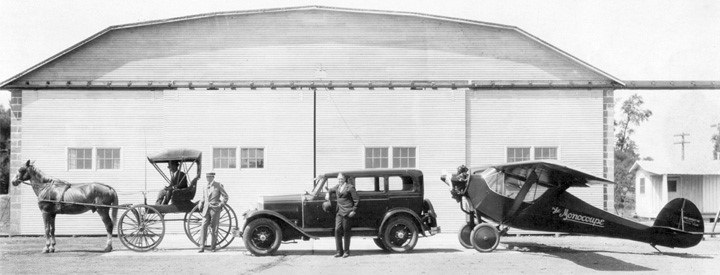
More known for his carriages, automobiles and racers, and motors, Velie (grandson of John Deere) also capitalized and manufactured the initial 55-65hp Monocoupe aircraft upon acquisition of controlling interest in Central States Aircraft Co in 1927, hence early popular reference to “Velie Monocoupes” signifying not only the powerplant but the constructor.

Velie product lineup

When Velie died of an embolism in Oct 1928, his son took the reins but he, too, suffered a heart attack in Mar 1929 and Don Luscombe took over.

1928: Mono-Aircraft Corp (pres: W L Velie),
1616 McGee St,
Moline IL.
USA

Velazco Escofet I

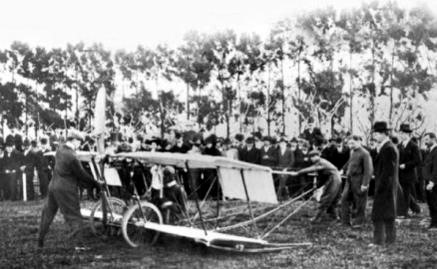
The machine was designed and built by the four (!) brothers Escofet and Enrique Martinez Velazco together with the Frenchman Henri de Rosiers. It was built as a glider then fitted with an Anzani engine but flight could not be achieved. Parts of the Escofet I were used in the second model. The Escofet II was momentous as it was the first machine in Uruguay to have actually flown on August 26, 1910. This first flight was also the last for the machine as on landing after about 200 meter it crashed severely, wounding the pilot.

Parts of the Escofet I were used in the second model.