In 1935, to meet Air Ministry Specification F5/34, calling for a single seat monoplane interceptor armed with six or eight machine guns, a retractable undercarriage was required and an enclosed cockpit; a speed of at least 275mph (442kph) at 15,000ft (4,572m) was stipulated. This requirement was taken up by a number of firms. Bristol produced the Type 146 (835hp/622kW Bristol Perseus). Vickers brought their Jockey Mk II into approximate line with the requirements as the Venom (625hp/466kW Bristol Aquila). Henry Folland produced his last design for Gloster, the G.38 (840hp/626kW Bristol Mercury IX). James Martin also looked at F5/34 and surprisingly found it to his taste. None of the aircraft built to this specification achieved production status.
Fundamentally a redesigned and improved Type 151 Jockey and, indeed, initially known as the Jockey II, the Type 279, for which Vickers adopted the name Venom, was intended to meet the requirements of Specification F.5/34. Powered by a 625hp Bristol Aquila AE.3S nine-cylinder sleeve-valve radial engine enclosed by a long-chord NACA cowling, the Venom was a highly sophisticated aircraft, with a metal monocoque fuselage, its stressed skin being affixed by countersunk rivets. It was unique at the time it entered flight test, on 17 June 1936, in having 90°-deflection flaps. The Venom retained the sideways-hinging engine feature of the Type 151, and a battery of eight 7.7mm machine guns was mounted in the wings from the start of test flying. The Venom proved exceptionally manoeuvrable, with outstanding roll rate and turning radius, but it lacked the power to compete seriously with its Rolls-Royce liquid-cooled Vee-type-engined contemporaries, and, as no sufficiently compact British air-cooled radial of adequate power was available for installation, it was scrapped in 1939.
Engine: Bristol Aquila, 625hp/466kW Max take-off weight: 1885 kg / 4156 lb Wingspan: 9.98 m / 33 ft 9 in Length: 7.36 m / 24 ft 2 in Height: 3.27 m / 11 ft 9 in Wing area: 13.56 sq.m / 145.96 sq ft Max. speed: 502 km/h / 312 mph Ceiling: 9755 m / 32000 ft
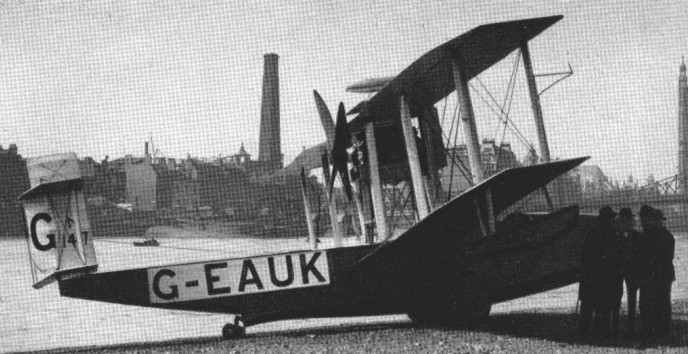
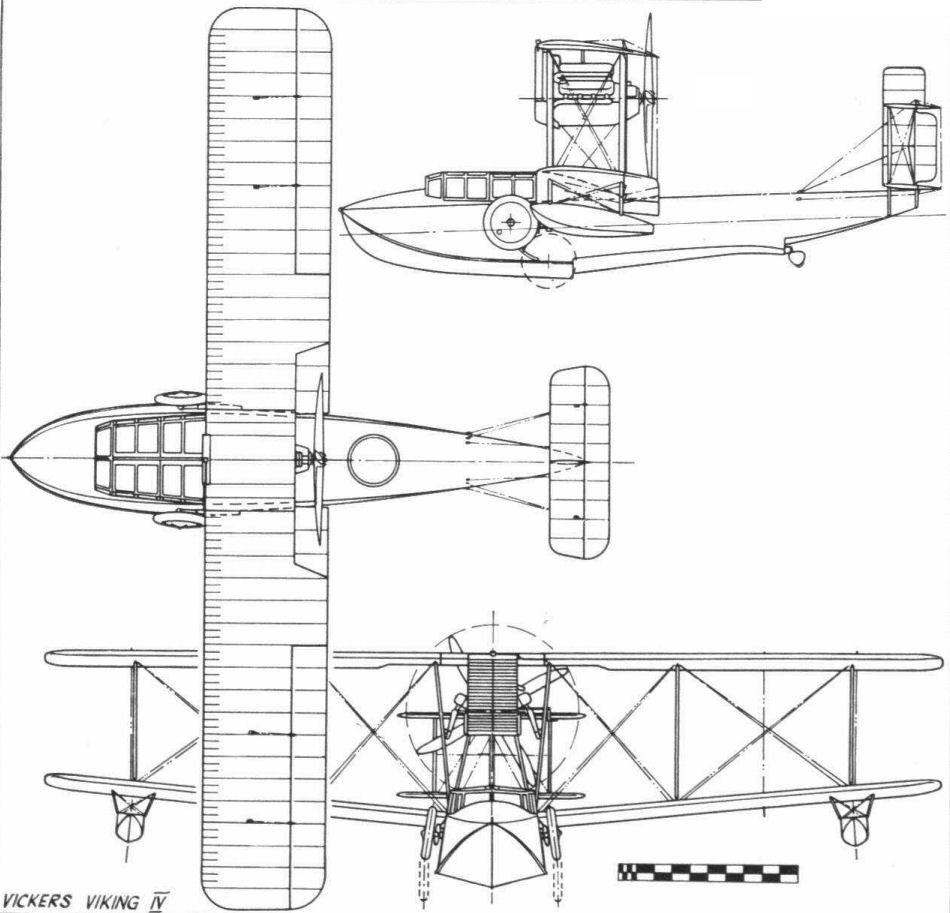
Direct London to Paris flights were pioneered in 1921 by a Vickers Viking III.
1921 Vickers Viking III flew from the Seine, near the centre of Paris, to the Thames, near the Houses of Parliament, in two hours with Major-General Sir Frederick Skyes, Controller General of Civil Aviation.
Air Ministry Specification G.4/31 called for a General Purpose aircraft, capable of level bombing, army co-operation, dive bombing, reconnaissance, casualty evacuation and torpedo bombing. The Vickers Type 253 won against the Fairey G.4/31, Westland PV-7, Handley Page HP.47, Armstrong Whitworth AW.19, Blackburn B-7, Hawker PV-4 and the Parnell G.4/31.
Designed by Rex Pierson, the Type 253 was the first aircraft built which partly used the Barnes Wallis geodetic design in the fuselage. Despite an order for 150, Vickers offered their private venture monoplane design the Type 246. This used the same geodetic design principles for both the fuselage and the wings, and first flew on 19 June 1935. It had superior performance to the 246 but did not attempt to meet the multi-role requirement, being a day and night bomber only. First flown with PV 0-9 markings, the 253 showed a lower tare weight, better performance and larger payload, partly as a result of the 8.85 – 1 high aspect ratio wing.
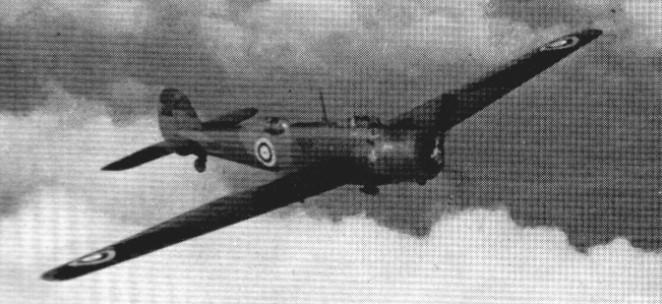
The Wellesley evolved from Vickers’ design for a general-purpose day and night bomber and coastal-defence torpedo-carrier biplane to satisfy Air Ministry Specification G.4/31, the company having decided to develop and build a monoplane aircraft to meet the same specification. When evaluated there was little doubt that the monoplane was superior, with the result that the Air Ministrv contract for the biplane was cancelled, being replaced on 10 September 1935 by one for 96 examples of the monoplane under a rewritten G.22/35 specification. The RAF ultimately ordered 176, named Wellesely, to a newly written specification 22/35, with a 14 month production run starting in March 1937.
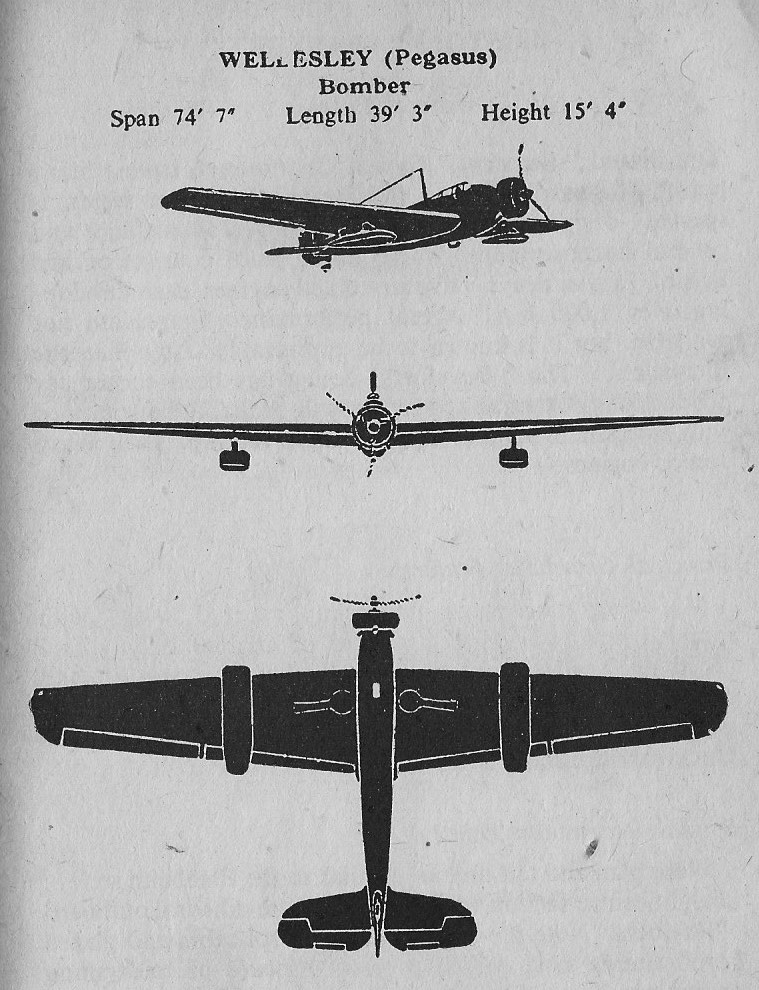
Named the Wellesley, it was the first RAF aircraft to utilise the geodetic form of construction devised by Barnes (later Sir Barnes) Wallis; offering a lightweight structure of great strength, it was adopted later for the Wellington. The other highly unusual feature was the provision of a pannier beneath each wing to serve as a bomb container. The low-set monoplane wing was also of geodetic construction, the main landing gear was hydraulically retractable, and power plant comprised a single Bristol Pegasus radial piston engine.
To avoid disrupting the geodetic structure, the bombload was carried in two streamlined panniers under the wings. The Wellesly Mk.1 had two separate cockpits, but this was changed in the Mk.II to a single piece cockpit canopy covering the pilot and navigator positions.
Wellesley Mk Is entered RAF service in April 1937 but by the outbreak of World War II most of them had been transferred to the Middle East, where they remained operational into 1941. The RAF received the first Welleselys in April 1937, for 76 Sqn at Finningley, and eventually equipped six RAF Bomber Command squadrons in the UK, Nos 35, 76, 77 and 148 Sqdns. Later a number were sent out to No.223 Sqdn, and as the home based machines were replaced, they too were sent out to the Middle East.
The primary use of the Wellesely during the econd World War was maily in the Middle East with only four examples remaining in Britain at the start of the war. Among its significant wartime operations was the bombing of Addis Ababa in August 1940, and Wellesleys of 223 Sqn were among aircraft that wiped out an Italian destroyer flotilla attack on Port Sudan in April 1941. Losses to Italian CR.42 fighters did occur when intecepted, as the Wellesley’s defensice armament of one fixed gun flexibly mounted firing aft was poor. They remained in the region until 1941 performing maritime reconnaissance duties.
No.14 Squadron based on Port Sudan, East Africa
The type is remembered especially in service with the RAF’s Long Range Development Flight, which was established at RAF Upper Heyford, Oxon, in January 1938. Equipment comprised six Wellesley Mk.Is modified by the installation of 28.7 lt 1010 hp / 753 kW Pegasus Mk XXII engines installed in NACA long-chord cowlings, and driving 3 blade Rotol ‘Incredible Hub’ constant-speed propellers; plus other changes which included strengthened landing gear, increased fuel capacity and the introduction of an autopilot. Adding a third crew member and a rest bunk and a folding pilot’s seat to allow mid-air pilot exchange. Between 5 and 7 November 1938, two of a flight of three of these aircraft (led by Sqn Ldr R. Kellett) succeeded in establishing a new world long-distance record, covering non-stop the 11,526km between Ismailia, Egypt, and Darwin, Australia, in just over 48 hours.
Wellesley Mk.I Engine: 1 x Bristol Pegasus XX, 690kW / 937 hp Max take-off weight: 5035 kg / 11100 lb Empty weight: 2889 kg / 6369 lb Wingspan: 22.73 m / 74 ft 7 in Length: 11.96 m / 39 ft 3 in Height: 3.76 m / 12 ft 4 in Wing area: 58.53 sq.m / 630.01 sq ft Max. speed: 198 kts / 367 km/h / 228 mph Service ceiling: 10600 m / 34,700 ft Range: 964 nm / 1786 km / 1110 miles Crew: 2 Armament: 2 x 7.7mm machine-guns Bombload: 900kg
Air Ministry Specification G.4/31 called for a General Purpose aircraft, capable of level bombing, army co-operation, dive bombing, reconnaissance, casualty evacuation and torpedo bombing. The Vickers Type 253 won against the Fairey G.4/31, Westland PV-7, Handley Page HP.47, Armstrong Whitworth AW.19, Blackburn B-7, Hawker PV-4 and the Parnell G.4/31.
Designed by Rex Pierson, the Type 246 was the first aircraft built which partly used the Barnes Wallis geodetic design in the fuselage. Despite an order for 150, Vickers offered their private venture monoplane design the Type 253. This used the same geodetic design principles for both the fuselage and the wings, and first flew on 19 June 1935. It had superior performance to the 246 but did not attempt to meet the multi-role requirement, being a day and night bomber only. First flown with PV 0-9 markings, the 253 showed a lower tare weight, better performance and larger payload., partly as a result of the 8.85 – 1 high aspect ratio wing. An initial order for 96 Type 246s was substituted for the Type 253 order.
One prototype, first flown on 6 August 1934. No production.
Engine: 1 x 635hp Bristol Pegasus IIM.3 Max take-off weight: 3791 kg / 8358 lb Empty weight: 1982 kg / 4370 lb Wingspan: 16.03 m / 52 ft 7 in Length: 11.28 m / 36 ft 0 in Height: 3.81 m / 12 ft 6 in Wing area: 53.79 sq.m / 578.99 sq ft Max. speed: 259 km/h / 161 mph Ceiling: 6614 m / 21700 ft Crew: 2
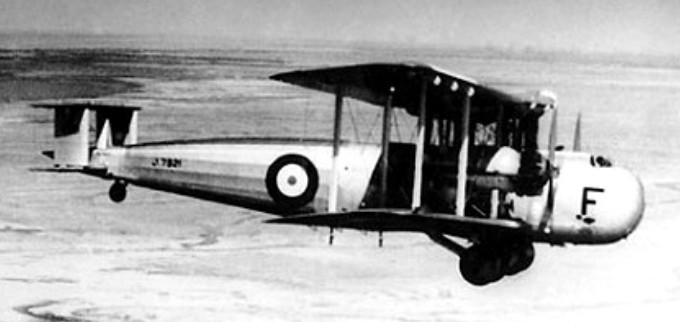
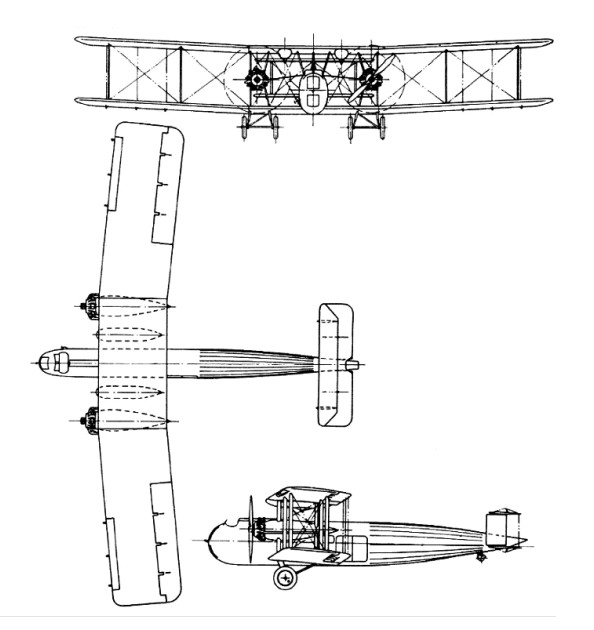
The Valentia was a development of the earlier Victoria troop-carrier, differing by having two 484kW Bristol Pegasus II.L3 or II.M3 engines (the latter for use in India) and an improved landing gear. Accommodation was for a crew of two and 22 troops; lockers were used for equipment and rifle-racks and stretcher supports were provided. Bomb racks could also be fitted if required. Twenty-eight were built as new and 54 Victorias were brought up to this standard.
Engines: 2 x Bristol II M3 Pegasus radials, 464kW / 626 hp Wingspan: 26.62 m / 87 ft 4 in Length: 18.14 m / 50 ft 6 in Height: 5.41 m / 17 ft 9 in Wing area: 2178 sq.ft / 202.34 sq.m Max take-off weight: 8845 kg / 19500 lb Empty weight: 4964 kg / 10944 lb Wing load: 9.02 lb/sq.ft / 44.0 kg/sq.m Max. speed: 104 kts / 193 km/h / 120 mph Service ceiling: 4955 m / 16250 ft Range: 695 nm / 1287 km / 800 miles Crew: 2 Bombload: 1000kg
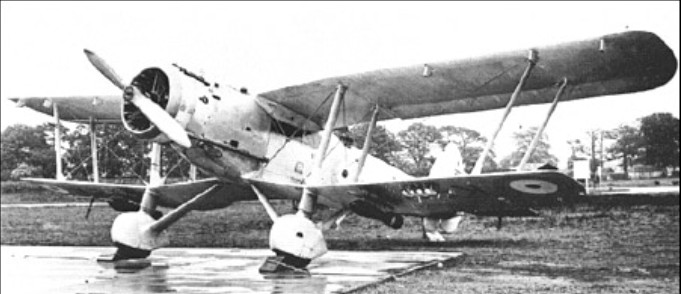
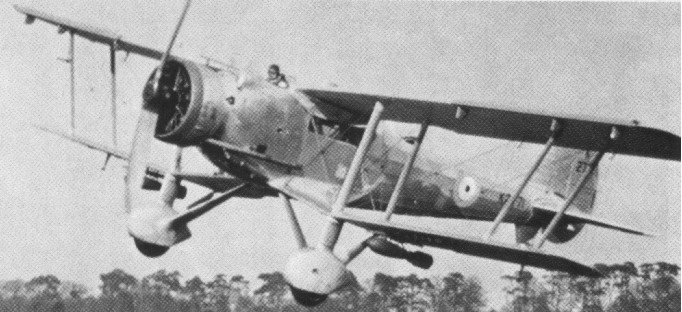
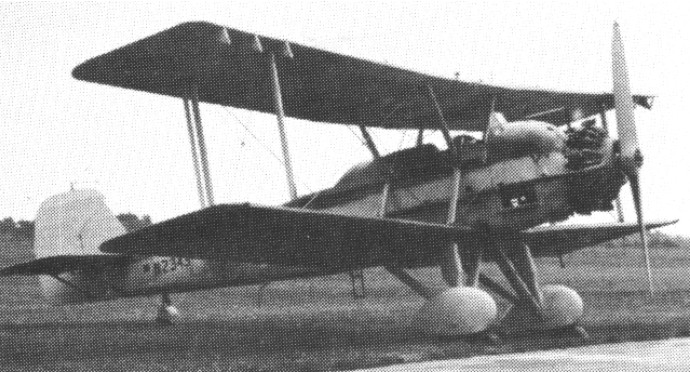
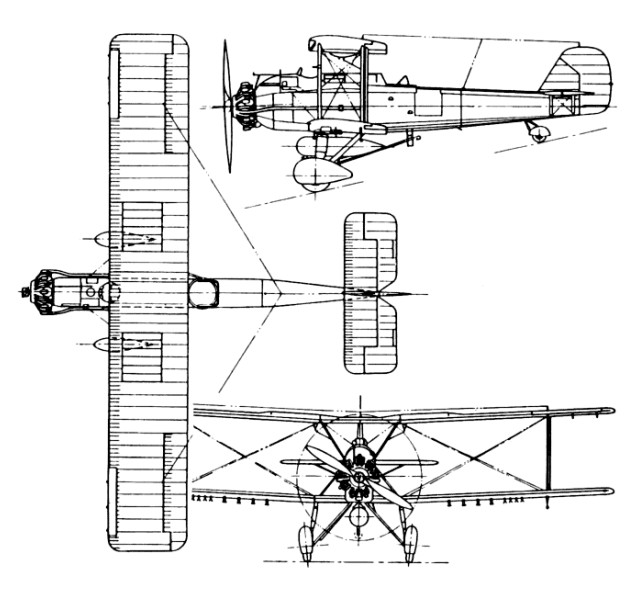
Designed by R.K Pierson & Barnes Wallis, the Vickers Type 207 was a single-engined two-seat biplane. Often known as the Vickers M.1/30, for it was built to Air Ministry specification for a carrier based torpedo bomber to replace the Blackburn Ripon. The Air Ministry paid Vickers for a single prototype; its competitors were the Blackburn M.1/30 and the Handley Page H.P.46.
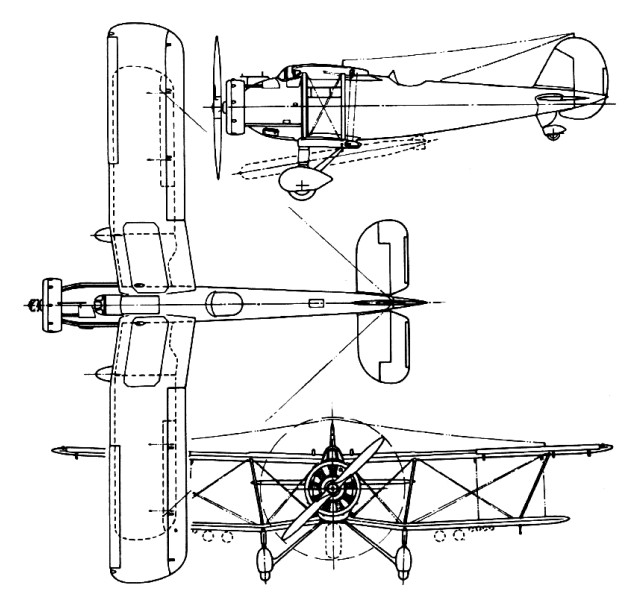
Like Blackburn, Vickers chose the 825 hp (615 kW) Rolls Royce H10 engine, later called the Buzzard IIIMS, a liquid cooled V-12 to power their aircraft. The Type 207 was a single bay biplane, without sweep or stagger and with wings of almost equal span. The upper wing carried Handley Page slots and Frise ailerons; the lower wing alone had dihedral. Both wings used the relatively thick and still novel Raf34 aerofoil section; they folded for storage. The rudder was balanced and the braced tailplane carried aerodynamic servo-assisted elevators operated via trailing edge tabs. Barnes Wallis had recently been appointed chief structural engineer for Vickers aircraft and he brought to the Type 207 new methods of duralumin construction in both wings and fuselage from his previous work on airships. Typically, these structures were complicated but light. The aircraft was fabric covered throughout.
The upper wing was well above the fuselage, braced to it by two pairs of V-form struts on either side; two single struts from the same points on the upper fuselage braced each lower wing. The pilot sat below the wing leading edge and the observer, equipped with a Lewis gun, sat well aft. The split axle undercarriage allowed torpedo dropping from under the aircraft and was fitted with wheel brakes as its ship-borne role required, together with an arrester hook and tail wheel. The Buzzard’s underslung radiator was positioned between the forward undercarriage legs.
The Type 207 flew for the first time on 11 January 1933, with Mutt Summers at the controls. The only notable modification was the addition of 2o of dihedral to the previously flat upper wing. The aircraft but neither of its crew was lost in the first fast diving test on 23 November 1933, when structural breakup was initiated by a tailplane failure. In the end there were no orders for any of the M.1/30 entrants.
Only one was built.
Engine: 1 × Rolls Royce Buzzard IIIMS, 825 hp (615 kW) Wingspan: 50 ft 0 in (15.24 m) Length: 43 ft 7 in (13.69 m) Height: 14 ft 5 in (14.42 m) Wing area: 724 sq.ft (67.3 sq.m) Empty weight: 5,200 lb (2,359 kg) Gross weight: 9,600 lb (4,354 kg) Maximum speed: at 4,000 ft (1,220 m) 159 mph (256 km/h) Rate of climb: to 4,000 ft (1,220 m) 800 ft/min (4.1 m/s) Armament: 1× 0.303 in (7.7 mm) Lewis gun 1×torpedo of a 2000 lb (907 kg) or 1000 lb (453 kg) bomb under fuselage; or 4×500 lb ((227 kg)bombs under inner wings Crew: 2
The Vincent was a three-seat general-purpose version of the Vildebeest, designed essentially for tropical service in the Middle East and therefore carrying comprehensive equipment. Fitted with a 484kW Bristol Pegasus IIM3 engine, it (like the Vildebeest) had sufficient fuel as standard for a 1000km flight while cruising at 195km/h; this range could be increased to 2000km by the use of an auxiliary fuel tank attached in the position normally occupied by the torpedo. A number of Vildebeests were converted into Vincents and, with new production aircraft, the RAF operated just under 200 from 1934. The last were withdrawn in 1941.
Engine: 1 x 635hp Bristol Pegasus IIM.3 Wingspan: 14.94 m / 49 ft 0 in Length: 11.18 m / 36 ft 8 in Height: 5.41 m / 17 ft 9 in Wing area: 67.63 sq.m / 727.96 sq ft Max take-off weight: 3677 kg / 8106 lb Empty weight: 1920 kg / 4233 lb Wing loading: 11.07 lb/sq.ft / 54.0 kg/sq.m Max. speed: 124 kts / 229 km/h / 142 mph Ceiling: 5791 m / 19000 ft Maximum range: 1086 nm / 2012 km Range: 543 nm / 1006 km / 625 miles Crew: 3 Armament: 2 x 7.7mm machine-guns, 8 x 50kg + 8 x 9kg bombs
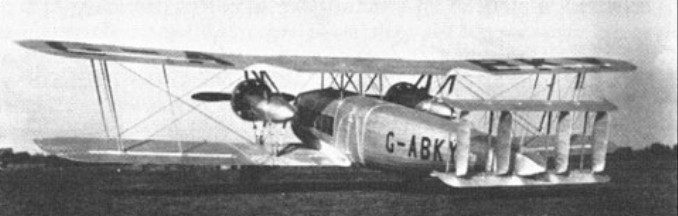
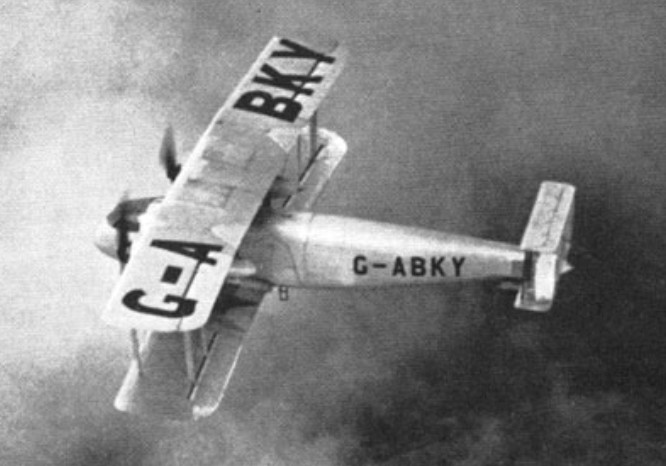
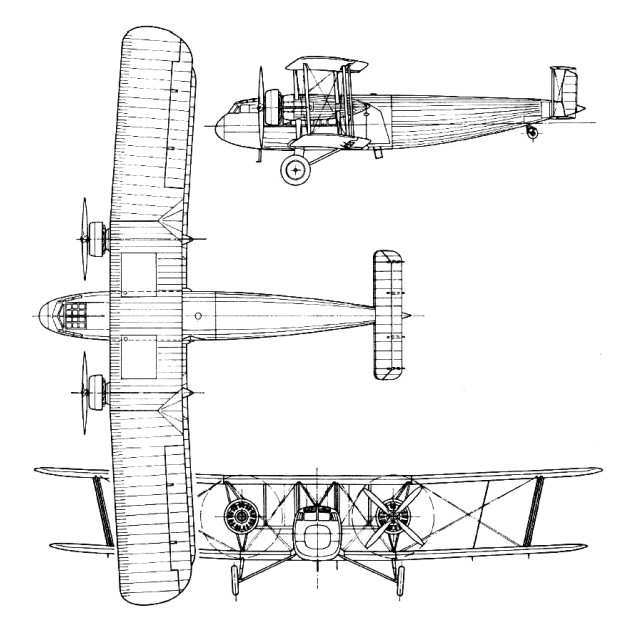
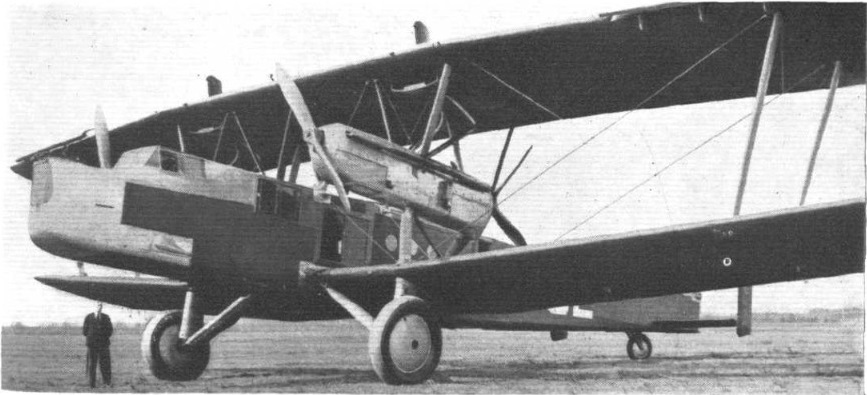
The Vickers Type 163 prototype biplane bomber design of the 1930s. It was based on the Vickers 150 Vanox scaled up to take four Rolls-Royce FXIVS 480 hp engines in paired mountings. The engines are mounted in tandem pairs on Y struts between the wings, two engines driving tractor props and two driving pusher props.
It was submitted both as a bomber and as a troop carrier to Air Ministry specifications B.19/27 and C.16/28 respectively first flying on 12 January 1931. As a bomber, the load weighed up to 1361 kilograms, housed in the inner compartment (a maximum of 8 bombs weighing 114 kg) and external hardpoints (up to 4 bombs weighing 114 kg or two 226 kg). Defensive armament consisted of two 7.7-mm machine guns Lewis, mounted on a mobile turret Scraff fore and aft fuselage. The 163 is all metal. Wheel brakes are fitted, and under the tail is a castoring tail wheel.
The aircraft was rejected by the military. In order to fully exploit the potential of the aircraft, it was decided to convert the Type 163 military transport aircraft that meets the specifications C.16 / 28. In this configuration, the aircraft could carry up to 21 soldiers. The machine can be operated as a bomber with a crew of 5, or as a troop carrier, with a crew of 4.
Engines: 4 × Rolls Royce FXIVS, 480 hp / 358 kW Length: 66 ft 9 in / 20.34 m Wingspan: 90 ft 0 in / 27.4 m Height: 22 ft 4 in / 6.80 m Wing area: 1,948 m² / 178 sq.m Gross vehicle weight: 25,700 lb / 11,700 kg Maximum speed: 139 kn / 258 kph / 160 mph at 6,500 ft / 1,980 m Cruising speed: 220 kph Range: 1,000 NMI / 1850 km / 1,150 mi Service ceiling: 25,200 ft / 7680 m Time to 10,000 ft (3,050 m): 18 min 15 sec Armament: 2 × 0.303 in Lewis Guns Capacity: up to 12 x 250 lb / 1361 kg bombs / 10 troops Crew: 4 / 5
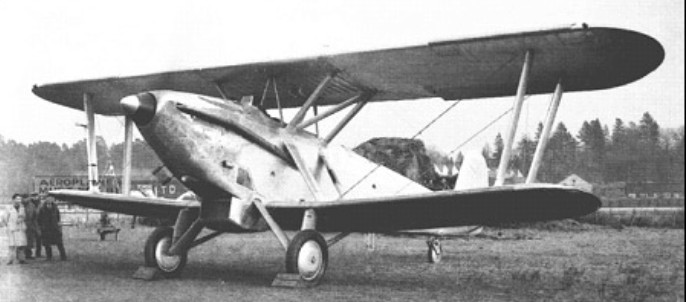
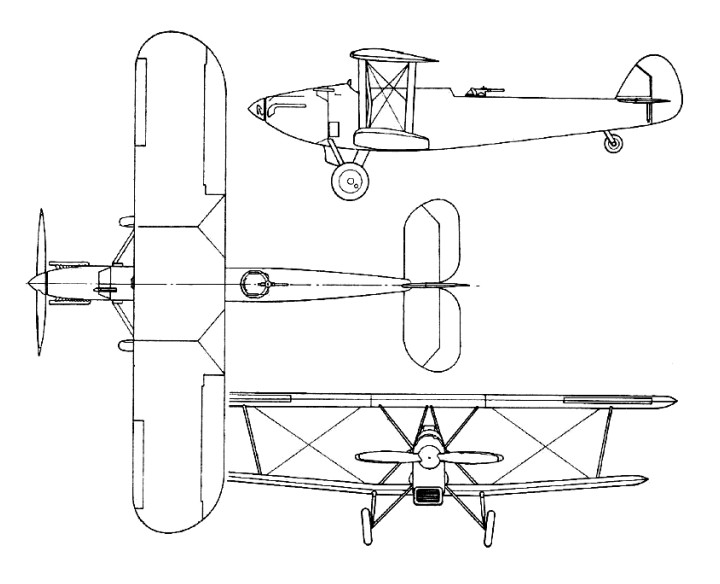
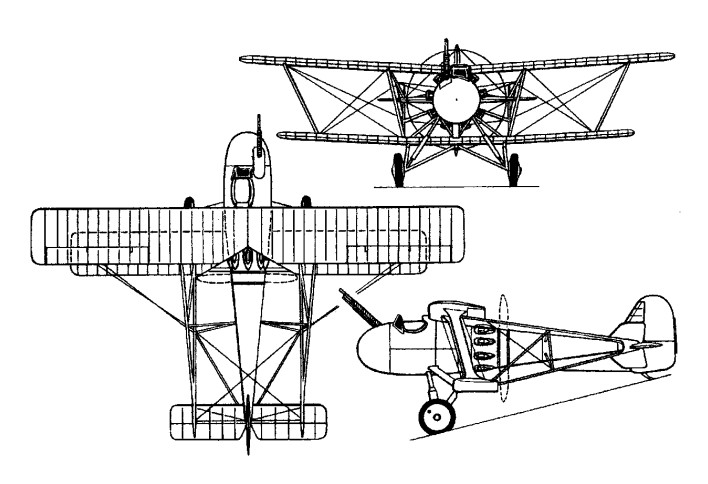
In the mid ‘twenties, the British Air Ministry found attractive the possibility of the 37mm COW (Coventry Ordnance Works) gun for use against bombers. Accordingly, Specification F.29/27 was issued calling for a single-seat dedicated bomber-interceptor armed with this large and heavy weapon. The specification called for the gun to be mounted in a fixed position to fire forward and upward at an oblique angle of at least 45°. Provision was to be made for oversize and automatically-fed ammunition clips totalling 50 shells, the entire COW gun mechanism had to be easily accessible to the pilot and steadiness as a gun platform was a prime requisite. Vickers submission to this Specification, the Type 161, was extraordinary in that it reverted to the long-abandoned pusher biplane formula with tail surfaces carried by booms. Despite its archaic configuration, however, the Type 161 embodied some advanced features and became the subject of a single-aircraft Air Ministry contract. An unequal-span two-bay biplane with comparatively high aspect ratio wings with duralumin plate and tube structure, it had a metal mono-coque nacelle, accommodating the pilot to port and the COW gun to starboard, which was faired into the upper wing and raised above the lower wing by splayed N-type struts. The 530hp Bristol Jupiter VIIF nine-cylinder radial carried at the rear of the nacelle drove a four-bladed propeller, aft of which was a curious, long tapered cone which, intended to promote directional stability, was supported by struts from the tubular tail-booms and the tailplane. The Type 161 was flown for the first time on 21 January 1931, and after provision of a broader-chord rudder, it flew extremely well, arriving at Martlesham Heath in September 1931 for official evaluation. Development was discontinued when official interest in promoting the quick-firing COW gun lapsed.
Max take-off weight: 1520 kg / 3351 lb Empty weight: 1080 kg / 2381 lb Wingspan: 9.75 m / 32 ft 0 in Length: 7.16 m / 24 ft 6 in Height: 3.76 m / 12 ft 4 in Wing area: 25.08 sq.m / 269.96 sq ft Max. speed: 298 km/h / 185 mph