The 1929 Victor Metal Aircraft Co Vimac was a two-place, open cockpit high-wing monoplane, powered by a Lee motor. It was reported as in development, but no final version was found.
Era
Victor Metal Aircraft VK-1
The 1929 VK-1 was a two-place, open cockpit biplane powered by a 90hp Cirrus Mk III engine. Designed by Felix Knoll and registered N851N c/n 101, the wingspan was 30 ft 0 in.
The registers indicate this was a possible metal-fuselage evolution of Knoll KN-1, but leave unexplained a major engine change to 220hp Wright.
Victor Metal Aircraft G-1 Sportster
The 1929 Victor Metal Aircraft Co G-1 Sportster was a two-place monoplane powered by a 75hp Lenape LM-5RA and registered NX498E.
Victor Metal Aircraft Co
1204 Wilson Blvd,
Camden NJ.
USA
Airplane builder circa 1929.
Victor Aircraft Corp
USA
This company built at Freeport, Long Island, New York, in 1917-1918, radial-engined scouting/advanced training biplanes designed by A. S. Heinrich.
Victory Aircraft Engr Co SS-1
Designed by William L Shaffer, the 1928 SS-1 was a three-place, open-cockpit biplane. It was fabric-covered steel-tube fuselage with wood-framed wings.
No production data was found about this short-lived company, who announced they would keep the initial selling price at $2,000, except for a sole registry of NX5626 c/n 1. Some records show the 50hp Hallett H-526 installation replaced by a 90hp Curtiss OX-5 engine. The X license was cancelled on 2 January 1930 and the ID cancelled 2 July 1934.
Engine: 150hp Hallett H-526
Wingspan: 31’0″
Length: 23’4″
Seats: 3
Victory Aircraft Engr Co
pres: Forrest W Hicks,
Victory Airport,
8016 Lankershim Blvd at Strathern St,
North Hollywood CA.
USA
Built the SS-1 model airplane in 1928.
Victory Aircraft
Originated 1942 at Malton, Ontario, under Canadian Ministry of Munitions and Supply, to take over and manage Malton aircraft factory of National Steel Car Corporation to speed production of Avro Lancaster bombers. First Victory- built Lancaster delivered to RAF in August 1943. Total production 430, including seven unarmed mailplanes for transatlantic government service operated by Trans- Canada Air Lines; these were forerunners of the Lancastrian post-war transport version of the Lancaster. One Avro Lincoln Mk XV bomber built 1945. Company acquired from Canadian government in July 1945 by Hawker Siddeley Aircraft Company Ltd, becoming A. V. Roe (Canada) and subsequently designing first Canadian jet fighter.
Victa R2
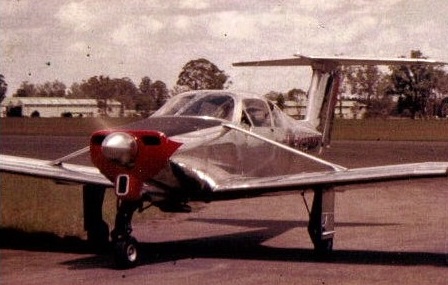
The Victa R2 was a four-seater monoplane designed by Luigi Pellarini. The R2 was all-metal with a T-tail, retractable nosewheel suspension, and was powered by a Lycoming O-360 piston engine with 135 kW.
The prototype C/n 02-1 VH-MVR flew for the first time on February 15, 1961. In April 1961 it was decided at Victa to cancel the development in favor of the Airtourer, as it turned out that the production cost would have become too high.
The R2 was disassembled and stored at Milperra until the Victa plant was closed. It was later taken to Bankstown where it remained in storage for many years.
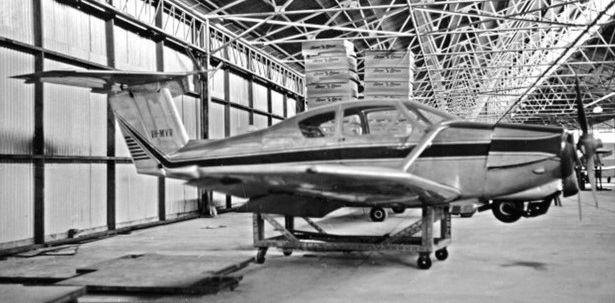
Engine: 1 × Lycoming O-360, 135 kW
Length: 6.58 m
Span: 9.75 m
Height: 2.53 m
Empty weight: 539 kg
Max. take-off wt: 1120 kg
Top speed: 280 km / h
Service ceiling: 5547 m
Range: 1190 km
Crew: 1
Passengers: 3
Victa 67 / R-101
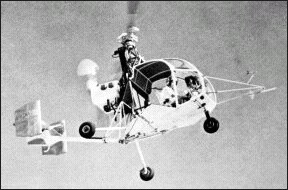
Victa’s aviation division designed a small two-seat gyroplane, the Model 67. The prototype, which was designed by John Blackler, was registered VH-MVB c/n 1 and flew in May 1962. With a tricycle undercarriage, twin-fin tail unit and a two-blade main rotor with a pusher propeller driven by a 160hp Lycoming engine, the prototype logged 150 flights and 20 hours of test flying time, but was abandoned due to financial constraints in 1966.
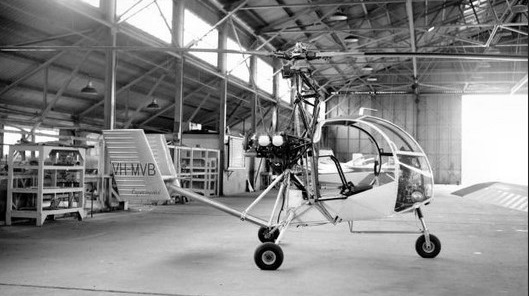
Engine: Lycoming O-320-A, 160 hp
Top speed: 153km/h

