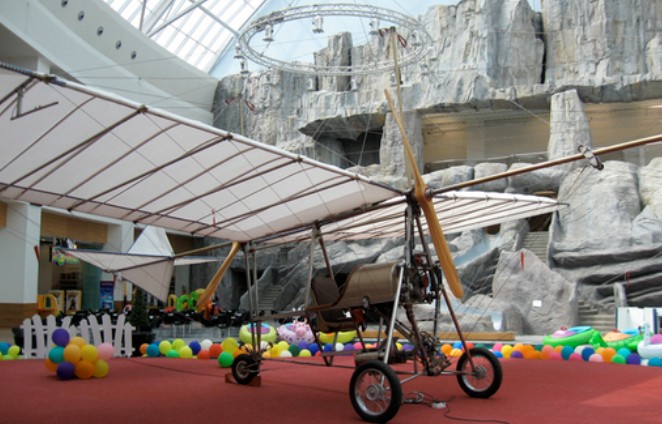
Supported by the Royal House and the Romanian Army, Vlaicu started building at the workshops of the Army Air Arsenal the Vlaicu I, the first plane built on Romanian territory.
Vlaicu first flew the aircraft on 17 June 1910 above the Cotroceni field.
Supported by the Royal House and the Romanian Army, Vlaicu started building at the workshops of the Army Air Arsenal the Vlaicu I, the first plane built on Romanian territory.
Vlaicu first flew the aircraft on 17 June 1910 above the Cotroceni field.

At the urging of his school friend, the poet Octavian Goga, Vlaicu went to Bucharest, where in front of an audience he demonstrated his prototype aircraft.
Aurel Vlaicu graduated from high school in Lica Sibiu State, in 1902, followed by two quarters in the Faculty of Mechanical Engineering of Budapest’s Polytechnic School. He receivrd his diploma in engineering after finishing the Ludwig-Maxmiliams-Universitrt Munich.
Returning to Romania in 1908, he finished his first glider a year later, helped by his brother, John, who made several flights in Brintinti village.
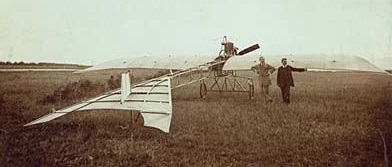
The Vlach No.4 was the first successful Czech aircraft, including its Czech engine, a 38 hp Laurin & Klement type L. Beginning in 1908 Metoděj Vlach was employed as the chief mechanic at Laurin & Klement in Mladá Boleslav where his first airplane, an underpowered biplane, was built. His No.4 was already started in 1911 and together with helpers Vítek and Ševit the new monoplane was finished in the summer of 1912 and exhibited at the Mladoboleslavská severočeská výstava (Northern Czech Mlada Boleslav Exposition), there winning the Gold medal.

Metoděj Vlach was born on July 6, 1887 at Říkovice near Přerov, Bohemia. After studying at a secondary school he went to work at Maribor, a train manufacturing company and then on to the firm Puch (Steier), a company producing cars. Beginning in 1908 he was employed as the chief mechanic at Laurin & Klement in Mladá Boleslav where his first airplane, an underpowered biplane, was built.

VR 160
Cycle: 2 stroke
No cylinders: 2
Bore: 47.5 mm
Stroke: 44 mm
Compression: 10
Displacement: 158 cc
Cooling: Liquid
Ignition: Electronic
Reduction: Mechanical amortisseur + embrayage 4:1
Weight: 15.5 kg
Max pwr: 30 hp at 9800 rpm
Max torque: 2.1 kgm
Fuel consumption: 3.8 G/hp/hr
Price 1998: 6 850 000 L
VR 80
Cycle: 2 stroke
No cylinders: 1
Bore: 47.5 mm
Stroke: 44 mm
Compression: 10
Displacement: 79 cc
Cooling: Liquid
Ignition: Electronic
Reduction: Mechanical amortisseur + embrayage 4:1
Weight: 10 kg
Max pwr: 14.5 hp at 9800 rpm
Max torque: 0.98 kgm
Fuel consumption: 2 lt/hr
Price 1998: 2 956 000 L

Flywheel 100
Empty weight: 21 kg
Engine: Vitorazi 79, 14.5 hp
Reduction: 1:4
Prop diameter: 100 cm
Fuel capacity: 6 lt
Price (1998): 7200 DM
Flywheel 160
Empty weight: 15 kg
Engine: Vitorazi 160, 30 hp
Reduction: 1:4
Prop diameter: 125 cm
Fuel capacity: 6 lt
Price (1998): 7 900 000 L
Flywheel 125
Empty weight: 18 kg
Engine: Vitorazi 67, 14.5 hp
Certification: DULF i.a.
Reduction: 1:4
Prop diameter: 125 cm
Fuel capacity: 6 lt
Price (1998): 7780 DM

The Moster 185Paramotor is for solo flying or tandem. The structure of the engine Moster 185 is simple, streamlined and compact. The complete weight of the engine is 12.9 kgs in pull starter version. The thermic group is cooled with the air generated by the extraction flow of the propeller, with direct drive.
The motor develops 25 hp at 7800 rpm and is particularly suitable for pilot + paramotor or trike between weights 100 and 160 Kgs (200 to 350 pounds). The engine has not been tested for tandem use or for a take off weight over 160 kgs. The thrust is regular, smooth, gentle up to 75 kgs (165 pounds) with a 130 cms (51 inches) propeller or 70 kgs (155 pounds) with 122 cms (48 inches) propeller.
2010 Price: US $1,700 – 1,890
Vittorazi Moster 185, 25 hp at 7800 rpm
Reduction drive: ratio 1/2.7 – PolyV belt.
Ignition coil: Inductive IDI
Spark-plug: NGK BR9ES
Temperatures max: EGT 550° – CHT 230°
Exhaust pipe: Hand-made with silencer – Optional silencer in carbon fiber
Propeller rotation: Counter-clock
Fuel: Unleaded gasoline – Synthetic oil 2.5 %
Consumption: 3.0-3.5 liters/hour at 30kg of trust, propeller 125 cms
Weight: 12.9 kg; pull starter version
1998:
via Roma 182
I-62010 Montcosaro Scalo (MC)
Italy
Paramotor builder

