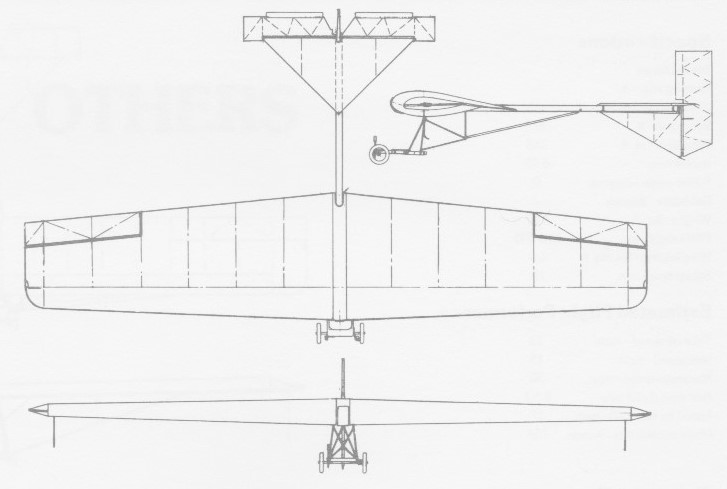
The 1971 Volmer Jensen VJ-12 was a hang glider conventionally controlled from aileron to elevator.
Era
Volmer VJ-10 / TG-29
The VJ-10 high-performance sailplane, the first two-place, side-by-side sailplane, was purchased by the military for the assault glider training program as the TG-29 42-65553.
It was designed and built by Volmer Jensen while at Bowlus, in 1939.
Volmer M-1 / Martin M-1

Jim Martin contracted Volmer Jensen to design and built him a glider for contest flying just before the Second World War.
The aircraft was constructed with a wooden structure and covered in doped aircraft fabric covering. The cantilever gull-style wing employed a NACA 4400 series airfoil. The tail was a conventional low-tail design and featured strut-bracing. The M-1 was registered as an Experimental – Amateur-built aircraft and was not type certified.
Jensen completed the aircraft in 1939.
Martin flew the aircraft in a number of US Nationals, as did a later owner of the M-1, Emil Lehecka. While Lehecka owned it the aircraft picked up the nickname of the Whatsit. By the 1970s the aircraft was owned by Francis Kalinowsky and was based at the Circle X airport in Florida. At that time it was reportedly in good repair and was well maintained.
The aircraft was removed from the Federal Aviation Administration registry and its whereabouts are unknown.
M-1
Wingspan: 48 ft 0 in (14.63 m)
Wing area: 180 sq ft (17 m2)
Aspect ratio: 12.8:1
Airfoil: NACA 4400 series
Empty weight: 438 lb (199 kg)
Gross weight: 631 lb (286 kg)
Maximum glide ratio: 28 at 50 mph (80 km/h)
Rate of sink: 132 ft/min (0.67 m/s) at 40 mph (64 km/h)
Crew: one
Volmer VJ-8 Gullwing
Volmer Jensens’ VJ-8 enclosed glider was built circa 1933.
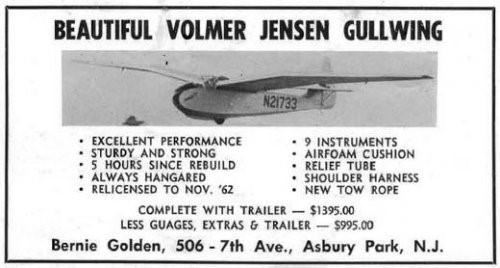
Volmer VJ-4
The 1928 VJ-4 cantilever wing glider was Jensen’s first original design, for a wealthy sportsman named Thomas Stimson.
Volmer 1927 Glider / VJ-3
Volmer S. Jensen was born in Milwaukee in 1909. He began to design and build sailplanes in 1925 at age 16. using plans published in the Boy Mechanic Magazine. He built a second one the following year from additional plans from the same source, and in 1927 he built his first glider with aerodynamic controls, an enclosed cockpit and a wheeled landing gear. It was based on the MIT glider Eddie Allen had taken to Europe in the mid-20s to compete against the Germans.
Volmer VJ-21 Jaybird
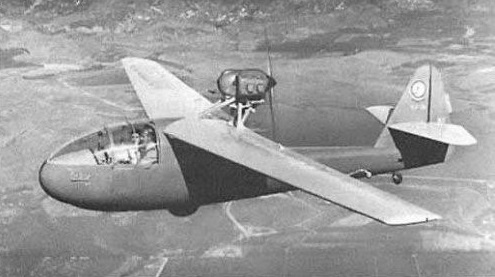
The Jarvis Jaybird design was acquired by Volmer Jensen as homebuilt project soon after World War II and became the VJ-21 Jaybird with retractable wheels and 75hp Continental A75 engine.
The 1947 Volmer Jaybird all-metal evolution features a pod nacelle with a pusher engine and has monowheel gear with outriggers on the wings. Reportedly more than 900 plans sold to builders through the 1960s.
A later owner (ca.1960) put a 125hp Continental C125 in, repositioned wings slightly lower and added small auxiliary fins.
VJ-21 Jaybird
Engine: 75hp Continental A-75
Wingspan: 45’0″
Length: 24’0″
Useful load: 500 lb
Max speed: 135 mph
Cruise speed: 110 mph
Stall: 35 mph
Range: 400 mi
Take-off run: 50′
Landing run: 150′
Seats: 2
Volmer Sport
The 1942 Sport built by Volmer Jensen was a two-place, open cockpit, low-wing monoplane, of resin-impregnated plywood construction.
Volmer VJ-24 SunFun

The VJ-24 is Volmer Jensen’s hang glider design built from aluminum. This motorglider is constructed of aluminum tubing plus fabric, and originated as a foot-launched glider. SunFun is made from pop riveted aircraft aluminium with the wings leading edge formed in styrene foam. Covering is polyester aircraft fabric doped. Control is by aileron, elevator and rudder. A permanent seat is built into the hanger structure.
The VJ-24 was first flown in about 1975 and showed excellent controllability with a joystick. Plans were available from Volmer Aircraft for $100.00. Materials have been estimated at $2400, with a building time of 250 hours.
The VJ-24 uses pip pins and thumb screws to assemble in 10 minutes without tools.
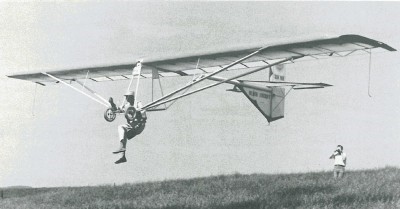
Designated the VJ-24E, the Sunfun is essentially a simplified version of the Swingwing hang glider or powered hang glider. The wings are fabric-covered aluminum tube and are a rectangular-planform type braced by V struts. The two wheels are for ground handling only, so the Sunfun is foot-launched and foot-landed. A 10-hp engine and fuel tank are installed beneath the wing and behind the pilot so that takeoff can be performed without benefit of a steep hill. Wingspan is 36 feet 6 inches, and total weight is 110 pounds. The Volmer VJ 24E Sunfun has a useful load of about 200 pounds, burns about 1.5USG per hour.
A minimum powered glider, the VJ-24W is a modified version of VJ-24E Sun Fun hang glider with wheeled landing gear, tractor engine, independent rudder control, manufactured by Airway Aircraft Inc., 905 Airway Ave., Glendale, CA 91201, USA.
Fairing behind pilot cuts drag. Independent three-axis controls. Construction is all metal with Dacron cover. Yamaha KT100 or McCulloch 101 engine. Two main wire wheels, tail skid undercarriage.
VJ-24
Wingspan: 36 ft
Wing chord: 4 ft 6 in
Wing area: 160 sq.ft
Empty weight: 110 lb
Speed range: 18-25 mph
VJ-24
Speed max: 40 mph
Cruise: 30 mph
Range: 30 sm
Stall: 17 mph
ROC: 350 fpm
Take-off dist: 100 ft
Landing dist: 100 ft
Engine: Yamaha, 15 hp
Fuel cap: 1.5 USG
Weight empty: 210 lbs
Gross: 410 lbs
Height: 5.75 ft
Length: 198.5 ft
Wing span: 36 ft
Wing area: 163 sq.ft
Seats: 1
Landing gear: tail wheel
VJ-24W Sun Fun
Wing span: 36.5 feet
Wing area: 163 square feet
Empty weight: 165 pounds
Max gross weight: 345
Engine: Yamaha KT-100, 97.6cc, 15 hp.
Reduction unit: 2,75:1
Prop: 57 in
Wingspan: 36 ft
Wing area: 160sq.ft
Aspect ratio: 8:1
Length 18’
Empty weight 200 lbs
Payload 200 lbs
Gross weight 400 lbs
Wing loading 2.5 lbs/sq.ft
L/D 10:1
Cruise speed 30mph
Stall speed 18mph
Vmax 40 mph
Takeoff run 100’
Landing roll 100’
Climb Rate 350 fpm
Fuel Capacity 1.5 USG
Chord length: 4.5 ft
Wing span: 36.5 ft
Wing area: 163 sq,ft
Aspect ratio: 6.75
Weight: 110 lb
Pilot weight: 160-200 lb
Takeoff speed: 13 mph
Stall speed: 15 mph
Max speed: 30 mph
Best glide ratio (L/D): 9.5
Best L/D speed: 17 mph
Min sink: 158 fpm

Volmer VJ-23 Swingwing

Designed by Volmer Jensen and Irv Culver, its cost Jensen roughly $400 in supply in 1971. The total construction time is estimated at three months of construction in free time. Culver is an aerodynamic engineer who designed the profile of the VJ 23 SwingWing and made the fatigue study.
Volmer VJ-23 Swingwing Article
The cantilever wing has a relative thickness of 16%, thus eliminating the reinforcement by cables or struts. The disassembled craft is designed to be assembled in 30 minutes.
The cantilever wing is largely built from spruce and plywood with a fabric covering. The wing is constructed in two parts of 4.88 meters and able to be assembled with three bolts. The wings, which weigh 15 kilos each, with a limit load factor of 2G and an ultimate load factor of 3G. The leading edge of the wing is made with a 1mm backing, and the leading edge ribs are 1cm thick marine plywood, with spruce for the ribs of the tail unit, and rods for the spar of the wing. Jensen does not use epoxy for the VJ23, preferring white glue that he has been trusted for years. The wings and tails are covered with Ceconite, a light fabric of 1.8oz / sqrd. The tail boom is an aluminum tube of diameter 10 cm and 4m long.
Apply the fabric without stretching it, then apply a coating to ensure waterproofing. The fabric can then be stretched with an iron.
The VJ-23 features padded arm rests and wheels. It is controlled by a joystick. The kit came with an airspeed indicator.
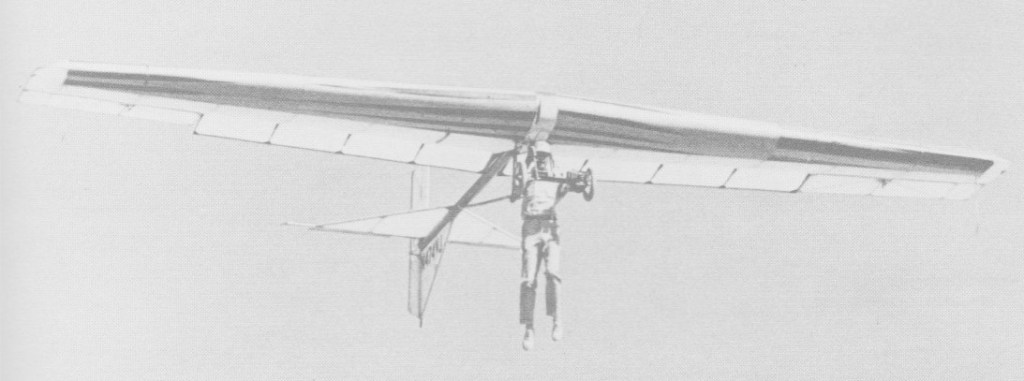
It was originally available in kit form only.
The airframe is made from 6061-T6 1.25in x .035 aluminium tubing. The 15 ft boom is made from 6061-T6 4in x .035 tubing. The ribs are wood truss. A permanent seat is built into the hanger structure.

What distinguishes SwingWing is its unusual ability to stay in the air. With a modest wind of about 30 km / h, the pilot takes off in less than two or three steps and then flies as long as he can stay in the ascending part. For short-term flights, the pilot is suspended by leggings, but a seat harness can be used with a seat for longer flights.
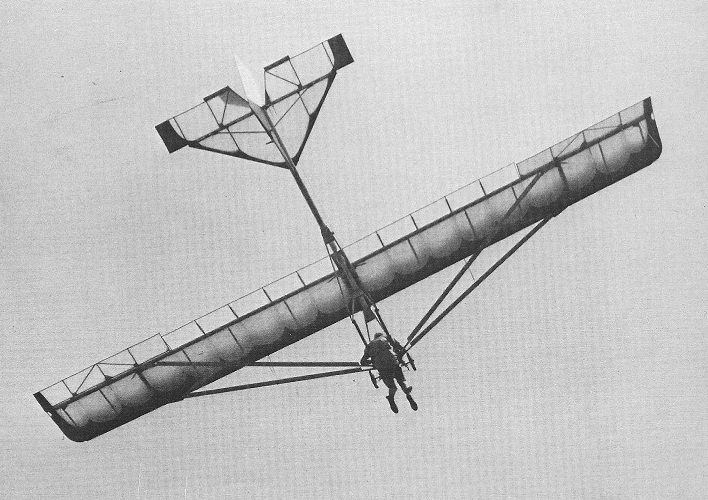
During a demonstration of SwingWing, Jensen remained in the air for more than 40 minutes, flying along and before a dune at an altitude of 35 ft (10 m) with a length of 300 yards. The 23° slope seemed to have an excellent performance for dynamic flight. The speed of cruising is between 25 and 40 km / h. The landing takes place in one or two steps.
Although the VJ23 prototype carries Federal Aviation Administration registration number N474VJ, registration is not required.
In 1978, David Cook became the first hang glider pilot to fly over the English Channel in one hour, flying at an altitude of 1000 feet in a powered Swingwing.
A motorized version has been built as the VJ-23E.
The VJ 23 was never built factory, but designed for amateur construction, very many plans were sold.
Designed in the early 1970s by Volmer Jensen, the Swingwing is essentially a powered hang glider. Empty weight without engine is 100 pounds, and the gross weight is 300 pounds. The Swingwing is built from aircraft plywood, spruce, steel tubing and fabric covering. Control surfaces include ailerons, elevators and rudder.
In 1978, David Cook became the first hang glider pilot to fly over the English Channel in one hour, flying at an altitude of 1000 feet in a powered Swingwing.

VJ-23
Wing span: 9.88 m
Length: 4.96 m
Wing area: 16.65 sq.m
Aspect ratio: 5.88
Airfoil: Irv Culver
Empty Weight: 45 kg / 100 lb
Gross Weight: 136 kg / 300 lb
Wing Load: 7.9 kg/sq.m
Vzmin: 1.1 m/sec
Glide Ratio: 12 @ 62 kph
Takeoff distance: 31 m
L/DMax: 12 32 kph
MinSink: 0.96 m/s 30 kph (18-20 mph)
Seats: 1
Cruise: 16-25 mph
Stall: 15 mph
Chord length: 4.7 ft
Wing span: 32.6 ft
Wing area: 179 sq,ft
Aspect ratio: 6.9
Wing sweep: 2˚
Weight: 100 lb
Pilot weight: 160-200 lb
Takeoff speed: 13 mph
Stall speed: 15 mph
Max speed: 25 mph
Best glide ratio (L/D): 9-1
Best L/D speed: 18 mph
Min sink: 176 fpm