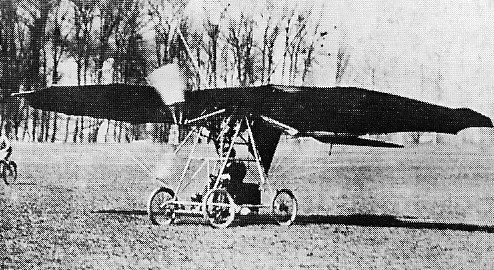
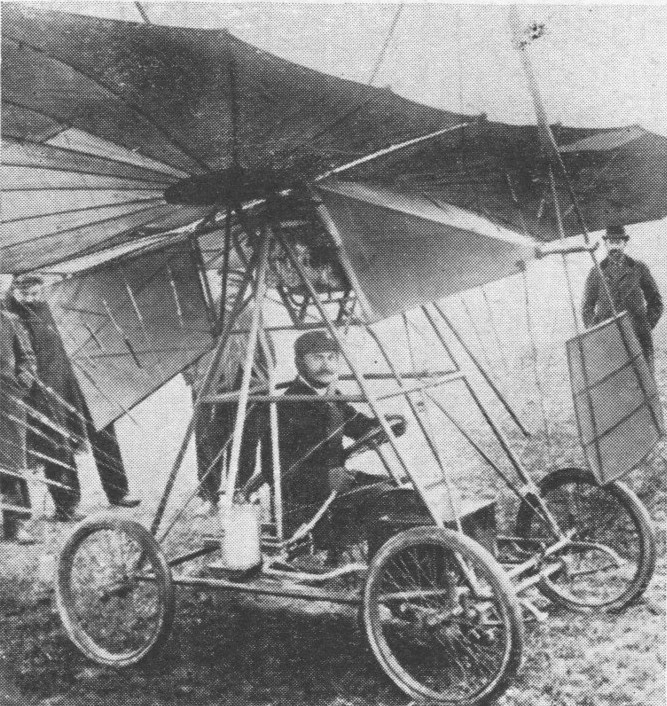
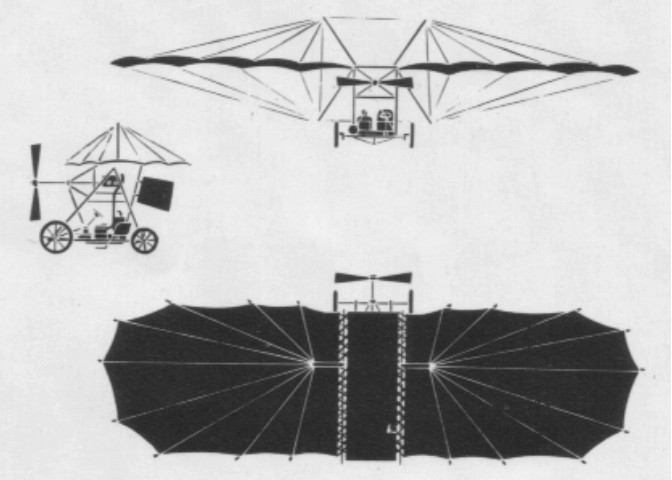
One of the first Europeans to make a powered flight (18 March 1906) in his own aeroplane. Traian Vuia is claimed as Romania’s first aviator, although at the time of his early flights he was resident in Paris and his birthplace was then apart of the Austro-Hungarian empire. His first aeroplane, built with the assistance of Frenchman Victor Tatin, travelled no more than 78.75 ft (24 m) on its longest hop-flight, but had several novel features, including a variable incidence wing and an undercarriage with pneumatic tyres.
The endurance of the motor was only three minutes.
Engine: modified Serpollet carbonic acid gas engine, 20 hp Prop: 7 ft 2.5 in (2.20 m) dia two blade Wing span: 22 ft 11.5 in (7.00 m) Length: 10 ft 6 in (3.20 m) Wing area: 204.5 sq.ft. (19,00 sq.m) Gross weight: 531 lb (241 kg) Seats: 1
Australia Formed 1971 by D. A. Phillips to develop Phillicopter two-seat light helicopter. Design had begun 1962, prototype first flew 1971, and an improved model appeared 1992.
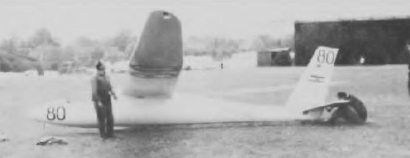
The Trener is a modified version of the LIBIS-18 single-seater Standard Class sailplane which first flew on 20 October 1964 and was designed by the Letalski Institut Branko Ivanus, Slovenija – LIBIS. Of wooden construction with cantilever shoulder mounted wings with tapered outer panels, the LIBIS-18 did not go into production.
The VTC Trener differs from it chiefly in having the all-moving tailplane mounted slightly higher on the sweptback fin and rudder, and an improved cockpit layout, the pilot sitting under a flush-fitting one-piece cockpit canopy. The Trener is also of all-wood construction, using beech and Swedish plywood, and has Wortmann wing sections giving a thickness/chord ratio of 18% at the root. The fuselage is a wooden monocoque with a non-retractable monowheel with a brake, andatailskid. An initial batch of 50 Treners is believed to have been ordered by the Yugoslav Aero Club, these being built by VTC at Vrsac.
Span: 49 ft 2.5 in Length: 22 ft 7.75 in Wing area: 139.6 sqft Aspect ratio: 17.35 Max speed: 136.5 mph (in smooth air) Max aero-tow speed: 93 mph Min sinking speed: 2.36 ft/sec at 48.5 mph Best glide ratio: 31:1 at 53 mph
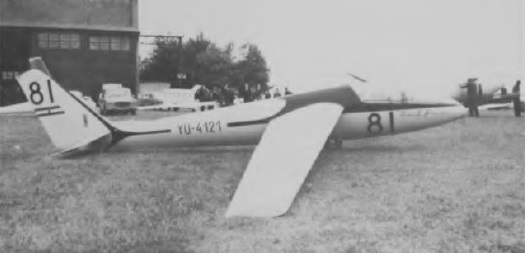
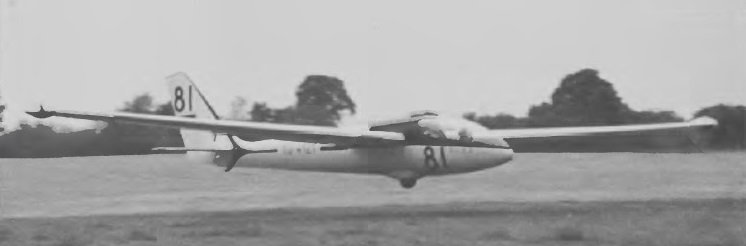
This Yugoslav single-seater high performance Standard Class sailplane was designed by T.Dragovic and Z. Gabrijel, two young engineers at the Faculte des Siences Mathematiques in Belgrade, and the prototype, known as the Delfin 1, made its first flight in December 1963. It made its public debut at the 1965 World Championships at South Cerney in Gloucestershire, and went into production as the Delfin 2 at the Vrsac works of VTC – Vazduhoplovno Tehnicki Centar (Aeronautical Technical Centre).
The Mk 2, which first flew on 26 April 1965, differed from the prototype in having the plywood fuselage covering extended to cover the nose, a smaller sideways opening canopy, a rubber-sprung nose skid added and wooden instead of metal ailerons, and 27 of this version were built, four of which were later converted to Delfin 3s. The Delfin 2 achieved its first real competition success when it came 1st and 2nd in the Polish National Championships of 1966, no mean feat in view of the strength of opposition from the indigenous SZD designs.
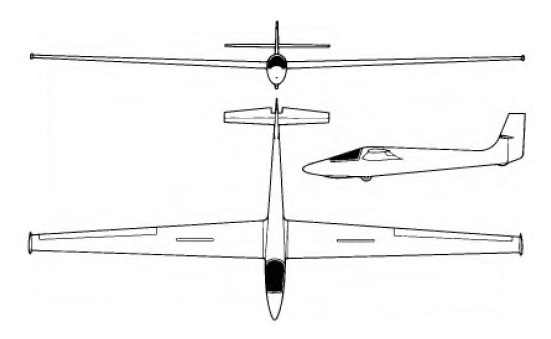
The Delfin 3 first flew on 29 July 1968 and has a conventional tailplane instead of an all moving one, reduced fin sweepback and increased rudder area. It is of plywood-covered wooden construction; the cantilever shoulder wings have plywood-covered leading edges and fabric-covered rear portions, and wing tip ‘salmon’ fairings are fitted. There are metal Schempp-Hirth air brakes above and below the wing surfaces at 60% of the chord. The fuselage is a monocoque structure with a small cross-section made possible by putting the pilot in a semi-reclining position under a one-piece curved flush fitting cockpit canopy that opens sideways to starboard for entry and exit. The swept back fin is integral with the fuselage, and the fixed tailplane has a trim tab in the starboard elevator. Landing gear consists of a non-retractable unsprung monowheel with a mechanical brake and a rubber-sprung nose skid, plus a tail bumper.
Delfin 3 Span: 49 ft 2.5 in / 15.0 m Length: 22 ft 5.5 in / 6.85 m Height: 5 ft 3 in Wing area: 138 sqft / 12.82 sq.m Aspect ratio: 17.55 Wing section: NACA 633 618 Empty weight: 492 lb / 223 kg Max weight: 717 lb / 325 kg Water ballast: None Max wing loading 25.3 kg/sq.m / 5.18 lb/sq ft Max speed: 155 mph / 135 kt / 250 km/h (in smooth air) Max rough air speed: 78 kt / 145 km/h Stalling speed: 32.5 kt / 60 km/h Min sinking speed: 2.13 ft/sec / 0.65 m/sec at 46.5 mph / 40.5 kt / 75 km/h Best glide ratio: 31:1 at 54 mph / 47 kt / 87 km/h
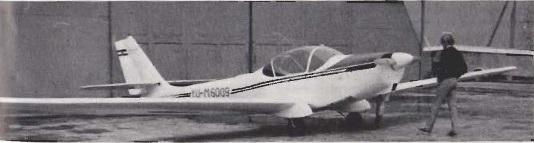
This two-seater powered sailplane was developed jointly by VTC of Yugoslavia and Sigmund Flugtechnik of West Germany, under the design leadership of Dipl-lng Alfred Vogt and Dipl-lng Ivan Sostaric. The prototype, registered YU-M6009, made its maiden flight on 24 June 1972 in the hands of VTC test pilot A.Stanojevic; it was certificated in May 1973 and an initial order for 10 was placed by the end of that year. The SSV-17 is a low-wing monoplane of glassfibre sandwich construction with a conventional retractable undercarriage, seating two side-by-side; it resembles the Rumanian IS-28M2, but has a swept-back fin and rudder and a low-set tailplane; the fin spar is of steel tube. The wing has a light alloy main spar and Schempp-Hirth air brakes above and below, but there are no flaps. The fuselage is a semi-monocoque structure and the fuselage/wing centre section, 6ft 6%in wide, forms the cabin floor and also serves as the wing spar carry-through structure. The main wheels have coil spring shock-absorption and retract upwards into ‘knuckle’ fairings, remaining semi-exposed when retracted to minimise damage in a wheels-up landing. The tailwheel is fixed and steerable. The powerplant is a Franklin 2A-120-A two-cylinder horizontally-opposed engine of 60hp driving a two blade Hoffman propeller; but following the Franklin Engine Co’s cessation of engine manufacture the rights to produce and market this company’s range of air-cooled piston engines was acquired by Pezetel of Poland in 1975, to power such types as the Polish built PZL-110 Rallye. It is believed that only the initial batch of 10 SSV-17s was built.
Span: 55 ft 9.25 in Length: 23 ft 11.5 in Height: 9 ft 3.75 in Wing area: 199.1 sqft Aspect ratio: 15.65 Empty weight: 943 lb Max weight: 1,472 lb Max level speed: 155 mph (power on) Cruising speed: 99.5 mph (power on) Best glide ratio: 29:1 (unpowered) Min sinking speed: 2.79 ft/sec (unpowered) Take-off run: 820 ft Range: 497 miles
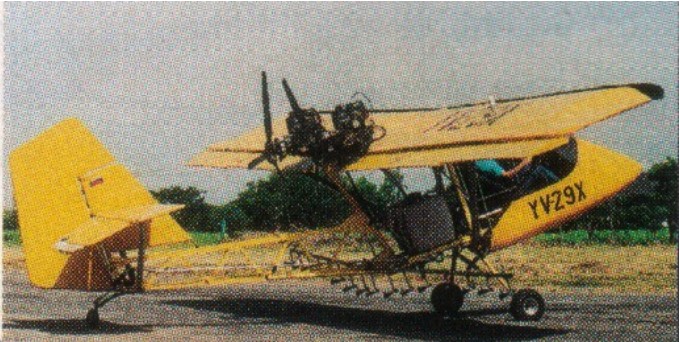
A tandem two-seat kit-built monoplane developed in Venezuela. First flown in January 1997.
Overlapping pusher propellers are mounted close in to the fuselage and the wingspan can be extended for special applications. Can be flown with or without the cabin doors. An optional ag-spray kit was available. The kit did cost US$24,995.
Top speed: 100 mph Cruise: 60 mph Stall: 22 mph Range: 250 sm Rate of climb: 1200 fpm Takeoff dist: 100 ft Landing dist: 200 ft Service ceiling: 15,000 ft HP range: 52-100 Fuel capacity: 24 USG Empty weight: 700 lb Gross weight: 1400 lb Height: 7.5 ft Length: 22 ft Wing span: 32 ft Wing area: 160 sq.ft Seats: 2 Landing gear: tailwheel