Caudron G.III

G.III

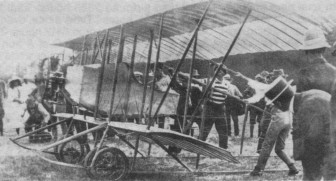
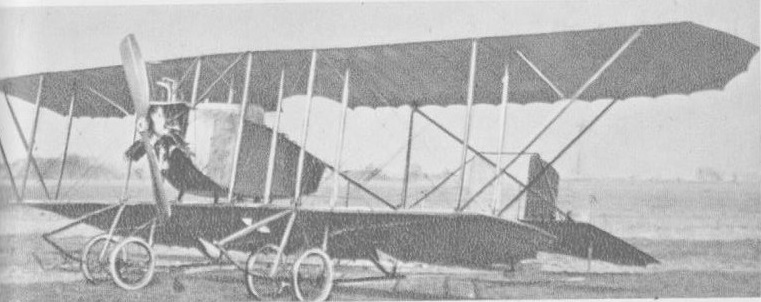
Developed from the G.II, the G.III was a two-seat sesquiplane powered by a 59.6kW Le Rhone, Gnome or Anzani engine mounted in the nose of the short crew nacelle. First flown in France in 1912, over 100 were operated by the Royal Naval Air Service and Royal Flying Corps for training. A few had initially been used prior to 1914 as seaplanes.

The G.III was a two-bay biplane with strut-braced extensions to the upper wing. The wings were of wooden construction with fabric covering. There was a small nacelle for the crew. The tail surfaces, with twin fins and rudders, were carried on open wire-braced wooden booms, the lower members continuing forward to form skids. Wing warping was used instead of ailerons. Two twin-wheel main undercarriage units were fitted.

The G.III remained in service with the French Air Force for artillery spotting duties on the Western Front and in the Balkans until mid-1916.

Others, built in Italy, were used operationally until March 1917.

Most of the G.IIIs flown by the American, Belgian and Russian air forces were used as trainers.

G.IIIAs were built for military use in 1914 and used extensively by France, U.K., Belgium, Russia, and Italy as two-seat reconnaissance/ artillery observation aircraft. Several hundred were built, mostly in France, but also by British Caudron and in Italy.

The Canterbury (NZ) Aviation Co. Ltd of New Zealand had six imported Caudron GIII one and two-seat trainers. They built up three locally made copies – #3 #5 and #9.

3 – Caudron-type single seater

‘White Wings’
First flown 21 Jul 1917
Local copy built by J G Mackie at Sockburn. Single-seater, 45hp Anzani.
Badly damaged on takeoff Sockburn 7 Oct 1917. Pilot H Morse.

5 – Caudron-type 2-seater

Local copy built by J G Mackie at Sockburn. Dual control, fitted with 60hp Motor ex-#2
First flown Oct 1917
Withdrawn from use Sockburn 1920

9 – Caudron-type single-seater

Local copy built by J G Mackie at Sockburn. Single-seater, 45hp Anzani.
First flown May 1918.
Withdrawn from use Sockburn 1920

Caudron G.III CFS-9 which was used as a trainer at AFC CFS, Point Cook, Australia, in 1916

Some 3000 G-3s were constructed 1913-18 being used as observation aircraft until 1916 and as trainers throughout WW1. The first G-3s were without ailerons. The elevator cables are attached to exterior control stick extension. With no pressure on the stick the elevators drag on the ground.

In 1913, a shipment of 20 (some says 12) Caudron G.3s arrived from France, accompanied by Gaston Caudron.

The Caudrons were used to train Chinese pilots at the Pukou Flight School, 185 miles west of Shanghai. By the end of World War I, the Chinese had added a number of other aircraft. The Caudrons continued as training craft until at least 1920.

Records include first flights at Peking and Peking to Tien-Tsin by Rene Caudron and passenger in July 1913; first biplane to loop (by Chanteloup on 17 September 1913); World Endurance Record by Poulet (16 hr 28 min) in May 1914.

Gallery

Engine: 80 hp Gnome, Le Rhone, Clerget or 100 hp Anzani
Props: 2 blade
Wingspan: 43 ft 11 in
Length: 21 ft
Height: 8 ft 6 in

Engine: 80 hp Gnome
Props: 2 blade
Wingspan: 43 ft 11 in
Length: 21 ft
Height: 8 ft 6 in
Take-off weight: 734 kg / 1618 lb
Empty weight: 445 kg / 981 lb
MTOW: 1612 lb
Max speed: 69 mph at SL
Service ceiling: 10,000 ft
Endurance: 4 hr
Armament: 1 x mg
Bombload: 20 lb

Engine: 1 x Le Rhone, 80 hp / 59kW
Take-off weight: 734 kg / 1618 lb
Empty weight: 445 kg / 981 lb
Wingspan: 13.4 m / 42 ft 8 in
Length: 6.4 m / 22 ft 9 in
Height: 2.6 m / 8 ft 6 in
Wing area: 27.0 sq.m / 290.63 sq ft
Max. speed: 106 km/h / 66 mph
Ceiling: 3000 m / 9850 ft
Range w/max.fuel: 300 km / 186 miles
Crew: 2

G-3
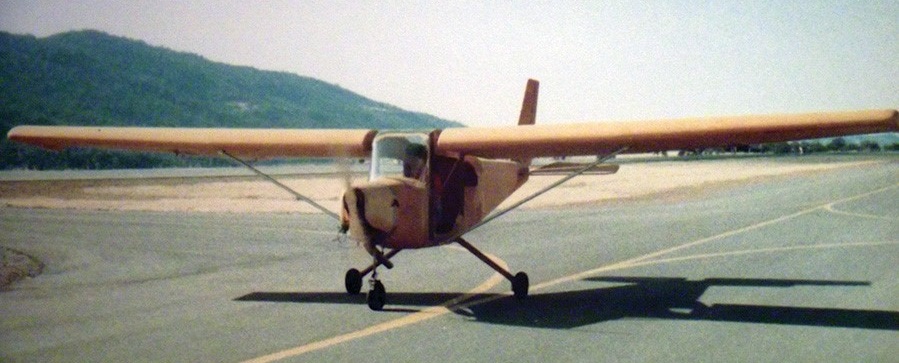
Engine: Walter NZ 120
Prop: Merville, 8 ft dia.
Weight: 1650 lb
Fuel capacity: 24 USG
Oil capacity: 5.67 USG
Speed: 56 mph
Endurance: 2 hr 30 min
Tires: 3.00×19 Dunlop
Aileron span: 9 ft 7 in
Aileron chord: 21 in
Elevator span: 6 ft 7 in
Stabiliser span: 13 ft 2 in
Caudron Frères / Type M / Type N 

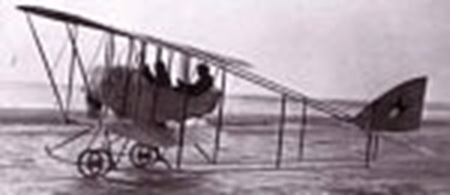
Although almost all the aircraft designed by the Caudron brothers were biplanes, they did in 1911-2 produce three monoplane types. These were the single seat racing Types M and N and the related but somewhat larger Type M2 military version.

The Types M and N were very similar and, though the designations were reported together with some details in contemporary accounts, it has proved difficult for modern historians to distinguish them. They shared the same fuselage and both used a variety of engines but a comparison of data from different contemporary sources suggests that the Type M had a larger wing than the Type N. Though there is some scatter, the span of the Type M was close to 8.7 m (28 ft 7 in) and of the Type N to 8.0 m (26 ft 3 in). In contrast, wing area varied within types.

Around this time, various French manufacturers like Voisin and Farman were hoping to improve the stability of aircraft against gusts by using wings that were partly flexible like those of birds and the Caudron Types M and N also included this feature. Each wing had two steel tube, wood filled spars, one at the leading edge and the other 500 mm (19.7 in) aft, a little behind one third chord, with ash ribs and wire bracing. The number of ribs varied between 10, 11 and 12 and they were conventionally rigid between the spars. Behind the rear spar the upper part of each rib was also rigid, ending at about 70% chord; the lower part was completed by a thin, flexible extension strip for about 60% of the chord. The wing was then fabric covered, though the flexible portion was only covered on the upper side. The wings were supported from above by landing wires from a four-legged pylon above the fuselage and by lifting wires from another below, shorter on the Type N than on the Type M. On the latter the tip of the lower pylon was braced by a horizontal, longitudinal strut to the centre of the undercarriage frame. Lateral control was by wing warping.

The structural fuselage of the Types M and N was a rectangular section, ash framed lattice girder with wire cross bracing. Poplar formers and stringers produced a more rounded, fabric covered section. The pilot sat well down in an open cockpit over the wing and behind the upper pylon. A wide range of engines were fitted, including the 35 hp (26 kW) Anzani three-cylinder inverted Y radial engine, the 45 hp (34 kW) Anzani 6-cylinder two row radial and the 50 hp (37 kW) Gnome. The last, a rotary engine, was usually covered over the upper part to screen the pilot from oil spray; the Anzanis were mounted uncowled. They all drove large, rather broad chord propellers. The very broad chord, low aspect ratio tailplane was constructed like the wing with a flexible rear surface acting both to improve stability and, by warping, act like conventional elevators, its trailing edge extending well beyond the end of the fuselage. A small, near rectangular, one piece, rigid fin was pivoted near its leading edge from the extreme tail.

The Types M and N had a tailskid undercarriage. A transverse steel bar was fixed at each end to an ash V-strut from the lower fuselage and further braced with a steel V-strut from its centre. A pair of axles, hinged at the centre of the bar, passed through the vertices of the ash struts via rubber shock absorbers with the mainwheels, slightly toed out and 1.4 m (4 ft 7 in) apart, beyond them. Early versions of the undercarriage used a single axle rather than a split one. There was an unusually long, curved, tall tailskid at the rear to keep the long tailplane clear of the ground.

Apart from basic specification (dimensions, weights and speed) in Laérophile 1912 and Jane’s All the World’s Aircraft 1913, no records of the Type M2 are currently known.

The first flight dates are not currently known, nor which type flew first, but there are reports of a Type N, piloted by Renée Caudron, flying on 23 December 1911. Fitted with the 35 hp (26 kW) Anzani engine, it flew an out and return flight from Caudron’s Le Crotoy base to Pointe-Saint-Quentin at 100 km/h (62 mph). Two days later it was on display at the 1911 Paris Salon. It was re-engined with a 45 hp (34 kW) Anzani for an English owner, E.W. Ewen, who flew it home across the English Channel on 2 May 1912. Flown by Maurice Guillaux it took part in a circuit of London race in June 1912, starting from Hendon, but retired from lack of fuel just before the end when it looked a likely winner. After many modifications it was on display at the Olympia show in February 1913. In September 1913 F. Goodden demonstrated it the Aerial Derby at Hendon, powered by a 35 hp (26 kW) Anzani; it had been entered for the race with the 45 hp (34 kW) engine but did not compete. The 8.4 m2 (90 sq ft) wing area of this aircraft, possibly the only Type N, was much smaller than that usually quoted (10 m2 (108 sq ft)). Though its span was 230 mm (9.1 in) less than the 8 m (26 ft 3 in) said to indicate a Type N and shown on the three-view in L’Aérophile, the main cause was a narrow chord (1.2 m (4 ft 0 in)) compared with the 1.4–1.5 m (4 ft 7 in – 4 ft 11 in) found in the French references.

Emile Obre flew many demonstration flights in early 1912 with a Type M, powered by a 50 hp (37 kW) Gnome engine. He flew across mainland France and in Corsica, Sardinia and French colonies in North Africa, visiting Tunis and Carthage, where the aircraft was damaged in an accident. At least three Type Ms were built.

Type N

Variants:

Type M
Span 8.7 m (28 ft 7 in) and long lower pylon braced to the undercarriage cross-member.

Type M2
Military machine
span 9.4 m (30 ft 10 in)
wing area 14 sq.m (151 sq ft)
length 6.1 m (20 ft 0 in)
weight 235 kg (518 lb)
maximum speed about 115 km/h (71 mph).

Type N
Span 8.0 m (26 ft 3 in) and short lower pylon.

Type N
Engine: 1 × Anzani or Gnome, 26–37 kW (35–50 hp)
Propeller: 2-bladed Caudron, 2.03 m (6 ft 8 in) diameter
Wingspan: 8.0 m (26 ft 3 in)
Wing area: 10.0 m2 (108 sq ft)
Length: 6.0 m (19 ft 8 in)
Height: 2.0 m (6 ft 7 in)
Empty weight: 175 kg (386 lb)
Gross weight: 300 kg (661 lb)
Maximum speed: 125 km/h (78 mph, 67 kn)
Crew: One

Caudron / Societe Anonyme des Avions Caudron / Societe Caudron-Renault / Ateliers Aeronautiques d’lssyles-Moulineaux 

Caudron Brothers Article

Gaston and Rene Caudron established an airplane factory as Caudron Freres at Romiotte (Seine) in 1910. Initial flight of the first of a series of highly successful biplanes (G.I, II, and III) was in February 1911. The G.III was considered extremely reliable and used widely as a trainer in the First World War. A single-seat monoplane trainer was produced in 1912. G.IIIAs were built for military use in 1914 and used extensively by France, U.K., Belgium, Russia, and Italy as two-seat reconnaissance/ artillery observation aircraft. Several hundred were built, mostly in France, but also by British Caudron and in Italy. The series continued with the G.IV (1915), several military variants, and also in that year the prototype R.4 three-seat bomber appeared. The R.II with five Lewis machine guns was produced a few months before the Armistice was declared.

The company had moved to Issy-les-Moulineaux (Seine) by 1919, and postwar products included the C 23 (and/or C 232) two-seat biplane, which inaugurated French commercial air services on February 10, 1919 with a flight from Paris to Brussels, the C 61 three-engined six/eight passenger biplane, a three-engined seven-seat development of C 61, the C 183, a further modernisation of two previous aircraft of which one only was built, in 1925.

The company, known as Societe Anonyme des Avions Caudron, ran into financial difficulties and was reorganized as Societe Caudron-Renault. Next became notable for distinctive streamlined aircraft from its designer Marcel Riffard, who joined in 1932. His C363 took second place in the 1933 Coupe Deutsch race, and developed versions took first three places in 1934 and 1935, and the first two places in 1936. Derivatives of these included the Rafale series of single- and two-seat sporting/racing aircraft of the late 1930s. Fifteen C 690Ms were built as advanced trainers for the Armee de I’Air. The series ended with the C 720. These were followed by the single-seat C 580 and C 680, C 600 Aiglon series, C 620/C 630 Simoun four-seat cabin monoplane, C 640 Typhon series, the C 670 ground-attack prototype, and the single-seat C 860, built in 1938 for an attempt (never made) on 1936 Paris-Tokyo flight record established by a Simoun. About 1,700 examples of C 440 (later AA.1) Goeland, twin-engined six-passenger transport were built in about ten years. Two series of light fighters were developed from the Coupe Deutsch racers. Following the C 710 and C 713 prototypes, the four-gun C 714 entered service. Improved variants of the CR 760 and 770 were under development when France collapsed. The factories built aircraft for Germany during the Occupation. Later nationalised as Ateliers Aeronautiques d’lssyles-Moulineaux, and incorporated into SNCAN in late 1947.

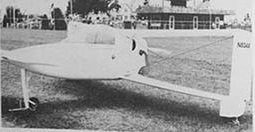
Catto Acro-X

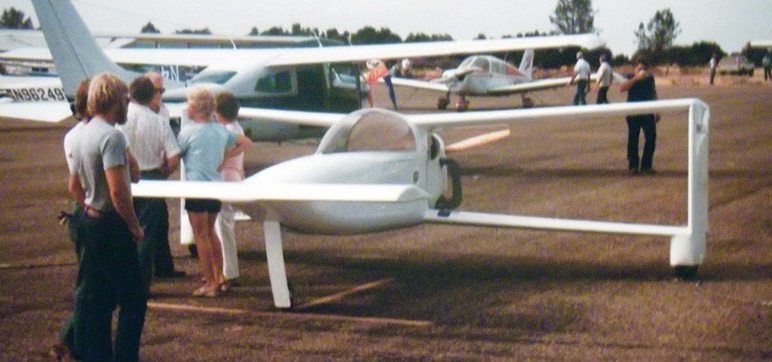
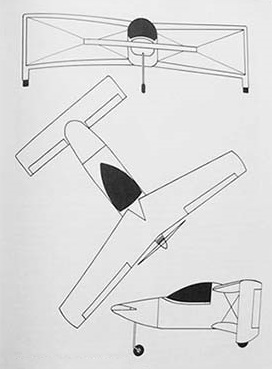
The Catto Acro-X, a pusher canard biplane, was on static display at the 1983 ARV competition in Oshkosh.

The aircraft cost about $8000 with a 50 hp engine.

Catto was forced to bail out and parachute from 500 feet when the Acro-X lost its canopy, jamming in the wing cross brace wires. He got out, and parachuted into the trees.