Weiss, Manfred, Flugzeug Und Motorenfabrikag.
Hungary
One of Hungary’s largest industrial organizations; opened an aircraft department at Budapest 1928, beginning with license-production of Fokker F.VIII and C.V and Bristol Jupiter engine. Built first of its own designs 1931; produced two-seat biplane 1936.
Era
Weir W.6 / Cierva W.6
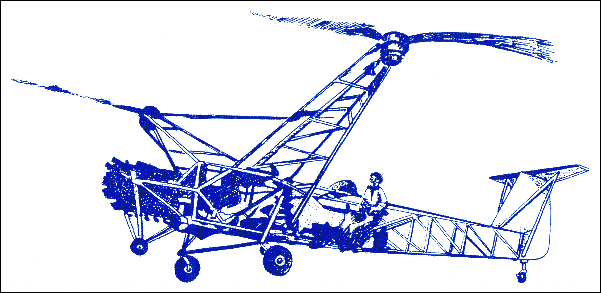
Much larger than its predecessors, this two-seater helicopter was powered by a more powerful fan-cooled engine located in the nose. Each of the two rotors had three blades made of compressed wood with leading edges in metal. They rotated at 275 r.p.m. and had both cyclic and collective control all enclosed within the hub. A ratchet-type freewheeling device was used for flying in auto-rotation.
The maiden flight took place in Scotland in October 1939, but World War II, then in its early stages, caused all work to be stopped on the W.6 in the middle of 1940.
Weir W.6
Seats: 2
Engine: 1 x Gipsy, 205hp
Rotor diameter: 7.62m
Length: 8.53m
Height: 3.2m
Gross weight: 1070kg
Cruising speed: 128km/h
Rate of climb: 198m/min
Absolute ceiling: 3810m
Weir W.5 / Cierva W.5
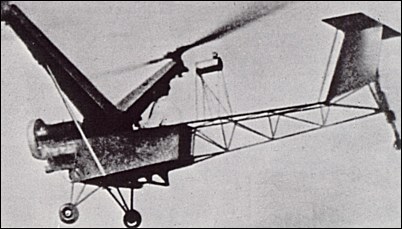
Weir’s chief designer, C.G.Pullin, first thought of converting the W.4 autogyro into a helicopter by using two co-axial rotors, but he finally adopted the system of rotors carried by outriggers on either side of the fuselage, like the 1937 Focke 61.
The W.5 was a single-seater powered by a 50 hp 4-cylinder air-cooled Weir engine; each of the two two-bladed rotors had cyclic and collective pitch control and they turned at 430 r.p.m.
This helicopter made its first flight at Dalrymple, Ayrshire, on 7th June 1938, when it was piloted by R.A.Pullin, son of the chief designer. By the outbreak of World War II it had logged eighty hours’ flying time.
Seats: 1
Engine: 1 x Weir, 50hp
Rotor diameter: 4.57m
Gross weight: 381kg
Max. speed: 112km/h
Rate of climb: 122m/min

Weir W-4
In 1930s built Autogiros under Cierva license; C.28/W-1 in 1933, W-2 in 1934, W-3 and W-4 in 1936.
Weir W.3
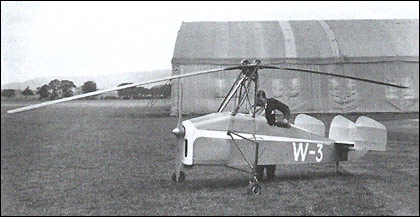
This single-seater was powered by an inverted 4-cylinder in-line engine and fitted with a two-bladed ‘auto-dynamic’ rotor. It could make a ‘jump take-off’: to do this, the rotor was run at overspeed in flat pitch then suddenly given sufficient positive pitch to produce the jump while the engine was declutched. The W.3 was publicly displayed at Hounslow Heath on 23rd July 1936.
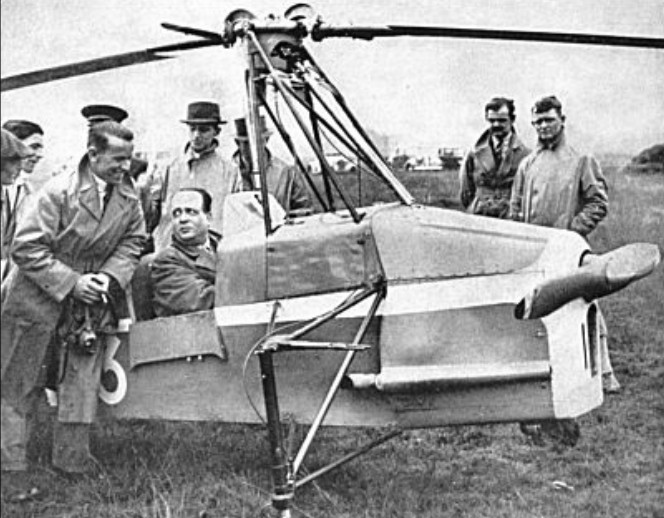
Seats: 1
Engine: 1 x Weir Pixie, 50hp
Rotor diameter: 5.66m
Length: 4.37m
Height: 2.16m
Gross weight: 295kg
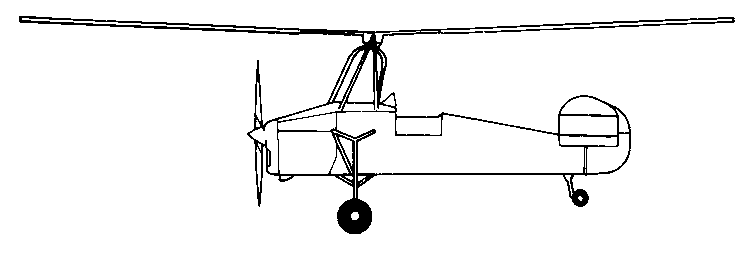
Weir W-2
In 1930s built Autogiros under Cierva license; C.28/W-1 in 1933, W-2 in 1934, W-3 and W-4 in 1936.
Weir W-1 / Cierva C.28
In 1930s built Autogiros under Cierva license; C.28/W-1 in 1933, W-2 in 1934, W-3 and W-4 in 1936.
Weir, G. & J. Ltd
UK
This engineering firm of Cathcart, Glasgow, built Airco D.H.9 and RAF B.E.2c, B.E.2e and F.E.2b aircraft under subcontract during First World War. In 1930s built Autogiros under Cierva license; C.28/W-1 in 1933, W-2 in 1934, W-3 and W-4 in 1936. In 1937-1938 built and flew W-5 twin-rotor helicopter under Focke license, followed by W-6 of 1938-1939, world’s first helicopter to carry a passenger. Outbreak of war ended development.
Weir Draggin Fly
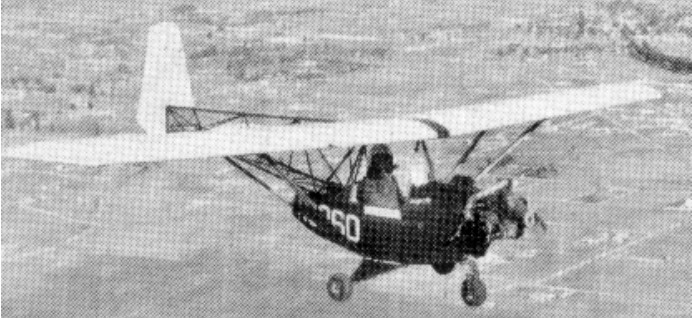
Draggin Fly was designed to be easy to build, inexpensive to fly and maintain, strong, safe, easy to fly with a stock 1600cc VW engine. Ron Weir recommends using only the 1600cc or 1700cc VW — “Smaller engine won’t fly it well, and a larger engine won‘t balance the plane well.”
Gross weight 688 lbs
Empty weight 470 lbs
Fuel capacity 8 Usgal
Wing¬span 24’5”
Length 17’5”
Engine VW1600cc-1700cc
Vmax 70+ mph
Cruise speed 65 mph
Climb rate 350 fpm
Takeoff run150’
Landing roll 200’
Range 170 sm
Weilage Boon
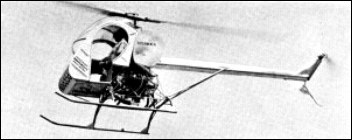
The Weilage Boon was an American two-seater side-by-side light helicopter developed for use by missionaries during the 1960’s. The Weilage Boon was powered by a Lycoming O-235-C four-cylinder horizontally-opposed air-cooled engine providing a top speed of 185km/h.

