CZAW Lake Sport Mermaid / WetAero M6 Mermaid

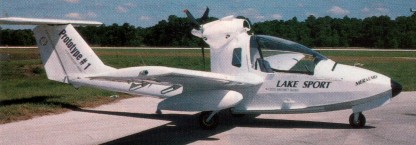
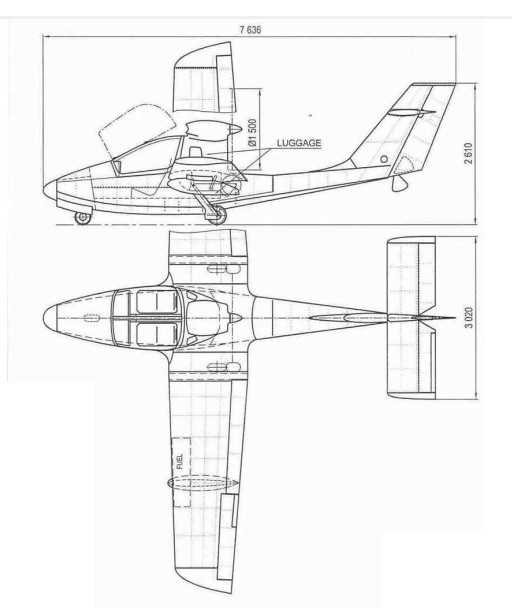
The all-new Mermaid is the first amphibian to be designed especially to comply with the FAAs new Light Sport Aircraft rules. It is also the first new certified single-engine amphibian to reach production in decades.
The design parameters were challenging: make a certifiable, roomy amphibian that will fit the LSA rules (2-place, 1235 pounds gross, low stall speed), and that will be affordable, reliable, and fun to fly; then give it the speed and range to be practical as a transportation device, and dual controls, for training and peace of mind. The Mermaid does it all, and more.
Of conventional all-metal design, the Mermaid is built by European craftsmen, with US-sourced materials. Its five watertight compartments are built with EDO-style pump-outs. The slipper-clutch Rotax 912ULS (914 also available) puts out 100 reliable horsepower while burning well under 5 gph. The useful load is over 500 pounds, and the large baggage area is located nearly on the CG, to make its capacity truly usable. The wide cockpit is comfortable; and it affords a large panel area.

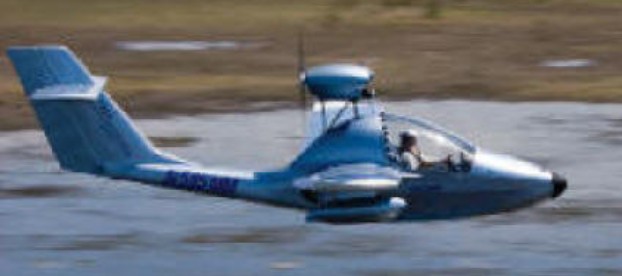
In the US, the very early stages of prototype 1 used a Rotax 100HP as the power plant. This installation was refined over the next two years with probably no less than 6 different configurations using the Rotax. After essentially complete redesign of the prototype number one in the U.S. with this power plant, the next one and half years of performing flight and water testing gave good results. Even though adequate in horsepower, performance should be better on hot and heavily loaded days, and there were propeller inefficiencies from some of the after body aerodynamic interference.
WetAero M6 Mermaid

During one of the demo flights a customer from Australia suggested it might have better performance with a Jabiru 125 HP power plant. During initial flight tests this power plant proved to perform slightly better than the Rotax. But the installation was still lacking its full potential until repositioned higher above the after body structure. This one modification substantially increased the performance of the M6. The Jabiru was a tough engine to cool in the pusher configuration. After almost a year perfecting this engine installation they were capable of running on step taxi without limitations.

But then one customer insisted on the Rotax installation.

Dan Card received the first production Mermaid in parts and began construction in December 2005. Parts and pieces to make the fuselage, bulkheads, tail, and wings arrived from Czech Aircraft Works, where they were previously partially assembled using the factory jigs. Dan still had much of the aircraft to build. The challenge to build the first customer-built Mermaid began with assembling the aircraft for fit and finish while meeting the individual aspects of being “the first.” The construction of the Mermaid is very conventional as far as riveted aluminum monocoque construction goes. With plenty of traditional rivets to squeeze and buck, the fuselage in essence emerges in one piece, from nose to vertical stabilizer, including a robust center section to which the wings attach. The V hull is reinforced with a boxed section (at the bow) that houses the nose wheel when it’s retracted and closed off by its doors. It’s also triangulated with a flat floor onto which the seats, rudder pedals, and center console get fastened. With a series of 10 bulkheads, about a foot apart, completing the structure, the hull area below the seats becomes exceedingly robust.

The wing center section extends past the cockpit just far enough to support (or be supported by) the repositionable (not fully retracted) hydraulically actuated main gear. The wings are attached just outside the main gear bay via three bolts in the main spar and one in the drag spar, but in each instance, there is no carry-through of either spar. The ailerons on the Mermaid are actuated by push-pull and torque tubes, not cables. The flaps stop at the butt end of the wing and do not extend through the center section and die into the fuselage. They are slotted and use a displaced hinge pivot similar to the RV-10, a Cirrus SR22, or a Lancair Legacy; not really clean, but simple. The center section is also used as a platform for supporting/carrying ancillary systems like the battery, fuel pumps and filters, strobe pack, solenoids, disconnects, and relays, but it also serves as the main attachment for the engine pylon.

This Mermaid’s inaugural flight took place in September 2007 and was conducted over the rural farmlands of Fresno, California.

The Mermaid received ASTM certification #19.

Stall: 35 kt / 40 mph / 64 kmh
Cruise: 100 kt / 115 mph / 185 kmh
VNE: 115 kt / 132 mph / 212 kmh
Empty Weight: 330 kg / 727 lbs
MTOW Weight: 560 kg / 1235 lbs
Climb Ratio: 1000 ft/min / 5 m/s
Take-off distance (50ft obstacle): 600 ft / 183 m
Landing distance (50ft obstacle): 600 ft / 183 m

Engine: Jabiru 3300, 120 hp
Wing span: 31 ft
Wing area: 124 sq.ft
Length: 24 ft
Empty weight: 888 lb
Gross weight: 1430 lb
Fuel capacity: 30 USG
Cruise: 115 mph
Stall: 40 mph
Range: 580 sm
Rate of climb: 1000 fpm
Takeoff dist: 450 ft
Landing dist: 500 ft
Seats: 2
Cockpit width: 44 in
Landing gear: retract tricycle
LSA: yes

WetAero M6 Mermaid
Engine: Rotax 912 ULS
Wing span: 33.3 ft / 10,152 m
Length: 25 ft / 7,62 m
Wing area: 134.5 sq.ft / 12,5 sq.m
Wing loading: 10.65 lb/sq.ft / 45,6 kg/sq.m
Empty weight: 925 lb / 420 kg
Gross weight: 1430 lb / 650 kg
Useful load: 505 lb / 230 kg
Cabin width: 46 inch / 117 kg
Fuel capacity: 2×15 U.S.gal / 2×57 liters
Luggage space: 16 cu.ft / 450 lt
“G” limit: +4 / -2 G
Take-off (grass): 511 ft / 156 m
Take off (50″ object grass): 850 ft / 259 m
Climb rate: 800 fpm / 4 m/s
Stall speed with flaps: 32 mph / 52 km/h
Stall speed w/o flaps: 36 mph / 57 km/s
Cruise speed (75% power – TAS): 110 mph / 177 km/h
Never exceed speed (VNE): 155 mph / 250 km/h
Range (75% power, no res.): 450 sm / 725 km
Endurance (no res.): 4,5 hours
Landing ground roll (grass): 434 ft / 132 m
Price 2012: $147,000 Rotax 912ULS Base Model
$168,000 fully optioned.

WetAero M6 Mermaid
Jabiru 3300 120 HP
Takeoff (grass): 450 ft / 137 m
Takeoff (50-foot object grass): 1,080 ft / 330 m
Climb rate: 910 fpm / 4,6 m/s
Stall speed with flaps: 32 mph / 52 km/h
Stall speed w/o flaps: 36 mph / 57 km/h
Cruise speed (75% power TAS): 118 mph / 190 km/h
Never-exceed speed (Vne): 155 mph / 250 km/h
Range (75% power, no reserve): 620 sm / 1000 km
Endurance (no reserve): 4 hours
Landing ground roll (grass): 434 ft / 132 m
CZAW Zodiac

In 1992, Heintz also entered into a license agreement with Czech Aircraft Works of Stare Mesto, Czech Republic, to produce and market his Zodiac CH 601 and STOL CH 701 designs for the European market. The Czech-produced Zodiacs were modified and lightened to meet European rules for microlight aircraft. CZAW produced some 750 such machines under this agreement. On 31 December 2006, after the license agreement, under which the Zenair Zodiac CH 601 and STOL CH 701 light aircraft designs were produced by CZAW, was terminated and the Czech production came to an end.

CZAW / Czech Aircraft Works / Czech Sport Aircraft

In 1992, Heintz also entered into a license agreement with Czech Aircraft Works of Stare Mesto, Czech Republic, to produce and market his Zodiac CH 601 and STOL CH 701 designs for the European market. The Czech-produced Zodiacs were modified and lightened to meet European rules for microlight aircraft. CZAW produced some 750 such machines under this agreement. On 31 December 2006, after the license agreement, under which the Zenair Zodiac CH 601 and STOL CH 701 light aircraft designs were produced by CZAW, was terminated and the Czech production came to an end.

Czech Aircraft Works (CZAW) was renamed Czech Sport Aircraft.

Cyclone Airsports AX2000             

HKS 700E powered AX2000

The Cyclone Airsports AX2000 is a development of the earlier Cyclone AX3, a UK regulation compliant variant of the French Ultralair Premier AX3. This, in turn, was a three axis development of the US Chotia Weedhopper from the early 1980s.

The AX2000 is a British built three axis microlight, with an aluminium tube framed three axis microlight with flying surfaces covered with a polyester fabric with outer PVF lamination (URLAM). The whole aircraft is built around a long, high aluminium keel boom, which bears the engine, wings and empennage.

The wing is a two spar structure, with surfaces formed by upper and lower battens rather than ribs. It carries conventional, full span, tapering ailerons but no flaps. The tailplane is mounted on the keel and has an anti-balance/trim tab on the starboard elevator. There is a small fixed fin below the keel but none above; the rudder is balanced and extends below the elevators, moving in a cut-out.

The short, deep fuselage is built around a wire braced tube beam. Lift and landing loads are taken by V-shaped, cross braced pairs of lift struts from the bottom of the fuselage to each wing, assisted by a centre line strut to the boom at the wing leading edge. The cockpit enclosure is non-structural, with forward opening doors to a pair of side-by-side seats. These are equipped with separate rudder pedals but the occupants share a central control column. The AX2000 has a tricycle undercarriage mounted close to the fuselage.

The engine is mounted, uncowled, ahead and above the wing leading edge, with the propeller shaft on the boom line. One of three engines may be fitted: a 48 kW (64 hp) Rotax 582/48 or 38 kW (50 hp) 503 2V, both upright twin cylinder two strokes, or the 45 kW (60 hp) HKS 700E (either V3 or Beta variants), flat twin four stroke.
Both Rotax engines drive propellers with ground adjustable pitch: the 582 has a three blade, composite propeller and the 503 a two blade wooden one.

As well the new engines, the AX2000 differs chiefly from the AX3 in having a completely double surface wing of reduced area and modified structure, a change of alloy for the main keel beam, a revised and lightened fuselage with new undercarriage, an increased fuel capacity and the addition of an elevator anti-balance trim tab.
The AX2000 is certificated as a glider tug, for gliders of class 1 and 2. A V-shaped forward tow line extension joins the main line to a pair of tug pillars attached to the rear spar on the under surfaces of the AX2000’s wing.

In mid-2011 there were 29 AX2000s on the UK civil aircraft register.

Wingspan: 9.10 m (29 ft 10 in)
Wing area: 15.77 m2 (169.7 sq ft)
Length: 5.60 m (18 ft 4 in)
Height: 2.10 m (6 ft 11 in)
Empty weight: 201 kg (443 lb)
Max takeoff weight: 450 kg (992 lb)
Fuel capacity: 62 L
Maximum speed: 100 km/h; 54 kn (62 mph) manoeuvring
Stall speed: 58 km/h; 31 kn (36 mph)
Never exceed speed: 145 km/h; 78 kn (90 mph)
Crew: 2

C.W. Aircraft

UK
Established 1936 by C R. Chronander and J. I. Waddington to design and develop Cygnet two-seat all-metal cabin monoplane, which first flew in 1937. Rights in Cygnet acquired by General Aircraft Ltd. in 1938. C W. was then re-formed as Chronander Waddington Aircraft Ltd., a company not concerned with the building of aircraft.

CVT M300

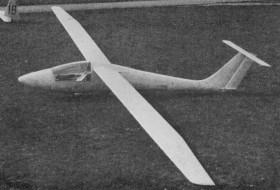
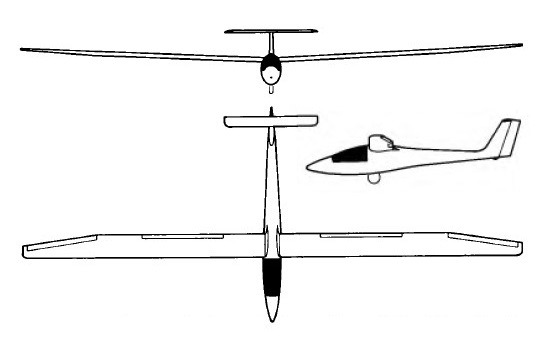
Designed by Alberto Morelli, the M-300 is a high performance single-seater intended not only for club use but for competition and record flying, and to this end particular attention has been paid to structural design and techniques both to reduce the time taken forcontruction and to ensure the necessary accuracy and quality of surface finish.

Only two prototypes of the M-300 were in the end built and flown at the CVT (Centro di Volo a Vela del Politecnico di Torino) at Turin, the first making its maiden flight in April 1968. The shoulder wings are of composite construction, the tapered wing spar being a machined aluminiumzinc alloy (-section beam with lightening holes in the web, and the ribs are milled out of a wooden sandwich, the wing skin being of thick pre-formed plywood panels. The fuselage is a semi-monocoque wooden structure with four main frames and nine stringers, and with a glassfibre nose cone; wing/fuselage attachment is by means of Redux-bonded dural fittings. The rudder is double-slotted and the all-moving tailplane on top of the fin is a narrow chord one-piece aluminium alloy structure. A retractable monowheel is provided.

Wing span: 15m / 49 ft 2.5 in
Wing area: 9.16sq.m / 98.6 sq.ft
Length: 6.39 m / 20 ft 11.52 in
Empty Weight: 190 kg / 419 lb
Gross Weight: 300 kg / 661 lb
Water ballast: None
Wing Load: 32.7 kg/sq.m / 6.69 lb/sq.ft
Max speed: 155mph / 135 kt / 250 km/h
Stalling speed: 38.5 kt / 71 km/h
MinSink: 0.62 m/sec / 2 ft/sec at 49 mph / 45.2 kt / 79 km/h
Best glide ratio: 38:1 at 55mph / 47.5 kt / 88 km/h
Aspect ratio: 24.7
No. of Seats: 1

Cvjetkovic CA-51

The construction of this plane dates back to January 1951 when Anton Cvjetković, a student of the third year of the Faculty of Technology in Zagreb, with the help of five faculty colleagues, was completed at the Radionice Airport in Croatia.

The first plane was designed at Marinkovićeva Street (Petrićeva op.a) where the Aerokluba chairman provided a studio apartment. There the hull and wings were built. In Zagreb it was a difficult time, it is not possible to purchase an engine for the plane. One of the friends had a used Volkswagen the engine was used.

The CA-51 aircraft is a wood unit intended to meet the level of amateur construction.

Construction was completed at the end of 1952. The first test flight was carried out by pilot Šuro Švarc on 19 November 1952 in Zagreb.

At the end of the VOC’s testing, the “Zagreb” Aeroclub is able to build five CA-51 aircraft. On one of the aircraft an additional fuel tank of 47 liters is fitted so that the range of 650 km is increased to 1,600 km. In the Zagreb-Bjelovar-Petrinja-Zagreb area, the pilot Berkovic flew about 1,200 km in 10 hours and 50 minutes with a speed of 110.8 km / h.

The constructor of the first aircraft emigrated to the USA in 1957 and there he set the further development of this aircraft, such as the 1961. the CA-61 aircraft with a Continental A65 engine, 47kW, and the 1965. the CA-65 with the Lycoming O-290-G engine of 92 kW.

YU-CMH No. 2 was located at a Museum in Belgrade.

CA-51
Engine: VW1000 cc, 22-hp at 3,000 rpm
Prop: two-blade wood
Wingspan: 8.40 m
Wing area: 11.76 m²
Length: 5.86 m
Height: 2.00 m
Empty weight: 211 kg
Normal flight: 328 kg
Fuel capacity: 39 lt
Max. speed: 224 km / h
Cruise speed: 127 km / h
Stall: 60 km / h
Range: 650 km
Ceiling: 2,700 m
Endurance: 5.5 h
Fuel consumption 4.2 lt/hr
Seats: 1
Cabin width: 1.3 m

Cvjetkovic CA-65 Skyfly

This airplane represents a further development of the CA-61 Mini Ace, which first flew in July 1965. The CA-65 is an all wood side by side two seater low-wing monoplane with retractable landing gear and dual controls, designed in 1964-65. It features a streamlined canopy, enclosed engine, tapered wing and fully retrac¬table gear. Its wood construction cuts requirements for tooling and special jigs to a minimum. The wing consists of a centre section and two outer panels set at 3o dihedral. The wing structure is made up of two spruce spars, built up girder type ribs and is completely plywood covered. The fuselage is of conventional wood construction and covered with plywood. A manually operated flap is fitted under the fusealage. The empennage consists of ply covered fixed surfaces and fabric covered control surfaces. On the folded wing version the outer panels fold upwards from the centre section. Mechanically, inward retracting, main undercarriage legs are fitted. Two 11 Imp gallon fuel tanks are installed in the fuselage. Engines from 108 to 150 hp.

Gallery

Engine: Lycoming 0-290-G, 125 h.p.
Span: 25 ft 0 in
Length: l9 ft 0 in
Wing Area: l08 sq.ft.
Empty Weight: 900 lb.
Loaded Weight: 1,500 lb.
Max. Speed: 135 mph.
Cruise Speed: 125 mph.
Stall Speed: 55 mph.
Initial Climb: 900 fpm.
Range: 450 miles.
Fuel capacity 22 Imp.G.
Ceiling 15,000.
Takeoff run 450 ft.
Landing roll 600 ft.
Seats: 2.

Engine: Lycoming O-320, 150 hp.
Vne: 156 kt.
MAUW: 1500 lb.
Empty wt: 963 lb.
Fuel cap: 113.5 lt.
Endurance: 3.2 hr.
Stall: 52 kt.
Cruise: 120 kt.

Engine: Lycoming
Wing span: 7.62 m
Wing area: 9.94 sq.m
MAUW: 680 kg
Empty weight: 408 kg
Fuel capacity: 105 lt
Max speed: 290 kph
Cruise speed: 250 kph
Minimum speed: 88 kph
Climb rate: 5 m/s
Seats: 2
Fuel consumption: 25 lt/hr
Plan price (1998): $180