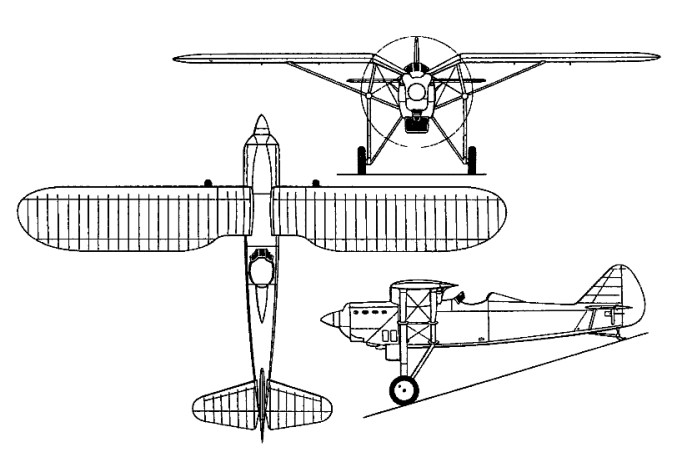
A glider circa 1935
Era
DFS / Deutsche Forschungsinstitut Für Segelflug / German Research Institute for Gliding / Rhon-Rossiten-Gesellschaft
Established as the Rhon-Rossiten-Gesellschaft at Wasserkuppe in 1925.
Became DFS on moving to Darmstadt in 1933 and undertook glider research. Designed and built the successful DFS 230 assault glider in the Second World War, and the DFS 228, an air-launched rocket aircraft used as a research vehicle for the DFS 346, a swept-wing reconnaissance project expected to reach 1,650mph (2,655kmh) at 66,000 ft (20,120 m). Also undertook development of Me 163 and Mistel composite bomber. Experimented with delta designs by Dr. Alexander Lippisch and evolved piloted V-1. In 1946 the DFS 346 project and its engineering design staff were taken by the Soviets to Podberczhye, where the project was said to have been completed.
DFL Tango
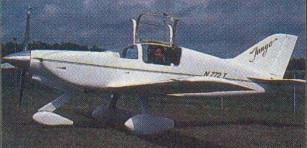
Fabricated in Asia from American moulds, prefabricated instrument panels and firewall forward options reduce the build time.
Top speed: 225 mph
Cruise: 208 mph
Stall: 63 mph
Range: 850 sm
Rate of climb: 1500 fpm
Takeoff dist: 600 ft
Landing dist: 800 ft
Engine: Lycoming O-360, 180 hp
HP range: 150-200 hp
Fuel capacity: 40 USG
Empty weight: 1040 lb
Gross weight: 1800 lb
Length: 19.3 ft
Height: 7.25 ft
Wing span: 25 ft
Wing area: 75 sq.ft
Seats: 2
Landing gear: nose
DFL Holdings Inc
1997: 3001 NE 20th Way Gainesville, FL 32609, USA.
Kitplane manufacturer
DFG Hintner Eindecker
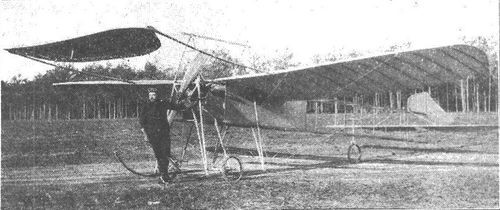
DFG Hintner Eindecker of 1910 was a monoplane drawn up by the Cornelius Hintner – a successful Austrian artist who later became famous as a film director – realized by the German firm of Deutsche-Flugmaschinenbau-GmbH.
The Hintner Eindecker was special in that the elevator was mounted in front of the tractor propeller. Power was supplied by a 25 hp Anzani 3-cylinder radial driving a Chauvière propeller. The wing area was about 30 m², where total weight (inclusive the pilot) was 280 kg.
During the first test flight the machine flew for 500 meters at a height of 25 meters, most likely only in a straight line. The machine lifted after a run of only 25 to 30 meters.
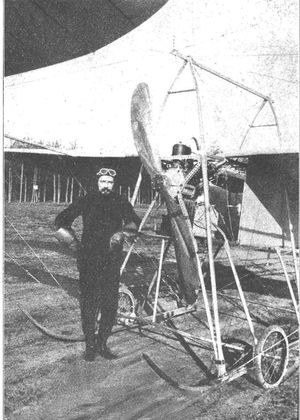
When Hintner flew his Eindecker he had no licence and almost certainly no flying experience whatsoever. He later received German flying licence No.110 on September 9, 1911 flying an Albatros biplane at Berlin.
DFG / Deutsche-Flugmaschinenbau-GmbH
Around 1910, the constructor at DFG was W. Schultze-Herfort who designed several monoplanes which were known under his own name.
DFE Ultralights
1995-8: RD 1, Box 185, Vanderbilt, PA 15486, USA.
UL builder
Dewoitine C-38
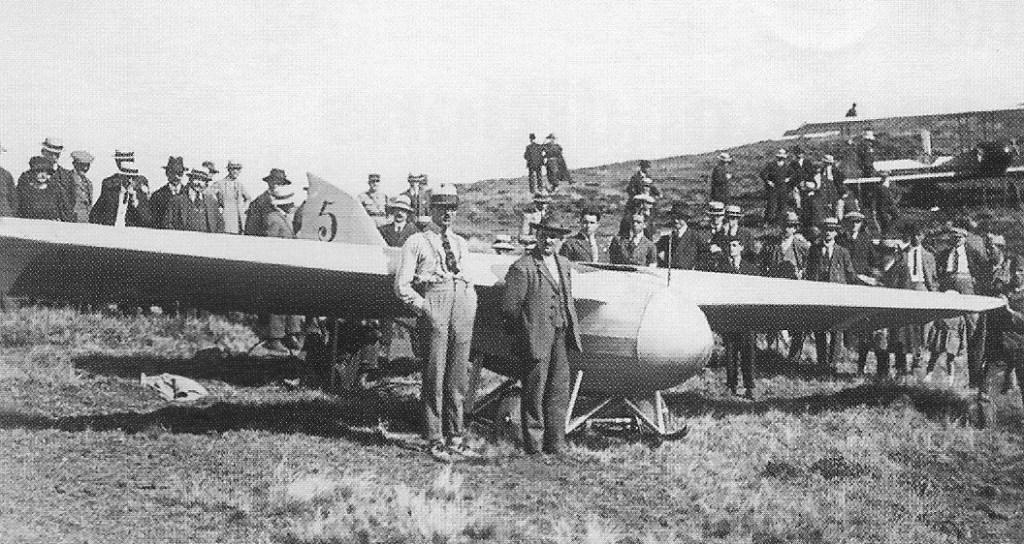
The Dewoitine monoplane had already been flown in the first French soaring contest at Clermont Ferrand in 1922. It was able under Georges Barbot, in the autumn of 1922, to make a gliding flight of 20 minutes from the plateau of Super-Bagderes (Pyrenees) with an altitude difference of 1200 meters. In 1923, it was flown by Barbot 8 hours, 36 minutes and 56 seconds in Biskra, Africa.
The Dewoitine monoplane has flexible wings without external brace-wires. For transportation, the wings can be folded back against the fuselage, without being entirely disconnected. Each wing has a hollow main spar and tapers outward.
It is steered by warping the ends of the wings, the rear two-thirds being flexible and the front third rigid.
The fuselage has a streamline form made by oval ribs- connected by light spars. On the glider, the front end of the fuselage consisted of a spherical cap of plywood, the latter was replaced by an engine on the low-powered airplane.
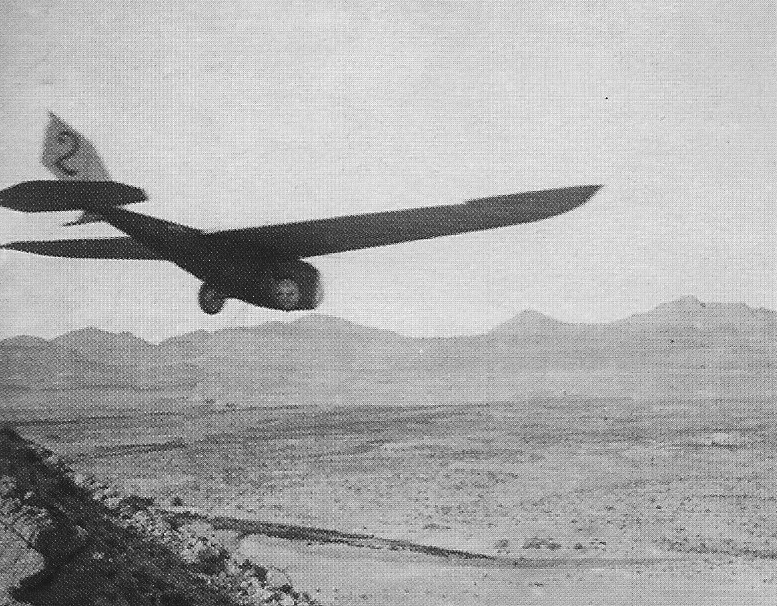
The 7 to 10 HP Anzani engine was originally designed for motorcycles. It had two opposite cylinders and was air-cooled. The brake horse-powers were;
7 HP at 1250 R.P.M.
8 HP at 1350 R.P.M.
9 HP at 1450 R.P.M.
11.75 HP at 1800 R.P.M.
12.75 HP at 2200 R.P.M.
With wide-open throttle, the revolution speed was about 1350 R.P.M., hence 8 HP.
The weight of the supporting structure is 35 kg (77.2 lb) or 4.375 kg (9.65 lb) per HP. The weight of the fuel is about 20 kg (44.1 lb) and the power plant 80 kg (176.4 lb). With a total weight of 250 kg (551.2 lb) the total load per HP is 31.25 kg (68.9 lb).
The engine is located in the front end of the fuselage and drives a two-bladed propeller. The fuselage is supported by an ordinary landing gear with rubber-tired wheels. The fuselage and wings are covered with fabric.
The flight performances are said to have been satisfactory. Barbot reached an altitude of 500 m (1640 ft) in a 25-minute flight from Francavat to Toulouse. The start was made from a level field.
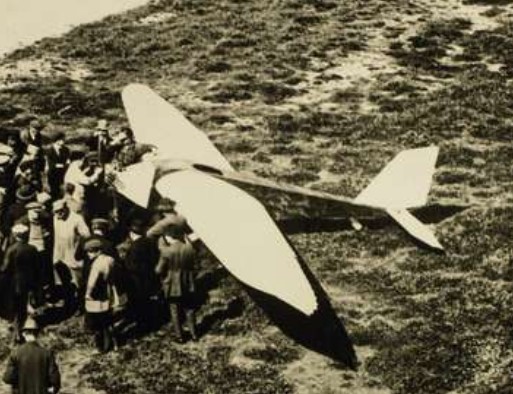
Barbot made another flight from St. Inglevert (France) across the English Channel to Lympne (England) and back. The time going was 50 minutes; returning, 43. minutes. The consumption for both flights was 4.5 liters (1.2 gallons) gasoline and 0.7 kg (1.54 lb) oil. At 1500 R.P.M. near the ground, the speed was 90 km/hr (56 mi/hr). At 1200 R.P.M it was 75 km/hr (47 mi/hr). The theoretical ceiling was 2000 m (6562 ft).
Span: 11.3 m (37.07 ft)
Wing area: 11.5 sq.m (123.78 sq ft)
Aspect ratio: 10
Length 4.9 m (16.08 ft)
Weight empty 115.0 kg (253.5 lb)
Total weight 250.0 kg (551.2 lb)
Dewoitine D.570
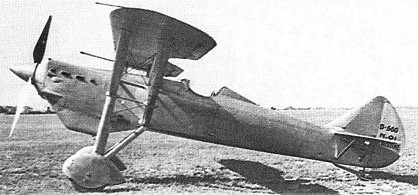
At the end of March 1933, criticism of the gulled wing of the D 560 led Emile Dewoitine to replace this with a wing of parasol form and of reduced span and area. Re-designated D 570, the modified prototype entered flight test on 27 November 1933, transferring from Francazal to the Centre d’Essais at Villacoublay early in December. It flew back to Francazal for minor modifications, and, on 21 December, while returning to Villacoublay, suffered an aileron failure and was destroyed.
Engine: HS 12Xbrs, 600 hp
Max take-off weight: 1709 kg / 3768 lb
Empty weight: 1284 kg / 2831 lb
Wingspan: 11.58 m / 37 ft 12 in
Length: 8.53 m / 27 ft 12 in
Height: 3.42 m / 11 ft 3 in
Wing area: 17.00 sq.m / 182.99 sq ft
Max. speed: 338 km/h / 210 mph
Dewoitine D.560
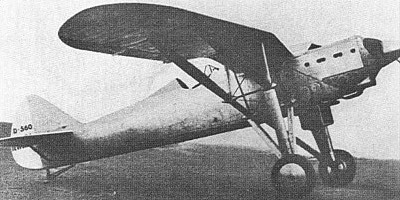
Aware of some prejudice against the low-wing monoplane configuration for single-seat fighters, Emile Dewoitine evolved almost simultaneously with the low-wing D 500 a fighter of shoulder-mounted gull wing configuration. This used the same 660 take-off horsepower HS 12Xbrs engine, the same fuselage and essentially similar tail surfaces. Designated D 560, this fighter flew for the first time on 5 October 1932, proving to be slower at rated altitude than the equivalent low-wing monoplane when flown at the Centre d’Essais at Villacoublay during the following month. The ventral radiator bath was extended forward similar to that of the D 500, and to rectify a stability problem the vertical tail was enlarged. The manoeuvrability of the D 560 proved outstanding, but evaluation pilots participating in the 1930 C1 programme universally condemned the gulled wing (which was also featured by other contenders – the Loire 43, the Gourdou-Leseurre 482 and the Mureaux 170). As a consequence, the D 560 was rebuilt as a classic parasol monoplane, the designation being changed to D 570.
Engine: HS 12Xbrs, 600 hp
Max take-off weight: 1698 kg / 3743 lb
Empty weight: 1270 kg / 2800 lb
Wingspan: 12.47 m / 40 ft 11 in
Length: 8.48 m / 27 ft 10 in
Height: 3.42 m / 11 ft 3 in
Wing area: 17.30 sq.m / 186.22 sq ft
Max. speed: 375 km/h / 233 mph