Dittmar, Heini

Inspired by his gliding brother Edgar, Heini Dittmar made an apprenticeship at the German Research Institute for gliding after leaving school. At the age of 18, he passed his A and B gliding test in 1929. In 1932, at the age of 21, he won the first victory of his class in the Rhön gliding competition with a self-made glider (Condor). Then he became involved as a research pilot.

After success with long-distance gliding, Dittmar became a member of the German gliding expedition to Argentina together with Hanna Reitsch and Wolf Hirth in 1934, where he set new world height records for gliders (February 16, 1934 over 4350 m). In 1934, Dittmar set another long-distance world record with Fafnir II and was awarded the Hindenburg Cup. In 1936, he made the first crossing of the Alps in a glider. Heini Dittmar crowned his career as a glider pilot with victory in the first international Rhön competition in 1937, which was later recognized as the first world championship in gliding. In addition, he was awarded the Golden Mark in Slide No. 1.

With the rocket aircraft Me 163 A-V4 KE + SW, Heini Dittmar reached 1003.67 km / h for the first time in a test flight on October 2, 1941 and was the first person to exceed the 1000 km / h mark in an aircraft. On July 6, 1944, Heini Dittmar reached a speed of 1130 km / h with Me 163 B V18 Komet VA + SP.

During and after World War II, Heini Dittmar worked as an aircraft designer and test pilot, but remained largely apolitical in the spirit of National Socialism. The National Socialists also used the enthusiasm for gliding that arose after the First World War to train young pilots and not least for the air force that was established. Heini Dittmar, who despite all modesty was also very popular abroad, represented the best possible advertisement for gliding through his appearance and success, which was carried out with books about Dittmar’s sporting achievements that were suitable for young people until the war.

A designer of high-performance sailplanes, Heine Dittmar produced a motorized version of his Segelmowein in 1953-1954 as the HD 153 Mowe two-seat light aircraft. Wing and tail detached for road transport. A small number of these aircraft, and of the later HD 156 three-seat aircraft, was built.

He died in 1960 when he crashed on a test flight with his own design HD-153 Motor-Möwe near Essen-Mülheim airfield. The machine, which was originally designed as a glider under the name HD 53 Möwe (later HD 153A-1 or HD 156A-1), had its first flight in 1953, but the type certification lasted until 1957. In the end, only eight or nine HD 153 and seven were built. HD 156 (more luxurious version of HD 153) of the machines equipped with a 71 kW Continental C-90 engine.

In his hometown, Mülheim an der Ruhr, as well as in Augsburg and Schweinfurt, the streets bear his name (Heini-Dittmar-Straße), as well as in Kiel-Holtenau (Dittmarweg).
Dittisham Aerostat

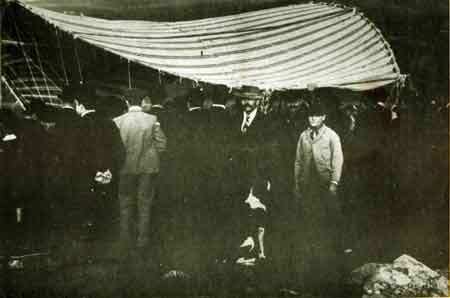
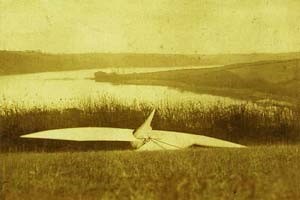
Designed and built by the Swiss engineer Albert Liwentaal while he was living in Devon, England, the Dittisham Aerostat of 1894 glider was tested twice, and crashed twice. The photograph, the image appearing to have been printed backwards, shows the result of the final trial, which took place near Bozomzeal, above Dittisham, Devon, along the River Dart.

Dits

France
Les Etablissements Henri Dits founded in 1922 to build the designs of pioneer Breguet pilot Rene Moineau, starting with a small metal aircraft for tropical service. During First World War produced an aircraft with twin propellers driven by engine mounted transversely in the fuselage.

Direct Fly Alto

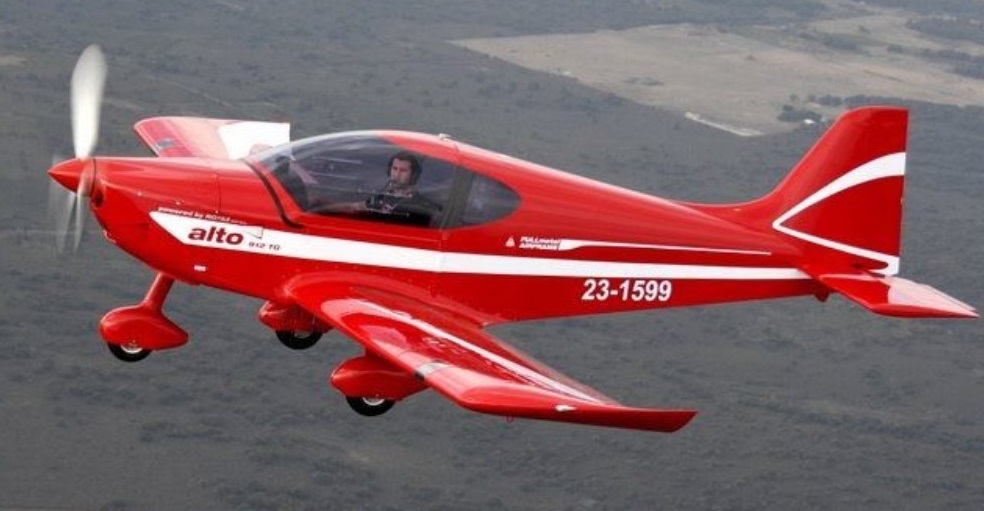
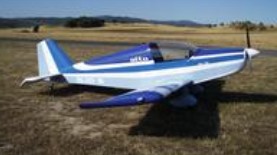
The Alto aircraft is an all-metal construction aircraft for amateur construction. The Alto aircraft meets both requirements to European category “ultralight aircraft” and “light sport aircraft” (LSA) category that has been defined in the U.S.A.

Different versions were offered. A basic version with the tricycle, nose type landing gear or optional with the tail landing gear with Rotax 912 ULS/UL as standard, but Jabiru on request, and wheel-type control or the stick control, standard is wheel control

Alto is single-engine, two-seat, low-wing, cantilever monoplane. The aircraft is all-metal riveted construction and may be equipped with rescue parachute system.

Alto 912 TG

The TG version (basic) is the tricycle, nose type with the nose landing gear steering. The main wheels are attached to the flexible all-composite legs. The main landing gear wheels brakes are operated by the hydraulic system, by means of break pedals (in the left side only) or with central brake with parking function. The TW version (optional) has the tail wheel landing gear.

The rectangular wing is a monospar construction with an auxiliary spar. The skin is made from duralumin sheet. The wing is equipped with ailerons, slotted flaps and integral fuel tanks with a total capacity of 105 l. All the parts are riveted together. The wing-body attachment forms a wing centre section, which is firmly placed into the fuselage. The wing main spar is connected to the wing centre section by bolts and the rear auxiliary spar is connected by a hinge.

The rectangular fuselage is of semimonocoque, riveted construction and has a bottom and the side walls reinforced by diagonal stiffeners. The dorsal is of oval cross section.

Alto 912 TG

The tail unit is of all-metal, riveted structure and has a standard configuration.

Aeroplane control consist of elevator, ailerons and rudder control surfaces. The manual control is of a wheel-type or a stick and deflections are transmitted by chains, push-pull tubes, and cables. The pedal control deflections are transmitted by cables to the rudder, and by push-pull tubes to the nose landing gear steering. The wing flaps and the elevator trim tabs are operated electrically. The main landing gear wheels brakes are independently operated by the hydraulic system, by means of break pedals on the pedal control.

The cockpit inner width is 106 cm and the wheel-type control and a forward sliding canopy make for easy boarding. The canopy is made from glass, and optionally may has light blue colour, and may be equipped with the wind-wings.

2009 Price: 44000 EURO

Alto TG 912 UL
Engine: Rotax 912UL, 80 hp
Length: 6,15 m / 20,18 ft
Wing span: 8,20 m / 26,9 ft
Wing area: 10,5 sq.m / 114 sq.ft
Height: 2,25 m / 7,38 ft
Cabin width: 1,10 m / 3,61 ft
Seats: 2
Fuel: 118 lt / 31,2 US gal
Take off run: 100 m / 328 ft
Landing run: 150 m / 492 ft
Empty weight: 280 kg / 618 lb
MTOW – ULM: 472 kg / 1041 lb
MTOW – LSA: 600 kg / 1320 lb
Vne: 255 km/h / 158 mph
Maximum speed: 230 km/h / 143 mph
Cruising speed: 185 km/h / 115 mph
Stall speed full flaps 450 kg: 65 km/h / 41 mph
Stall speed no flaps 600 kg: 81 km/h / 51 mph
G factor: +4 / -2
Climb rate 450 kg: 5,6 m/s / 1100 fpm
Climb rate 600 kg: 4,5 m/s / 890 fpm

Alto TG 912 ULS
Engine: Rotax 912ULS, 100 hp
Length: 6,15 m / 20,18 ft
Wing span: 8,20 m / 26,9 ft
Wing area: 10,5 sq.m / 114 sq.ft
Height: 2,25 m / 7,38 ft
Cabin width: 1,10 m / 3,61 ft
Seats: 2
Fuel: 118 lt / 31,2 US gal
Take off run: 90 m / 295 ft
Landing run: 150 m / 492 ft
Empty weight: 285 kg / 628 lb
MTOW – ULM: 472 kg / 1041 lb
MTOW – LSA: 600 kg / 1320 lb
Vne: 270 km/h / 168 mph
Maximum speed: 250 km/h/ 155 mph
Cruising speed: 200 km/h / 124 mph
Stall speed full flaps 450 kg: 65 km/h / 41 mph
Stall speed no flaps 600 kg: 81 km/h / 51 mph
G factor: +4 / -2
Climb rate 450 kg: 6,3 m/s / 1250 fpm
Climb rate 600 kg: 5,1 m/s / 1005 fpm
Take-off distance (50ft obstacle): 440 ft / 135 m
Landing distance (50ft obstacle): 490 ft / 150 m

Direct Fly sro

The company Direct Fly s.r.o. was founded in 2006. The main subject of enterprise of the company is batch production of the ultralight sport aircraft ALTO. The aircraft factory is situated near Uherské Hradiště – Kunovice, in region with 70 years tradition of aircraft production.

Dinger Wings Sting Ray

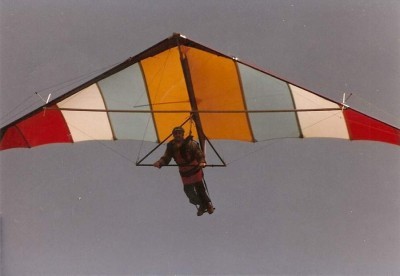
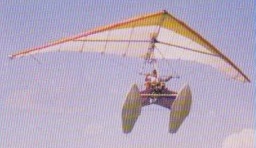
The 1976 String Ray was a copy of UP’s Dragon Fly. The String Ray was on the market within weeks of first seeing the Dragon Fly at the Nationals at Escape Country. Russ Hansen played the curious spectator, asking UP’s pilots about various aspects of their new glider so as to ease Dinger Wings re-creation.

Manufactured by Dean Aldinger Sacramento Ca in the 70’s, the sting ray had clipped tips, but no battens, the prototype was dark blue with red leading edges/tips and only had one deflector pointed down at a 45* angle.

He didn’t make a lot of that model and the tips were heavy IMO. This model is not one considered very safe except under the mildest conditions. It was high performance for its time but not especially stable. This glider wasn’t stable, which is why he stopped making it. He made a lot of innovations incorporated into later models.

Dean was a great hang glider builder but lost some friends that were flying his hang gliders and quit building.

Nose angle: 105°

Dinelli Aereoplano Glider

Guido Dinelli, an Italian shoemaker, was the second person in South America who is known to have made a gliding flight, while Pablo Suarez is believed to have been the first to do so. Both gliding flights took place at Tandil, Argentina, from atop Garibaldi Hill. Dinelli’s flight, on May 25, 1904, was made with a glider which he designed in late 1903. The glide was remarkable, covering 590 feet… a considerable distance.

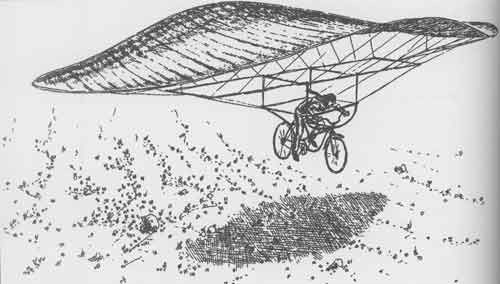
Dinelli and his “Aereoplano apparatus” weighed a combined total of 211 pounds and was controlled by a number of ropes pulled by the operator. The glider, constructed of steam-bent spruce covered with cotton fabric, apparently was attached to a bicycle. Dinelli seems to have garnered some construction advice from Frank Brown, an English clown with the Carlo Brothers Circus. The wing was arranged to tilt (in order to vary the angle of incidence) so Dinelli could choose when to gain lift. He pedaled the bicycle to gain speed and then tilted the wing to lift just as he left the edge of Garibaldi Hill, timed to take advantage of an updraft. Dinelli’s glide, apparently his last, ended with damage to his glider and bruises to himself.