Established 1993, produces the Dragon Fly model 333 two-seat piston-engined light helicopter (certificated June 1996). HELIOT variant is for military and civil special operations, with a 661 lb (300 kg) useful load and is fitted with a camera and color monitor; can carry an external module to permit unmanned remote flying; with module removed, HELIOT can be piloted.
1998: Via Raffaello, 1/A, I-22060 Cucciago (CO), Italy.
Era
Drachenstudio Kecur Royal
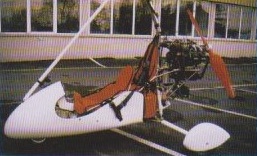
The stainless steel chassis of the Royal Karat originates from Slovenia, and the basic structure is also used by the Take Off company. The Karat wing is produced by the same supplier.
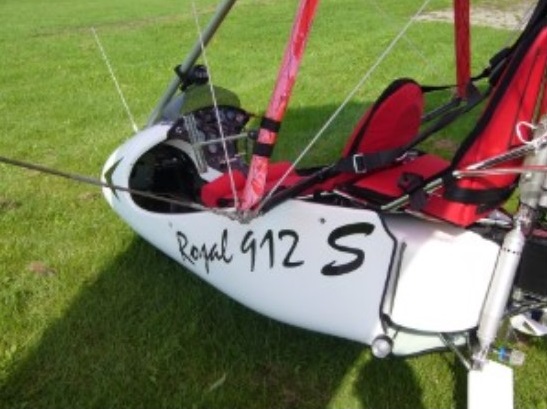
Royal Karat
Empty weight: 190 kg
Wing span: 10.60 m
Wing area: 13.8 sq.m
Fuel capacity: 60 lt
Certification: Vz
Engine: Rotax 582, 64 hp
MAUW: 400 kg
Seats: 2
Max speed: 130 kph
Cruise speed: 85 kph
Minimum speed: 50 kph
Climb rate: 4.5 m/s
Fuel consumption: 11 lt/hr
Price (1998): 38 800 DM
Drachenstudio Kecur GmbH
1998:
Őtzbachstr. 1
D-40822 Mettmann
Germany
Trike unit builder
Doyn Aircraft Inc
USA
This Wichita, Kansas, company, offering conversions to provide more power and performance to Cessna models 150,170,172,175, and Cardinal, was taken over by Air-Mod Engineering Company of Oklahoma City. The Cessna 170 conversions were known as the Doyn Dart I; the Dart II of the mid-1960s was a refined version of the Piper Apache. Beech Travelair conversions were also completed.
Doyle O-2 Oriole / O-3 Oriole
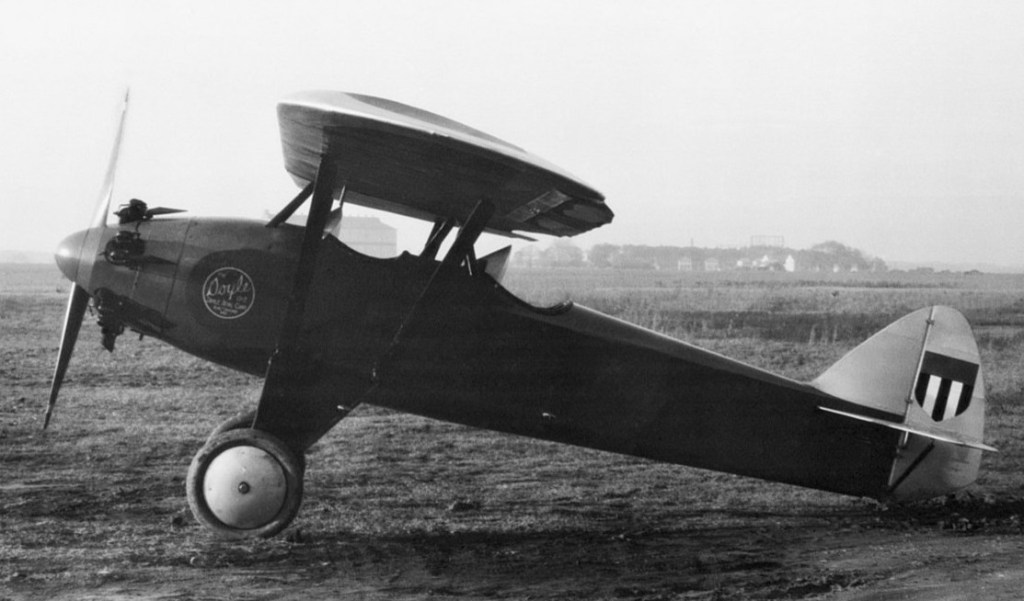
William Burke of the Vulcan Last Company backed the Wilson and Harvey Doyle plan to build a two-place, tandem, open-cockpit parasol sportplane and the Vulcan Aircraft Division began design work in a rented second floor room and construction in a former street car barn in Portsmouth.
The resulting Vulcan American Moth was a hit, but the relationship among the principles was deteriorating and the Doyle brothers left to start their own Doyle Aircraft Company in Baltimore. They produced fourteen Doyle Orioles which were similar to the Moth before bankruptcy ended the effort.
The prototype flew on 15 October 1928 with a yellow and black paint scheme and was priced at $2,975. Doyle Aero did not survive the Great Depression economy and ceased operations after a short production run. Harvey Doyle became an aeronautical engineer, and Wilson Doyle would become a professor of Political Science.
Seven of the O-2 Oriole and one O-3 Oriole were all built in 1928.
The last surviving O-2 serial number A-5 (NX9531) was restored in 1984 after being in storage since 1934 and identified by its designer Harvey Doyle.
Doyle Aero Corp
Two brothers named Wilson and Harvey Doyle were 1925 graduates of Harvard and Yale respectively and moved to Portsmouth, Ohio, where William Burke of the Vulcan Last Company. Burke backed their plan to build a two-place, tandem, open-cockpit parasol sportplane and the Vulcan Aircraft Division began.
The result was the Vulcan “American Moth.” The plane was a hit, but the relationship among the principles was deteriorating and the Doyle brothers left to start their own Doyle Aircraft Company in Baltimore in 1929. They produced fourteen Doyle Orioles which were similar to the Moth before bankruptcy ended the effort.
Doyle Moon Maid ROG-1
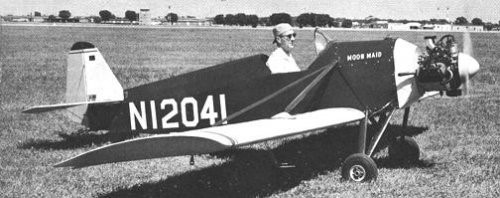
Moon Maid started out to be a gyroplane, but after a couple of years the designer/builder, Richard Doyle, decided to turn it into a standard airplane, stretching the fuselage four feet and replacing the rotor with a pair of wings spanning 23.5 feet. He pow¬ered it with a Bob Huggins 1523cc VW conversion of about 50 hp, one of the first homebuilts to use VW power.
The aircraft first took the air (now as N12041) in June 1964. The Moon Maid initially had a 25hp VW1200, later received a 50hp VW1600 and finally a 60hp VW1840.
During its career the aircraft was modified several times and amongst others received a dorsal fin, a slightly enlarged vertical tail and a new cantilever undercarriage with wheel pants.
Although plans were available for amateur construction (for engines in the 35-50hp range), no further aircraft were built.
Engine Huggins VW 1523cc conversion, 50 hp.
Gross weight 660 lbs.
Empty weight 460 lbs.
Fuel capacity 12 USgal.
Wing¬span 23 ft 6 in
Length 18 ft
Vmax 90 mph.
Cruise speed 80 mph.
Climb rate 600 fpm.
Range 200 nm.
Doyle
Richard Doyle, 104 5. Albert, Mt. Prospect, IL 60056, USA.
Built the Doyle Moon Maid ROG-1 circa 1964
Downer Aircraft Industries Inc
USA
Formed at Alexandria, Minnesota, in 1959, from the former Northern Aircraft Inc to continue production of the Bellanca Model 14. Built the Model 14-19-2 Cruisemaster and the Downer Bellanca 260 Model 14-19-3. Further development was undertaken by Inter-Air Inc. Following merger with American Aviation Corp of Freeland, Michigan, supplied parts and conversion kits for Seabee.
Douseler 1909 4-cylinder
Dousler built/convert a 40hp 4-cyl water-cooled aero engine used in his plane by Douseler at the Dominguez Hills air meet.

