A single-seat pleasure and agricultural ultralight (first flown 1994 and originally a homebuilt type; subsequent production in assembled form has ended)
Era
Dube Aerocruiser
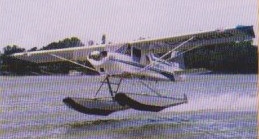
The Aerocruiser 2+2 has the same shape as the two seat version, with has identical dimensions but a redesigned cabin layout in which the rear bench seat folds back. The fuselage is fabric covered and the wings are all aluminium.
Aerocruiser 2+2
Engine: Lycoming O-360, 180 hp
Wing span: 9.75 m
Wing area: 16 sq.m
MAUW: 997 kg
Empty weight: 494 kg
Fuel capacity: 265 lt
Max speed: 260 kph
Cruise speed: 195 kph
Minimum speed: 65 kph
Climb rate: 5 m/s
Seats: 4
Fuel consumption: 38 lt/hr
Price (1998): Can$95,000
Duane’s Hanger
1995-6: Duane Patrick, 226 Melton Rd, Liberty, SC 29657, USA.
DSL São Paulo Monoplane
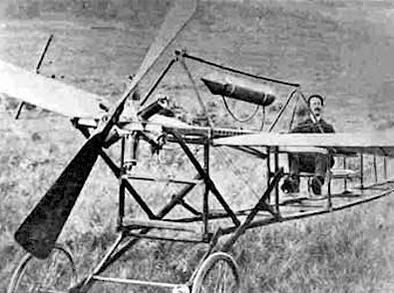
First airplane designed and constructed in Brazil – 100% made by Dimitri Sensaud de Lavaud; even the propellers and the engine were manufactured by him. It first flew on January 7, 1910 at Osasco: 6 seconds for 103 meters; also considered to be the first flight by an aircraft of complete South America design and construction.

DSK Airmotive Hawk
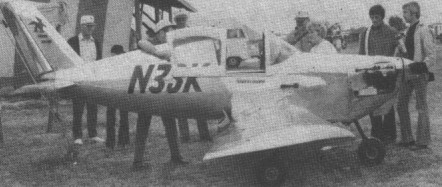
The Hawk is a single-seat, low-wing monoplane stressed to 9G’s. Originally it was designed by Dick Killingsworth to be built around a surplus 200-gal drop-tank, but plans also provide for a bulkhead and stressed skin structure, The wings are built with twin light-alley spars and the landing gear is the non-retractable tricycle type. Fuel is carried in a forward tank with the capacity of nine gallons, but an optional 14-gallon tank can be added in the aft section.
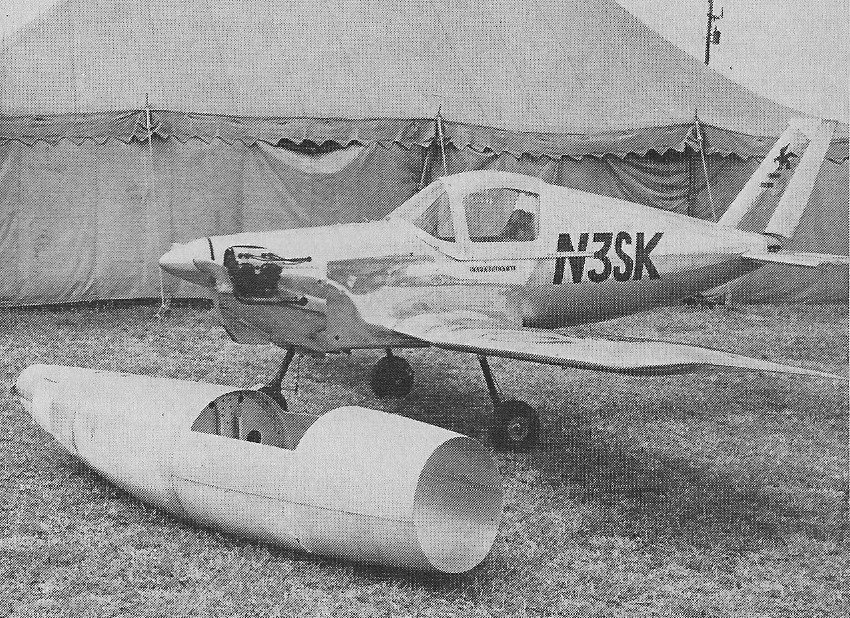
Powered by a Lycoming O-145B-2, the Hawk was designed to be built with ordinary hand tools, pop rivets and very little welding or machine work. By 1974 over 250 sets of plans had been sold, at $50 each.
Gross Wt. 893 lbs.
Empty Wt. 525 lbs.
Fuel capacity 9-23 USG.
Wingspan 20’4”.
Length 15’.
Engine 65-hp Lycoming.
Top speed 156 mph.
Cruise 141 mph.
Stall 50 mph.
Climb rate 1500 fpm.
Ceiling 12,000 ft.
Takeoff run 600 ft.
Landing roll 550 ft.
Range (14 gals) 480 sm.
DSK Airmotive
1980: DSK Airmotive Inc, Box 629, Fort Walton Beach, FL 32548, USA.
Drzewiecki Canard
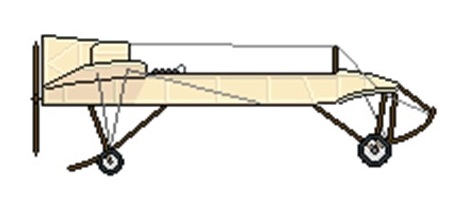
Aeronautics was also among Stefan Drzewiecki’s interests. His works regarding aircraft stability led to building in 1911-1912 a “self-stable” aircraft in canard layout. Interesting feature of the plane was lack of typical steering areas – altitude was adjusted by changing engine power while turning was done by adjusting AoA of either half of the nose wing. First flight was made in 1913, but because of this unusual steering feature pilots were reluctant to fly. Eventually Drzewiecki designed improved version, but outbreak of World War I stopped further development.
Drzewiecki, Stefan
Stefan Drzewiecki (1844-1938) was a World-renowned scientist and inventor, credited with – among others – designing kilometric counter for cabs (1867), automatic railway coupler (1872), device plotting ship’s course on map (1872), first submarine using a periscope (1877) and first one with electric propulsion (1888). From 1877 Russian Navy built 50 small submarines of Drzewiecki’s design. In 1901 navies of Russia and France introduced torpedo launchers operating on pressurized air designed by Drzewiecki. In 1892 he wrote (in France) theoretical work regarding scientific methods of manufacture of ship (and plane) propellers and in 1920 presented a general theory for screw-propeller thrust (which in turn led to creation of propellers with adjustable blades).
Druine D.6 Condor

A later and larger successor to the D.5 Turbi, the D.6 Condor was similarly a low-wing, wooden-framed monoplane available as a licence-built product or as a home build from plans.
The initial version was designated D.61 and was designed for Continental engines of 65 or 75 hp.
The D.62 was, like the D.31, built under licence by Rollason in the UK from 1961. Variants include versions converted for glider towing.
First flow in 1961, the D.62A was a pre-production version of which two were built. The D.62B was the standard production version.

The D.62C was specially equipped for glider towing with wingtip endplates, larger wheels, raised cockpit canopy, and 130 hp Rolls-Royce Continental O-240 engine.
The Condor was given a dual system of c/ns when in production with Rollason. A number prefixed RAE was re-located using exactly the same number as the aircraft’s PFA number. Production was centred on Croydon, with first flights from Redhill. Production was transferred in 1973 to Shoreham although none wee finished there.
Versions:
D.61 – Basic version, Continental A65 or A75
D.62 – Initial UK version, Continental C90
D.62A – initial production version. Rolls-Royce/Continental O-200-A
D.62B – Refined D.62A, all after c/n RAE.612, fitted with flaps
D.62C- Glider tug, Rolls-Royce/Continental O-240-A
D.63 – Tricycle undercarriage
D.62A
D.62B
Engine: 1 x 75hp Continental A 75
Max take-off weight: 669 kg / 1475 lb
Wingspan: 8.72 m / 28 ft 7 in
Length: 6.95 m / 22 ft 10 in
Height: 1.75 m / 5 ft 9 in
Cruise speed: 160 km/h / 99 mph
Range: 627 km / 390 miles
D.62B
Engine: Continental O-200, 100hp
Wingspan: 27 ft 6 in / 8.38 m
Length: 22 ft 6 in / 6.86 m
Empty weight: 920 lb / 417 kg
MTOW: 1475 lb / 670 kg
Max cruise: 100 kt / 115 mph / 185 kph
ROC SL: 610 fpm / 185 m/min
Service ceiling: 12,000 ft / 3650 m
Range MAUW: 285 nm / 328 mi / 528 km
Seats: 2
D.62C
Engine: Rolls-Royce Continental O-240, 130 hp

Dewoitine D.480 / D.482
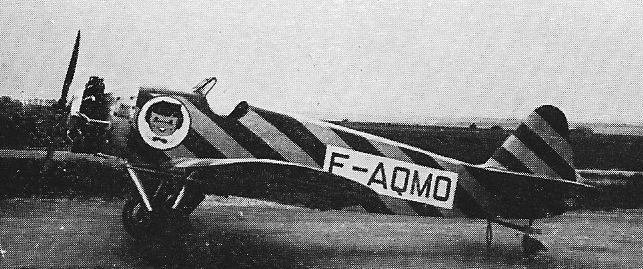
The D.482 side-by-side two-seat trainer was produced in 1932 as a higher-powered development of the D.480, the 95hp Salmson 7 Ac radial of the D.480 being replaced by a 135hp Salmson 9 Nc.
A number were produced by the Societe Aeronautique Francaise in the early 1930s.
D.480
Engine: 95hp Salmson 7 Ac
D.482
Engine: 135hp Salmson 9 Nc
Wingspan: 41 ft 8 in
Length: 24 ft 3.25 in
Height: 9 ft 3 in
Wing area: 204.5 sq.ft
Empty weight: 1424 lb
Loaded weight: 2005 lb
Max speed: 87 mph
Service ceiling: 14,673 ft
Range: 373 mi

