Działowski Brothers

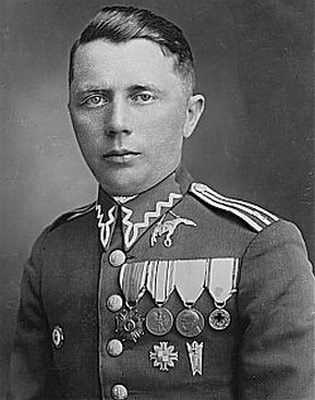
Stanisław Działowski

Stanisław Działowski was born on 11.04.1900 in Mielec. He completed six years of elementary school and two classes of high school. In the years 1914-1915 he was in locksmith practice in Vienna, which he did not finish. On December 3, 1916, he joined the air force in the Austro-Hungarian army in Vienna, from where he was sent to the aircraft construction school in Hungary (Szeged), where he stayed until the end of the First World War.
After returning to Poland, he joined the Polish army in November 1918 and, as a corporal, he became the head of the airfield assembly plant in the pilot school park, with which in 1919 he was transferred to Bydgoszcz. In this post he worked until 1926. On April 1 that same year, he joined the pilot school as a pilot student, after which (November 1, 1926) he was assigned as a pilot to the ITBL in Warsaw, at the same time acting as a pilot in the main port training squadron. In May 1927, he passed on his own request to the 2nd Air Regiment to Krakow, where he works as a pilot and constructor of the air park. In 1928, together with his brother Mieczysław Działowski, he founded the aviation company Bracia Działowscy in the park with the thought of producing airplanes for the army.

In 1936, he was released from the army and retired to the rank of senior pilot sergeant. He then worked as a civilian in the 2nd Air Regiment. In 1938, together with his brother, he started working at PZL Warszawa, Mokotów (WP-1) as master assembly master. In 1939, he was transferred to work in PZL WP-2 in Mielec , from where he moved to SHL in Kielce just before the war.

In the interwar period, he belonged to extremely talented aircraft designers. Resigned only to his own strength, working amateurishly, he built with his brother Mieczysław, five successful prototypes of sports aircraft, glider and the original car-plane (not completed due to lack of funds) so-called “Aeromobil” .

In 1925, they built the glider “Bydgoszczanka”, which competed in the Second National Glider Competition in Gdynia, Oksywie, where it received a diploma for a very original design. Shortly after the break-up of the “Bydgoszczanka” glider at the 2nd Glider Competition, they began to build the aircraft. Stanisław Działowski, who was the constructor of the aircraft, had nine years of experience in servicing aircraft and renovations, including five years as head of the Pilots Park Aviation Park in Bydgoszcz. The construction of the plane was made possible by the Bydgoszcz-based shoemaker Jan Krüger, an aviation enthusiast who bought the Haacke engine from Gabriel’s brothers. From here, the aircraft received the DKD-I designation, from the names of the contractors and the founder of the engine. In 1926, the brothers took the first Polish interurban flight from Bydgoszcz to Warsaw. The following airplane constructions of the Działowski brothers are: DKD-II , DKD-III (participated in 1927 in the National Awionete Competition and 3rd place for KKA in 1928), two DKD-IV (with Anzani engine and Siemens-Halske engine, the machine with this first engine has won the 1st place in the 2nd National Competition of Light Ships in 1928, with the second 5th place, both constructors – participants of the competition, also as pilots received for the 1st and 3rd place of their machines the prize of 13 thousand PLN), DKD-V (built on the Challenge in 1932, crashed during a forced landing) KKA in 1928), and pilot S. Działowski suffered severe injuries), DKD-VI , DKD-VII , DKD-VIII (the last two not fully built) and “Aeromobil” (air taxi, unfinished).

Before the outbreak of the war he gave up independent construction work, discouraged by constant financial difficulties and poor health after the crash.

In September 1939, he was appointed to the army and then found himself in Romania, from where he managed to get to France. In France he worked in the assembly plant of Lioré-et-Olivier LeO 451 aircraft. In March 1940, he became a pilot instructor at the 108th Aviation Battalion in Montpellier. After the fall of France, he was evacuated to Great Britain. On June 27, 1940, he was admitted to the RAF and, after training, he flew in the 2nd Anti-Aircraft Cooperation Unit (AACU – Anti-Aircraft Cooperation Unit). On 15.10.1941, he was wounded in a combat flight and sent to a military hospital in East Kilbrick, Scotland. On March 17, 1941, he was released from the RAF for health reasons. He died on 19.03.1942 at the RAF Sanatorium in Perth. Buried in the Wellhill Cemetery there.

As a pilot, he flew on 20 types of aircraft about 800 hours, he also made 12 parachute jumps. He had the following badges and decorations: Bronze Cross of Merit, Medal of the XII anniversary, Field Pilot Badge, Gold Honorary LOPP Badge and parachute badge.

D’Yves Yvasion 2000

The model fitted with a JPX can be used on a trike.
Electric start is standard.

2000 J
Empty weight: 31 kg
Engine: JPX
Reduction: 2.3
Prop diameter: 110-120 cm
Fuel capacity: 10 lt
Price (1998): F27 000

2000 L
Empty weight: 25 kg
Engine: Lark, 14 hp
Reduction: 2.4
Prop diameter: 110-120 cm
Fuel capacity: 9 lt
Price (1998): F25 000

2000 LM
Empty weight: 23
Engine: Luckey Motors, 14 hp
Reduction: 2.2 / 2.4
Prop diameter: 110-120 cm
Fuel capacity: 7 lt
Price (1998): F24 000

2000 Y
Empty weight: 23 kg
Engine: Vittorazi
Reduction: 3.2
Prop diameter: 110-120
Fuel capacity: 7 lt
Price (1998): F26 800

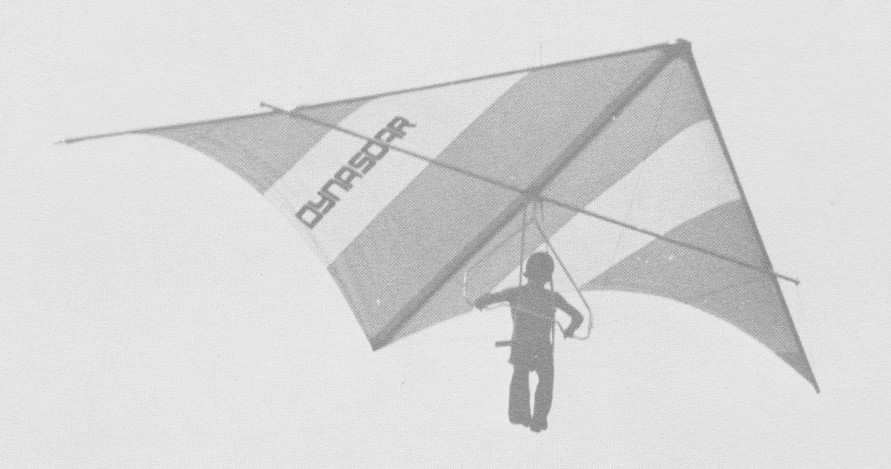
Dyna Soar Standard          

The Dyna Soar Standard is a standard Rogallo which features a “Dyna-pin” which consists of a hitch pin, stainless steel spring, and quick release pin for quick assembly of the leading edges to the cross spar. The flying wires can be interchanged to move the control bar from seat to prone to supine position. Wing stabiliser minimise leading edge distortion at higher loading. The keel reflex, standard n all models, improves the L/D and compliments the wing stabilisers for a more stable flight.

The airframe is made from 6063-T832 1.5 in x 0.058 anodised alumingium tubing, and the rigging is aircraft quality 3/32in 7×7 plastic coated. All nuts and bolts are aircraft quality, and tangs are stainless. The sail is Howe and Bainbridge 3.8 oz stabilised dacron. All seams are double zig zag stiched and stress points are reinforced.

It can be adapted for towing.

15×15
Leading edge: 15 ft 6 in
Keel length: 15 ft 6 in
Wing span: 20 ft 6 in
Wing area: 155 sq,ft
Aspect ratio: 3.75
Nose angle: 83˚
Sail billow: 3.5˚
Weight: 34 lb
Pilot weight: 90-140 lb
Takeoff speed: 15 mph
Stall speed: 14 mph
Max speed: 21 mph
Best glide ratio (L/D): 5:1
Best L/D speed: 20 mph
Min sink: 450 fpm

15×17
Leading edge: 17 ft 6 in
Keel length: 17 ft 6 in
Wing span: 23 ft 2.5 in
Wing area: 210 sq,ft
Aspect ratio: 3.75
Nose angle: 83˚
Sail billow: 3.5˚
Weight: 41 lb
Pilot weight: 150-200 lb
Takeoff speed: 15 mph
Stall speed: 14 mph
Max speed: 21 mph
Best glide ratio (L/D): 5:1
Best L/D speed: 20 mph
Min sink: 450 fpm

15×18
Leading edge: 18 ft 6 in
Keel length: 18 ft 6 in
Wing span: 24 ft 6 in
Wing area: 240 sq,ft
Aspect ratio: 3.75
Nose angle: 83˚
Sail billow: 3.5˚
Weight: 45 lb
Pilot weight: 170-240 lb
Takeoff speed: 15 mph
Stall speed: 14 mph
Max speed: 21 mph
Best glide ratio (L/D): 5:1
Best L/D speed: 20 mph
Min sink: 450 fpm

Dynamic Sport Power / Tandem

The PPG frame can be split into two lateral parts, leaving the engine on its own mounting. Electric start was available as a £350 option on all models.

Power 1.1
Empty weight: 25 kg
Engine: Hirth F33, 21.9 hp
Reduction: 1:1.8
Prop diameter: 110 cm
Fuel capacity: 10 lt
Price (1998): £2,650

Power 1.2
Empty weight: 27 kg
Engine: Hirth F33, 21.9 hp
Reduction: 1:1.8
Prop diameter: 120 cm
Fuel capacity: 10 lt
Price (1998): £2,750

Tandem 1.2
Empty weight: 29.5 kg
Engine: Hirth F33, 21.9 hp
Reduction: 1:2.2
Prop diameter: 1:2.2
Fuel capacity: 124 cm
Price (1998): DM6,000

Dynamic Sport Model 1.1 / Dynamic Sport Model 1.2 / Dynamic Sport Model 1

The frame can be split into two lateral parts, leaving the engine on its own mounting. Electric start was available as a £350 option on all models.

Model 1.1
Empty weight: 22 kg
Engine: Hirth F36, 12 hp
Reduction: 1:2
Prop diameter: 110 cm
Fuel capacity: 5/10 lt
Price (1998): £2,150

Model 1.2
Empty weight: 25 kg
Engine: Hirth F36, 12 hp
Reduction: 1:2.7
Prop diameter: 120 cm
Fuel capacity: 5/10 lt
Price (1998): £2,250

Model 1
Empty weight: 20 kg
Engine: Hirth F36, 12 hp
Reduction: 1:2
Prop diameter: 100 cm
Fuel capacity: 5/10 lt
Price (1998): £1,999

Dynamic Sport Viper

Paraglider circa 1998.

Viper 28
Wing area: 27 sq.m
Pilot weight: 65-85 kg
No. of cells: 70
Wing span: 12.25 m
Aspect ratio: 5.56
Min sink: 1 m/s
Max speed: 50 kph
Price (1998) 4150 DM

Viper 29
Wing area: 29 sq.m
Pilot weight: 80-100 kg
No. of cells: 73
Wing span: 12.8 m
Aspect ratio: 5.65
Min sink: 0.9 m/s
Max speed: 50 kph
Price (1998) 4200 DM

Viper 31
Wing area: 31 sq.m
Pilot weight: 95-115 kg
No. of cells: 76
Wing span: 13.3 m
Aspect ratio: 5.71
Min sink: 0.9 m/s
Max speed: 50 kph
Price (1998) 4250 DM

Dynamic Sport Raven

Paraglider circa 1998.

Raven AX 26
Wing area: 26.9 sq.m
Pilot weight: 50-70 kg
No. of cells: 38
Wing span: 11.1 m
Aspect ratio: 4.56
Min sink: 1.2 m/s
Max speed: 42 kph
Price (1998) 3200 DM

Raven AX 28
Wing area: 28.9 sq.m
Pilot weight: 65-85 kg
No. of cells: 40
Wing span: 11.6 m
Aspect ratio: 4.6
Min sink: 1.2 m/s
Max speed: 42 kph
Price (1998) 3250 DM

Raven AX 30
Wing area: 30.9 sq.m
Pilot weight: 80-110 kg
No. of cells: 42
Wing span: 12.1 m
Aspect ratio: 4.68
Min sink: 1.2 m/s
Max speed: 42 kph
Price (1998) 3300 DM

Dynamic Sport Gravis

Paraglider circa 1998.

Gravis 25
Wing area: 25.5 sq.m
Pilot weight: 50-70 kg
No. of cells: 30
Wing span: 10 m
Aspect ratio: 3.9
Min sink: 1.3 m/s
Max speed: 42 kph
Price (1998) 2800 DM

Gravis 27
Wing area: 27.5 sq.m
Pilot weight: 65-85 kg
No. of cells: 32
Wing span: 10.5 m
Aspect ratio: 4
Min sink: 1.3 m/s
Max speed: 42 kph
Price (1998) 2850 DM

Gravis 29
Wing area: 29.5 sq.m
Pilot weight: 80-110 kg
No. of cells: 34
Wing span: 11 m
Aspect ratio: 4.1
Min sink: 1.3 m/s
Max speed: 42 kph
Price (1998) 2900 DM