Developed the Eagle DW-1 single-seat agricultural biplane.
Era
EAF / State Aircraft Factory (Greece)
In 1925 the Blackburn Aeroplane & Motor Co concluded an arrangement with the Greek Government to organise an aircraft factory at Phaleron, near Athens, Greece. The factory constructed a series of Velos two seat torpedo planes, designed by Blackburn; a series of Armstrong Whitworth Atlas two seat fighters; and a series of Avro 504O 504N trainers.
EAA Pee Wee
Single seat single engined biplane with con¬ventional three axis control. Conventional tail. Control inputs through stick for pitch/roll and pedals for yaw. Wings braced by struts. Undercarriage has three wheels in tail drag¬ger formation. Aluminium tube framework, with optional pod. Engine mounted between wings driving tractor prop¬eller.
Named Pee Wee after an early lightweight aircraft developed by Joe Kirk, one of EAA’s directors in the ’50s and ’60s, the Pee Wee machine is a tractor biplane powered by a KFM opposed twin engine with electric start. The design allows a pod to be incorporated, so that if the builder wishes he or she can take advantage of the engine heat to warm the feet.
The Princeton Sailwing shape is used in the wing construction and, as befits a biplane, a tail dragger undercarriage is fitted.
Engine: KFM 107.
Empty weight 220 lb, 100 kg.
EAA Super Acro-Sport
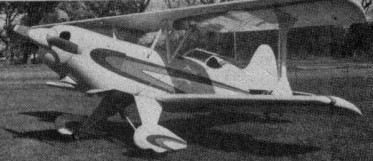
This further development of the Acro-Sport is intended for unlimited international-class aerobatic competition. Though basically similar in appearance to its counterpart, the Super Acro-Sport takes advantage of a more powerful engine turning a fixed-pitch prop, an improved roll rate and inverted flight capabilities. Its two wings have almost sym¬metrical airfoil sections. Also added was a trim tab on the starboard elevator and a servo tab on the port side.
Engine 200-hp Lycoming.
Gross Wt. 1350 lb.
Empty Wt. 884 lb.
Fuel capacity 20 USG
Wingspan 19 ft 7 in
Length 17 ft 6 ft
Top speed 156 mph
Cruise 135 mph
Stall 50 mph
Climb rate 3700 fpm
Ceiling 15,000 ft
Takeoff run 125 ft
Landing roll 800 ft
Range 300 miles
EAA Acro-Sport II
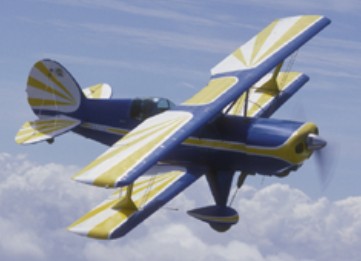
The Acro II, a two-place larger version of the single-place Acro Sport, can be constructed for little more than its single-place brothers. With its larger wheels, wide landing gear and light gross weight, the Acro II is a fun, docile sport airplane designed for engines ranging in power from 115 to 200 hp. When fitted with a 180-hp Lycoming, its empty weight of 875 pounds. First flown on 9 July 1978, like all Acro Sports, its cockpit is designed to be comfortable for pilots up to 6 ft 6 in and 240 pounds. The airframe is larger than the really “midget” biplanes to avoid “touchy” flight characteristics and allow for more baggage. Designed by Paul Poberezny, the Acro II features an M-6 airfoil with a 43-inch chord.
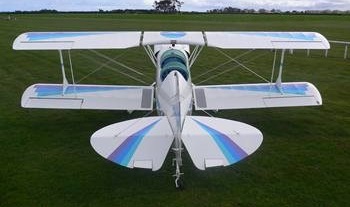
As with all Acro Sport projects, the fuselage is welded steel tube, wings are spruce and Stits Poly-fiber is used for covering. An excellent aerobatic trainer with responsive controls and docile straight and level flight characteristics. Cruise at 123 mph (180 hp), stall at 53 and max out at 152.
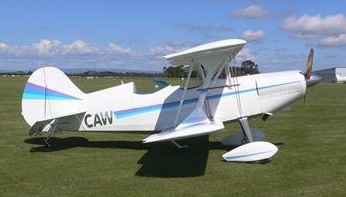
I fly N400GB, an Acro II ser# 573.
Daniel Reed
Aug 2022
Engine: Lycoming O-360, 180 hp.
HP range: 115-180.
Speed max: 152 mph.
Cruise: 123 mph.
Range: 300 sm.
Stall: 53 mph.
ROC: 1200 fpm.
Take-off dist: 350 ft.
Landing dist: 800 ft.
Service ceiling: 25,000 ft.
Fuel cap: 26 USG.
Weight empty: 875 lbs.
Gross: 1520 lbs.
Height: 6.7 ft.
Length: 18.85 ft.
Wing span: 21.67 ft.
Wing area: 152 sq.ft.
Seats: 2.
Landing gear: tail wheel.
EAA Acro-Sport
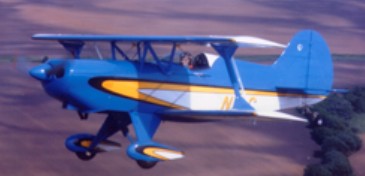
This biplane was designed by EAA President Paul Poberezny who wanted to come up with a plane that could be used in high school industrial arts programs and Civil Air Patrol groups as an educational tool. The first flew in January 1972, less than 12 months after the design was started. The Acro-Sport can be fabricated with tools normally found in a high-school shop. It is built with steel tube covered by fabric and 100- to 200-hp engines.


Engine: Lycoming IO-360, 180 hp.
Speed max: 152 mph.
Cruise: 130 mph.
Range: 350 sm.
Stall: 50 mph.
ROC: 3500 fpm.
Take-off dist: 350 ft.
Landing dist: 800 ft.
Service ceiling: 25,000 ft.
HP range: 85-200.
Fuel cap: 20 USG.
Weight empty: 739 lbs.
Gross: 1350 lbs.
Height: 6 ft.
Length: 17.5 ft.
Wing span: 19.7 ft.
Wing area: 116 sq.ft.
Seats: 1.
Landing gear: tail wheel.
EAA A-1 Biplane
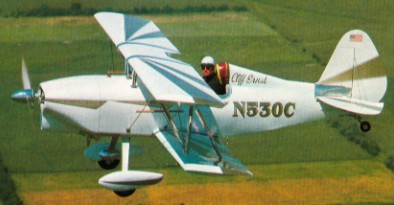
In 1955, the EAA decided to develop a single-seat sport biplane as a service to its members. The prototype was built as a classroom project by students of St.Rita’s High School in Chicago. It flew for the first time on 10 June 1960. The E.A.A. Biplane was designed in response to many requests from members of the American Experimental Aircraft Association for a single seater sports biplane of simple yet rugged construction. The fuselage consists of a welded chrome-moly steel tube frame, to which are fitted plywood formers and wooden stringers, the whole being fabric covered apart from the aluminium coaming panels. Both upper and lower wings have solid spruce spars and built-up wooden ribs, and are internally and externally wire braced. The leading edge to the front spar is aluminium covered, the remainder being fabric covered. Interplane and centre section struts are made of streamline steel tube. A 9.5 Imp. gallon fuel tank is fitted behind the firewall. The empennage, like the fuselage, is built up of welded steel tube and is fabric covered and externally braced. The ailerons which are installed on the lower wing only, are operated by means of push rods, while the elevator and rudder are cable operated. The main undercarriage is built up of steel tube with bungee cords for shock absorption.
Engine: Continental C-85, 85 hp.
Wing span: 20 ft 0 in (6.1 m).
Wing Area: 108 sq. ft.
Wing Loading: 9.4 lb./sq.ft.
Length: 17 ft 0 in (5.18 m).
Height: 6 ft 0 in (1.83 m).
Max TO wt: 1150 lb (522 kg).
Empty Wt. 640 lb.
Fuel capacity 12 USG.
Max level speed: 125 mph (201 kph).
Stall mph 55.
Climb rate 800fpm.
Takeoff run 500 ft.
Landing roll 550 ft.
Range 200 sm.
EAA
1980: Box 229, Hales Corners, WI 53130, USA.
1982: Experimental Aircraft Association, EAA-Oshkosh, PO Box 2591, Oshkosh, Wisconsin 54903, USA.
E2RA Yeelan
Paraglider new in 1998.
Yeelan 23
No. of cells: 67
Aspect ratio: 6.23
Max speed: 48 kph
Price (1998) 23,000 Fr
Yeelan 26
Wing area: 25.85 sq.m
Pilot weight: 85-97 kg
No. of cells: 67
Wing span: 12.69 m
Aspect ratio: 6.23
Max speed: 48 kph
Price (1998) 23,000 Fr
Yeelan 29
Wing area: 28.65 sq.m
Pilot weight: 96-110 kg
No. of cells: 67
Wing span: 13.36 m
Aspect ratio: 6.23
Max speed: 48 kph
Price (1998) 23,000 Fr
E2RA Weelo

Paraglider circa 1997-8.
Weelo 21
Year: 1997
Price: € 2.100
Surface Area: 21,6 sq.m
Span: 9.8 m
Ratio: 4.4
Upper surface: New Skytex
Wing weight: 4.8 kg
Box-Cell-Closed: 25/27/04
Risers: 1,7 mm Cousin/SuperAramid
Pilot weight: 60-75 kg
Wing loading: 3.1 kg/sq.m
Acceler. / Maximum / Minimum: 42 / 36 / 21 kph
Best-Sink-Rate: 1.3 m/s
Best-Glide-Ratio: 1,5 m/s at 33 kph
Weelo 24
Year: 1997
Price: € 2.100
Surface Area: 24.1 sq.m
Span: 10.2 m
Ratio: 4.4
Upper surface: New Skytex
Wing weight: 5.0 kg
Box-Cell-Closed: 25/27/04
Risers: 1,7 mm Cousin/SuperAramid
Pilot weight: 67-80 kg
Wing loading: 3.1 kg/sq.m
Acceler. / Maximum / Minimum: 42 / 36 / 21 kph
Best-Sink-Rate: 1.3 m/s
Best-Glide-Ratio: 1,5 m/s at 33 kph
Certification: AFNOR Standard
Weelo 24
Wing area: 24.7 sq.m
Certification: Afnor
Pilot weight: 67-85 kg
No. of cells: 27
Wing span: 10.23 m
Aspect ratio: 4.35
Min sink: 1.4 m/s
Max speed: 40 kph
Price (1998) 14,000 Fr
Weelo 28
Year: 1997
Price: € 2.100
Surface Area: 27.8 sq.m
Span: 11 m
Ratio: 4.4
Upper surface: New Skytex
Wing weight: 5.5 kg
Box-Cell-Closed: 25/27/04
Risers: 1,7 mm Cousin/SuperAramid
Pilot weight: 75-90 kg
Wing loading: 3.0 kg/sq.m
Acceler. / Maximum / Minimum: 42 / 36 / 21 kph
Best-Sink-Rate: 1.3 m/s
Best-Glide-Ratio: 1,5 m/s at 33 kph
Certification: AFNOR Standard
Weelo 28
Wing area: 27.83 sq.m
Certification: Afnor
Pilot weight: 78-97 kg
No. of cells: 27
Wing span: 11 m
Aspect ratio: 4.35
Min sink: 1.4 m/s
Max speed: 40 kph
Price (1998) 14,000 Fr
Weelo 30
Year: 1997
Price: € 2.100
Surface Area: 30.1 sq.m
Span: 11.4 m
Ratio: 4.4
Upper surface: New Skytex
Wing weight: 6.0 kg
Box-Cell-Closed: 25/27/04
Risers: 1,7 mm Cousin/SuperAramid
Pilot weight: 85-105 kg
Wing loading: 3.2 kg/sq.m
Acceler. / Maximum / Minimum: 42 / 36 / 21 kph
Best-Sink-Rate: 1.3 m/s
Best-Glide-Ratio: 1,5 m/s at 33 kph
Certification: AFNOR Standard
Weelo 30
Wing area: 30.1 sq.m
Pilot weight: 85-105 kg
No. of cells: 27
Wing span: 11.44 m
Aspect ratio: 4.35
Min sink: 1.4 m/s
Max speed: 40 kph
Price (1998) 14,000 Fr

