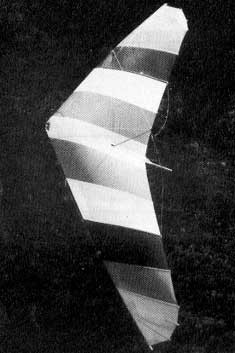
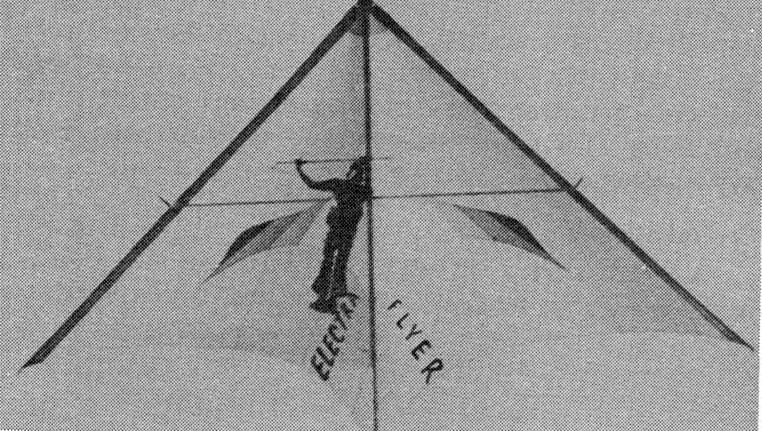
The 1980 Electra Flyer Vulcan was an attempt at a bowsprit glider to compete with similar designs from other manufacturers. It lacked pitch stability and had too much spiral instability for comfortable thermalling. Its sink rate was also unacceptably high, according to the test pilots. It was not a successful design, and never saw production.
Introduced in 1980, the Spirit was the successor to the Floater, with a simplified sail cut but retaining the Floater’s general planform and hinged cross-spar. The sink rate suffered somewhat from the modifications, but it was fairly manoeuvrable and easier to launch and land than its predecessor.
Olympus 140 Wing area: 12.9 m² Wing span: 9.9 m Aspect ratio: 7.83 Hang glider weight: 22 kg Minimum pilot weight: 50 kg Maximum pilot weight: 65 kg Packed length: 5.75 m Packed length short: 3.5 m Number of battens: 14 Nose angle: 121°
Olympus 160 Wing area: 14.86 m² Wing span: 10.5 m Aspect ratio: 7.65 Hang glider weight: 24 kg Minimum pilot weight: 65 kg Maximum pilot weight: 80 kg Packed length: 6 m Packed length short: 3.5 m Number of battens: 14 Nose angle: 121°
Olympus 180 Wing area: 16.6 m² Wing span: 10.75 m Aspect ratio: 7.2 Hang glider weight: 24 kg Minimum pilot weight: 80 kg Maximum pilot weight: 100 kg Packed length: 6.15 m Packed length short: 3.5 m Number of battens: 14 Nose angle: 121°
Designed primarily by Tom Price (with some input from Tom Peghiny and Larry Newman) and released in 1979, the Floater was Electra Flyer’s first attempt at a glider to compete with the Moyes gliders and La Mouette’s Atlas, both of which employed light wing loading to achieve a low sink rate while still offering some glide at speed. While it achieved both goals, it turned out not to be competitive with its rivals. It remained in production for a year, being replaced with a somewhat smaller version called the Spirit which, while it did not have the Floater’s sink rate, was more maneuverable and easier to fly.
The largest size Floater was a popular tandem glider in the early 1980s.
Floater 165 Wing area: 15.3 m² Hang glider weight: 24 kg Minimum pilot weight: 45 kg Maximum pilot weight: 70 kg Minimum speed: 29 km/h Max glide ratio (L/H): 7.5 Minimum sink rate: 1.15 m/s Number of battens: 24
Floater 185 Wing area: 17.2 m² Hang glider weight: 25 kg Minimum pilot weight: 60 kg Maximum pilot weight: 80 kg Minimum speed: 29 km/h Max glide ratio (L/H): 7.5 Minimum sink rate: 1.15 m/s
Floater 205 Wing area: 19 m² Hang glider weight: 26 kg Minimum pilot weight: 70 kg Maximum pilot weight: 90 kg Minimum speed: 29 km/h Max glide ratio (L/H): 7.5 Minimum sink rate: 1.15 m/s
Floater 235 Wing area: 21.8 m² Hang glider weight: 30 kg Minimum pilot weight: 80 kg Maximum pilot weight: 100 kg Minimum speed: 29 km/h Max glide ratio (L/H): 7.5 Minimum sink rate: 1.15 m/s
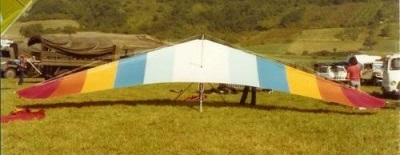
The 1980 Dove was intended as a successor to the Cirrus 5, without deflexors but with a sail cut to compensate for the leading edge’s bend under load. For its time, it was a decent “floater” but didn’t have the speed range of the Cirrus models. Since it was lighter than most gliders of the time, it found some use as a trainer for novice pilots.
A high speed performance glider, the Cirrus features diffused leading edges, ram air injected tapered leading edge pockets which create an airfoil, and full batten sails. It has a quick response. Broad speed range, stability at low speeds, and mild stall characteristics. It was designed for the Hang III pilot.
The Cirrus can be converted for towing. No tools are requires for set-up or take-down.
The airframe is made of 6061-T6 1.5in x .049 clear anodised aluminium throughout. Tubing ends are capped with solid aluminium plugs to prevent crushing. Rigging is 3/32in 7×7 stainless steel vinyl coated nico swedged. Out rigger cables are 1/16in 1×19 stainless steel. A cam operated quick release system for kingpost wires is fitted.
All nuts and bolts are aircraft quality and all parts are gold and black anodised. The pilot support is a “Backsaver” prone harness.
The sail is 3.8oz stabilised dacron in a choice of 11 colours, fitted with aluminium and plastic ribs.
It was one of the first gliders with battens. They were made of flexible plastic strips, and kept the sail from flapping.
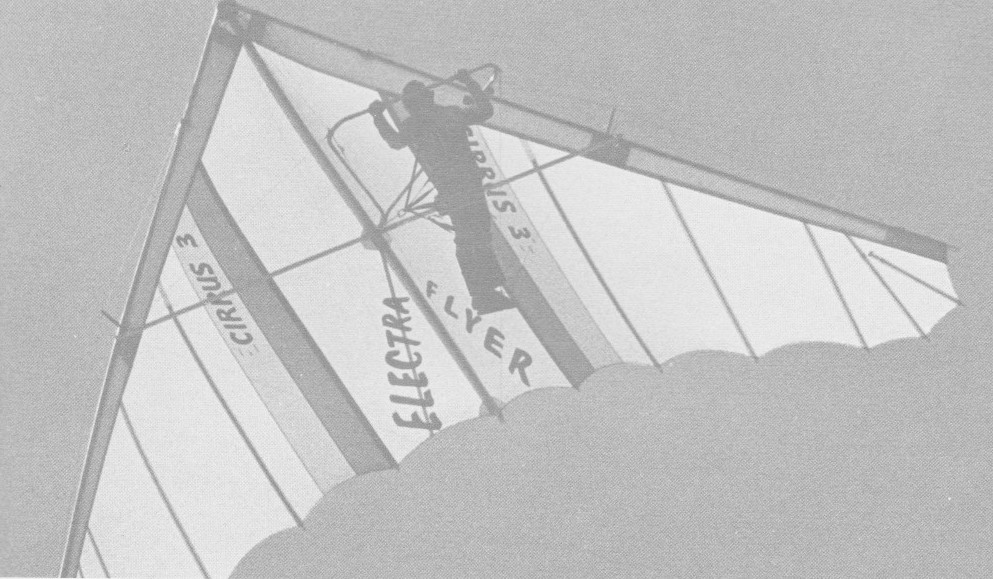
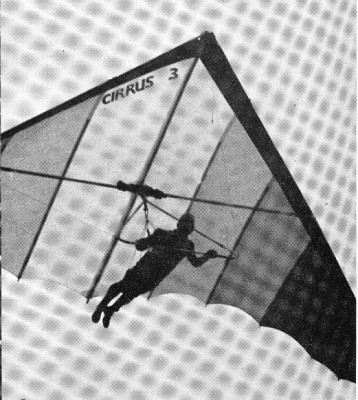
Cirrus 3
The 1976 Electra Flyers Cirrus 3 was very tough in turn, with considerable roll-over loss. The 3 deflexors settings were very important to give the correct contour in flight. But if the wing landed on the ground they bent or often broke.
Cirrus 5B
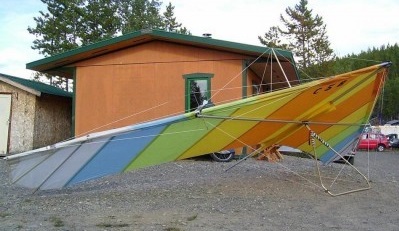
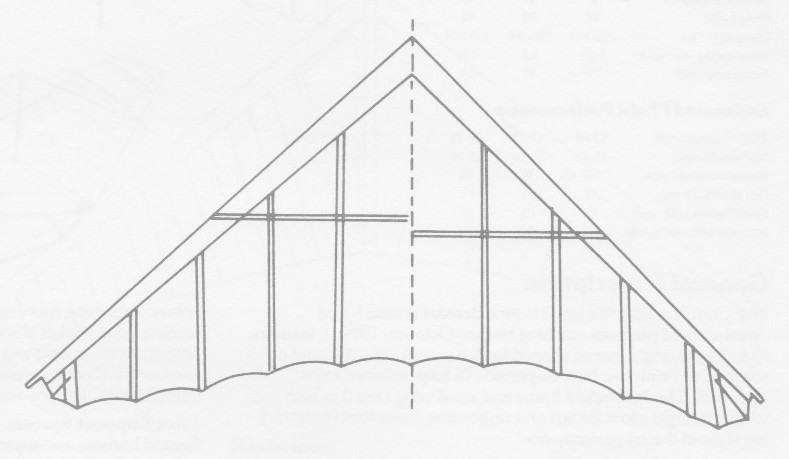
The Cirrus 5 was introduced in 1977 in four sizes, with the C5A being the largest and the C5D being the smallest. The C5B had a keel pocket and six flexible battens per side. Although designed for the novice pilot, it was quite tail-heavy and inclined to tip-stall during low-speed turns. Its handling and sink rate did not approach that of the Olympus, but it had better penetration at speed. Manufacture was discontinued in 1981.
Cirrus 2 Leading edge: 20 ft Keel length: 13 ft Wing span: 31 ft / 9.15 m Wing area: 195 sq,ft / 17.9 sq.m Aspect ratio: 5.63 Nose angle: 98˚ Sail billow: 1.25˚ Weight: 42 lb / 19 kg Pilot weight: 180-225 lb / 80-100 kg Takeoff speed: 10 mph Stall speed: 10 mph / 10 kph Max speed: 47 mph Best glide ratio (L/D): 8:1 Best L/D speed: 25 mph Min sink: 250 fpm Number of battens: 12 Packed length: 5.8 m
Cirrus 3 Leading edge: 19 ft Keel length: 13 ft Wing span: 28 ft / 8.54 m Wing area: 180 sq,ft / 16.5 sq.m Aspect ratio: 4.35 Nose angle: 91˚ Sail billow: 1.25˚ Weight: 39 lb / 18 kg Pilot weight: 135-190 lb / 60-85 kg Takeoff speed: 10 mph Stall speed: 10 mph / 16 kph Max speed: 50 mph Best glide ratio (L/D): 8:1 Best L/D speed: 26 mph Min sink: 250 fpm Packed length: 5.8 m Number of battens: 12
Cirrus 4 Leading edge: 20 ft Keel length: 9 ft Wing span: 31 ft Wing area: 120 sq,ft Nose angle: 98˚ Sail billow: 1˚ Weight: 40 lb Pilot weight: 150-190 lb Takeoff speed: 10 mph Stall speed: 10 mph Max speed: 47 mph Best glide ratio (L/D): 8.5:1 Best L/D speed: 25 mph Min sink: 235 fpm
Cirrus mini Wing area: 14.77 m² Wing span: 8.1 m Aspect ratio: 4.61 Hang glider weight: 17 kg Minimum pilot weight: 40 kg Maximum pilot weight: 60 kg Minimum speed: 16 km/h Max glide ratio (L/H): 8 Packed length: 5.6 m Number of battens: 12 Nose angle: 91°
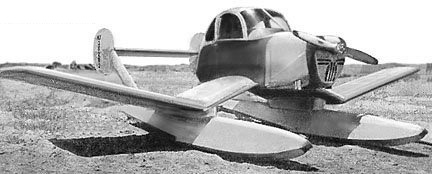
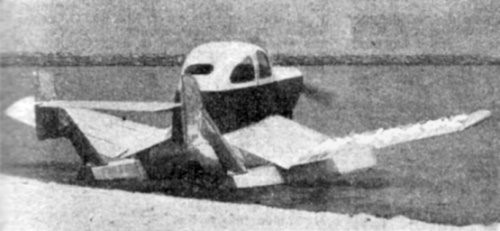
Dewey Eldred’s Flyer’s Dream NX36282 was a very original prototype floatplane designed by Dewey Eldred and Sol Fingerhut. Built in 1946 in Willoughby, Ohio, it featured an automobile-like nacelle mounted on top of a 30-ft span W-shaped wing placed in lowermost position. Its tail was mounted at the end of twin-booms extending attached to the rear of the floats. It used a 125 hp engine and first flew June 4, 1946.
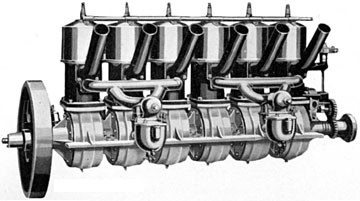
The 1910 Elbridge Engine Co Featherweight 6 was a six-cylinder inline, water-cooled aero engine producing 60-90hp from 453.6ci. The dry weight was 250 lb.
The 1910 Elbridge Engine Co Featherweight 4 four-cylinder, inline water-cooled aero engine produced 40-60hp@1400rpm from 302.4ci, with a dry weight of 200 lb.
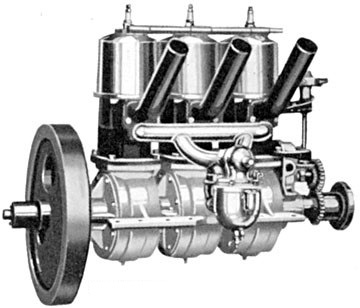
The 1910 Elbridge Engine Co Featherweight 3 was a three-cylinder inline water-cooled aero engine producing 0-45hp@1400rpm from 226.8ci. the dry weight was 150 lb.