The Europrop International TP400-D6 is an 11,000 shp (8,203 kW) powerplant for the Airbus A400M military transport aircraft, developed and produced by Europrop International. It supersedes the now defunct Aero Propulsion Alliance TP400-D1 M88 derivative proposed earlier. It is the third most powerful turboprop after the contra-rotating Kuznetsov NK-12 and Progress D-27, making the TP400 the most powerful single-rotation turboprop.
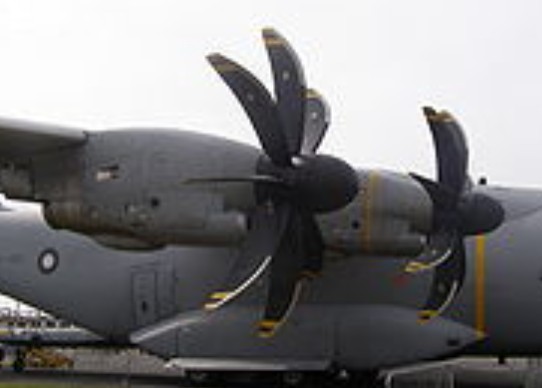
The engine has a twin-spool gas generator, with a third coaxial shaft connecting the low pressure power turbine to the 5.3 m diameter, eight bladed, composite propeller, via an offset reduction gearbox. Gas generator configuration is as follows: Five-stage intermediate pressure (IP) compressor, driven by a single-stage IP turbine; contra-rotating six-stage high pressure (HP) compressor driven by a single-stage, air-cooled, HP turbine.
A three shaft configuration (i.e. 2 spool gas generator) was chosen to maximize overall pressure ratio, whilst retaining a free power turbine. An earlier proposal, designated the TP400-D1, based on the core size of the SNECMA M88-2 military turbofan was considered by Airbus to be too heavy and not sufficiently fuel efficient, so an all-new, smaller, core was chosen for the -D4.
Maximum power output is 11,000 shp installed, with an Overall Pressure Ratio of about 25:1 and a Rotor Inlet Temperature of roughly 1,500 K. With Gearbox, output can be up to 100 kNm (6840 Ft-Lb) of torque. The IP compressor has a pressure ratio of 3.5, whereas the HP compressor develops a pressure ratio of about 7.2.
The engine first ran on 28 October 2005 using a water brake as the load. During subsequent testing, the engine reached full power. On 28 February 2006 the engine was tested for the first time with the propeller installed.
Certification was scheduled for October 2007, with the A400M first flight scheduled shortly afterwards. However continued technical problems have delayed the certification test program and pushed the entire A400M aircraft program into further delays. Two milestones were reached in June 2008: its first ground run on a flight testbed, and completing integration with the first production aircraft.
The engine delays were primarily due to problems with completing the FADEC software to the satisfaction of the civil authorities. Flight trials of a single TP400-D6 engine, mounted on the port wing of a C130K flying test bed, were completed only on 30 September 2009. On 11 December 2009, the maiden flight of the A400M took place.
TP400-D6
Type: Turboprop
Length: 138 in (3.5 m)
Diameter: 36.4 in (0.92 m)
Dry weight: 1,890 kilograms (4,167 lb)
Compressor: Five stage intermediate pressure unit, with no variable stators and a six stage high pressure unit with two rows of variables
Turbine: Single stage high pressure and intermediate pressure units, three stage power turbine
Maximum power output: 11,000 horsepower (8,203 kW)
Overall pressure ratio: 25
Turbine inlet temperature: 1500K approx
Specific fuel consumption: 0.39 lb/shp-hr (0.238 kg/kW-hr) approx
Power-to-weight ratio: 4.41 kW/kg (2.68 hp/lb)