Freedom Fliers Buckeye

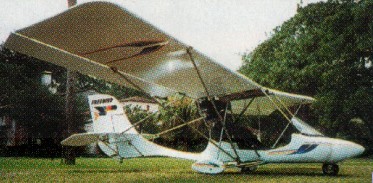
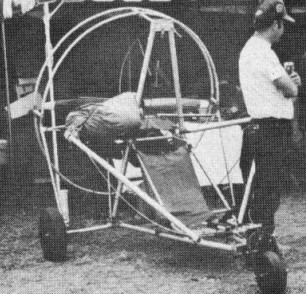
Dual independent hand-controlled steering levers with nose wheel steerable through foot-controlled T-bar.

Engine: Cuyuna ULII-02 (429 cc) 35 hp.
Static thrust: 212 lb
Empty wt: 179 lb
Wing span: 33’6”.
Wing area: 395 sq.ft.
Fuel cap; 2.5 USG.
Construction: Aluminium, Ripstop nylon.
Max wt: 379 lb
Max speed: 26 mph
Vne: 26 mph
Climb rate: 350 fpm
Glide ratio: 2.5-1.
Wing loading: 0.96 lbs/sq.ft.
Power loading: 10.83 lbs/hp.
Engine: Rotax 377 or 477.
Cruise speed: 23 kts.
Stall: 23 kts.

Freebird LiteSport

LiteSport Ultra

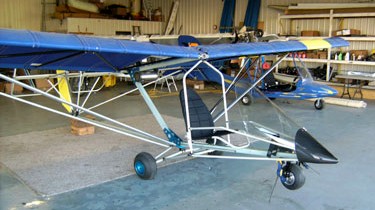
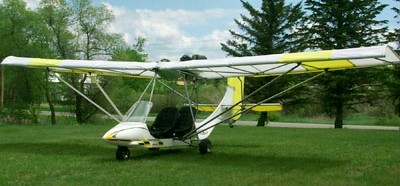
The LiteSport Classic is a side by side, Experimental/UltraLight comes standard with the high lift wing. Like all FBI Aircraft, the Classic has detachable wings for simple trailering.
These LSA aircraft come standard with all anodized aluminum, side by side two seater controllable from either seat, with a fiberglass nose cone, hydraulic brakes, and polished aluminum wheels.

LiteSport Classic
Cruise: 75 mph
Stall: 36 mph
Rate of climb: 800 fpm
Takeoff dist: 300 ft
Landing dist: 300 ft
Engine: Rotax 503, 52 hp
HP range: 52-85
Fuel capacity: 10 USG
Empty weight: 440 lb
Gross weight: 870 lb
Length: 16.8 ft
Wing span: 28 ft
Wing area: 142 sq.ft
Seats: 2
Cockpit width: 42 in
Landing gear: nose
LSA: yes

LiteSport Ultra
Cruise: 55 mph
Stall: 22 mph
Range: 90 sm
Rate of climb: 850 fpm
Takeoff dist: 75 ft
Landing dist: 150 ft
Engine: Rotax 447
Fuel capacity: 5 USG
Empty weight: 330 lb
Gross weight: 530 lb
Length: 15.6 ft
Wing span: 26 ft
Wing area: 142 sq.ft
Seats: 1
Cockpit width: 22 in
Landing gear: nose
LSA: yes

LiteSport II
Cruise: 75 mph
Stall: 32 mph
Range: 160 sm
Rate of climb: 800 fpm
Takeoff dist: 250 ft
Landing dist: 150 ft
Engine: Rotax 503, 48 hp
HP range: 48-80
Fuel capacity: 8.5 USG
Empty weight: 375 lb
Gross weight: 900 lb
Length: 15.2 ft
Wing span: 26 ft
Wing area: 142 sq.ft
Cockpit width: 22 in
Seats: 2
Landing gear: nose
LSA: yes

Freebird Sport Aircraft Freebird

Freebird

The FreeBird 103 was computer designed to make a legal 254lb ultralight with 3 axis control, steerable nose wheel, and the Black Max hydraulic brake system. Using the same basic wing design used on the LS-Ultra, the fuselage was totally redesigned to shave weight without compromising integrity.
Designed by Sherman Hawley, the wings fold for storage in a one bay garage, and the craft can be towed by car, and wing unfolded in ten minutes.

Freebird 103

Top speed: 80 mph
Cruise: 75 mph
Stall: 28 mph
Range: 170 sm
Rate of climb: 800 fpm
Takeoff dist: 125 ft
Landing dist: 150 ft
Service ceiling: 12,000 ft
Engine: Rotax 503, 52 hp
Fuel capacity: 10 USG
Empty weight: 385 lb
Gross weight: 970 lb
Height: 4.5 ft
Length: 17 ft
Wing span: 28 ft
Wing area: 132 sq.ft
Seats: 2
Landing gear: nose

Frederick-Ames EOS

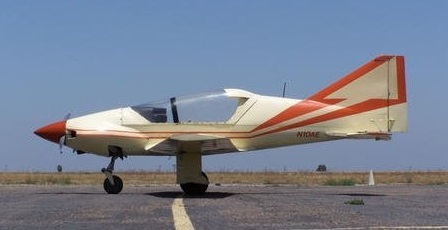
Fred Smith, president of Frederick-Ames Research Corporation at Novi, Michigan, USA, designed a small single-seat sporting aircraft called the EOS (after the Greek goddess of the dawn) N10AE, which first appeared in an incomplete form at the 1973 EAA Fly-in at Oshkosh.

Type: Single-seat light sporting aircraft.
Wings: Cantilever tapered low-wing monoplane. Wing section NACA 651212. Light alloy all-metal structure, except for glass fiber wing fillets, pop riveted and epoxy resin bonded.
Fuselage: Conventional light alloy semi-monocoque structure, pop riveted and epoxy resin bonded. Glass fiber engine cowling and 7 in (178 mm) prop extension shaft with Mooney 201 spinner.
Tail unit: Cantilever light alloy structure, comprising triangular fin, integral with rear fuselage, rudder, and all-moving tail plane with projecting balance arms at roots. Tail plane actuated via servo tabs.
Landing gear: Manually-retractable tricycle type. Main units retract inwards. Fully castoring and steerable nose wheel. Rubber-in-compression shock-absorption. Disc brakes.
Accommodation: Single glass fiber seat under large transparent canopy.
Systems: Electrical system includes 45A alternator and starter.

On its maiden flight on April 25, 1974, the 55 hp Hirth 650 cc engine seized and the aircraft crash landed, causing extensive damage. Despite some restoration work, the aircraft was abandoned through lack of finance.

In early 1978 the project was revived, with a modified Volkswagen motor car engine in place of the original engine. First flight of the reworked aircraft was in mid-1978, piloted by Robert Bishop. By August 1978 the EOS had completed about ten flying hours, and further modifications to the aircraft had been made. Eventually the release of plans and/or kits was never realized, and the prototype remains the only example ever built.

Power plant: Volkswagen 1,834 cc, 70 hp
Propeller: Rand Robinson three-blade ground-adjustable
Propeller diameter: 4 ft 2 in (1.27 m)
Span: 26 ft 0 in (7.92 m)
Wing area: 75 sq.ft (6.97 sq.m)
Wing aspect ratio: 9
Length: 16 ft 7 in (5.05 m)
Height: 6 ft 6 in (1.98 m)
Empty weight: 670 lb (304 kg)
Loaded weight: 975 lb (442 kg)
Fuel capacity 15 gal (56.75 l)
Max speed: 200 mph (322 kmh)
Cruise speed: 175 mph (281 kmh) at 5,000 ft (1,525 m)
Stall speed: 57 mph (92 kmh) at 4,500 ft (1,370 m)
Climb: 1,000 ft (305 m)/min
Take off run: 1,000 ft (305 m)
Frazer-Walker Gyrojet

Reported in 1964, the Frazer-Walker Gyrojet four-place VTOL amphibian to be built by Handley Page Ltd, London, sold in the US by Frazer-Walker Aircraft Corp, New York, has a 250hp Lycoming engine mounted aft driving a two-bladed pusher propeller. Lift is from a three-blade rotor fitted with mechanical “spin-up” device for short takeoff and a tip-jet powered system for use when a vertical takeoff is desired. The fuselage is of fibreglass. Royor blades are uncoupled from the engine in flight and rotate under aerodynamic forces.

Engine: 250hp Lycoming
Useful load: 1070 lb
Gross weight: 3000 lb
Top speed: 145 mph
Range: 750 mi