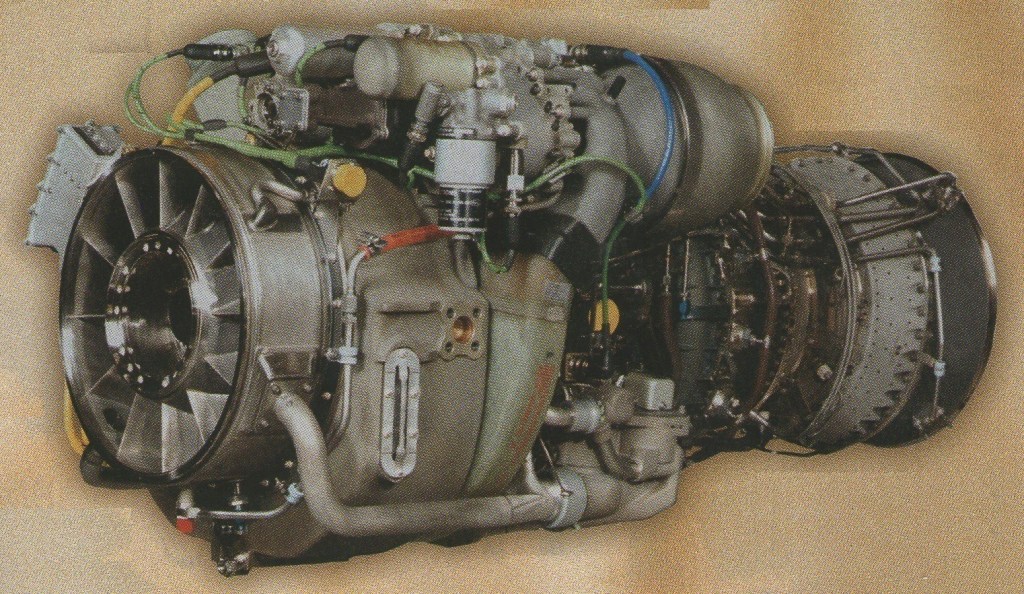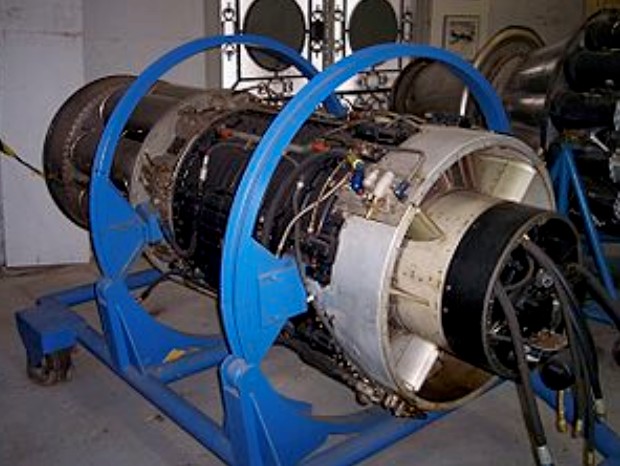
General Electric J47 / TG-190 / X-39

General Electric J47

The General Electric J47 turbojet (GE company designation TG-190) was developed by General Electric from the earlier J35 engine, and first flew in May 1948. First run on 21 June 1947, the J47 was the first axial-flow turbojet approved for commercial use in the United States. It was used in many types of aircraft and 36,500 were manufactured before production ceased in 1956. It saw continued service in the US military until 1978.

Overhaul life for the J47 ranged from 15 hours (in 1948) to a theoretical 1,200 hours (625 achievable in practice) in 1956. For example, the J47-GE-23 was rated to run 225 hours between overhauls. As installed on the F-86F, it experienced one in-flight shutdown every 33,000 hours in 1955 and 1956.

Variants:
J47-GE-1 – 4,850 pounds-force (22 kN) thrust
J47-GE-17B – 5,425 pounds-force (24 kN) thrust
J47-GE-19 – 5,200 pounds-force (23 kN)
J47-GE-23 – 5,800 pounds-force (26 kN), (6,500 pounds-force (29 kN) with water injection)
J47-GE-25 – 7,200 pounds-force (32 kN) thrust
J47-GE-27 – 5,200 pounds-force (23 kN), 5,970 pounds-force (27 kN) thrust
J47-GE-33 – 5,550 pounds-force (25 kN) thrust

Applications:
Boeing B-47 Stratojet
KB-50J Superfortress
KC-97L Stratotanker
Chase XC-123A
Convair B-36
Convair NB-36
Curtiss XF-87 Blackhawk
Martin XB-51
North American B-45 Tornado
North American F-86 Sabre
North American F-86D Sabre
North American FJ-2 Fury
Republic XF-91 Thunderceptor

Ground-based vehicles that used the engine include:
Spirit of America
M-497 Black Beetle jet-powered locomotive

The nuclear-powered X39
In the 1950s, interest in the development of nuclear-powered aircraft led GE to experiment with two nuclear-powered gas turbine designs, one based on the J47, and another new and much larger engine called the X211.

The design based on the J47 became the X39 program. This system consisted of two modified J47 engines which, instead of combusting jet fuel, received their heated, compressed air from a heat exchanger that was part of the Heat Transfer Reactor Experiment (HTRE) reactor. The X-39 was successfully operated in conjunction with three different reactors, the HTRE-1, HTRE-2 and HTRE-3. Had the program not been cancelled, these engines would have been used to power the proposed Convair X-6.

Specifications:

J47-GE-23
Type: turbojet
Length: 144 inches (3.7 m)
Diameter: 39.5 inches (1.00 m)
Dry weight: 2,707 pounds (1,228 kg)
Compressor: 12-stage axial compressor
Turbine: Single-stage axial
Maximum thrust:
5,800 pounds-force (26 kN) at 7950 rpm
6,500 pounds-force (29 kN) with water injection
Specific fuel consumption: 0.98 lb/hr/lb
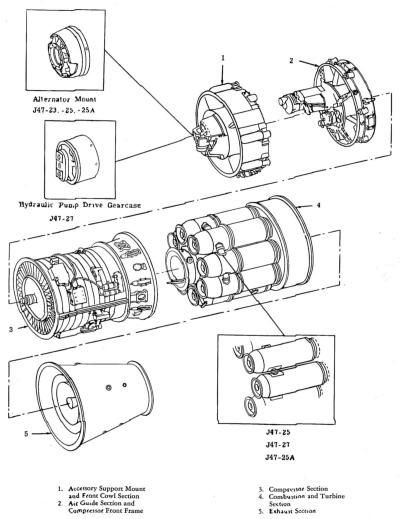
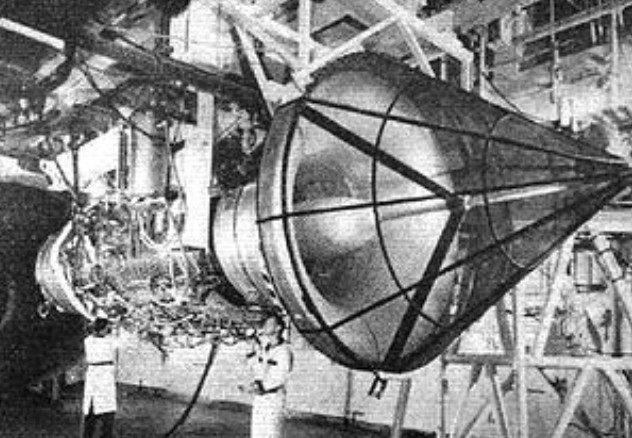
J47-GE25

General Electric GE4

General Electric GE4/J5

The General Electric GE4 turbojet engine was designed in the late 1960s as the powerplant for the Boeing 2707 supersonic transport. The GE4 was a nine-stage, single-shaft, axial-flow turbojet based largely on the General Electric YJ93 which powered the North American XB-70 bomber. The GE4 was the most powerful engine of its era, producing 50,000 lbf (220 kN) dry, and 65,000 lbf (290 kN) with afterburner. The Boeing 2707 was cancelled in 1971, putting an end to further work on the GE4. First run in 1967, only three were built.

Specifications
GE4/J5P
Type: Turbojet
Length: 27ft 4 in (833.1cm)
Diameter: 5ft 11 in (180.3cm)
Dry weight: 11,300 lb (5,100 kg)
Compressor: Nine-stage axial
Combustors: Annular straight-through-flow
Turbine: Two-stage axial
Fuel type: Special high-temperature JP-6 Fuel
Maximum thrust: 50,000 lbf (220 kN) (63,200 lbf (281 kN) with afterburning)
Overall pressure ratio: 12.5:1
Turbine inlet temperature: 2,200 ºF (1,204 ºC)
Thrust-to-weight ratio: 6.02
Compressor inlet diameter: 60.6 in (1,539 mm)
Exhaust nozzle diameter: 74.2 in (1,880 mm)
Core airflow: 620 lb (280 kg) per second
Noise:
Takeoff: 104 dB
Sideline: 117 dB
Approach: 107 dB

General Electric TF39 / CTF39

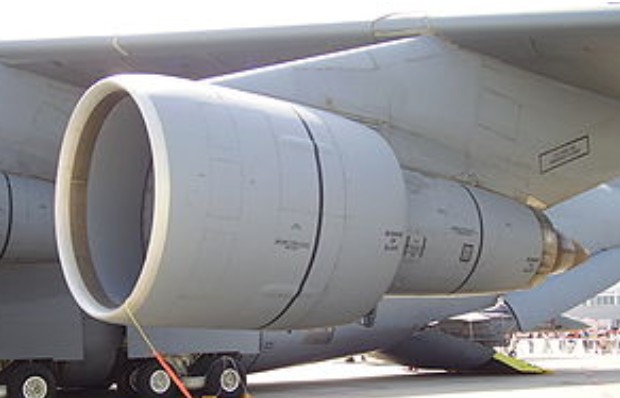
A TF39 on a C-5 Galaxy

The General Electric TF39 is a high-bypass turbofan engine. Developed to power the Lockheed C-5 Galaxy and first run in 1964, it was the first high-power, high-bypass jet engine available. The TF39 was developed into the CF6 series of engines, and formed the basis of the General Electric LM2500 marine and industrial gas turbine.

The United States Air Force opened the “CX-X Program” in 1964, intending to produce a next-generation strategic airlifter. Of the several airframe and engine proposals returned for consideration, Lockheed’s aircraft and General Electric’s engine were selected for the new design in 1965.
The high-bypass turbofan was a huge leap in engine performance, offering a thrust of 43,000 pounds, while improving fuel efficiency by about 25%. The TF39 had an 8-to-1 bypass ratio, 25-to-1 compressor pressure ratio, a 2,500 °F (1,370 °C) turbine temperature made possible by advanced forced-air cooling. The first engine went for testing in 1965. Between 1968 and 1971, 463 TF39-1 and -1A engines were produced and delivered to power the C-5A fleet.

The TF39 is rated from 41,000 to 43,000 lbf (191 to 205 kN) of thrust. It employed a great deal of then-new technological features such as:
1½ stage fan blades (unique to TF39).
8:1 bypass ratio.
Variable stator vanes.
Turbines equipped with advanced cooling.
Fuel efficiency better than any engines available at the time.
Cascade-type thrust reversers.

Mechanically, the TF39 is rather unusual for a high bypass ratio turbofan; the single stage is snubbered (‘Snubbers’ are protuberances that stick-out at right angles to the fan aerofoil somewhere between mid-span and blade tip). The snubbers on adjacent fan blades butt-up against each other, in a peripheral sense and improve the vibration characteristics of the blade to the fan rotor which has a set of inlet guide vanes for the outer bypass section and the core booster stage located in front of the fan rotor, rather than behind. This unique design is clearly seen from the front.

The only application was the Lockheed C-5A/B/C Galaxy.

Specifications:

TF39-1C
Type: Turbofan
Length: 312 in (792 cm)
Diameter: 97 in (246 cm)
Dry weight: 8000 lb (3630 kg)
Compressor: Axial, 1 stage fan, 5 stage low pressure compressor, 16 stage high pressure compressor
Combustors: Annular
Turbine: Axial, 2 stage high pressure turbine, 6 stage low pressure turbine.
Maximum thrust: 43,300 lbf (193 kN)
Overall pressure ratio: 25:1
Specific fuel consumption: 0.313 lb/lbf-hr
Thrust-to-weight ratio: 5.4:1

General Electric CJ805 / TF35

A CJ805-3A turbojet installed on a Convair 880 airliner

The General Electric CJ805 is a jet engine which was developed by GE Aviation in the late 1950s. A simplified civilian version of the J79 featuring an axial compressor, it was developed in two versions. The basic CJ805-3 was a turbojet and powered the Convair 880, while CJ805-23 (military designation TF35), a turbofan derivative, powered the Convair 990 airliners.

Variants and applications:

CJ805-3
Convair 880

CJ805-3A
Convair 880-22 : Revised variable inlet guide vane and stator control.

CJ805-3B
Convair 880-22M : Increased thrust.

CJ805-23
Flight testing in a Douglas RB-66: Aft-fan variant with a direct drive fan attached to a free-running LP turbine.

CJ805-23A

CJ805-23B
Convair 990

CJ805-23C
Intended for the proposed Sud Aviation Caravelle 10A
Only a single Sud Aviation Caravelle intended as a prototype for the US market, was equipped with the CJ805.

Specifications:

CJ805-3B
Type: Single-spool turbojet
Length: 188.9 in (4,798 mm) with thrust reverser/suppressor
Diameter: 31.6 in (803 mm)
Dry weight: 3,213 lb (1,457 kg) with thrust reverser/suppressor
Compressor: 17-stage axial flow
Combustors: can-annular
Turbine: 2× gas generator power stages + 1× free running turbine with fan blades on the periphery
Fuel type: Aviation kerosene
Oil system: pressure spray/splash
Maximum thrust: 11,650 lb (5.28 kN) for take-off
Overall pressure ratio: 13:1
Specific fuel consumption: 0.75 lb/lb·hr (76.45 kg/kN·hr) at max. continuous rating
Thrust-to-weight ratio: 3.626 lbf/lb (0.356 kN/kg)

General Electric CJ610

The General Electric CJ610 is a non-afterburning turbojet engine derived from the military J85, and is used on a number of civilian business jets. First run in the 1960s, the model has logged over 16.5 million hours of operation. Civilian versions have powered business jets such as the Learjet 23 and the Hamburger Flugzeugbau HFB-320 Hansa Jet.

A development, the CF700 added a rear-mounted fan mounted directly on the free-running low-pressure turbine.

Applications:
Aero Commander 1121 Jet Commander
HFB-320 Hansa Jet
Learjet 23
Learjet 24
Learjet 25
Learjet 28
Learjet 29

Specifications:
CJ610
Type: Turbojet
Length: 45.4 to 51.1 inches (1.15 – 1.30 m) (depending on accessory equipment installed)
Diameter: 17.7 inches (0.45 m)
Dry weight: 396 – 421 pounds (180 – 191 kg)(depending on accessory equipment installed)
Compressor: 8-stage axial flow
Turbine: 2-stage
Maximum thrust: 2,850 – 3,100 lbf (12.7 – 13.8 kN) at sea level
Specific fuel consumption: 0.96 – 0.97 lb/(lbf·h) ( 27 g/kN·s )

General Electric CFE738

The CFE738 is a small turbofan engine aimed at the business/commuter jet market manufactured by the CFE Company, and is used on the Dassault Falcon 2000.

The success of the GE27/GLC38 gas generator development of the 1980s led to the formation of the CFE Company by GE and the Garrett Engine Division of Allied Signal (later Honeywell) in 1987.

The CFE738 consists of a single stage fan, driven by a 3-stage low-pressure (LP) turbine, supercharging a 5-stage high-pressure (HP) axial/centrifugal compressor driven by a 2-stage HP turbine. The engine has an overall pressure ratio of 35:1, which is extremely high for an engine with a centrifugal compressor. Other cycle parameters are a bypass ratio 5.3 and airflow of 240 lb/s. The take-off thrust is 5,600 lbf, flat-rated to ISA+15C.

Applications:
Dassault Falcon 2000

Specifications:
Type: Turbofan
Length: 68.3 in
Diameter: 35.50 in (Fan)
Dry weight: 1,214 lb (Basic) Dry Weight: 1,325 lb
Compressor: Fan/Compressor Stages: 1/5+1C
Turbine: High-Pressure Turbine/Low-Pressure Turbine Stages: 2/3
Maximum thrust: Max. Thrust (Sea Level Static): 5,918 lbf, Cruise Net Thrust (Mach 0.8, 40000 ft, ISA): 1310 lbf
Overall pressure ratio: ~30:1, Bypass Ratio: 5.3
Specific fuel consumption: (Sea Level Static): 0.369 lb/hr/lbf, (Mach 0.8, 40000 ft, ISA): 0.645 lb/hr/lbf

General Electric CF34

The General Electric CF34 is a civilian turbofan developed by GE Aircraft Engines from its TF34 military engine. First run in the 1960s, the original engines comprise a single stage fan, driven by a 4-stage LP turbine, supercharging a 14-stage HP compressor, driven by a 2-stage HP turbine, with an annular combustor. Later higher thrust versions of the CF34 feature an advanced technology core, with only 10 HP compressor stages. Later variants, the -10A and -10E, were derived from the CFM56 engine family, and have a radically different HP spool, comprising a 9 stage compressor driven by a single stage turbine. The LP spool has 3 core booster stages behind the fan. Static thrust is 18,500 lbf for the -10E variant.

Applications:

CF34-1
Bombardier CL-601-1A
Bombardier CL-601-1A/ER

CF34-3A
Bombardier CL-601-3A

CF34-3A1
Bombardier CRJ100 ER/LR

CF34-3A2

CF34-3B
Bombardier CL-604
Bombardier CL-605

CF34-3B1
Bombardier CRJ200 ER/LR
Bombardier CRJ440 ER/LR

CF34-8C1
Bombardier CRJ700 (Series 701)

CF34-8C5
Bombardier CRJ700 (Series 705)
Bombardier CRJ900
Bombardier CRJ900 NextGen

CF34-8C5A1
Bombardier CRJ1000 NextGen

CF34-8C5B1
Bombardier CRJ700 NextGen

CF34-8E
Embraer E-170
Embraer E-175

CF34-10A
Comac ARJ21

CF34-10E
Embraer E-190
Embraer E-195

Specifications:

CF34-3
Length: 103 in (2.6 m)
Diameter: 49 in (1.2 m)
Dry weight: 1,625 lb (737 kg) – 1,670 lb (760 kg)
Compressor: 1 fan / 14 HP stages
Turbine: 4 LP stages / 2 HP stages
Thrust at sea level: 9,220 lbf (41.0 kN)
Power-to-weight ratio: 5.6:1
Overall pressure ratio at max. power: 21:1
Bypass ratio: 6.2:1

CF34-8
Length: 121.2 in (3.08 m) – 128 in (3.3 m)
Diameter: 52 in (1.3 m) – 53.4 in (1.36 m)
Dry weight: 2,408 lb (1,092 kg) – 2,600 lb (1,200 kg)
Compressor: 1 fan / 10 HP stages
Turbine: 4 LP stages / 2 HP stages
Thrust at sea level: 13,790 lbf (61.3 kN) – 14,510 lbf (64.5 kN)
Power-to-weight ratio: 5.3:1
Overall pressure ratio at max. power: 28:1 – 28.5:1
Bypass ratio: 5:1

CF34-10
Length: 90 in (2.3 m) – 145.5 in (3.70 m)
Diameter: 57 in (1.4 m)
Dry weight: 3,700 lb (1,700 kg)
Compressor: 1 fan + 3 LP stages / 9 HP stages
Turbine: 4 LP stages / 1 HP stage
Thrust at sea level: 18,285 lbf (81.34 kN) – 20,000 lbf (89 kN)
Power-to-weight ratio: 5.2:1
Overall pressure ratio at max. power: 29:1
Bypass ratio: 5:1

General Electric H75 / H80 / H85

The General Electric H80 is a turboprop aircraft engine produced by GE BGA Turboprops. The H80 is an updated derivative of the Walter M601. First run in 2009, FAA certification of the engine obtained at 13 March 2012. Russian type certificate received in October 2012 also approved by EASA, Brazilian Civil Aviation agency (ANAC) and the Argentine Administración Nacional de Aviación Civil.

The H80 will update the legacy M601 in several ways, including power and efficiency. The H80 will be a significant power upgrade over the M601, reaching 800 shaft horsepower (shp) rather than the 650 shp of the M601. Another important upgrade to the engine will be improving its hot day performance. That improvement is a major reason why the H80 was selected to power the Thrush Model 510 as a crop duster for Afghanistan.

Thrush Aircraft has exclusively teamed with General Electric to produce the Thrush 510G powered by the GE H80 turbine engine. The H80 provides increased temperature margins to enhance hot-day takeoff performance and high-altitude cruise speeds. GE chose Thrush to launch this new engine.

The GE H80 turboprop engine that powers the Thrush 510G was initially based upon the Walter M601 engine. The new H80 represents a complete rethink by GE Aviation that resulted in a free-turbine design that is lighter, more powerful, and more fuel efficient. In addition, the H80 has the ability to produce its full-rated 800 shp at high altitudes and field elevations, even on the hottest of days. Plus, the H80 requires no hot section inspection, and has a TBO of 3,600 hours.

Variants:
H80
formerly the M601H-80
H75
750 shp derivative
H85
850 shp derivative

Applications:
Thrush Model 510
Let 410NG
Technoavia Rysachok

Specification:

H80
Type: Turboprop
Length: 66″ (1.670 mm)
Diameter: 22″ (560 mm)
Dryweight: 382 lbs
Pressure Ratio: 6.7
TBO: Hours 3600, cycles 6600

General Electric T700 / CT7

The General Electric T700 and CT7 are a family of turboshaft and turboprop engines in the 1,500-3,000 shp class.

In 1967, General Electric began work on a new turboshaft engine demonstrator designated the “GE12” in response to US Army interest in a next-generation utility helicopter. The Army effort led, in the 1970s, to development of the Sikorsky S-70 Black Hawk, powered by twin GE “T700” turboshafts, the production descendant of the GE12.

The T700 was initially bench-tested in 1973, passed military qualification in 1976, and went into production in 1978. The initial “T700-GE-700” is an ungeared free-turbine turboshaft, with a five-stage axial / one-stage centrifugal mixed-flow compressor, featuring one-piece “blisk” axial stages, with the inlet guide vanes and first two stator stages variable; an annular combustion chamber with central fuel injection to improve combustion and reduce smoke; a two-stage compressor turbine; and a two-stage free power turbine with tip-shrouded blades. The engine is designed for high reliability, featuring an inlet particle separator designed to spin out dirt, sand, and dust. The T700-GE-700 is rated at 1,622 shp (1,210 kW) intermediate power.

The T700-GE-700 was followed by improved and uprated Army engine variants for the UH-60 Black Hawk and the AH-64 Apache helicopters, as well as marinized naval engine variants for the SH-60 Seahawk derivative of the Black Hawk, the SH-2G Seasprite, and the Bell AH-1W Supercobra. T700s are also used on Italian and commercial variants of the AgustaWestland EH101/AW101 helicopter, and Italian variants of the NHIndustries NH90 helicopter. These are all twin-engine machines, except for the three-engined EH101.

The commercial version of the T700 is the “CT7”, with the engine used on the Bell 214ST (an enlarged version of the Huey), commercial Black Hawks, and the Sikorsky S-92 derivative of the Black Hawk, all of which are twin-engine helicopters.

The CT7 turboprop variants use the same core as the turboshaft variants, with a propeller gearbox fitted forward of the core. CT7 turboprops are used on variants of the Swedish SAAB 340 airliner, the Indonesian-Spanish Airtech CN-235 cargolifter, and the Czech Let L-610G airliner, all twin-turboprop aircraft. The baseline CT7-5A provides 1,735 shp (1,294 kW) on takeoff.

In the late 1980s, GE also proposed a much larger turboprop, the T407/GLC38, with a five-stage axial/one-stage centrifugal mixed-flow compressor; an annular combustor with 15 burners; a two-stage compressor turbine; a three-stage power turbine; and max takeoff power of 6,000 shp (4,475 kW).
The YT706 is based on the CT7-8A engine. Compared with the T700 powering H-60 helicopters, the YT706 has a larger compressor, hot section improvements and a full authority digital engine control. The YT706 provides up to 30 percent more power than the current T700-701C and will increase the hot-and-high mission capability of the MH-60M Black Hawk procured by the U.S. Army for its Special Operations applications.

Variants:

T700: Military turboshaft engine.
YT700: Prototype version.
T700-700: Initial T700 variant. The improved T700-GE-701A, -701B, -701C,-701D versions have also been developed fro the original -700.
T700-TEI701D: Licensed produced version of Tusaş Engine Industries of Turkey. Developed for use in the Sikorsky/Turkish Aerospace Industries T-70 Utility Helicopter.

CT7 turboshaft: Commercial version of T700.
CT7-2A : Basic model
CT7-2D : Higher flow compressor and surface coatings to improve resistance to wear and corrosion
CT7-2D1 : Similar to the CT7-2D but uses a CT7-6 type hot section
CT7-6
CT7-6A
CT7-8
CT7-8A
CT7-8A1
CT7-8A5
CT7-8B
CT7-8B5
CT7-8E
CT7-8E5
CT7-8F
CT7-8F5

CT7 turbprop: Turboprop version of CT7.
CT7-5A2
CT7-5A3
CT7-7A
CT7-7A1
CT7-9B
CT7-9B1
CT7-9B2
CT7-9C
CT7-9C3
CT7-9D
CT7-9D2

Applications:

T700/CT7 turboshaft
AgustaWestland AW101
AgustaWestland AW149
AgustaWestland AW189
AgustaWestland CH-149 Cormorant
Bell 214ST
Bell 525
Bell AH-1W SuperCobra
Bell AH-1Z Viper
Bell UH-1Y Venom
Boeing AH-64 Apache
Kaman SH-2G Super Seasprite
Lockheed Martin VH-71 Kestrel
Mitsubishi H-60
NHIndustries NH90
Piasecki X-49
Sikorsky CH-148 Cyclone
Sikorsky HH-60 Jayhawk
Sikorsky HH-60 Pave Hawk
Sikorsky SH-60 Seahawk
Sikorsky UH-60 Black Hawk
Sikorsky S-70
Sikorsky S-92
Sikorsky S-97

CT7 turboprop
CASA/IPTN CN-235
Let L-610G
Saab 340
Sukhoi Su-80

Specifications:

T700
Type: Turboshaft
Length: 47 in (T700-GE-700/701 series) to 48.2 in (T700/T6A)
Diameter: 25 in / 26 in (T700/T6E)
Dry weight: 400 lb (YT700-GE-700); 437 lb (T700-GE-700); 537 lb (T700/T6E)
Compressor: 6 stage-5 stage axial, 1 stage centrifugal.
Combustors: Annular
Turbine: 2 stage gas generator and 2 stage power turbine
Fuel type: JP-4 or JP-5 (YT700-GE-700)
Oil system: self contained, pressurized, recirculating dry sump
Maximum power output:
YT700-GE-700:1,536 shp (1,145 kW);
T700-GE-700: 1,622 shp (1,210 kW);
T700/T6E: 2,380 shp (1,775 kW);
YT706-GE-700: 2,638 shp (1,967 kW)
Overall pressure ratio: 17x
Specific fuel consumption: 0.433 (T700/T6E) to 0.465 (T700-GE-701A)
Power-to-weight ratio: 3.84 shp/lb (YT700-GE-700); 3.71 shp/lb (T700-GE-700); 4.48 shp/lb (T700/T6E)