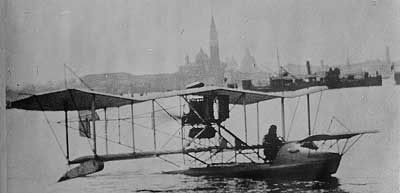
Ginocchio biplane flying boat seen here in 1913 at Venezia (Venice)
Manlio Ginocchio was an Italian aviation pioneer, and an officer in the Italian Navy. After earlier experiences with flying and designing of machines, he designed and built his “Idro-canotto” and powered it with a 90 hp Salmson engine. The machine was not very successful and remained in one example, although it was acquired by the Italian Navy and became part of the early Italian naval establishment in Venice.
Manlio Ginocchio was an Italian aviation pioneer, and an officer in the Italian Navy. After earlier experiences with flying and designing of machines, he designed and built his “Idro-canotto”
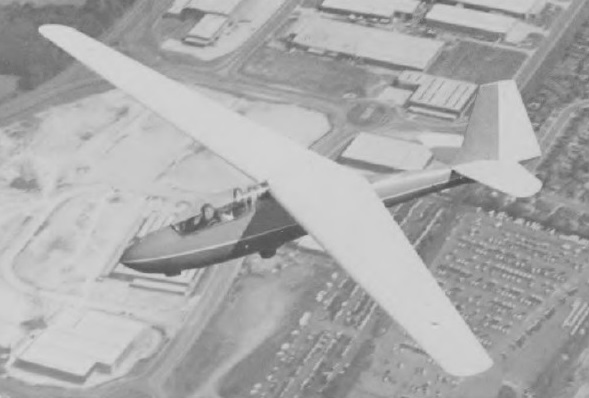
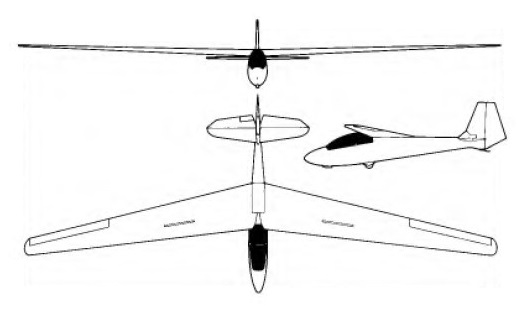
This two-seater semi aerobatic sailplane with its distinctive forward wing sweep was designed in 1956 by Mr Lesniak, who began construction of a prototype with Mr Vie Ginn at the Dunstable Gliding Club’s workshops at Dunstable, UK.
After a time the project was abandoned and after several years the uncompleted Kestrel prototype was saved from destruction by Mr Ron Dodd, a chartered engineer who had worked at the RAE Farnborough, and Mr Jeff Butt. They reactivated the project, with Mr Dodd recalculating, modifying and improving the design, and they completed the Kestrel prototype, which eventually made its first flight on 19 July 1969 at Enstone as c/n 1 BGA.1571.
It is of conventional wood and fabric construction, the two-part wings incorporating large Schempp-Hirth air brakes and Frise ailerons, and there are metal-bonded reinforcements at the wing roots. The all-wood fuselage has plywood/balsa sandwich reinforcement from the tip of the nose to just aft of the cockpit. Landing gear consists of a fixed monowheel and a tailskid, with a skid block mounted under the nose to protect it. The pilots sit in tandem in a roomy cockpit under a two-piece canopy, the sideways-hinged forward section being a complete Skylark 4 canopy which also secures the transparent detachable rear half.
Span: 59 ft 0.5 in / 18.0 m Length: 24 ft 8.25 in / 7.54 m Wing area: 243 sq ft / 22.57 sq.m Aspect ratio: 14.3 Wing section: Gottingen 549/M12 Empty weight: 680 lb / 308 kg Max weight: 1,100 lb / 499 kg Water ballast: None Max wing loading: 4.55 lb/sq ft / 22.21 kg/sq.m Max speed: 98 mph / 85 kt / 158 km/h Stalling speed: 32.5 kt / 60 km/h Max rough air speed: 71.5 kt / 133 km/h Min sinking speed: 2.2 ft/sec / 0.67 m/sec at 50 mph / 43 kt / 80 km/h Best glide ratio: 28:1
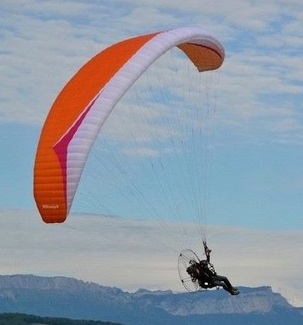
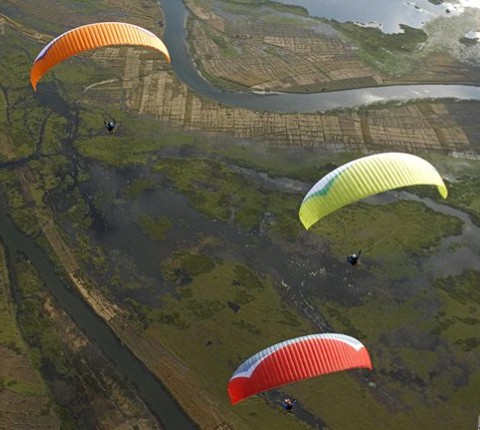
The Mirage is based on a Reflex profile but has an easy inflation and easy loading for takeoff compared to the wings made with the same profile type. This is due to a new generation of light leading edge, to an optimum placement of the attachment points, and to an original line cascade which utilizes the full efficiency of the profile.
There are 2 profiles in the wing with different angles of attack across the wingspan. The original planform shape decreases the drag. It is very easy to manage the angle and radius of the turn with dynamic and precise handling.
The Intermediate Mirage Paramotor wing has a dynamic roll but without excess. It is very stable in pitch, which helps to coordinate the turn with a paramotor and allows tight turns or wide turns with a good sink rate.
The arc has been calculated to help to initiate the turn with roll, but at the same time keeping a strict directional stability and avoiding any bad rolling tendency. This is a very important characteristic in PPG, and helps to control the spiral dive.
The wing is very stable in all axes, especially at full speed. The sink rate is excellent at both slow and fast speeds, which allows a wide useable speed range.
The risers include a wing tip steering kit to pilot the wing when accelerated.
Free flight weight 80-100kg Weight with paramotor 105-135kg
A competition machine, the third version of Gin Seok’s Boomerang, the Boomerang III is announced in 2005 with a better climb rate than the previous Boomerang (II), safer, easier to fly and more stable at maximum speed. Development concentrated on a new profile, with 2 years of studies and tests of profiles in the Korean Air Force Academy wind tunnel. The leading edge inlets, are more refined, and a different internal structure was developed for the glider, made with fine adjustments of the panels, tapes, internal ribs, main ribs, diagonal ribs and reinforcements. The prototypes were tested by the factory pilots (Louise Crandal and Jimmy Pacher, among others) during the Europeans and World Cup Tour 2002.
Boomerang III AFNOR Comp DHV3 Pilot wt: 75-95 kg.
Boomerang Sport
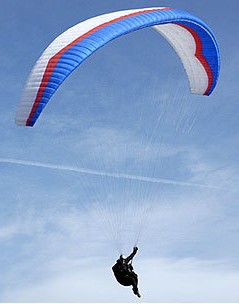
Designed for cross country and competition, the Boomerang Sport DHV2-3 glider in the Gin’s range is based on the Boom 4; it has an aspect ratio of 6,2 and a big arc with square tips. The Boomerang Sport incorporates Gin’s patented Rigifoil System in the leading edge, and a unique acceleration system called Kick-Down System that offers the pilot increased feedback through the speed bar pressure. At 50% acceleration there is marked increase in pressure to alert the pilot of his position along the polar curve, helping the pilot to be more aware of the incidence of the wing and therefore glide performance. The Boomerang Sport offers easy inflation, and precise feedback creating a comfortable, safe and stable feeling. The Boomerang Sport is constructed using Porcher fabrics and Liros lines. It was available in 4 sizes and 4 color schemes.