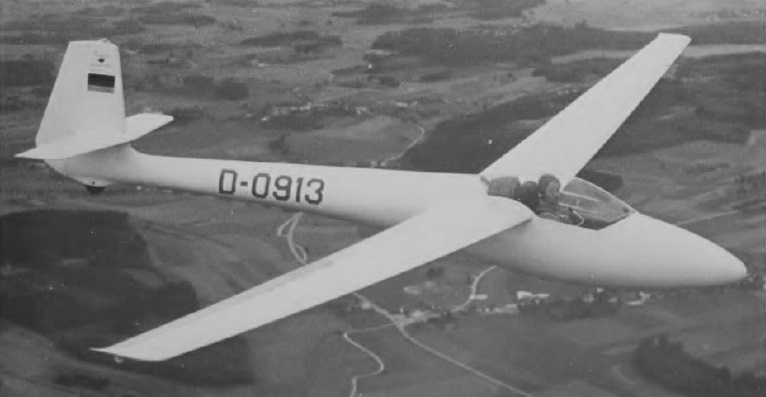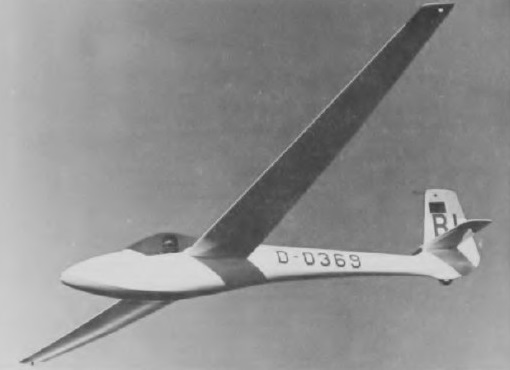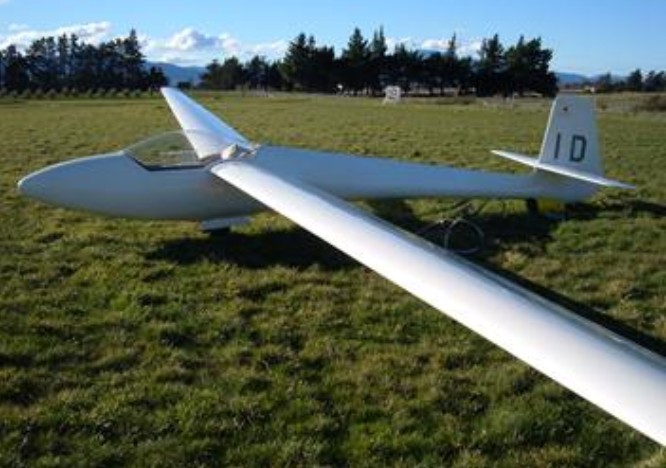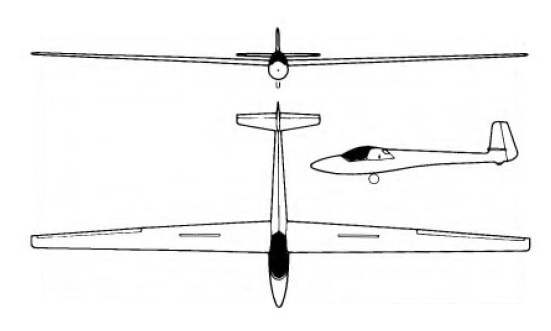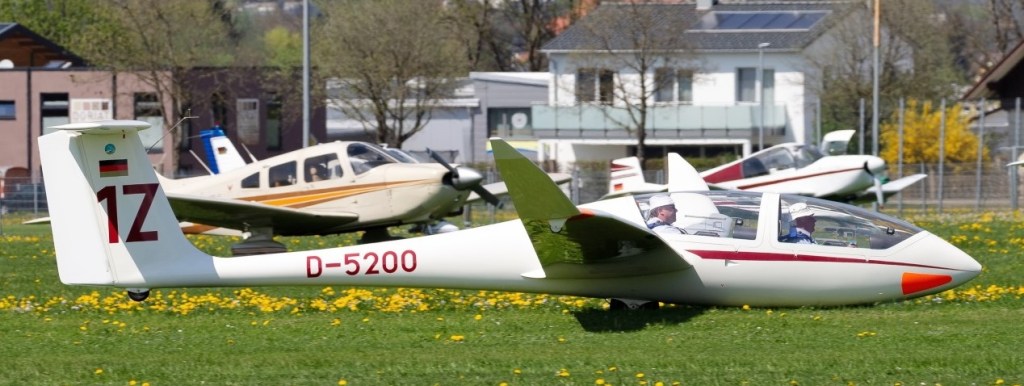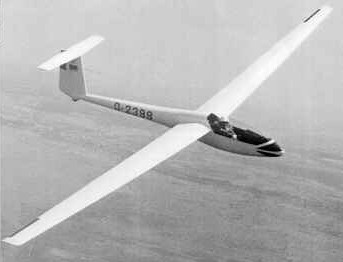
Glasflugel 206 Hornet

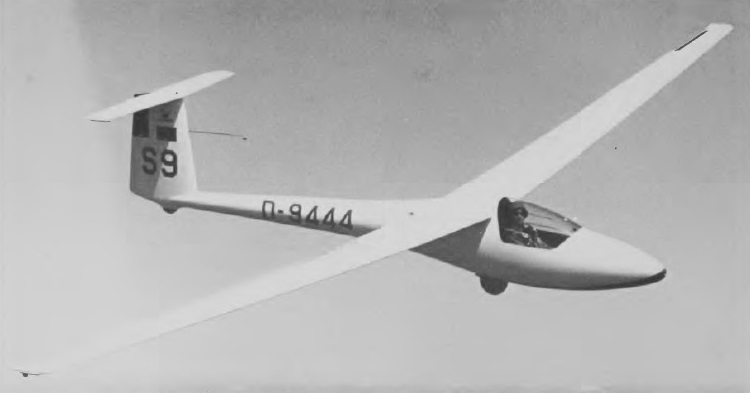
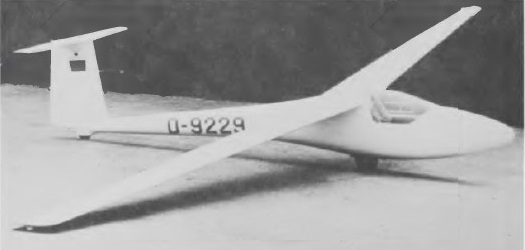
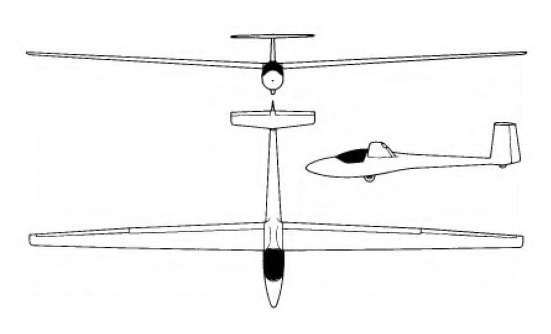
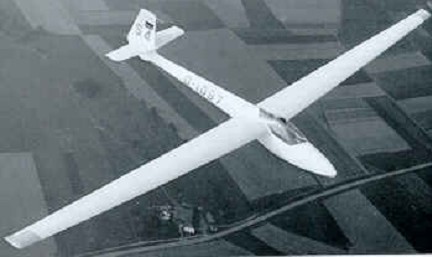
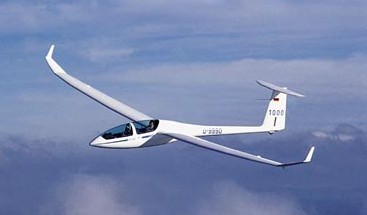
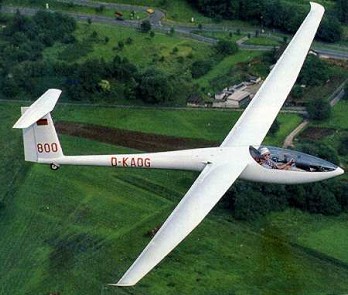
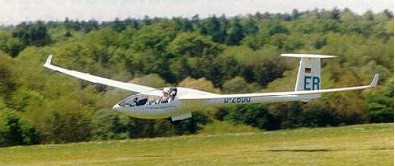
Designed by Eugene Hanle as a successor to the H 201 Standard Libelle, the Hornet is a derivative of the Club Libelle, differing from it chiefly in having an enlarged, longer two-piece flush-fitting cockpit canopy hinged at the front and rear, a retractable instead of fixed monowheel, and provision for up to 165lb of water ballast.
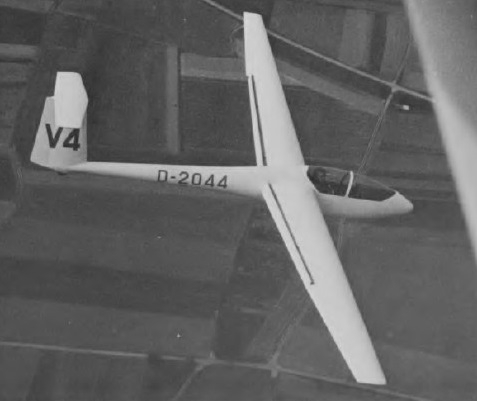
This Standard Class mid-wing design has a T-tail and the entire structure is of glassfibre monocoque, glassfibre/foam sandwich and glassfibre/balsa sandwich. The mid wing has a different incidence to improve high speed performance. Rotating air brake-type flaps and partially mass-balanced ailerons are on the wing trailing edges, and the elevator has a spring trim. The Hornet has trailing edge dive brakes operating well behind the laminar lift- producing area of the upper wing. The structure is fiberglass with a carbon wing box spar and skin, and Kevlar reinforced cockpit.

The unsprung monowheel has an internally expanding brake, and there is a fixed tailwheel.
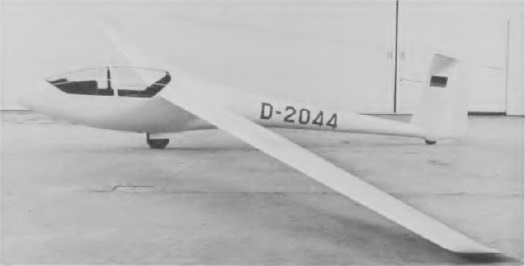
The prototype made its first flight on 21 December 1974 and a total of 90 Hornets had been delivered by the summer of 1979.

The Hornet C introduced in 1979 has a carbon-fibre torsion box to each wing, with carbon-fibre spar caps and a wing skin of carbon-fibre/plastic foam sandwich; the lighter weight of these wings allows the water ballast capacity to be increased to 375 lb (an additional 30 kg / 66 lb). The wing root fairings are modified and the C has the same one-piece cockpit canopy as the Glasflugel Mosquito. The prototype Hornet C first flew on 6 April 1979.
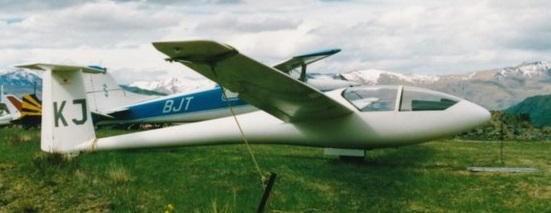
Glasflugel H-206 Hornet ZK-GKJ

Hornet
Wing span: 15.0 m / 49 ft 2.5 in
Length: 6.4 m / 21 ft 0 in
Height: 1.4 m / 4ft 7 in
Wing area: 9.80 sq.m / 105.5 sq ft
Wing section: Wortmann FX-67-K-150
Aspect ratio: 23.0
Empty weight: 227 kg / 500 lb
Max weight: 420 kg / 926 lb
Water ballast: 120 kg / 265 lb
Max wing loading: 42.9 kg/sq.m / 8.8 lb/sq ft
Max speed: 135 kt / 250 km/h
Stalling speed: 36 kt / 67 km/h
Min sinking speed: 0.60 m/sec / 1.97 ft/sec at 40.5 kt / 75 km/h
Best glide ratio: 38 at 56 kt / 103 km/h

Wing span: 15 m / 49.2 ft
Wing area: 9.8 sq.m / 105.5 sq.ft
Aspect ratio: 23
Airfoil: Wortmann FX 66-17
Length: 21 ft 0 in
Height: 4 ft 7 in
Empty Weight: 227 kg / 500 lb
Payload: 193 kg / 426 lb
Gross Weight: 420 kg / 926 lb
Wing Load: 42.86 kg/sq.m / 8.8 lb/sq.ft
Water Ballast: 170 kg / 375 lb
Max speed: 155 mph
Max aero-tow speed: 93 mph
L/DMax: 38 103 kph / 56 kt / 64 mph
Best glide ratio: 38:1 at 47mph
MinSink: 0.60 m/s / 1.96 fps / 1.16 kt at 47mph
Seats: 1
No. Built: 102
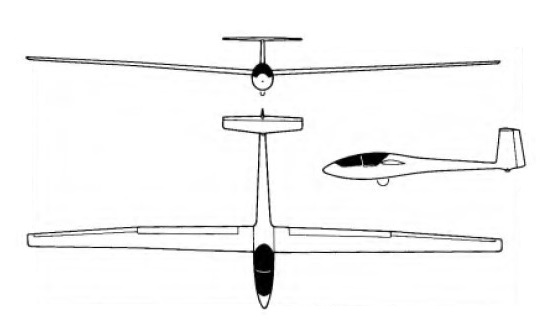
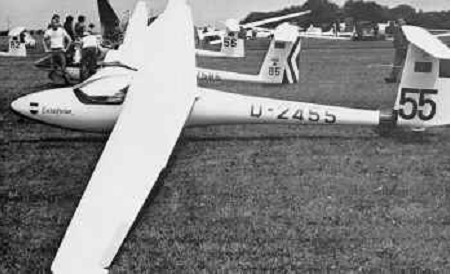
Glasflugel H-205 Club Libelle

The Libelle and Standard Libelle had proved to be so popular that the need was recognised for a development of these designs suitable for club training, especially for conversion training to the modern high performance glassfibre types in both Standard and Open Classes, and also for advanced cross-country soaring in preparation for Diamond C flights. Good handling characteristics and ease of landing away from base for the less experienced pilot were also necessary, and these were the qualities Eugen Hanle sought in the Club Libelle.

This was based on the Standard Libelle, differing from it principally in having new double-taper shoulder-mounted wings with a double taper, and a T-tail. The two-piece wings are of glassfibre reinforced plastic (GRP) foam section with spar flanges of parallel glassfibre and spar webs of GRP-balsa. The wings carry broad-span trailing edge flaps for approach control.

The fuselage is an all glassfibre monocoque with no balsa or other type of sandwich, and there is a fixed monowheel with a brake. The cockpit is roomier than the Standard Libelle’s, although the one-piece canopy is shorter, and the Club model does not carry water ballast.

The prototype Club Libelle made its first flight in September 1973 and a total of 171 had been built when production ended in August 1976.

Gallery

Wing span: 15m / 49 ft 2.5 in
Wing area: 9.8 sq.m / 105.5 sq.ft
Wing section: Wortmann FX-66-17A-11 -182
Aspect ratio: 23
Length: 6.4 m / 21 ft 0 in
Height: 1.4m / 4ft 7in
Empty Weight: 200 kg / 441 lb
Payload: 130 kg / 286 lb
Gross Weight: 330 kg / 727 lb
Wing Load: 33.67kg/sq.m / 6.9lb/sq.ft
Water Ballast: 0
Max speed: 124 mph / 108 kt / 200 km/h
Stalling speed: 32.5 kt / 60 km/h
L/DMax: 35.1 at 90 kph /49 kt / 56 mph
MinSink: 0.56 m/s / 1.84 fps / 1.09 kt at 42 mph / 36.5 kt / 67 km/h
Seats: 1

Glasflugel H.201 Standard Libelle

Designed by Wolfgang Hűtter and Eugen Hanle, the Standard Libelle is a version of the Open Class H 301 Libelle with modifications to meet the Standard Class requirements; these consisted of removing the flaps and tail braking parachute, fitting a fixed instead of retractable monowheel and raising the height of the canopy. A new Wortmann wing section is featured and terminal velocity dive brakes are fitted. The canopy has a catch that enables the front to be raised by 25mm in flight to provide a blast of ventilating air if required, instead of the more conventional small sliding panel. The Standard Libelle is of similar glassfibre construction to the H 301 Libelle, and likewise has provision for 110 lb of water ballast in the wing leading edge.

The H 201 Standard Class version prototype first flew in October 1967. It originally had a fixed landing gear; but with a change in the Standard Class rules, a retractable gear (H 201B) became standard. The B model features larger upper surface dive brakes, a larger stabilizer for better low-speed handling, PVC foam filler for the wing ( instead of balsa) to increase durability and profile accuracy, and (as an option) a water ballast system (50 kg. /100 lb.) with lighter gross weight.

Glasflugel H201 Standard Libelle

A total of 601 being built.

One flown by Per-Axel Persson of Sweden, winner of the 1948 World Championships, came second in the Standard Class at the 1968 World Championships at Leszno in Poland. In 1970 Sue Martin of Australia set a womens world Out & Return record with a flight of 656 km / 407.64.

Libelle 201B

Gallery

Standard Libelle H 201
Wing span: 15m / 49.2ft
Wing area: 9.85sq.m / 106sq.ft
Empty Weight: 185kg / 408lb
Payload: 164kg / 362lb
Gross Weight: 349kg / 770lb
Wing Load: 29.44kg/sq.m / 6.07lb/sq.ft
Water Ballast: 50kg / 110lb
Aspect ratio: 23
MinSink: 0.55 m/s / 1.8 fps / 1.07 kt
L/DMax: 38 85 kph / 46 kt / 53 mph
Seats: 1
Airfoil: Wortmann
Structure: fiberglass

H 201B
Span: 49 ft 2.5 in / 15.0 m
Length: 20 ft 4 in / 6.2 m
Height: 4 ft 4 in / 1.31 m
Wing area: 105.5 sq ft / 9.8 sq.m
Aspect ratio: 23.0
Wing section: Wortmann FX-66-17A-11-182
Empty weight: 408 lb / 185 kg
Max weight: 772 lb / 350 kg
Water ballast: 110 lb / 50 kg
Max wing loading: 7.31 lb/sq.ft / 35.7 kg/sq.m
Max speed (smooth air): 155 mph / 135 kt / 250 km/h
Max rough air speed: 135 kt / 250 km/h
Stalling speed: 33.5 kt / 62 km/h
Min sinking speed: 1.96 ft/sec / 0.60 m/sec at 46.5 mph / 40 kt / 75 km/h
Best glide ratio: 38:1 at 53 mph / 46 kt / 85 km/h

Glaser-Dirks DG-1000

Long term plans for DG Flugzeugbau were to design and construct a a two seater glider, the DG-1000 – and from 2009 on the DG-1001.
The Airfoil is a laminar wing section designed by Horstmann/Quast from DLR Braunschweig. The Technical University of Delft completed the design with the addition of winglets and optimizing the wing- fuselage intersection. The wing section is slightly less efficient at best L/D, however much better above 160 km/h. This was combined with very docile stalling characteristics and low bug- and rain sensitivity.
The DG-1000 can be flown with 2 wing-spans. For easier rigging each wing features a parting device at about the 17.2 meter point. For flying at the 18 meter span a set of 0.4 meter long wing tips with “miniwinglets” are added (similar to the standard DG-800 18m tips). This configuration is designed to produce good rolling qualities and predictable flight behavior.
For cross-country flying the 20m wing tip extensions with integral winglets are added.
In addition the four-part trapezoidal wing of the DG-1000 has a small advantage over a two-part trapezoidal plan form at low speeds.
The wings of the DG-1000 wing are about 89 kg.
The fuselage incorporates a high seating position of the rear seat and a two-piece canopy. The landing gear has a shock-absorbing, new mechanism providing high comfort. One wheel extends forward from the landing gear compartment beyond the centre of gravity. The DG-1000 therefore tends to sit up, even with a pilot in the front cockpit. The sudden pitch up on winch launch is avoided because the glider always rests on the tail wheel.
The big spring gives comfort during taxiing and the wheel comes with a hydraulic disk brake.
The higher weight for the tail wheel is easy to handle with a towing device made by COBRA-Trailer.
The sailplane has been designed with new profile sections and optimized to the size of the wings. There is a compartment in the vertical fin for ballast weights which is accessible via a removable panel.
The wing-fuselage intersection was optimized for optima lboundary layer conditions with special airfoils in this area.
Winglets are standard for the 20m span which performance-wise will result in a wingspan of approx. 21 meters.
The drag of the nose wheel has been eliminated.
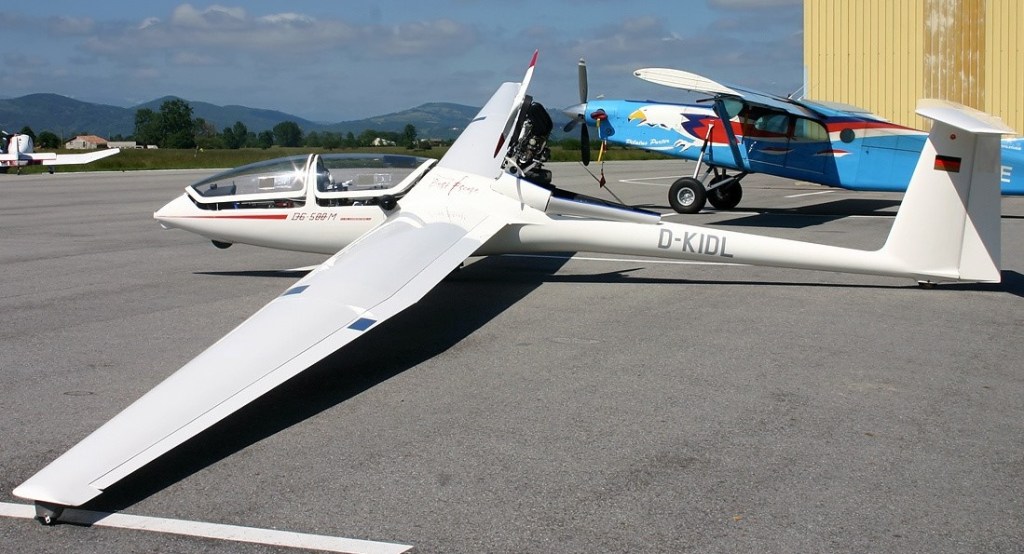
From the beginning the DG-1000 was planed with an engine – as a self-launcher or as a Turbo-version.
The maiden flight did not occur until July 28th, 2000.

The DG-1001S is the standard model with a 20 m span, winglets, retractable main gear, trim box, and water ballast. Additional there is an option for the landing gear of the DG-505 Orion.

DG-1001S-18/20
For this variation wing tips for an 18 m wingspan are available. 1.4 meter extensions, including winglets are available as options. In this version the DG-1000 is a very good aerobatic trainer. The extensions transform the ship into a high-performance cross-country machine.

DG-1001S Club
A less expensive entry model, the span is fixed at 18 m, the gear is non retractable, and there is no water ballast system. The Club Model can be ordered with “normal” retractable gear, water ballast system, and with removable tips. This gives the option of later adding the wing extensions, including winglets thus giving a complete DG-1001S-18/20m.

DG-1001T
The motorized version as a Turbo with a wing span of 18 or 20 m was available since spring 2005.
The DG-1000, with the help of the trim box and fin tank, can be set up with a suitably rearward C.G. for spin training.

DG-1001M
The motorized version as a Self Launcher with a wing span of 20 m was available since autumn 2009.

DG-1000
Wing span: 20m / 65.6ft
Wing area: 17.51sq.m / 188sq.ft
Empty Weight: 410kg / 902lb
Payload: 750kg / 1653lb
Gross Weight: 42.8kg /
Wing Load: 160kg /sq.m / 8.76lb/sq.ft
Water Ballast: 352lb
L/DMax: 1/46.5
MinSink: .51mps/ 100.3 fpm
Aspect ratio: 22.84
Seats: 2

DG-1001S 18m
Wingspan: 18 m / 59,1 ft
Wing area: 16,72 sq.m / 180 sq.ft
Aspect ratio: 19,38
Length: 8,66 m / 28,4 ft
Fuselage width: 0,73 m / 2,4 ft
Fuselage height: 1,0 m / 3,3 ft
Tail wingspan: 3,2 m
Empty weight with
min. instruments: 400 kg / 882lb
Wing loading with 80 kg loading: 28,7 kg/sq.m / 5,87 lb/sq.ft
Max. TOW: 750 kg / 1653 lb
Max. wing loading: 44,9 kg / sq.m / 9,20 lb/sq.ft
VNE: 270 kph / 146 kt
Acrobatic: unlimited

DG-1001S 20m
Wingspan: 20 m / 65,6 ft
Wing area: 17,51 sq.m / 188 sq.ft
Aspect ratio: 22,84
Length: 8,66 m / 28,4 ft
Fuselage width: 0,73 m / 2,4 ft
Fuselage height: 1,0 m / 3,3 ft
Tail wingspan: 3,2 m
Empty weight with
min. instruments: 410 kg / 902lb
Wing loading with 80 kg loading: 28,0 kg/sq.m / 5,73 lb/sq.ft
Max. TOW: 750 kg / 1653lb
Max. wing loading: 42,8 kg / sq.m / 8,76 lb/sq.ft
VNE: 270kph / 146 kt
Acrobatic: limited
Best L/D with max. TOW: 1:46,5
Min. sink (W= 625 kg): 0,51 m/sec / 100,3 ft/min

Glaser-Dirks DG-800

Models of the DG-800, which first flew in 1991, have been developed including the unpowered DG- 800S, the Rotax powered DG-800A and the liquid cooled buried engine configuration of the 800B substantially reduces noise emissions. Each model comes either with a one piece 18 m. wing or a 15 m wing with tip extensions increasing the span to 18 m. The engine in the DG-800 A is a 32 kW/ 43 bhp. Rotax 505A.
Later 800Bs are fitted with an Oehler Solo liquid cooled two-cycle engine with automatic fuel- injection.

DG-800 18m
Wing span: 18m / 59ft
Wing area: 11.81 sq.m / 127sq.ft
Empty Weight: 338kg / 745lb
Payload: 187kg / 412lb
Gross Weight: 525kg / 1157lb
Wing Load: 44.45 kg/sq.m / 9.11lb/sq.ft
Water Ballast: 100kg / 220lb
L/DMax: 50 110 kph / 59 kt / 68 mph
MinSink: 0.50 m/s / 1.63 fps / 0.99 kt
Seats: 1
Aspect ratio: 27.42
Airfoil: Boermans DU-89-138/14, root; DU-92-137/14 tip
Structure: CFRP/AFRP/GFRP
Engine: 37 kW/51 bhp MidWest AE 50 or 40 kW/55 bhp Oehler Solo 2625

DG-800 15m
Wing span: 15m / 49.2ft
Wing area: 10.7sq.m / 115sq.ft
Empty Weight: 224kg / 736lb.
Payload: 191kg / 421lb.
Gross Weight: 525kg / 1157lb
Wing Load: 44.45kg/sq.m / 9.11 lb/sq.ft
Water Ballast: 100kg / 220lb
L/DMax: 45 116 kph/ 63 kt/ 72 mph
MinSink: 0.59 m/s / 1.92 fps. / 1.14 kt
Seats: 1
Aspect ratio: 21.07
Airfoil: Boermans DU-89-138/14, root; DU-92-137/14 tip
Structure: CFRP/AFRP/GFRP
Engine: 37 kW/51 bhp MidWest AE 50 or 40 kW/55 bhp Oehler Solo 2625

DG-808C 15m
Wingspan: 15 m (49.2 ft)
Wing area: 10,68 sq.m (115.0 sq.ft)
Aspect ratio: 21,07
Fuselage length: 7,055 m (23.1 ft)
Fuselage height: 1,434 m (4.7 ft)
Empty weight with parting (full instruments): 334 kg (736lb)
Wing loading with 80 kg payload: 38,8 kg/sq.m (7,95 lbs/sq.ft)
Water ballast wings (option): 100 lt(26.4 US gal)
Max. Weight of the normal version: 525 kg (1156lb)
Max. Wing loading: 49,2 kg/sq.m (10.1 lbs/sq.ft)
Max. Speed vne: 270 kph (146 kt)
Stall speed with 80 kg (176 lbs) payload: 72 kph (39 kt)
Best glide ratio at max. weight: 1:45 at 116 kph (63 kt)
Min. Sink at 400 kg (881 lbs): 0,59 m/s (116 ft/min) at 80 kph (43 kt)
Engine: SOLO 2625, 39kW/53hp
Reduction gearing: 3:1
Fuel tank fuselage: 22 lt(5.8 US gal)
Fuel tank wing (Option) : 2 x 10 lt(2×2,5 US gal)
Take-off distance 15m (50 ft) obst. weight 450 kg / 992 lbs): 200m (656ft)
Climb rate (weight 450 kg / 992 lbs): 4,5 m/s (885 ft/min)

DG-808C 18m
Wingspan: 18 m (59.0 ft)
Wing area: 11,81 sq.m (127.0 sq.ft)
Aspect ratio: 27,43
Fuselage length: 7,055 m (23.1 ft)
Fuselage height: 1,434 m (4.7 ft)
Empty weight with parting (full instruments): 338 kg (745lb)
Empty weight no parting (full instruments): 335 kg (738lb)
Wing loading with 80 kg payload: 35,1 kg/sq.m (7,19 lbs/sq.ft)
Water ballast wings (option): 100 lt(26.4 US gal)
Max. Weight of the normal version: 525 kg (1156lb)
Max. Wing loading: 44,5 kg/sq.m (9,1 lbs/sq.ft)
Max. Speed vne: 270 kph (146 kt)
Stall speed with 80 kg (176 lbs) payload: 68 kph (37 kt)
Best glide ratio at max. Weight about: 1:50 at 110 kph (59 kt)
Min. Sink at 400 kg (881 lbs): 0,50 m/s (98 ft/min) at 76 kph (41 kt)

DG-808S
Wingspan: 15 m (49.2 ft)
Wing area: 10,68 sq.m (115.0 sq.ft)
Aspect ratio: 21,07
Fuselage length: 6.86 m (22.5 ft)
Fuselage height: 1.39 m (4.56 ft)
Empty weight (full instruments): 256 kg (564lb)
Wing loading with 80 kg payload: 32.4 kg/sq.m (6.62 lbs/sq.ft)
Waterballast wings: 120 lt/174 lt/239 lt (31.7 USG /46.0 USG /63.2 USG)
Waterballast in fin tank: 6 lt(1.6 USG)
Max. weight: 570 kg (1255lb)
Max. wing loading: 53.4 kg/sq.m (11 lb/sqft)
Max. speed VNE: 270 kph (146 kt)
Stall speed with 80 kg (176 lbs) payload: 66 kph (35.5 kt)
Best glide ratio at max weight: 1:45 at 116 kph (63 kt)
Min. sink at 400 kg (881 lbs): 0,55 m/s (108 fpm) at 75 kph (40 kt)

DG-808S (without winglets)
Wingspan: 18 m (59.0 ft)
Wing area: 11,81 sq.m (127.0 sq.ft)
Aspect ratio: 27,43
Fuselage length: 6.86 m (22.5 ft)
Fuselage height: 1.39 m (4.56 ft)
Empty weight (full instruments): 262 kg (578lb)
Wing loading with 80 kg payload: 29.4 kg/sq.m (6.02 lbs/sq.ft)
Waterballast wings: 120 lt/174 lt/239 lt(31.7 USG /46.0 USG /63.2 USG)
Waterballast in fin tank: 6 lt(1.6 USG)
Max. weight: 600 kg (1321lb)
Max. wing loading: 50.8 kg/sq.m (10.4 lb/sqft)
Max. speed VNE: 270 kph (146 kt)
Stall speed with 80 kg (176 lbs) payload: 63 kph (34 kt)
Best glide ratio at max weight: 1:50 at 110 kph (59 kt)
Min. sink at 400 kg (881 lbs): 0,47 m/s (92 fpm) at 72 kph (39 kt)

Glaser-Dirks DG-600

The successor to the DG-202/DG-400, the unpowered 15 m. racing class DG-600 first flew in 1987, followed by the mast mounted self- launching DG-600M in 1989.
The fuselage is based on that of the DG-400, but with a more slender tailboom. The wing has a thin section with fully span flaperons. Approach control is by the top surface double panel Schemmpp-Hirth type airbrakes. There is also a fin ballast tank which carries 7 kg / 15.4 lb of water.
The 600 came with four different wingtip configurations- conventional 15 m, 15 m with winglets, conventional 17 m. and swept back 18 m.
The DG-600/18 and DG-600/18M named Evolution have gross weight of 480 kg/ 1,058 lb and 440 kg/ 970 lb respectively. In the 600M, main ballast is reduced to 120 kg/ 265 lb.

DG-600 17M
Wing span: 17m / 55.7ft
Wing area: 11.59sq.m / 124.75sq.ft
Empty Weight: 255kg / 562lb
Payload: 270kg /595lb.
Gross Weight: 525kg / 1157lb
Wing Load: 45.3kg/sq.m / 9.27lb/sq.ft
Water Ballast: 180kg / 397lb
MinSink: 0.50 m/s / 1.64 fps / 0.97 kt
L/DMax: 46 83 kph/ 45 kt/ 52 mph
Aspect ratio: 24.9
Airfoil: HQ-37 on tips
Seats: 1
Structure: CFRP/ aramid

Glaser-Dirks DG505

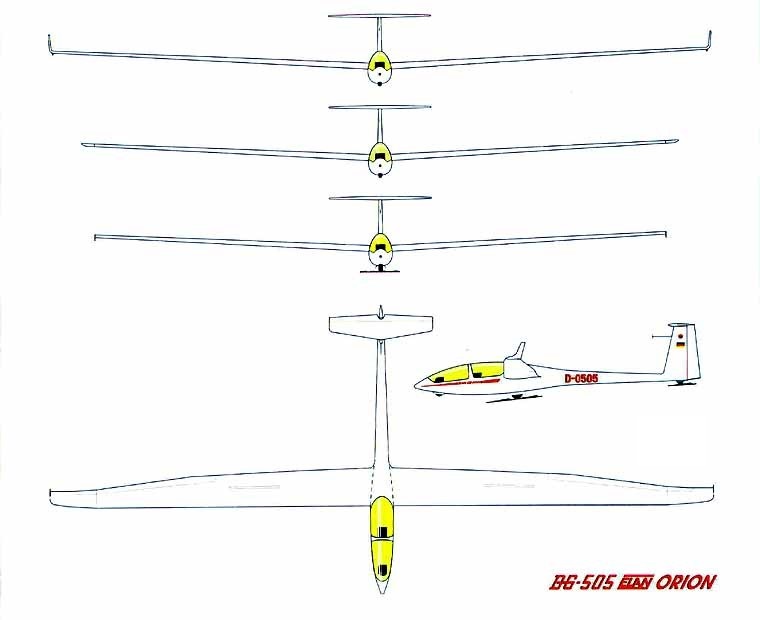
The DG-505 Elan Orion is a two seat glider for training, high performance flying and aerobatics. It can perform basic training, fly a speed triangle with 20 m span, 160 liters of water ballast and a glide ratio of 44 and train aerobatics with 17.2 m span. The designation DG-505 marks the development of the DG-500 and features various major improvements, in particular the cockpit space was increased to enable pilots up to 2 m to fly from either seat.

18 m wing tips for flying characteristics equal to the DG-505 Elan Trainer are available as an option. Operators who own already a DG-505 Elan Trainer can use the Orion with 18 m span without different flying characteristics.

With the standard wing tip extensions the wingspan can be increased to 20 m for high performance and competition flying.

The winglets at the 20 m tips make possible almost as good a performance as with 22 m wingspan (comparison flights with a 22 m DG-505 showed that at same wing loading there is only a performance decrease of 3 % although the wingspan is reduced by 10%). In addition the winglets which are permanently installed to the wing tip extensions improve the excellent handling qualities. The sweep back of the wing tip extensions provides further improvement of low speed performance and handling, both important benefits for thermalling.

Variation:
Windward Performance Perlan I

Wingspan: 18.0 m./ 59.1 ft
Wing area: 16.6 sq. m. / 178.6 sq.ft
Aspect ratio 19.52
Airfoil Wortmann FX-73-K-170/20 root; -170/22 tip.
Water ballast 160 kg / 353 lb
Structure CFRP/GFRP.
Crew: ½

DG Flugzeugbau DG505 Elan Orion
Wingspan: 20 m
Max T/O weight: 750 kg
Glide ratio: 44
Cruise speed: 110 km/h
Max speed: 270 km/h
Crew: 2

Wingspan: 22.00 m./ 72.2 ft
Wing area: 8.29 sq.m./ 196.8 sq.ft
Aspect ratio 19.52
Airfoil Wortmann FX-73-K-170/20 root; -170/22 tip.
Aspect Ratio: 26.5
Length: 8.66m
Height: 1.66m
Empty Weight: 550Kg
Gross Weight: 825Kg
Water ballast 160 kg / 353 lb
Min Sink: 0.58m/s
Glide Ratio: 44
Stall speed: 80Km/h
VNE: 270Km/h
G: 5.3/-2.65
Structure CFRP/GFRP.
Crew: ½

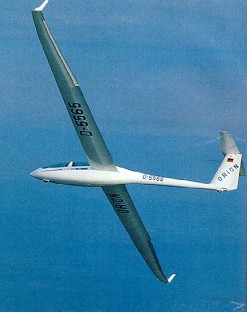
DG-505 Orion

Glaser-Dirks DG-500

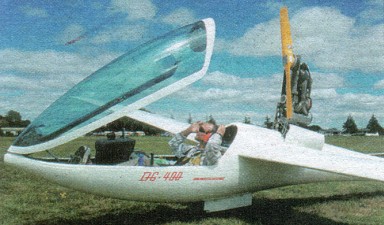
The DG-500 comes in a number of sizes which all share the same basic fuselage. The 500T Elan Trainer, which first flew in 1989 has an unflapped 18 m. wing without provision for water ballast; retractable gear is an option. The front cockpit design has been purposely made similar to that of the DG-300 Club. The higher performance versions (DG-500-22 Elan and DG-500 M) have a 22 m flapped wing and are, respectively, unpowered and self-launch models. The powered model (DG- 500M) has been liquid cooled Rotax powerplant on an electrically retracting pylon, digital engine instrumentation (DEI) and water ballast reduced to 100 kg 220 lb, and comes with an optional steerable nosewheel. The DEI, which has instrumentation in both cockpits, shows rpm, temperatures, pressures and fuel quantity as well as controlling the amount of fuel injected by the electronic fuel system. Engine retraction is automatic once the propeller has been stopped and centred. All 22m ships, which have a four piece wing, have retractable gear as standard. Performance of the 500M is similar to the 500/22 Elan, but empty and gross weights are 565 kg/ 1,246 lb and 825/1,819 lb respectively. All developed with 3 different sets of wingtips; 17.2 m for aerobatics, 18 m and (with winglets) 20 m. A flapped unpowered development of the DG-500/22 Elan. Known as the DG-500/20 Elan Winglets, has been designed for the German 20 m two-place contest class. This has the 750 kg/ 1,653 lb gross weight of the DG-500/22, and a wing loading of 45.0 kg/sq.m./ 9.22 lb/sq. ft. Manufacture of the DG-500 is partly by Elan in Slovenia.

Wing span: 18m / 59.1ft
Wing area: 16.6sq.m / 178.6sq.ft
Empty Weight: 390kg/ 860lb
Payload: 225kg / 496lb
Gross Weight: 615kg / 1356lb
Wing Load: 37.05kg/sq.m / 7.59lb/sq.ft
Water Ballast: 160kg / 353lb
Aspect ratio: 19.52
No. of Seats: 2
Structure: CFRP/GFRP
Airfoil: Wortmann FX-73-K-170/20 root; -170/22 tip

DG-500/22
Wing span: 15m / 49.2ft
Wing area: 10.95sq.m / 117.9sq.ft
Empty Weight: 255kg / 562lb
Payload: 270kg / 595lb
Gross Weight: 525kg / 1157lb
Wing Load: 47.94kg/sq.m / 9.82lb/sq.ft
Water Ballast: 180kg / 397lb
L/DMax: 40 @ 109 kph / 59 kt / 68 mph
No. of Seats: 2
MinSink: 80 kph / 43 kt /49 mph
Aspect ratio: 20.5
Airfoil: HQ-35; HQ 37 on tips extensions
Structure: CFRP/ aramid

Glaser-Dirks DG-400

The DG400 is a single-seater motor glider version of the DG202, with a dorsally-mounted 43hp Rotax engine driving a tractor airscrew and electrically retractable backwards into the fuselage.

Fuel capacity is 4.5 Imp gallons, with optional extra fuel tanks in each wing. Detachable wing tips can be fitted to the DG400/15 to increase the span to 17m for Open Class competition, in which form it becomes the DG400/17. Without the tip extensions, the 15 m version carries 20 kg / 43 lb more payload, but with higher sink rate (0.60 m/s / 1.97 fps / 1.17 kt ) and lower L/D (41).

The DG400 prototype first flew in May 1981 in the hands of Walter Binder, and first production deliveries were planned for December 1981.

B. Brunzil of Switzerland raised the world 500 km speed triangle record to 170.06 kph/ 91.8 kt/ 105,7 mph flying a DG-400.

DG-400/15
Span: 49 ft 2.5 in
Length: 23 ft 0 in
Empty weight: 595 lb
Max take-off weight: 1,058 lb
Sink rate: 0.60 m/s / 1.97 fps / 1.17 kt
L/D: 41

DG-400/17
Span: 55 ft 9 in
Length: 23 ft 0 in
Empty weight: 610 lb
Max take-off weight: 992 lb

DG-400/17 M
Wing span: 17m / 55.8ft
Wing area: 10.57sq.m / 113.8sq.ft
Empty Weight: 310kg / 683lb
Payload: 155kg / 342lb
Gross Weight: 460kg / 1014lb
Wing Load: 43.52kg/sq.m / 8.91lb/sq.ft
Aspect ratio: 27.3
MinSink: 0.50 m/s / 1.64 fps / 0.97 kt
No. of Seats: 1
L/DMax: 45 @109 kph / 59 kt / 69 mph
Airfoil: Wortmann FX67-K-170-17 root, FX-60-K-126 tip
Structure: carbon wing, fiberglass fuselage/tail
Engine: Rotax 503, 32 kW/ 43 bhp