1911:
(Albert John) Hall-(Bert) Scott Motor Car Co
Berkeley and San Francisco CA.
USA
Engine builder
1911:
(Albert John) Hall-(Bert) Scott Motor Car Co
Berkeley and San Francisco CA.
USA
Engine builder
The 1928 Hallett H-526 was a 7-cylinder air cooled radial aero engine that produced 130hp from 526ci.
Inglewood CA.
USA
Bult the H-526 aero engine in 1928.
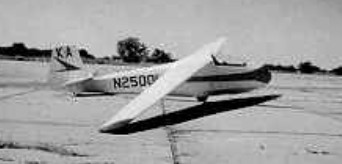
The Cherokee II, designed by Stanley Hall, was introduced in 1956 specifically for amateur construction from plans. The entire wood airframe is covered in fabric. Upper surface spoilers control the glidepath, and the landing gear is fixed. Many examples vary in detail. L/D max. 23. The design was further developed by several builders including the Cherokee RM by Terry Miller and John Ree with a 13.4 m. / 44 ft. span wing with NACA 64(3)-618 airfoil which increased L/D max. to about 28, and the 15 m. Leonard Annebula which has Prue type trailling edge airbrakes and a claimed L/D max. of 31.
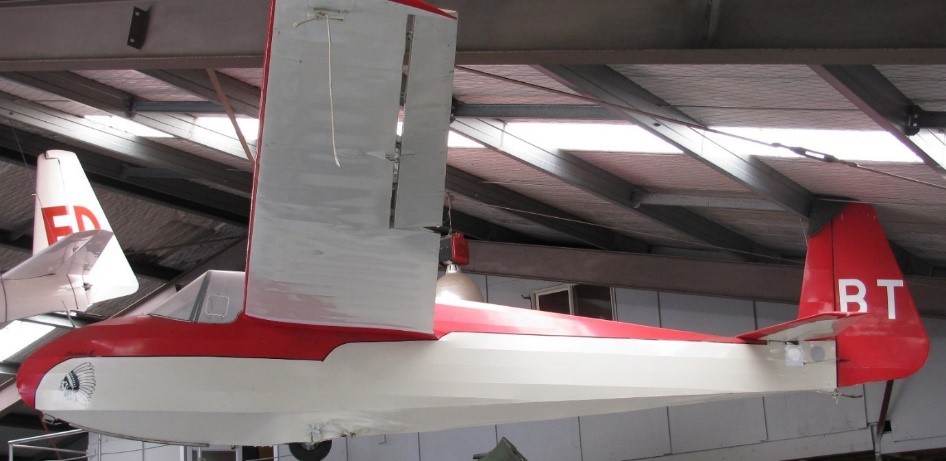
Plans are available only as secondhand now.
A Cherokee RM belongs to the National Soaring Museum.
The Flagor/Hall powered version of a Hall Cherokee II single seater sailplane was produced by Mr Ken Flaglor of Northbrook, Illinois, who fitted the Cherokee II he had built from plans some years before with two 10hp West Bend Model 82001-1 and Model 82002-1 Power Bee go-kart engines. These were mounted on pylons each side of the fuselage under the wings, and drove opposite-rotating Troyer wooden pusher propellers of 2 ft 0 in diameter; the fuel capacity was 2 US gallons. The first flight of Mr Flaglor’s powered Cherokee II, registered N12042, was made in June 1964. The basic Cherokee II is a shoulder wing single seater of conventional wood and fabric construction, plans of which were marketed by its designer, Mr Stanley A. Hall.
Wing span: 12.19m / 40ft
Wing area: 11.61sq.m / 125sq.ft
Empty Weight: 154kg / 340lb
Payload: 86kg / 190lb
Gross Weight: 240kg / 530lb
Wing Load: 20.3kg/sq.m / 4.23lb/sq.ft
Aspect ratio: 12.8
Airfoil: Go 549
MinSink: 0.82 m/s / 2.7 fps / 1.59 kt
No. of Seats: 1
L/DMax: 23 @ 74 kph / 36 kt / 46 mph
No. Built: 80
Structure: wood/fabric; 2-spar wing
Flagor/Hall Cherokee II
Engines: 2 x 10hp West Bend Model 82001-1 and Model 82002-1 Power Bee
Propellers: 2 x Troyer wooden 2 ft 0 in diameter
Span: 40 ft 0 in
Length: 21 ft 6 in
Wing area: 125 sqft
Aspect ratio: 12.8
Empty weight: 375 lb
Max weight: 580 1b
Fuel capacity: 2 US gallons
Max level speed: 72 mph (power on)
Cruising speed: 60 mph (power on)
Min sinking speed: 4 ft/sec (unpowered)
Best glide ratio: 16.5:1 at4 5mph (unpowered)
Take-off run: 900 ft
Endurance: 1 hour (power on)
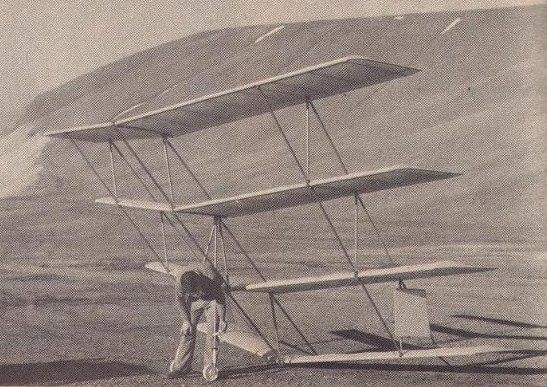
In the late 1970s, an American hang-glider enthusiast called Larry Hall used the Sellers Quadruplane as the basis for his own hang-glider design. The design goal was to fly a human pilot using super-efficient RC sailplane wings, with enough wings (stacked) to keep airspeeds low and provide good soaring ability.
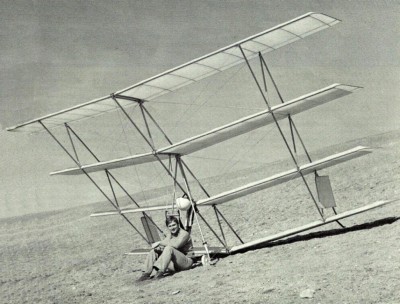
Each wing panel of the QuadraPlane was separate, so setup/teardown always looked like a yard sale in progress. Each wing panel had 1.5 degrees more positive incidence than the wing below, for a total of 4.5 degrees between the top and bottom wings. This was done to provide an automatic dive recovery system, even though no reflexed airfoils were used. This increasing wing incidence, and the forward stagger of the upper wings, assured that they made more lift than the lower (rearward) wings, in a dive, and that would bring the glider back to normal flight modes, very quickly. Back in the day, a hang glider with an automatic dive recovery system was a rare bird.
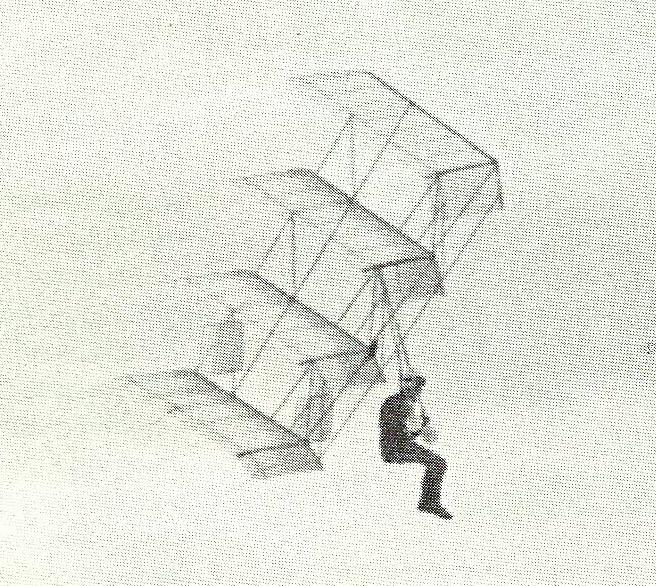
The QuadraPlane had no tail surfaces. Steering was done by cables to the tip drag rudders, and they were very effective. The short wingspan meant that the QuadraPlane could turn in very small circles, and do it very well.
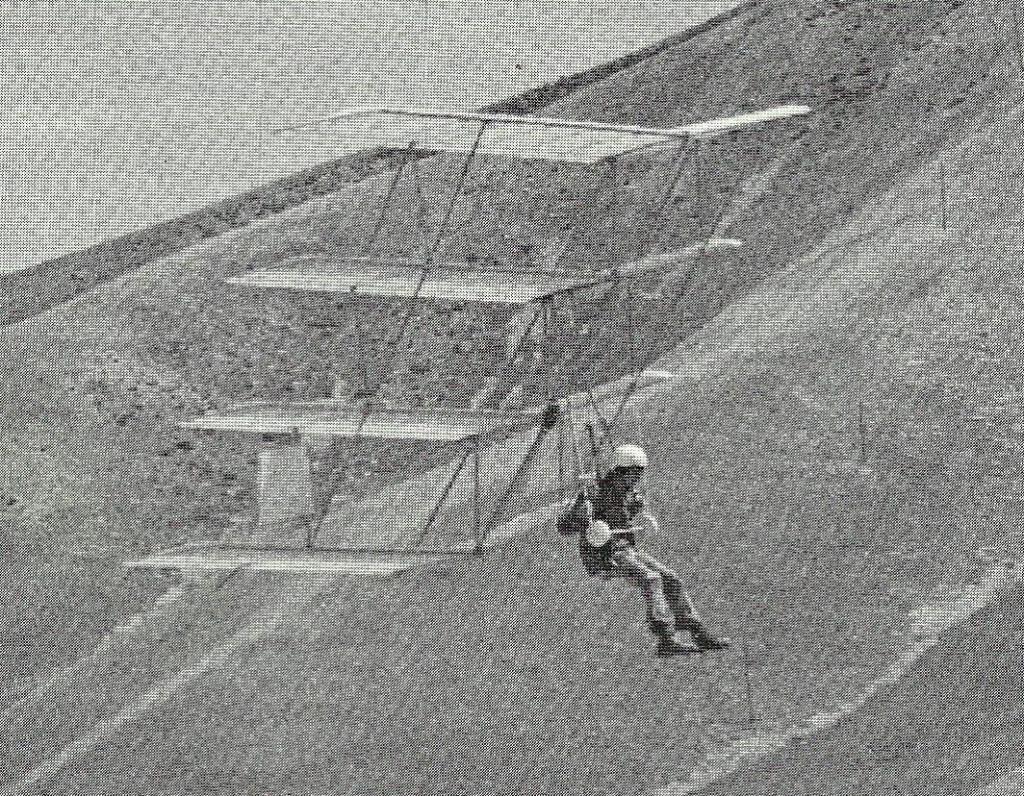
The pilot sat in a “swing seat” harness, with the pilot’s waist just below the triangle control-bar (where the wheels are). The glider was foot-launched, like any hang glider. In flight, the pilot had an amazing view, being far in front of the lower wings.
The QuadraPlane is now stored in the rafters of a hangar at the Morgan, Utah airstrip.
Spans from top:
20′ 10″; 19′ 10″; 18′ 10″; 17′ 10″
Chord 2′ 6″
Wing Area 185 sq.ft
Dihedral 6 degrees
Weight Approx. 65 lbs.
Stagger 45 degrees
Sweep 10 degrees
Airfoil Similar to Icarus II without reflex
Rudder Area 2.36 sq.ft each
Overall height 10 ft
In 1928 Harold Hall built a 6-cylinder, inline water cooled aero engine, producing 300hp from 884ci. Only the one was built, and installed in a Fokker D.7 for testing.
In 1936 Hall flew the XP2H-1 four-engined patrol bomber, largest American-built flying-boat at that time.
The twin-engined Hall PH-1 was superseded by PH-2 and PH-3 variants which served in small numbers with the U.S. Coast Guard during the Second World War.
USA
Founded 1927 to develop a prototype naval flying-boat based on the hull design of Britain’s Felixstowe F.5 for the U.S. Naval Aircraft Factory. The twin-engined Hall PH-1 was superseded by PH-2 and PH-3 variants which served in small numbers with the U.S. Coast Guard during the Second World War. In 1936 Hall flew the XP2H-1 four-engined patrol bomber, largest American-built flying-boat at that time.

As work progressed, Bob Hall turned his attention to the International Air Races at Niagara Falls New York which were to begin June 24, 1932. At 8:40 p.m. the evening before the big races were to begin at Niagara Falls, the two place aircraft took to the air for the first time with Bob Hall at the controls. Spectators commented that it resembled a giant moth as it flew through the twilight sky. Actually the new speed plane was intended to resemble an insect, in its paint scheme at least.
It was painted green with cream and brown designs on its wings and fuselage patterned after the Cicada, a type of Mexican locust. To complete the picture, eyes were painted on the engine cowling. With these facts in mind, it is easy to see why the name “Cicada” would forever identify this aircraft
After its first test flight, which Hall considered a success, work continued on the ship late into the night. The morning of June 26th, Hall, bleary eyed from lack of sleep, flew the plane to Niagara Falls just in time for the final day of air racing. He had decided to race the “Cicada” at Niagara Falls just to see what the new speed plane could do in competition.

The Niagara Falls Manufacturer’s Trophy Race was the big event on the 26th. It was a fifty mile free-for-all race with a high cash purse plus a trophy. When all was said and done, Bob Hall flying the “Cicada” placed fourth. His comparatively poor showing can be attributed to several factors. First, the “Cicada” was not primarily a pylon racing plane nor was it completely finished. Second, Hall was certainly not in tip-top shape after the last minute rush, and probably did not do as good a job of piloting as he was normally capable of.
Bob Hall then flew the “Cicada” home where he completed final details on the aircraft. It was then officially delivered to Frank Lynch who decided to enter the 1932 Bendix Trophy Race, in preparation for his round the world attempt. After considerable testing, Frank was forced to scratch his racer from the Bendix competition because of engine problems which could not be smoothed out in time for the start of the Bendix race.
Determined that he would race the “Cicada” one way or the other, Frank Lynch hastily began the task of fitting his speedster with a P&W R-1340 “Wasp” engine (800hp) , hoping to at least get in some pylon racing at Cleveland.
At this point in my story we must go back to early 1932 and the second race plane that Bob Hall was building under contract. It also was due to be finished in time to compete in the 1932 Cleveland Air Races that were to begin August 27th and run through September 5th.

After sitting out the 1932 Cleveland races, Frank Lynch flew his racer back to Bowles-Agawam airport where it was to be gone over in preparation for future competition. A short time later after some minor reworking, Frank Lynch climbed into the cockpit for a routine test flight. But as it turned out, this would be the last flight for both Frank Lynch and the “Cicada”. For as the “Cicada” roared down the runway and became airborne, it suddenly veered from its line of flight and clipped a corner of a hangar top, crashed and burned as horrified spectators watched in disbelief.
L-1
Engine:P&W R-985 Wasp jr
Wing span: 34 feet 6 inches
Overall length: 23 feet 7 inches
Wing area: 170 square feet
Gross weigh: 3300-3500 pounds
est cruise: 175 mph
Top speed 210 mph

