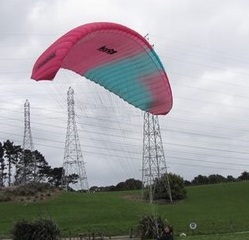
A design from 1993, this was designed as a beginner wing.
Sirocco M
Pilot weight: 65-92 kgs
A design from 1993, this was designed as a beginner wing.
Sirocco M
Pilot weight: 65-92 kgs
Don Harkness was the first Australian who designed and developed a type-approved aircraft engine. The engine was the Harkness Hornet, first built in 1928 and later installed in two locally built aircraft types, the Genair and the Wonga.
The Harker Hawk PFA 003-10004 is a single-engined aircraft registered G-BDNE. An original design by Don Hawker, the Harker Hawk was started in 1973. A two seat low wing monoplane with slightly swept-back wings, it had a tail wheel undercarriage. Powered by a Continental A65, construction of PFA.03010004 was underway during 1974.
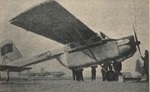
The Drepeau Rouge 1 is a five passenger, one pilot aircraft from China, with a 450kg useful load.
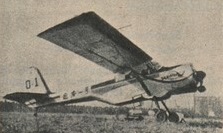
The Harbin Yun An 1 was constructed by professors and students, and is a version of the Drepeau Rouge 1.
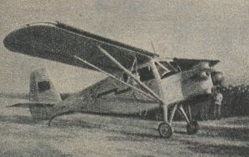
The 1958 Kiang No.1 was a one-off model. Built in 130 days by the Kharbin Institute. The three-seat Kiang-2 was intended for agricultural use.
Max speed: 100 mph
Range: 416 mi
To/Ldg dist: 80 yda
Payload: 484 lb
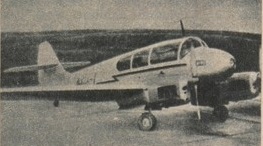
The Harbin Songhuajiang-1 (松花江一号) was a Chinese unlicensed copy of the Aero Ae 45S produced in 1959.
Built at the Weijian State-owned Machinery Factory, Harbin, it first flew on 29 September 1959.
Engines: 2 x Walter Minor 4-III, 104 hp
Propeller: two-blade
Wingspan: 40ft 4,25in
Length: 28ft 1,8in
Maximum Take-off Weight: 3527 lb
Crew: 1 + 5
Maximum Speed: 170.3 mph
Range: 500.2 mi
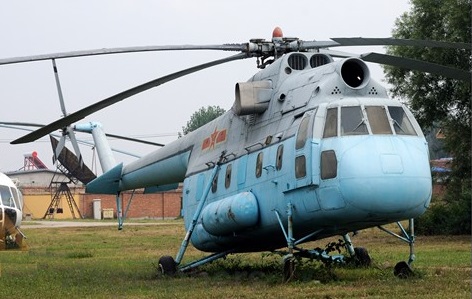
Development of helicopters continued in 1968 with the first flight of the Harbin Z-6. A development of the Z5 (Mi-4) equipped with turbine engines, it was not a success, only 15 were built.

In July 1982 it was reported that the Harbin Aircraft Works had developed a turbine-powered version of the Y-11, with PT6A-110 turboprops. A prototype was reputed to have flown. With a gross weight of 12,125 lb / 5500 kg, the maximum payload is 3748 lb / 1700 kg, and the Y-11T is estimated to have a max speed of 175 mph / 282 kph and a max range of 876 miles / 1410 km.
Developed from the earlier piston-engined Y-11, the twin-PT-6A-powered Y-12 has an enlarged cabin to accommodate up to 17 passengers. A first production batch of 18 aircraft was scheduled for completion by the end of 1986.
The Y-12 prototype first flew in 1982, and there have been three series production versions
Y12 (I)
Initial version with 500 shp PT6A-11 engines, 93” diameter propellers,
leading edge slats, seating for 17 passengers and a MTOW of 5000 kg.
Y12 (II)
Later production version with higher-rated 600 shp PT6A-27 engines, plain leading edge, 98” diameter propellers and MTOW increased to 5300 kg. The UK CAA issued Type Certificate FA49 for this variant in 1990 and examples are in operation in Malaysia and Fiji.
Y12 (IV)
Improved model with sweptback wingtips, redesigned seating for 18-19 passengers and max. weight increased to 5700 kg. The Canadian Aerospace Corporation markets a version of the aircraft under the Twin Panda name as a DHC-6 replacement.
The Sri Lankan Air Force ordered six Y-12 turboprop utility transports from China in 1986, and at least two have been delivered to the Chinese Air Force for aerial survey work.
The Y12 was originally produced by Harbin Aircraft Manufacturing Corporation (HAMC), and under Chinese commercial arrangements is marketed by the China Aviation Technology Import and Export Company (CATIC). HAMC has subsequently been reorganised in 1999 as Hafei Aviation Industry Co. Ltd (HAI), responsible for the Y12 and other sub-contract work.
Federal Aviation Administration Type Certificate: A00006WI applies to the Hafei Aviation Industry Company Limited Y12 IV.
Harbin Y 12 II Turbo Panda
Engines: 2 x PT 6 A 27, 500 shp
Length: 48.885 ft / 14.9 m
Height: 18.373 ft / 5.6 m
Wingspan: 56.43 ft / 17.2 m
Wing area: 369.205 sq.ft / 34.3 sq.m
Max take off weight: 11686.5 lb / 5300.0 kg
Weight empty: 6262.2 lb / 2840.0 kg
Max weight carried: 5424.3 lb / 2460.0 kg
Max speed: 158 kt / 292 km/h
Cruising speed: 135 kt / 250 km/h
Initial climb rate: 1653.54 ft/min / 8.4 m/s
Service ceiling: 22966 ft / 7000 m
Wing loading: 31.78 lb/sq.ft / 155.0 kg/sq.m
Range: 724 nm / 1340 km
Crew: 2
Payload: 17pax
Y-12-II
Engine: 2 x P&WAC PT6A.
Installed pwr: 925 kW.
Span: 17.2 m.
Length: 14.9 m.
Wing area: 34.3 sq.m.
Empty wt: 2840 kg.
MTOW: 5000 kg.
Payload: 1700 kg.
Cruise speed: 330 kph.
Initial ROC: 528 m / min.
Ceiling: 7000 m.
T/O run: 180 m.
Ldg run: 208 m.
Fuel internal: 1600 lt.
Range/payload: 1440 km with 800 kg.
Capacity: 17 pax.
Y12 IV
Engines: 2x Pratt & Whitney Canada PT6A-27
Propellers: 2x Hartzell HC-B3TN-3B/T10173(N)B-3
MCTOW 12,500 lb (5670 kg)
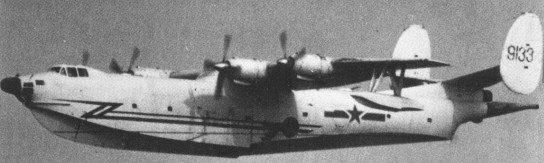
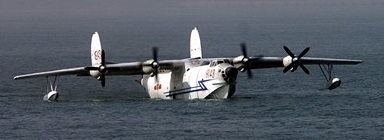
The SH-5 is an indigenous seaplane designed to replace the domestically produced Beriev Be-6s then in PLANAF service. Design work began in 1970, with the new aircraft aimed at performing maritime patrol and search and rescue duties. An entirely new in design, static testing didn’t begin until 1974. The Harbin Shuishang Hongzhaji 5 / PS-5 first flew April 1976, with series production commencing 1984 and 8-9 built to 1987 at Harbin.
The four-turboprop amphibian PS-5 appears to have the wing and powerplant of the Y-8 (An-12) transport and the tailplane and twin fins of the Beriev Be-6, combined with a new fuselage.
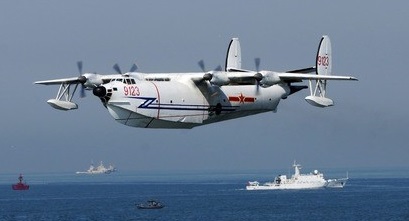
Powered by four 3,150 hp WJ¬-5A-1 (AI-24A) turboprops, PS-5S has 22,045-lb (10-tonne) max payload, includ¬ing four torpedoes or AShMs on underwing racks, or up to 13,227 lb (six tonnes) of depth bombs.
The SH-5 saw active use, and several of the aircraft were upgraded with EW systems. One example was converted for use as an aerial firefighter. In 2009, production of a new variant was announced with deliveries planned for 2014.
Created in 1952 from the Mansyu Hikoki Seizo Kabushiki Kaisha of Manchuria. Began the H-6 bomber program in 1957, initially assembling two Tu-16s from Soviet supplied components, the first flying in September 1959, but in 1961 this program was transferred to Xi’an. Manufactured the H-5 jet bomber from 1966 to the 1980s, based on the Soviet llyushin II-28. Developed and still produces the Y-11 (first flown about 1975) and Y-12 (first flown June 1984) general-purpose transports and Z-9 Haitun twin-turboshaft helicopter as license-produced Eurocopter Dauphin 2. Was pursuing development of a new helicopter in 1999, and is a partner in the Colibri EC 120 B helicopter program . Also produced two prototype (one static) and five production SH-5 anti-submarine amphibians (one civil, tested as a firebomber).
In 1998, the core company of Harbin Aircraft Industry Group (HAIG) was under under AVIC II and occupied a 514 ha (1.270 acre) site, including 350,000 sq.m of workshop space. The workforce in 1998 numbered approximately 18,000.
Harbin partnered with Eurocopter and Singapore Technologies Aerospace in the Eurocopter EC 120 Colibri programme, for which it builds the cabin.

