Hiway Hang Gliders Demon / Flight Designs Demon

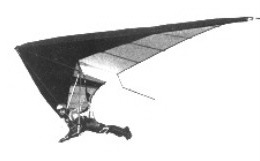
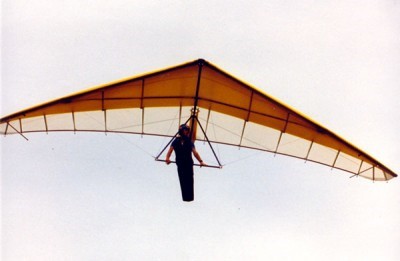
The 1980 Demon was the first double surface wing produced by the Hiway company. Produced in three sizes, 150, 175 and 195 (between 80 and 83) the Demon was regarded as an excellent performer which has mellow handling. A distinguishing feature is the use of a foam insert in the leading edge as opposed to mylar sheet used by competitors.

A 165 which was a 198 prototype Demon had extremely light handling and ‘suspicious’ in pitch but production gliders were fine in this respect. All Demons had foam-backed leading edges as opposed to Mylar. Later models also had blue ‘painted’ rather than anodised tubing.

It was quite heavy at the time.

The Demon (for advanced pilots) was also made under license from Hiway by Flight Designs of Salinas, California. The American version also served as the wing for the “Jetwing” trike also produced by Flight Designs. After Flight Designs was bought out by Pioneer Parachute in 1982, some sails were made by the latter company. These were highly inferior to the original versions, and can be identified by the use of straight-stitch seams rather than zig-zag seams.

1980 Demon medium
Leading edge: 19 ft
Root chord: 8 ft 5 in
Span: 33 ft 6 in
Nose angle: 130 deg approx.
Weight: 72 lb

1980 Demon large
Weight 68 lb

Demon 160
Wing area: 14.8 m²
Wing span: 9.73 m
Aspect ratio: 6.4
Hang glider weight: 29 kg
Minimum pilot weight: 54 kg
Maximum pilot weight: 69 kg
Minimum speed: 25 km/h
Max glide ratio (L/H): 8.6
Max glide ratio speed: 29 km/h
Minimum sink rate: 0.9 m/s
Packed length: 5.57 m
Packed length short: 4.25 m
Nose angle: 125°

Demon 175
Wing area: 16.26 m²
Wing span: 10 m
Aspect ratio: 6.2
Hang glider weight: 33 kg
Minimum pilot weight: 63 kg
Maximum pilot weight: 91 kg
Max glide ratio speed: 30 km/h
Packed length: 5.67 m
Packed length short: 4.25 m
Nose angle: 125°

Demon 195
Wing area: 18.12 m²
Wing span: 10.6 m
Aspect ratio: 6.3
Hang glider weight: 32 kg
Minimum pilot weight: 82 kg
Maximum pilot weight: 100 kg
Max glide ratio speed: 32 km/h
Nose angle: 125°

Hiway Hang Gliders Cloudbase

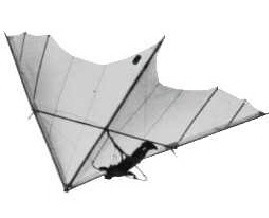
Made in 1975, the Hiway Cloudbase was a second generation glider which incorporated battens and deflexers. At this time battens became the norm. Early models had two radial battens whilst later ones, as pictured, have chordwise battens. The Cloudbase can be slowed down without the nose or wing dropping. On light marginal days this gives the pilot time to put the kite back on the top when the wind drops momentarily, instead of having to go down. On stronger days the higher aspect ratio ensures that the glider can use parts of the sky that other machines simply cannot reach. The Cloudbase was supplied in three sizes to cover pilot weights from 7 to 18 st.

Cloudbase model 20
medium 10-15 st
Leading edge 20 ft 2 in
Keel 18 ft 2 in
Sail area 220 sq ft
Aspect ratio 4
Weight 43 lbs
Price 1975 £378.00

Hiway Hang Gliders Ltd

Hiway, founded by John Ievers and Steve Hunt, first produced a standard Rogallo, in 1973.

Hiway Hang Gliders Ltd
Sirhowy Hill
Tredegar
Gwent NP2 4XP
UK

27/35 Bernard Rd
Brighton
UK

Hiway decided to return to simplicity for a new range of gliders, with no wing wires. Hiway designed the airframe to fles in a particular way under flight loads, and then sew the sail to fit the shape exactly.
The first of the range were 1) Super Scorpion, a cross-country hang glider. 2) Spectrum, intermediate glider. 3) Gemini, purpose designed two-place glider. 4) Harrier, primary and training glider.

Hiway hang gliders was re-floated as Hiway (83) Ltd. under the directorship of Jim Bowyer, Rod Macdonald and John Ievers (one of the original founders). Glider designs which have been carried over to the new company were as follows: Excalibur, a high performance CFX with flexible tips. Price £1141.95. Vision. double surface intermediate. £897.00. Explorer .Advanced rigid wing with aerodynamic controls. These were made to fulfill a German contract.Price £1581.25. Superscorpion 2. Post P1 .Price £747.50.(Manufactured 83 to 85).Stubby. Training glider.

Historical Aircraft Corp PZL P.11

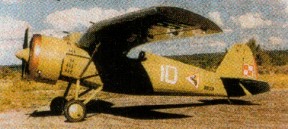
Historical Aircraft Corp offers kits to build a range of 60 percent scale single-seat fighter representations, including P-51D, Corsair, PZL P.11 c and, P-40 Tomahawk, plus an 85 percent scale representation of Ryan STA.
First flown in 1990, the kit included engine, prop and instruments, with a 1997 price of US$25,500.
Historical Aircraft Corp P.11c

Top speed: 105 mph
Cruise: 90 mph
Stall: 55 mph
Range: 300 sm
Rate of climb: 900 fpm
Takeoff dist: 900 ft
Landing dist: 900 ft
Service ceiling: 12,500 ft
Engine: 100 hp
Fuel capacity: 11 USG
Empty weight: 850 lb
Gross weight: 1100 lb
Height: 7.5 ft
Length: 18.3 ft
Wing span: 27.8 ft
Wing area: 97.3 sq.ft
Seats: 1
Landing gear: tailwheel

Hispano-Suiza 14AA

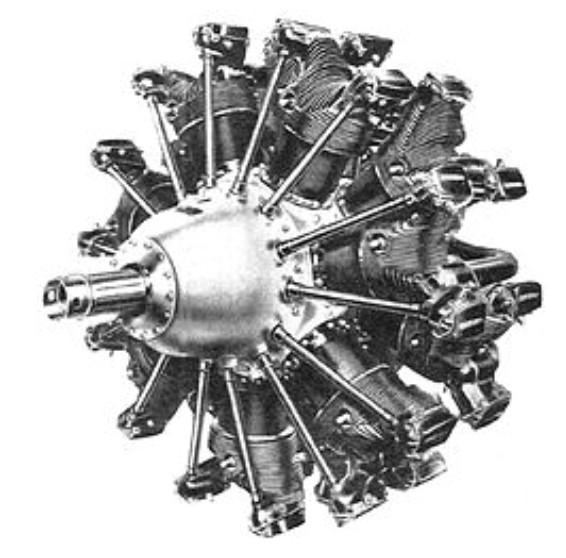
The Hispano-Suiza 14AA was a fourteen-cylinder aircraft radial engine used in France during the late 1930s. As Hispano-Suiza lacked recent experience in developing radial engines, it was derived from the licensed Wright R-2600 engine. Due to reliability problems, the engine was largely supplanted by the similar Gnome-Rhône 14N.

Not to be confused with the smaller Hispano-Suiza 14AB, which was derived from the smaller Wright Whirlwind series.

Applications:
Amiot 341
LeO 45
Farman F.223
Latécoère 530
Latécoère 570
Koolhoven F.K.58

Specifications:

14AA-04
Type: Fourteen-cylinder two-row supercharged air-cooled radial engine
Bore: 156 mm (6.13 in)
Stroke: 170 mm (6.69 in)
Displacement: 45.25 l (2,761 in³)
Length: 1,650 mm (64.96 in)
Diameter: 1,260 mm (49.61 in)
Dry weight: 640 kg (1,411 lb)
Valvetrain: Overhead valves
Supercharger: Single-speed centrifugal type supercharger, 10.0:1 reduction
Fuel system: Carburetor
Fuel type: 85-87 octane rating gasoline
Cooling system: Air-cooled
Reduction gear: 1.58:1
Power output: 793 kW (1,063 hp) at 2,125 rpm for takeoff
Specific power: 17.52 kW/l (0.39 hp/in³)
Compression ratio: 6.2:1
Specific fuel consumption: 369 g/(kW•h) (0.61 lb/(hp•h))
Oil consumption: 12 g/(kW•h) (0.32 oz/(hp•h))
Power-to-weight ratio: 1.24 kW/kg (0.75 hp/lb)

Hispano-Suiza 12Z / SNECMA Hispano 12Z

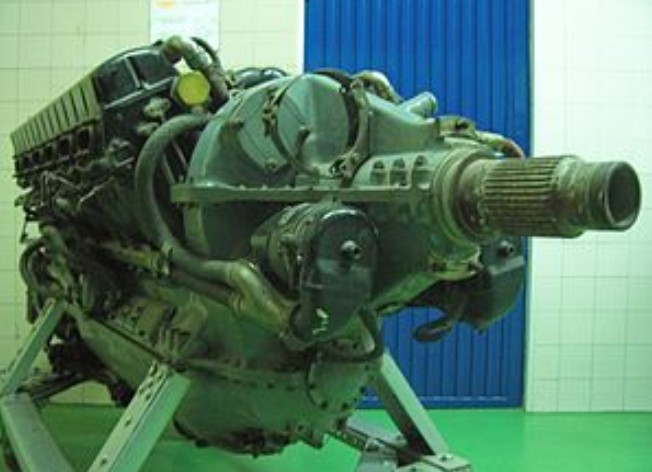
The 12Z was the final evolution of the series of Hispano-Suiza V-12 aircraft engines, which had just entered production when France fell to the Germans during World War II. A small number were produced during the war but the German occupation government would not allow full-scale production to start. After the war small numbers were built to equip new designs, but the rapid introduction of the jet engine ended further development.

The 12Z differed from the earlier 12Y primarily in the use of four valves per cylinder operated by dual overhead cams. This gave the cylinders considerably better volumetric efficiency and faster operation, raising the RPM from 2,400 to 2,700. The engine was also designed to run only on 100 octane fuel (instead of 87, which was common at that point) which allowed the compression ratio to rise from the 12Y’s 5.8:1 to the 12Z’s 6.75:1. These changes raised the power from 1,000 to 1,300 hp (750 to 970 kW) at sea level.
Unfortunately the engine continued to use a single-stage, single-speed supercharger and therefore lacked the all-altitude performance of German and British designs. But tuning the supercharger for a different critical altitude improved high-altitude performance considerably, delivering 1,500 hp (1,120 kW) at 21,000 ft (6,400 m) as opposed to 930 hp (690 kW) at 2,950 ft (900 m) for the 12Y.

Small prototype runs started in 1939, and were fitted to the French Armée de l’Air’s front-line fighter aircraft, the M.S.410 and D.520, creating the M.S.450 and D.524 respectively. Production of the main model, the 12Z-17, was just starting at the time of the armistice. Production was undertaken in Hispano-Suiza’s Spanish factories, but these engines had many problems and were never used in any numbers.

After the war a new version tuned to operate with 92 octane fuel, as opposed to the -17’s 100/130, was built in limited numbers as the 12Z-89. Compression ratio was raised slightly to 7:1, but with the lower grade fuel the power dropped slightly to 1,280 hp (950 kW) at 2,600 rpm (1,479 hp (1,100 kW) maximum take-off). These engines apparently had the same sorts of reliability issues as the earlier -17’s made in Spain, and the type never entered production.

Variants:
Hispano-Suiza 12Z-1
The initial version of the engine used for development

Hispano-Suiza 12Z-17
development peak at time of the Fall of France in May 1940

Hispano-Suiza 12Z-89
post-war development,not successful.

Applications:
Ikarus S-49C
Hispano Aviación HA-1112
Breguet 482

Specifications:
12Z-1
Type: V-12 60° liquid-cooled, geareed drive supercharged four stroke piston engine
Bore: 150mm (5.9in)
Stroke: 170mm (6.69in)
Displacement: 36.05 litres (2,199.9 cu.in)
Length: 2,384mm (93.8in)
Width: 744mm (29.3in)
Height: 1,074mm (42.3in)
Dry weight: 620kg (1,367lb)
Hollow propeller shaft to accommodate a cannon barrel
Valvetrain: Two intake and two sodium-cooled exhaust valves per cylinder actuated by dual overhead camshafts
Supercharger: Gear-driven single-stage two-speed centrifugal type supercharger with automatic boost control – ratios 6.36:1 and 9.38:1
Fuel system: Direct fuel injection @ 40kg/sq.cm (570psi) 2x Lavalette P511-AS2 6-plunger injection pumps with 1x Lavalette KFD injector per cylinder
Fuel type: 100/130-octane rating gasoline
Oil system: Dry sump, pressure feed @ 5kg/sq.cm (70psi), 20.5 centistokes (100S.U. secs) viscosity oil
Cooling system: Ethylene Glycol/water mix
Reduction gear: Spur reduction gear ratio 0.6:1
Air Equipment 1525 compressed gas starting system
Power output:
Take-off – 1,342kW (1,800hp) @ 1,150mm (45.3in)Hg boost @ 2,800rpm
Military, low – 1,193kW (1,600hp) @ 2,500m (8,200ft) @ 2,800rpm
Military, high – 984kW (1,320hp) @ 8,000m (26,200ft) @ 2,800rpm
Cruising, low – 1,193kW (900hp) @ 3,000m (9,800ft) @ 2,100rpm
Cruising, high – 1,193kW (900hp) @ 5,600m (18,400ft) @ 2,100rpm
Specific power: @ take-off power – 37.22kW/l (0.818hp/in³)
Compression ratio: 7.0:1
Specific fuel consumption: 0.29kg/kW/hr (0.48lb/hp/hr)
Oil consumption: 0.006 kg/kW/hr (0.018lb/hp/hr)
Power-to-weight ratio: @take-off power – 2.16kW/kg (1.32hp/lb)
B.M.E.P. (Brake mean effective pressure) 16.3 kg/sq.cm (232psi)

Hispano-Suiza 12N

Up to 1927, Hispano-Suiza’s many engine types, of various layouts and cylinder numbers, were all recognisable developments of the World War I V-8 Hispano-Suiza 8. 1927-8 saw the introduction of four completely new engines, two V-12s designed by Marc Birkigt, and two with six cylinders inline. The Hispano-Suiza 12N, known by the manufacturers as the Type 61, was the larger of the V-12s, with a displacement of 36.0 L (2,197 cu in), the other being the 27.0 L (1,648 cu in) 12M. Apart from capacity and power, these two engines had much in common. The 12M first ran in 1927 and the 12N a year later.

Both 12M and 12N were 60° V engines with carburettors, inlets and exhausts on the outer faces. There were three carburettors per bank, each charging a pair of cylinders. Much of the new technology was in the cylinder design: these types introduced wet liners, an Hispano automobile engine innovation which brought the cooling water into direct contact with the steel cylinder barrel rather than by screwing it into an aluminium water jacket. This improved cooling, simplified assembly and allowed larger cylinder bores without increasing their separation. The cylinder barrels were open at top and bottom and threaded for screwing into the block only near the top, with valve seats ground into the aluminium cylinder head. The lower end of the barrel extended into the crankcase, simplifying both manufacture and assembly. Block and crankcase were bolted together.

The 12M and 12N engines were the first to use the gas nitriding surface hardening process on the cylinder walls, which reduced both wear and oil consumption. They also used a novel, complicated but effective method of main bearing cooling, enhancing the local lubricant flow without requiring high overall oil pump speeds. The unit cost in 1931 was 250,000 FF.

Both types were designed so that Epicyclic gearing could be added or removed quickly; some earlier Hispano-Suiza engines offered gearing but as a permanent fixture on a specific sub-type. The gears added 45 kg (99 lb) to the weight. In 1935 the 12Ner variant was fitted with an in-flight- electrically operated variable pitch propeller.

The 12N series was developed into the 12Y (Type 73) supercharged engine, first run in 1932.

A Hispano-Suiza 12Nb powered the Breguet XIX Point d’Interrogation on the first non-stop flight from Paris to New York in September 1930. This was the first east to west flight between Europe and the USA, rather than to the North American continent.
In the early 1930s, 12N engines powered the flying boats operating the French Atlantic and African routes.

The Swiss government, in the form of the KTA (Kriegstechninischen Abteilung or War Technical Department) purchased construction licences for the 12Nb and in 1932 eighty units were built at the Saurer lorry factory.

Variants:

12Nb/650
Compression ratio 6.2, maximum power 560 kW (750 hp) at 2,100 rpm.

12Nbr/650
Compression ratio 6.2, maximum power 550 kW (740 hp) at 2,100 rpm. Gearing ratio of 2:1 or 1.61:1.

12Ns
Compression ratio 7, nominal power 670 kW (900 hp) at 2,200 rpm. For Schneider Cup 1928.

12Nsr
Compression ratio 10, nominal power 745 kW (1,000 hp) at 2,400 rpm. For Schneider Cup 1931. Farman compressor.

12Nc
Compression ratio 6.2, nominal power 533 kW (715 hp) at 2,000 rpm. For Ford 14A Trimotor.

12Ncr

12Ndr
Electrically controlled pitch propeller, anti-clockwise turning (1935).

12Ner
As 12Ndr, modified with articulated connecting rods.

12Nfr
As Ndr, clockwise turning.

12Ngr
As Ner, clockwise turning.

Applications:
Amiot 140
Avia B-34
Bernard H.V.41
Bernard H.V.42
Bernard 80 & 81
Blériot 5190
Breguet XIX Point d’Interrogation
Breguet 330
CAMS 58.3
Couzinet 70
Farman F.302
Latécoère 28
Latécoère 290
Latécoère 300 and 301
Latécoère 381
Latécoère 440
Latécoère 490
Latécoère 521
Letov Š-616
Levasseur PL.14
Levasseur PL.15
Lioré et Olivier LeO 25.8
Westland Wapiti IV (uncertain if completed with 14N)

Specifications:

12Nbr/650
Type: V-12, water cooled
Bore: 150 mm (5.90 in)
Stroke: 170 mm (6.69 in)
Displacement: 36.0 L (2,197 cu in)
Dry weight: 520 kg (1146 lb)
Reduction gear: 2:1
Power output: (normal) 550 kW (740 hp) at 2,000 rpm
Compression ratio: 6.2