Horton Ho I

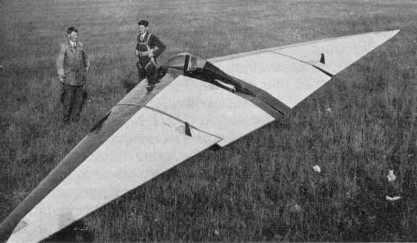
Reimar and Walter Horten started out with models, then progressing to gliders and eventually to powered aircraft. Their first tailless design, the Ho I sailplane. This was built at Bonn during the year 1931-1932 and had a flying life of about 7 hours.
It had a span of 40 ft. and a wing loading of 2 lb/sq.ft. The control system comprised a control flap giving elevator control and normal ailerons at the wing tip. Directional control was by leading edge drag rudder at the wing tip.
All the control flaps were hinged at the upper surface with a circular arc lower leading edge forming a seal with the wing. There was no aerodynamic balance.
The wing section was symmetrical throughout and thick enough (25% C) at the center section to house most of the pilots body. His head projected from the upper surface and was faired by a perspex cockpit cover. A rubber mounted skid formed the undercarriage.
The control system was unsatisfactory and was changed on subsequent aircraft. It seems to have been impossible to stop a slow speed turn by use of ailerons alone and the drag rudder, which at first was on the lower surface only, was ineffective and caused a nose down pitching moment. When an upper surface flap was added to cure this the braking action became too fierce and springs had to be incorporated to make the control heavier. Reference was made to a yawing tendency at low speed which could result in an uncontrollable turn through 360°.
The Ho I sailplane, won a prize at the 1934 Rhon soaring competitions, but the brothers were not satisfied with its performance and burned it.

Ho.1b

Ho.1
Wing Span: 12.4m
Wing Area: 21sq.m
Aspect ratio: 7.3
Empty Weight: 120kg
Payload: 90kg
Gross Weight: 210kg
Wing Load: 10kg/sq.m
L/DMax: 21 @ 72 kph
MinSink: 0.80 m/s 60 kph
Seats: 1

Horten H I b
Wing span: 12.4m
Wing area: 21sq.m
Empty Weight: 120kg
Payload: 90kg
Gross Weight: 210kg
Wing Load: 10kg/sq.m
Aspect ratio: 7.3
L/DMax: 21 72 kph
MinSink: 0.8 m/s 60 kph
Seats: 1

Horten Gebruder

Walter and Reimar Horten conducted flying-wing experiments prewar, building a series of tailless high-performance gliders. The Horten Ho V and Ho VI were both powered aircraft, leading to the turbojet-powered Ho IX flown in the summer of 1944. Before being destroyed in a landing accident after only a few hours flight, it had been flown at a speed of 800km/h. This was developed by Gothaer Waggonfabrik as the Gotha Go 229 V3 single-seat fighter, but the Gothaer works were captured by advancing U.S. forces before this prototype was completed.

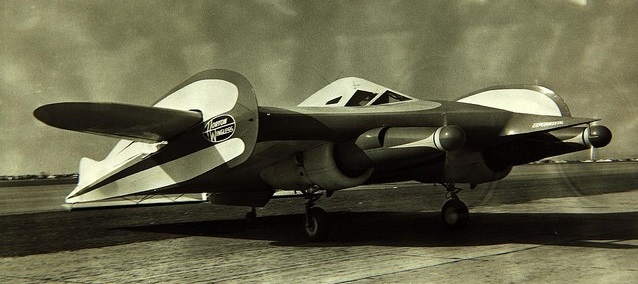
Horton Aircraft HW-X-26-52 Wingless

The Horton Wingless aircraft was invented by William Horton of Huntington Beach, California in 1952. He called the strange-looking plane “wingless” because he claimed the entire craft was a simple air foil with vertical fins and utilized all surfaces for lift. Unfortunately, Horton did not have the money to develop it, but was able to get into a partnership with billionaire Howard Hughes and Harlow Curtis.

The aircraft was a welded steel frame covered with a fabric skin and powered by two Pratt and Whitney R985 radial engines. Instead of a long high aspect ratio wing the fuselage was to create the lift and tip plates which he called ‘sealers’ were to tip losses that otherwise plague such airfoils. Essentially it was a highly-modified Cessna UC-78 with a more airfoil-shaped fuselage than wing.

Registered N39C, the aircraft logged around 160 hrs of flight time before Bill Horton had a falling out with Hughes. Horton was railroaded to prison.

Although this innovative prototype flew successfully, no backers were attracted. The venture failed not because the airplane didn’t fly, but because Hughes wanted to take full credit for the patents and production rights, which Horton refused to allow. Hughes sued Horton which effectively stopped any further development of the aircraft. Hughes managed to have the prototype and partially-constructed production version moved to the bone yard at the south end of the Orange Co airport and deliberately burned.

Horton Aircraft Corporation

Horton Aircraft was organized in 1952 for the purpose of engaging in the business of manufacturing and selling a so-called “Horton Wingless Airplane.” Its only asset was said to be a patent issued to William E. Horton, its president, with respect to the wingless plane and assigned by him to the company. Horton had agreed to assign the patent rights to the company for 500,000 shares of its stock, and to build and sell a model of the plane to the company for an additional 200,000 shares. The company’s entire personnel consisted of three directors, including Horton; and it had more than 800 stockholders. The first registration statement filed April 26, 1955, proposed the public offering of 400,000 shares by the company and 100,000 shares held by Horton, at $1 per share or the market price, whichever was higher. The second, filed October 18, 1956, proposed the public offering of 100,000 shares held by Horton at $25 per share.

The aircraft was designed and built by Bill Horton in a three way partnership with Howard Hughes and Harlow Curtice of General Motors. Horton had a falling out with Hughes.

The Securities and Exchange Commission announced the issuance of a “stop order” decision suspending the effectiveness of two registration statements filed by Horton Aircraft Corporation, of Las Vegas, Nevada, because of false and misleading representations contained in the registration statements, which proposed the public offering of 500,000 and 100,000 shares, respectively, of Horton Aircraft stock.

According to the Commission’s decision, Horton “had no patent rights or patent he could validly assign” to the company and it was at least doubtful whether he could legally sell a model of the wingless plane to the company because of a June, 1954 court decision upholding the validity of an earlier assignment to another company of Horton’s interest in his “invention” of the wingless plane. Furthermore, the Commission ruled that false and misleading statements were made in the registration statement with respect to the nature and performance of the wingless plane. The plane was represented as having no wings and it was stated that a model constructed by Horton in 1954 had been test-flown continuously and its performance had equalled Horton’s expectations.

The Commission found that the wingless plane in fact had wings which extended about 8 feet from the fuselage and had a depth of 5 to 6 feet, and that these wings, although retractable had never been retracted in flight. “The registration statements should have disclosed,” the Commission stated, “that the Horton plane, which was remodelled from a standard airplane, has in general performed in a manner inferior to that of a conventional plane Horton has used as a basis for comparison, that his plane admittedly was not built to fly any distance and the test flights were short, the longest flight being about 150 miles, that the maximum speed of the plane was about one-half that of another plane using the same motors, and that it had never been tested for range or load-carrying capacity. The second registration statement should have further disclosed that the prototype has not been test flown since it crashed in landing in June, 1955.

Moreover, the statement that the plane’s performance has equalled Horton’s expectations is misleading in view of statements made in brochures and form letters which Horton caused to be prepared and circulated by registrant in connection with previous sales of unregistered stock. Those statements, which were false and misleading, were to the effect that Horton’s development of the Horton Wingless Plane is comparable to the achievements of the Wright brothers, Leonardo da Vinci, Sikorsky, Billy Mitchell, and Charles Lindbergh; that his plane is one of the greatest aeronautical engineering achievements of all ages and the greatest advance in aviation since the advent of flying; that it can carry 100% greater payload over 100% greater range and is faster and easier to control than any other plane, and can carry twice the load at half the cost of any other plane; and that the Horton Wingless Jumbo Transport plane will carry 4,000 persons a distance of 25,000 miles non-stop) at 60,000 feet altitude, at speeds of over 400 miles per hour.”

The Commission also found false and misleading the disclosures in the registration statements with respect to past stock sales without prior registration, the selling costs of the proposed offerings, and the proposed use of the proceeds of the financing, as well as the implications that the $25 per share price of the second offering was based upon and related to some reasonable valuation of the stock.

Horton Aircraft and Horton were permanently enjoined by the United States District Court in Los Angeles in September, 1954 from making false and misleading statements in the sale of Horton Aircraft stock. Horton was convicted on March 8, 1957, of fraud in the sale of Horton Aircraft stock and sentenced to 3 years’ imprisonment followed by 5 years’ probation.
Hornet Microlights Invader 330 / Striker

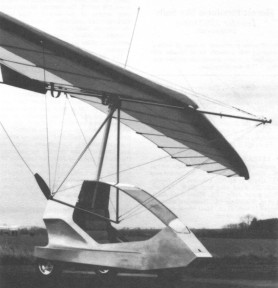
The Invader 330 is a one plus one derivative of the Invader 440 (side by side one/two seat), using the smaller Robin EC34PM engine and a Flexiform Sky Sails Striker wing.

Engine: Robin EC34PM.
Toothed belt reduction.
Length overall 11.0ft, 3.35 m.
Wing span 34.5 ft, 10.52 m.
Sweep back 15 degs.
Total wing area 200 sq.ft, 18.6 sq.m.
Wing aspect ratio 7.5/1.
Wheel track 4.3 ft, 1.31 m.
Nosewheel diameter overall 16 inch, 41 cm.
Main wheels diameter overall 16 inch, 41 cm.

Hornet Microlights Invader 440 / Dual Striker

Hornet/Flexiform Sky Sails Invader 440/Dual Striker – A side by side two seat single engined flex wing aircraft with weight shift control. Rogallo wing with keel pocket. Pilot suspended below wing in trike unit, using bar to control pitch and yaw/rod by altering relative positions of trike unit and wing. Wing braced from above by kingpost and cables, from below by cables; bowsprit construction with 65% double surface; pre formed ribs. Undercarriage has three wheels in tricycle formation; steel spring suspension on nosewheel and rubber suspension on main wheels. Push right go left nose¬wheel steering independent from yaw control. Brakes on main wheels. Aluminium tube/ glass fibre trike unit, partially enplosed. Engine mounted below wing driving pusher propeller. All major components made from aircraft quality materials.
The Invader gives weather protection, quick rigging and ease of ground handling a high priority. The wind tunnel developed trike unit is almost fully enclosed, only the sides being open, and is of mono pole construction. The mono pole is an aerofoil rather than the usual round section and is mated to a one piece rear axle instead of the two piece plus tie wire arrangement commonly used with mono poles.
To cope with rough field operation, all three wheels have suspension and in addition the nose wheel geometry is arranged to give a self stabilising effect, so that the aircraft runs true even if the pilot makes a less than perfect touchdown. A hand operated brake is fitted to the main wheels, arranged so that it can be used as a parking brake. The fuel tank is made from aluminium alloy with internal baffles.
Rigging is confined to the wing and is hence claimed to take a maximum of 15 minutes. The trike unit has road tyres on the rear, running on stainless steel axles and taper=roller bearings, so that it can be towed complete on its own wheels. Wing fitment is the Flexiform Skysails Dual Striker, a fast wing which Hornet designer Richard Wolfenden says is well matched to the new trike unit.

Length overall 14.0 ft, 4.27 m.
Height overall 12.5 ft, 3.80m.
Wing span 38.0 ft, 11.58m.
Chord at root 9.0 ft, 2.74m.
Chord at tip 3.5ft, 1.07m.
Dihedral 2 degs.
Sweepback 15 degs.
Keel pocket depth 1.2ft, 0.37m.
Total wing area 250 sq.ft
23.2 sq.m.
Keel pocket area 3.5 sq.ft, 0.33 sq.m.
Wing aspect ratio 6.0/1.
Wheel track 4.3 ft, 1.31 m.
Nosewheel diameter overall 16 inch, 41 cm.
Main wheels diameter overall 16 inch, 41 cm.
Engine: Robin EC44, 50 hp.
Propeller diameter and pitch 60×34 inch, 1.52×0.86m.
Toothed belt reduction, ratio 2.8/1.
Max static thrust 280 lb, 127kg.
Power per unit area 0.20hp/sq.m, 2.2 hp/sq.m.
Fuel capacity 5.0 US gal, 4.2 Imp gal, 19.1 litre.
Empty weight 290 lb, 132kg.
Max take off weight 682 lb, 309kg.
Payload 392 lb, 1.78kg.
Max wing loading 2.73 lb/sq.m, 13.3 kg/sq.m.
Max power loading 13.6 lb/hp, 6.2 kg/hp.
Load factors +4.5, 2.0 design.

Hornet Microlights Supreme 440 / 440 Dual

The Supreme 440 is identical to the 440 Dual except that the chrome plated joint pieces and electric start are fitted as standard.
While some manufacturers of big engined two seat trikes recommend that ballast should be carried when flying solo, Hornet prefer instead to reduce the throttle opening, saying that, thanks to the lift characteristics of the Cutlass CD wing, the solo pilot can take off quite quickly even on part throttle.

440 Dual
Engine: Robin EC44, 45 hp at 6500 rpm.
Propeller diameter and pitch 54 x 36 inch, 1.37 x 0.91 m.
Toothed belt reduction, ratio 2.5/1.
Max static thrust 270 lb, 122 kg.
Power per unit area 0.23 hp/sq.ft, 2.4hp/sq.m.
Fuel capacity 4.8 US gal, 4.0 Imp gal, 18.2 litre in each tank; two tanks.
Empty weight 293 (313) lb, 133 (142) kg.
Max take off weight 685 lb, 311 kg.
Payload 392 lb, 178 kg.
Max wing loading 3.46 lb/sq.ft, 16.9 kg/sq.m.
Max pow¬er loading 15.2 lb/hp, 6.9 kg/hp.
Load factors; >+3.75 ultimate.
Max level speed 60 mph, 97 kph.
Never exceed speed 68 mph, 109 kph.
Max cruising speed 45 mph, 72 kph.
Economic cruising speed 40 mph, 64 kph.
Stalling speed 26 mph, 42 kph.
Max climb rate at sea level 850 ft/min, 4.3 m/s.
Take off distance 45ft, 14m.
Landing dis¬tance 110ft, 35m (without brakes).
Total range at average cruising speed 190 mile, 306 km.

Supreme 440
Engine: Robin EC44, 45 hp at 6500 rpm.
Propeller diameter and pitch 54 x 36 inch, 1.37 x 0.91 m.
Toothed belt reduction, ratio 2.5/1.
Max static thrust 270 lb, 122 kg.
Power per unit area 0.23 hp/sq.ft, 2.4hp/sq.m.
Fuel capacity 4.8 US gal, 4.0 Imp gal, 18.2 litre in each tank; two tanks.
Empty weight 313 lb, 142 kg.
Max take off weight 705 lb, 320 kg.
Payload 392 lb, 178 kg.
Max wing loading 3.56 lb/sq.ft, 17.4 kg/sq.m.
Max pow¬er loading 15.7 lb/hp, 7.1 kg/hp.
Load factors; >+3.75 ultimate.
Max level speed 60 mph, 97 kph.
Never exceed speed 68 mph, 109 kph.
Max cruising speed 45 mph, 72 kph.
Economic cruising speed 40 mph, 64 kph.
Stalling speed 26 mph, 42 kph.
Max climb rate at sea level 850 ft/min, 4.3 m/s.
Take off distance 45ft, 14m.
Landing dis¬tance 110ft, 35m (without brakes).
Total range at average cruising speed 190 mile, 306 km.

Hornet Microlights Skyhook Sailwings 250/Sabre C

Single seat single engined flex wing aircraft with weight shift control. Rogallo wing with keel pocket. Pilot suspended below wing in trike unit, using bar to control pitch and yaw/roll by altering relative positions of trike unit and wing. Wing braced from above by kingpost and cables, from below by cables; floating cross tube construction with 55% double surface enclosing cross tube; pre-formed ribs. Undercarriage has three wheels in tricycle formation; no suspension on any wheels. Push right go left nosewheel steering independent from yaw control. Optional brake on nosewheel. Aluminium tube trike unit without pod (250), with pod and side fairings (250 Executive). Engine mounted below wing driving pusher propeller. All major components made from aircraft quality materials. Front fork assembly made from aluminium alloy.
The 250 is a basic single seat trike unit generally sold with a Skyhook Sailwings Sabre C wing. Other wings offered are Skyhook Sailwings Cutlass C, Airwave Nimrod, Gold Marque Sports Gyr and Flexiform Skysails Striker.
Instead of the usual bolt and saddle washers method, Hornets use tube joint pieces made from external sleeving, welded together in the appropriate shape (T, L or whatever). The tubes are slid inside the joint pieces and retained by aircraft quality bolts or, for less critical applications, stainless steel rivets. Made from steel, the joint pieces have passivated zinc plating for corrosion protection; chromium plating is an option.
A recognition point is the U shaped nose tube, designed to facilitate the fitting of Hornet’s own glass fibre pod. When fitted with this pod plus glass fibre side fairings, the trike unit is known as the 250 Executive. Other options include a nosewheel brake, alloy skis, alloy wheels, an extra fuel tank holding 3.6 US gal (3.0 Imp Gal).