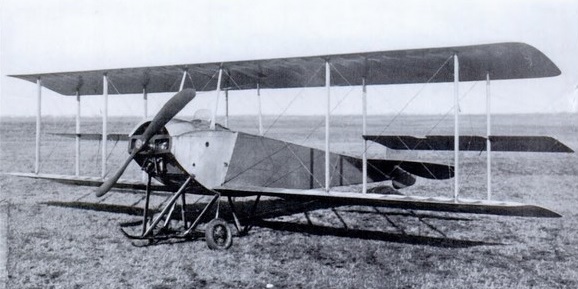
The Huntington Tractor Scout, two-place trainer, was built for an unsuccessful military evaluation in 1915. Powered by a 90 hp Gyro engine, it was built at the Hempstead Plains Airfield in Garden City.
The Huntington Tractor Scout, two-place trainer, was built for an unsuccessful military evaluation in 1915. Powered by a 90 hp Gyro engine, it was built at the Hempstead Plains Airfield in Garden City.
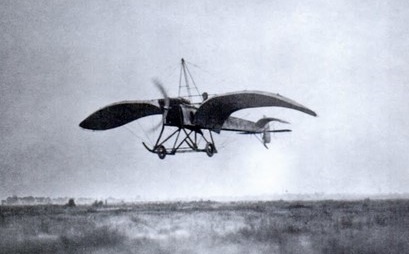
A more traditional design, the 1914 Huntington Clam was flown several times at the Hempstead Plains Airfield.
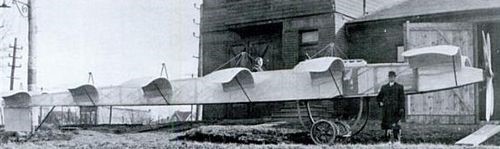
A multi-wing aeroplane designed and built by Howard Huntington sometime during 1912/1913. The photo shows Huntington in front of his house in Hollis, Queens, on January 22, 1914.
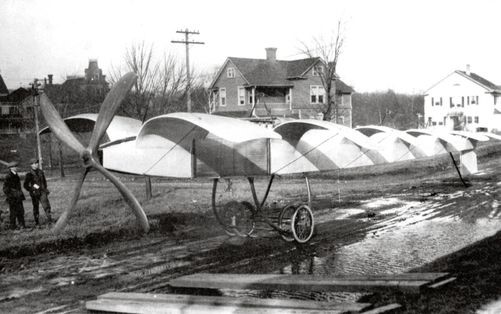
In June of 1914 Huntington constructed a single wing variant of his multiplane – the Huntington “Clam”.
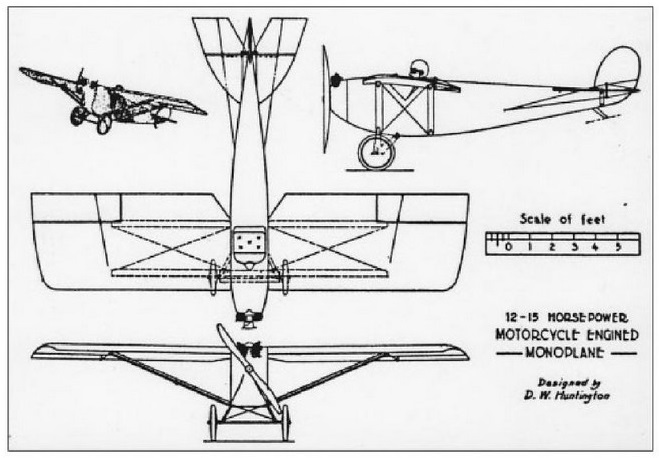
The 1920 Huntington H-12 monoplane was a successful design powered with a motorcycle engine. Designed and built by Dwight Huntington of Hempstead, this was the first kit, or plan-built, lightplane professionally engineered in the United States.
With a wingspan of 20 ft, the wings were attached to the upper longerons, but downward vision was increased by windows in the sides of the cockpit. It was powered by a 15 hp Harley Davidson motorcycle engine.
Able to cruise a 60 mph, plans of the H-12 were sold through aviation magazines into the late 1920s.
The cost of construction, without motor, was well under $80.
A four/six-seat amphibian with a Pratt & Whitney Wasp engine.
A two-seat landplane, powered by a Wright-built Gipsy.
USA
Incorporated in 1928 at Bridgeport, Connecticut, this company developed two airplanes, the Huntingdon II two-seat landplane, powered by a Wright-built Gipsy, and the Huntingdon 12, a four/six-seat amphibian with a Pratt & Whitney Wasp engine.
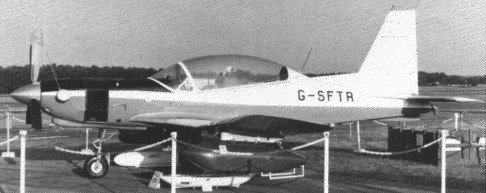
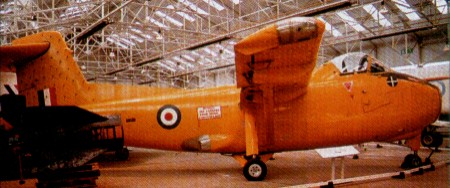
The Hunting H.126 was a one-off single-seat research aircraft with fixed tricycle landing gear designed to test the effects of directing the jet exhaust air across the flaps and control surfaces to increase lift, or as they were known in Britain, “jet flaps”. The exhaust efflux of a turbojet engine is ducted to the trailing edge of an aircraft’s wings and ejected through a narrow slit along the trailing edge. As well as being used to provide propulsion, the efflux can be deflected downward to form a “jet-flap” of high velocity gas which makes possible the achievement of lift coefficients of 10 or more. The shoulder-level wing featured a set of struts, not for support but in order to provide piping for the compressed air used in the blown flaps. A maxi¬mum of 60% of the jet exhaust can be directed to the wings and a further 10% to reaction jets in the tail and wingtips.

The H.126 first flew on 26 March 1963, being flown in a series of one-hundred test flights at the Royal Aircraft Establishment’s Aerodynamics Flight at RAE Bedford by mid-1965 with the program ending in 1967. After two years storage it was sent to the United States in 1969 for wind tunnel testing by NASA returning in May 1970. Stored for another two years it was struck off charge in September 1972 and eventually made its way to the RAF Museum at RAF Cosford.
A notice inside the cockpit reads “The airspeed must not fall below 28 knots”.

Powerplant: one Bristol Siddeley Orpheus turbojet.
The Percival light aircraft manufacturing company became part of the Canadian-owned Hunting Group in 1954. Production was undertaken of the Percival P.56 Provost trainer for the RAF and several overseas forces. A turbine-powered derivative, the P.84 Jet Provost, flew shortly after the merger and was delivered to the RAF subsequently as its standard basic jet trainer. This eventually continued in production in much-modified form as the BAC Strikemaster. The Percival P.50 Prince twin-engined light transport was manufactured for civilian operators, as the Pembroke C.1 for the RAF, Swedish Air Force, Luftwaffe, and several other air arms, and as the Sea Prince for the Fleet Air Arm. An executive President variant was manufactured in small numbers after the company became Hunting Aircraft Ltd.
In 1957 the Hunting-Percival Company was renamed Hunting Aircraft and continued with production of the Provost, Jet Provost, Prince, Pembroke, and Sea Prince before being absorbed by the British Aircraft Corporation. BAC had a controlling interest in the company on its formation in 1960, and acquired the remaining shares in 1964.

