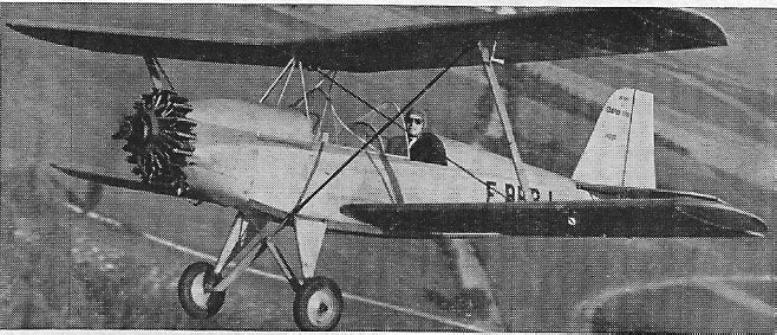
The Aero 110 fuselage has a fabric covered steel-tube framework and powered by a 45 hp Salmson 9ADB radial air-cooled engine.
A Single-bay staggered biplane, upper and lower wings are of equal span and chord. A hinged panel in the upper wing provides access to the front cockpit. Full dual controls are fitted.
Produced by the Societe Indraero and flown for the first time on 1 May 1950, the Aero 110 was produced for the Service de l’Aviation Legre et Sportive (S.A.L.S.).
Engine: 45 hp Salmson 9ADB Wing span: 24 ft 11 in Length: 18 ft 4 in Empty weight: 594 lb Loaded weight: 1000 lb Max speed: 81 mph Cruise: 71.4 mph
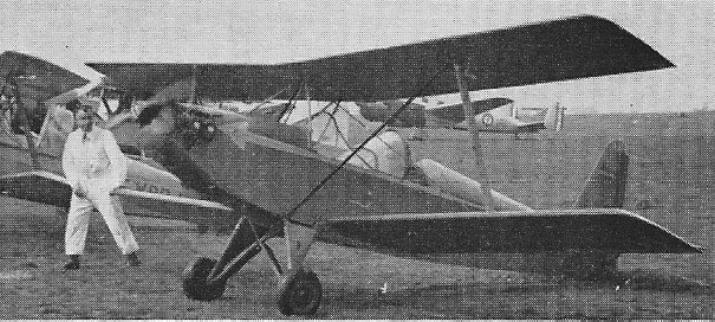
Developed by the Societe Indraero and first flown in 1953, the Aero 101 was designed by MM. Chapeau and Blanchet as a light tandem two-seat training biplane for the Service de l’Aviation Legre et Sportive (S.A.L.S.), and an initial production batch of thirteen was built.
Derived from the Aero 110, it differs by being all-wood construction, a tail wheel and brakes. Powered by a 75 hp Minie 4 DC-32 engine, the tandem open cockpits are fitted with dual controls.
Engine: 75 hp Minie 4 DC-32 Wing span: 24 ft 11 in Length: 18 ft 4 in Max speed: 108.6 mph Cruise: 93 mph ROC: 630 fpm
Russia Formerly known as VIST and founded 1990, is developing a range of turboshaft-powered transport aircraft with vertical take-off and landing/air-cushion capability, by virtue of engine power being switched between conventional propellers and a large horizontal fan occupying the center fuselage. Also developing a 32-passenger regional airliner as the lnalet-32, featuring an aerodynamically shaped fuselage and stub wings, plus the more conventional Inalet- 60 62/68-passenger regional airliner and freighter with twin turbofan engines mounted at the rear of the fuselage.
The 1987 Impuls was popular in Germany. It is a very robust make, everything of very strong material. Not for absolute beginners but flies nicely and quite lively.
There was a security announcement by DHV for the lower cables that go together at the keel on the behind (maybe only Impuls IC). There is a special solution for the cable going into the keel, watch out for the cable at this point because it can break!
Impuls
Negative aspects include there is no single surface glider with more weight, takeoff in windy conditions is very tricky: the extreme pitch-up makes it very difficult to hold the glider “neutral”, and tube dimensions are “special”, not common on other gliders.
It is a copy of the Wills Wings Harrier, but better. US Gliders at that time still used bolts and wingnuts. Like all European gliders, the Impuls had ball-lock pins plus some more nice solutions.
The 1990 Impuls IC is a double sail hangglider. DHV rating is 2, as it is intermediate wing good for beginners and weekend flyers. It flies fine, it is easy to take off and has a very wide flare window at landing. Although it has a very low landing speed, it still has a good penetration. Maximum speed is designated at 90 km/h. Its low sink rate and good L\D ratio keeps it on the top most of the days. It has its drawbacks. It is turn-heavy and has a lots of bar pressure on pitch down.
Impuls IC
The Impuls Si appeared in 1990.
Impuls 14 Wing area: 14 sq.m Certification: DHV 2 Pilot weight: 45-75 kg Wing span: 8.9 m Nose Angle: 122 deg Aspect ratio: 5.7 Price (1998) 4950 DM Hang glider weight: 22 kg Minimum speed: 25 km/h Maximum speed: 80 km/h Packed length: 5.3 m Packed length short: 3.3 m
Impuls 16 Wing area: 15.8 sq.m Pilot weight: 55-110 kg Wing span: 9.8 m Nose Angle: 124 deg Aspect ratio: 6.08 Price (1998) 4550 DM Hang glider weight: 24 kg Packed length: 5.6 m Packed length short: 3.5 m
Impuls 17 Wing area: 17.4 sq.m Certification: DHV 2 Pilot weight: 60-121 kg Wing span: 10 m Nose Angle: 120 deg Aspect ratio: 5.7 Price (1998) 4950 DM Hang glider weight: 29 kg Minimum speed: 25 km/h Maximum speed: 80 km/h Packed length: 6 m Packed length short: 4.2 m
Impuls IC Wing area: 15.2 sq.m Certification: DHV 2 Pilot weight: 50-100 kg Wing span: 10.1 m Nose Angle: 126 deg Aspect ratio: 6.7 Price (1998) 7400 DM DHV rating: 2 Hang glider weight: 28 kg Minimum speed: 27 km/h Maximum speed: 90 km/h Packed length: 5.9 m Packed length short: 3.9 m Number of battens: 22
Impuls Si Wing area: 15.4 m² Hang glider weight: 28 kg Minimum pilot weight: 55 kg Maximum pilot weight: 95 kg
IMPA initiated an aircraft production line continued with the prototype IMPA RR-12D-13D RR IMPA, IMPA Your Sa, IMPA Plover, the Impita, and in 1944 opened an office in the town of Quilmes dedicated to this production.
IMPA initiated an aircraft production line continued with the prototype IMPA RR-12D-13D RR IMPA, IMPA Your Sa, IMPA Plover, the Impita, and in 1944 opened an office in the town of Quilmes dedicated to this production.
IMPA initiated an aircraft production line continued with the prototype IMPA RR-12D-13D RR IMPA, IMPA Your Sa, IMPA Plover, the Impita, and in 1944 opened an office in the town of Quilmes dedicated to this production.
IMPA initiated an aircraft production line continued with the prototype IMPA RR-12D-13D RR IMPA, IMPA Your Sa, IMPA Plover, the Impita, and in 1944 opened an office in the town of Quilmes dedicated to this production.