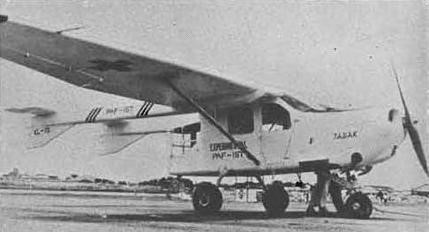
IST/PAF ARDA XL-15 Tagak

In the early 1950s in the Philippines, the Institute of Science and Technology (I.S.T., previously known as the Bureau of Science) designed at least three different prototypes, both to investigate the scope for local aircraft design and production and to examine the use of indigenous materials in their construction. One such material of interest was Wobex (Woven bamboo experimental), a reinforced woven bamboo.

The XL-15 Tagak was the second of these prototypes, developed in collaboration with the Philippine Air Force, it was designed by Antonio J. de Leon as a utility, liaison or ambulance aircraft and as a test bed for the use of local materials in aviation. It was a single-engine, high-wing monoplane with a twin-boom layout and tricycle undercarriage to enable easy access to the fuselage pod via rear doors. The inner wing sections, fitted with slotted flaps on the trailing edges had constant chord but further out the wings tapered, with slotted ailerons. There was a single lift strut on each side between wing and lower fuselage, with an airfoil profile to add to the lift from the wings.

The fuselage of the Tagak was a wood and plywood framed semi-monocoque skinned with Wobex and ply. Its cabin, behind the 185 hp Lycoming flat six engine, was 3.26 m (10 ft 6 in) long to the rear of the pod. There were two front seats under the wing leading edge, two more behind and room for one or two (stacked) stretcher cases. The cabin had two windows on each side and the rear part of the pod, which projected behind the wing trailing edge, was also extensively glazed. The two tail booms, of all ply construction, were integral with the wing centre section. The fins, with long chord underside fillets, were integral with the booms. The tailplane was rectangular and extended beyond the fins, carrying a horn balanced elevator. The fixed surfaces were of wood and ply construction, with Wobex covering; control surfaces were fabric covered.

Flight testing of the Tagak began in October 1954. By 1956 some small modifications had been made: rudder area was increased and a shimmy-damper added to the nosewheel leg.

Only one was built.

Engine: 1 × Lycoming O-425A, 138 kW (185 hp)
Propeller: 2-bladed fixed pitch
Wingspan: 12.0 m (39 ft 4 in)
Wing area: 20.30 m2 (218.5 sq ft)
Airfoil: NACA 23012 (inner section), USA 35B outer section
Length: 9.15 m (30 ft 0 in)
Height: 2.80 m (9 ft 2 in)
Empty weight: 780 kg (1,720 lb)
Gross weight: 1,250 kg (2,756 lb)
Fuel capacity: 174 L (38 Imp gal, 46 US gal)
Maximum speed: 200 km/h (120 mph, 110 kn)
Cruise speed: 158 km/h (98 mph, 85 kn)
Range: 675 km (419 mi, 364 nmi)
Service ceiling: 4,000 m (13,000 ft)
Rate of climb: 3.0 m/s (590 ft/min)
Seats: 4

IST/PAF ARDA XL-10B Balang / Grasshopper

The XL-10B Balang (Grasshopper) was a powered glider joint project of Institute of Science and Technology (IST) and Philippine Air Force (PAF) Air Research and Development Authority (ARDA).

It first flew in 1953.

Engine: 20 hp
Wingspan: 12 m
Length: 5.20 m
Height: 1.5 m
Aspect ratio: 8.1
Wing area: 17.8 sq,m
Empty weight: 185 kg
Loaded weight: 280 kg
Max speed: 125 kph
Cruise speed: 72-80 kph
Stall: 49 kph
Glide speed: 75 mph

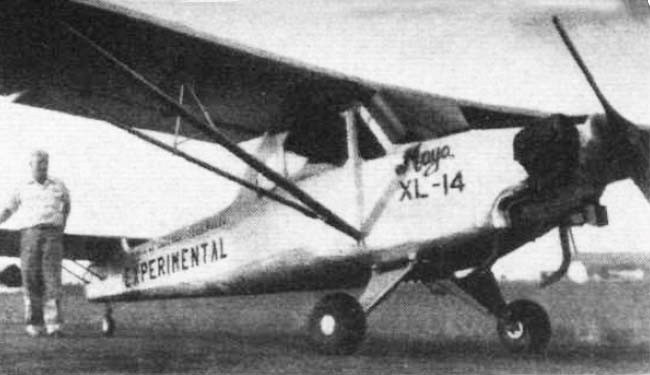
I.S.T.XL-14 Maya

In the early 1950s in the Republic of the Philippines, the Institute of Science and Technology (I.S.T., previously known as the Bureau of Science) designed at least three different prototypes, both to investigate the scope for local aircraft design and production and to examine the use of indigenous materials in their construction. One such material of interest was Wobex (Woven bamboo experimental), a reinforced woven bamboo.

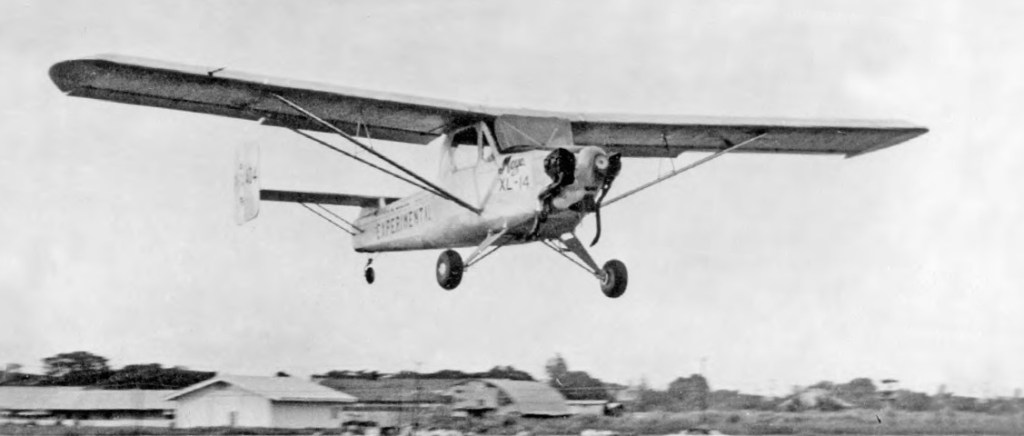
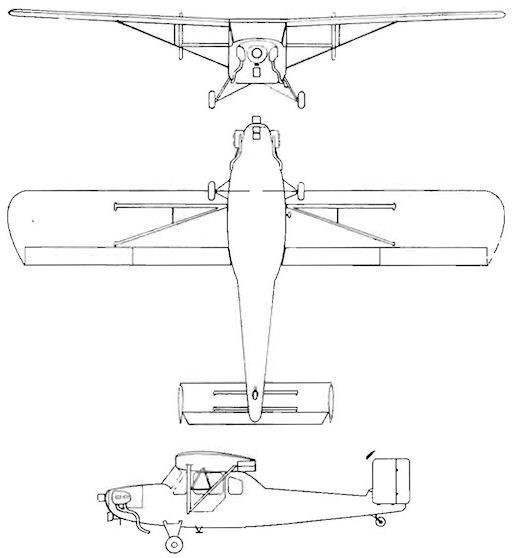
Designed by Antonio J. de Leon, the XL-14 Maya (until 1995 the Maya was the national bird of the Philippines) was the first of this series of prototypes. It was a single-engine, high-wing monoplane of standard layout except for its twin tail. The wing had constant chord and was built around two parallel, solid spars and wooden ribs. The leading edges were covered and reinforced with Wobex and the rest of the wing was fabric covered. The centre section was integral with the cabin top and the outer wings were braced on each side with V struts from the wing spars to the lower fuselage. Ailerons and slotted flaps were fitted. It had a strut braced tailplane, set slightly above the fuselage top on a short pylon. The tailplane carried almost rectangular endplate fins and rudders. The tail structure was wooden with fabric covering.

The Maya, bearing its experimental category registration PI-X-104 on its fins, had a semi-monocoque fuselage with wooden stringers and Wobex mat covering. The cabin stood above the rear fuselage line, enclosing side-by-side seats with a third, occasional seat, or luggage space, behind. In front a 75 kW (100 hp) Lycoming flat four engine, with cylinder-heads exposed, drove a two-blade propeller. It had a conventional undercarriage, with each mainwheel mounted on V-struts and half axles hinged to the fuselage central underside via rubber shock absorbers. The fixed tailwheel was steerable.

The date of the Maya’s first flight is not known, though the aircraft was complete by May 1955 and a later design, the XL-15 Tagak was being flight tested by October 1954. Only one Maya was built, for although it was described as being suitable for agricultural use and for utility and observation work, its function was always as a constructional material experimental aircraft.

Engine: 1 × Lycoming O-235-2, 75 kW (100 hp)
Propeller: 2-bladed wooden, fixed pitch
Wingspan: 10.24 m (33 ft 7 in)
Wing area: 16.0 sq,m (172 sq ft)
Length: 6.30 m (20 ft 8 in)
Height: 2.40 m (7 ft 10 in) tail up
Empty weight: 510 kg (1,124 lb)
Gross weight: 780 kg (1,720 lb)
Fuel capacity: 68 L (15 Imp gal, 18 US gal)
Maximum speed: 184 km/h (114 mph, 99 kn)
Cruise speed: 150 km/h (93 mph, 81 kn)
Range: 480 km (300 mi, 260 nmi)
Service ceiling: 3,820 m (12,530 ft)
Rate of climb: 3.6 m/s (710 ft/min) initial
Capacity: 2/3 (3rd passenger under 50kg (110 lb))

Isotta Fraschini V.5

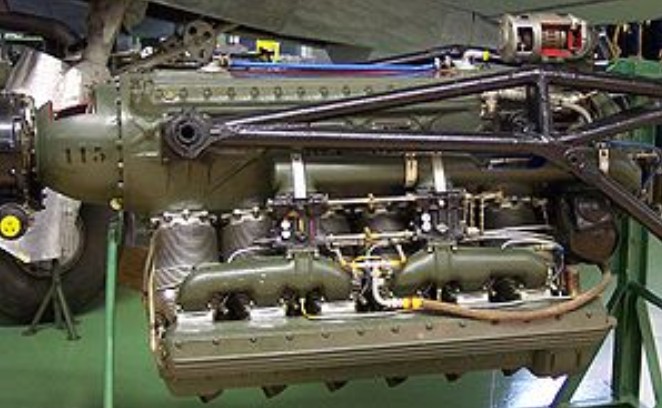
The Isotta Fraschini V.5 of 1916 was an Italian eight-cylinder, water-cooled, in-line piston aero engine first run in 1915. The “V” denoted “Volo” or “flight” rather than piston arrangement.

The V.5’s construction was fairly typical of aircraft engines of the period with cast-iron cylinders mounted in pairs with common heads and water jackets. It had much in common with the six-cylinder Isotta Fraschini V.4 and was built at a similar time. Though powerful, it was very heavy and thus, like some other Isotta Fraschini engines, better suited to airships than aircraft.

Applications:
Forlanini airship

Specifications:
Type: 8-cylinder inline
Bore: 130 mm (5.12 in)
Stroke: 180 mm (7.09 in)
Displacement: 19 L (1,165 cu in)
Length: 1,990 mm (78.3 in)
Width: 600 mm (23.6 in)
Height: 1,010 mm (39.8 in)
Dry weight: 351 kg (774 lb)
Valvetrain: Overhead camshaft
Fuel system: Twin carburettors, twin eight spark magnetos
Oil system: Forced feed
Cooling system: water; cast iron cylinders in pairs, each pair in a steel water jacket
Reduction gear: direct
Power output: 183 kW (245 hp) at 1,400 rpm

Isotta Fraschini V.4

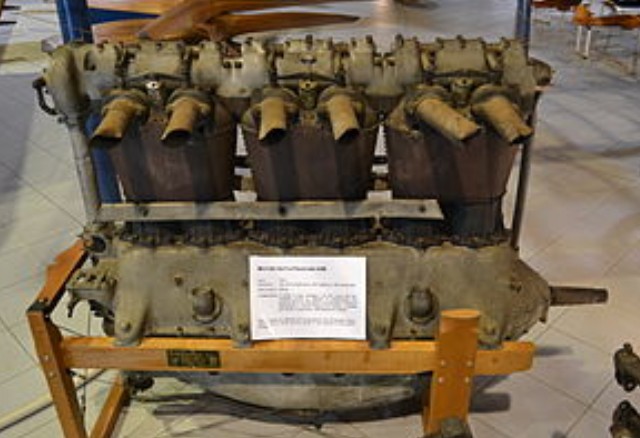
The Isotta Fraschini V.4 of 1916 was an Italian six-cylinder, water-cooled, in-line piston aero engine of World War I (the “V” denoted “Volo” or “flight”). Its construction was fairly typical of aircraft engines of the period with six cast-iron cylinders mounted in pairs with common heads. This engine was also produced by Alfa Romeo.

Applications:
CANT 7
Caproni Ca.3
Caproni Ca.30
Caproni Ca.33
Caproni Ca.34
Caproni Ca.35
Caproni Ca.36
FBA Type H
Macchi L.1
Macchi M.5
SIAI S.8

Specifications:

V.4b
Type: Six-cylinder, water-cooled, in-line piston engine
Bore: 130 mm (5.12 in)
Stroke: 180 mm (7.09 in)
Displacement: 14.3 L (874 cu in)
Length: 1,470 mm (58 in)
Width: 460 mm (18.11 in)
Height: 1,020 mm (40.15 in)
Dry weight: 264 kg (584 lb)
Valvetrain: Overhead camshaft
Fuel system: Twin carburettors, two six spark magnetos
Oil system: Forced feed
Cooling system: Water; cylinders in pairs, each pair in a steel water jacket
Power output: 142 kW (190 hp) at 1,450 rpm
Compression ratio: 4.8

Isotta Fraschini Delta / R.C.21/60 / R.C.35

Isotta Fraschini Delta RC131

The Delta was a 12-cylinder inverted-V aircraft engine built by Isotta Fraschini prior to and during World War II. First run in 1927, the Delta produced about 750 hp in common versions, although others were rated up to 900 hp. The Delta was not widely used, although it could be found on a number of production aircraft and some advanced prototypes.

Although the air-cooling might be considered an anachronism even during the 1930s, the engine included a number of otherwise advanced features. For instance, the valves were powered by dual overhead cams driven by power shafts at the rear of the engine. Exhaust ports were arranged to exit toward the middle of the engine, one cylinder bank being the mirror of the other, allowing the piping to be ganged below the engine nacelle.

Around 3300 were built.

Applications:
Ambrosini SAI.107
Ambrosini SAI.207 prototype
Ambrosini SAI.403 prototype
CANT Z.515
Caproni Ca.313
Caproni Ca.314
Caproni Ca.331
Caudron C.714 (C.760) prototype
Henschel Hs 129 prototype
Reggiane Re.2001 prototype

Specifications:

Delta R.C.35 IS
Type: 12-cylinder air-cooled 60 degree inverted vee
Bore: 132 mm (5.197 in)
Stroke: 160/165 mm (6.299/6.496 in), with main and articulated rod
Displacement: 26.685 Litres (1,628.44 in³)
Length: 2000 mm (78.8 in.)
Width: 840 mm (33.07 in.)
Height: 883 mm (34.76 in.)
Dry weight: 510 kg (1,111 lb)
Valvetrain: 2 Poppet valves per cylinder, sodium cooled exhaust valves, double overhead camshafts.
Supercharger: single stage single speed centrifugal type supercharger, gear ratio 9.8:1
Fuel system: 4Isotta Fraschini downdraft carburetors Fuel type: 80/87 octane petrol (aviation gasoline) Oil system: dry sump, 2 scavenging, 1 pressure pump Cooling system: Air-cooled Power output: 770hp/2600rpm take off, 750hp/2600rpm/4000meters. Reduction gear ratio 0.64:1 Specific power: 0.75 hp/in³ (34.1 kW/L) Compression ratio: 6.4:1 Specific fuel consumption: 270 grams/hphour maximum, 250 grams/hp*hour cruise (70%)
Power-to-weight ratio: 1.485 hp/kg (0.67 hp/lb)

Issoire PIK-30 / Societe Siren PIK-30 / Eiri Avion PIK 30

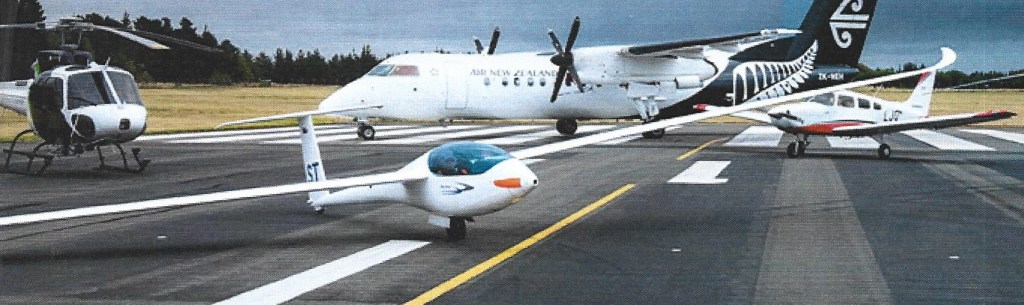
Issoire, part of the groupe Siren, acquired a license from Eiri Avion to build the 15 m. self- launching Finnish PIK 20E designed by Pekka Tammi and M.Moniot. The Pik 30 is a self- launching 17 m. development which first flew in 1984. It has the capability of being flown as a 15 m. sailplane or, with tip extensions, with 17 m. span. The PIK 30 has a mast mounted manually actuated retractable engine.
Construction of the wings and tail surfaces: GFRP sandwich with PVC core; carbon fiber spar caps and cockpit sides: GFRP monocoque structure reinforced with ribs of carbon fiber.

SIREN PIK-30 ZK-GST

Span: 17m / 55.8ft
Area: 10.63sq.m / 114.42sq.ft
Empty Weight: 340kg / 750lb
Payload: 120kg / 264lb
Gross Weight: 460kg / 1014lb
Wing Load: 43.27 kg
/sq.m / 8.86 lb/sq.ft
Water Ballast: 0
Aspect ratio: 27.2
L/DMax: 45 110 kph / 59 kt / 68 mph
MinSink: 0.54 m/s / 1.77 fps / 1.05 kt
Airfoil: Wortmann FX-67 K170, root, K150, tip
Engine: 32 kW/ 43 bhp Rotax 503
Seats: 1
No. Built: 10

Issoire E 78 Silene

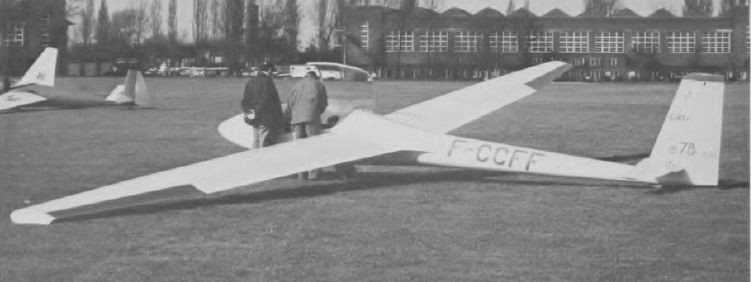
The E 78 Silene side-by-side two-seat sailplane was developed by CERVA (Consortium Europeen de Realisation et de Ventes d’Avions) and is the first French glassfibre two-seater. The company was owned by Siren SA and Wassmer-Aviation SA. The E 78 was designed by Siren and, following the closure of Wassmer, was transferred to Issoire in late 1977. The aim was to produce a sailplane suitable for all stages of glider training from ab initio to cross-country flights.

Construction was started in February 1973 and the prototype first flew at Argenton on 2 July 1974.

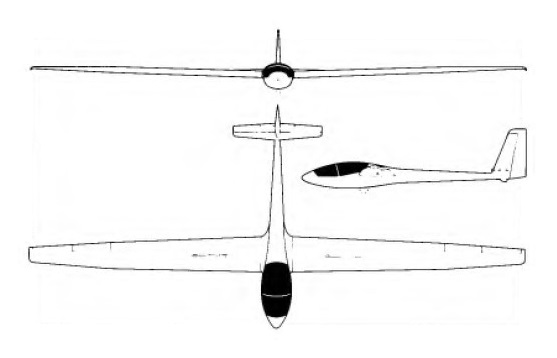
The wings are of glassfibre/plastic foam sandwich construction, incorporating two-section ailerons of similar material and Schempp-Hirth airbrakes operating both above and below each wing. Flaps are not fitted. The fuselage is a semi-monocoque glassfibre/plastic foam sandwich structure. The conventional tail unit incorporates a fixed incidence tailplane and trim tabs on each elevator.

The pilots sit in staggered position to keep the width of the fuselage to a minimum, the starboard seat being set slightly to the rear. The Silene is available with either retractable or fixed landing wheel with hydraulic brake and shock absorber.

E 78 Silene
Wing span: 18.0 m / 59 ft 0 3/4 in
Length: 7.95 m / 26 ft 1 in
Height: 1.5 m / 4 ft 11 in
Wing area: 18.0 sq.m / 193.8 sq ft
Wing section: Berlin E55 166
Aspect ratio: 18.0
Empty weight: 365 kg / 805 lb
Max weight: 565 kg / 1,246 lb
Water ballast: None
Max wing loading: 29 kg/sq.m / 5.94 lb/sq ft
Max speed: 119 kt / 220 km/h
Stalling speed: 34 kt / 63 km/h
Min sinking speed: 0.59 m/sec / 1.8 ft/sec at 39 kt / 73 km/h
Best glide ratio: 38 at 51 kt / 95 km/h