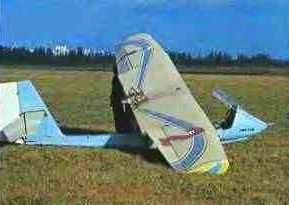
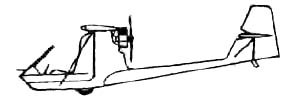
The JAI-44 (Russian: ХАИ-44) was developed by the SKB JAI student collective as a light sports aircraft and was released in 1989.
Engine: 54 hp FW-1600 Wingspan: 7.5 m Length: 5.5 m Wing area: 14.25 m² Empty weight: 230 kg Maximum takeoff weight: 330 kg Maximum speed at sea level: 110 km / h Landing speed: 52 km / h Accommodation: 1
The JAI-42 (Russian: ХАИ-42) was developed by the SKB JAI student group as a light sports aircraft and was launched in 1987, receiving the nickname “Rosinante” in resemblance to Don Quixote’s lanky horse.
Only the one was built, first flying in 1987.
JAI-42 Rosinant Engine: 35 hp RMZ-640 Wingspan: 8.4 m Length: 4.5 m Wing area: 10.2 m² Empty weight: 192 kg Maximum takeoff weight: 280 kg Maximum speed at sea level: 85 km / h Landing speed: 60 km / h Range: 130 km Accommodation: 1
The two-seater JAI-41 (Russian: ХАИ-41) was designed as a pilot training and teaching motor-deltaplane and for the development of topographic surveys, aerial photography and cartography tasks.
Developed at the JAI in 1987, the JAI-41 participated in the First Soviet Glider Championship, which took place in September 1988 in Crimea.
Only the one was built.
Engine: 42-hp Vulcan V-40 Wingspan: 10.0 m Length: 3.6 m Wing area: 16,6 m² Empty weight: 120 kg Maximum takeoff weight: 220 kg Maximum speed at sea level: 70 km / h Landing speed: 40 km / h Range: 160 km Take-off run: 30 m Accommodation: 1
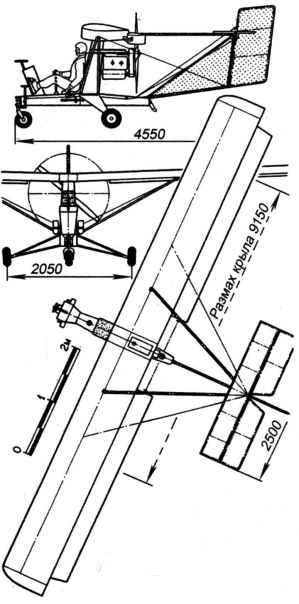
In 1986 at SKB JAI a light aircraft named JAI-40 (Russian: ХАИ-40) and nicknamed “VOK” was developed. Originally this device was obtained as a student work directed by G. Jmyz from the previous JAI-21. The aircraft was safe, light in handling and excellent speed and economy characteristics.
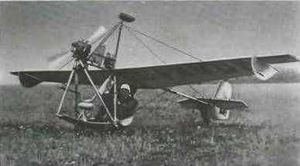
The JAI-40 was designed as a mixed construction single-seater high-wing monoplane. The wing, braced by inverted V posts, was constructed of wood with some use of composite materials and featured control surfaces along the entire length of the trailing edge.
The bar-type fuselage was constructed of metal tubes and sheets.
The glue unit was conceived on the basis of a fabric-coated duralumin tube structure. The horizontal planes were located high above the empennage and were braced to the structure by cables. The rudder featured a large area.
The landing gear was designed in a tricycle configuration. The front wheel was of the steerable type and was located directly at the bow of the device. The pilot sat in a seat on the basic structure of the fuselage. To avoid impacts during landing at large approach angles, a skid was installed under the rear of the fuselage.
The drive configuration difficulties were offset by installing a 35 hp RMZ-640 geared motor. This engine was installed directly on the vertical pylon for fixing the wings, moving a propeller with two wooden blades 1.38 meters in diameter. The selection of the engine and the use of a wing with 8.2 aspect ratio allowed the model to fly easily and have an excellent take-off step. Later and in order to improve performance, a 42 hp Vulcan engine designed by VP Manuilenko would be installed, moving a propeller of 1.51 meters in diameter.
Its further development was reinforced and in 1988 it reached first place in its class in the light aircraft competition held in Túshino. With a takeoff weight of 305 kg and a 42 hp engine this little machine was capable of reaching 105 km / h.
JAI-40 in its final version
The JAI-40 successfully participated in the SLA-87 light aircraft competition.
JAI-40 Engine: 1 x Vulcan 42 hp Wingspan: 8.50 m Length: 4.75 m Wing area: 9.60 m² Tailplane wingspan: 5 m Vertical fin area: 1.64 m² Rudder area: 0.90 m² Queue area: 1.40 m² Elevators area: 0.86 m² Wing aspect ratio: 8.7 Wing Profile: GA -1 Wheel spacing: 2.05m Empty weight: 172 kg Gross weight: 262 kg Maximum takeoff weight: 305 kg Wing loading: 2.44 lb / sq.ft Power load: 7.48 kg / hp Fuel capacity: 10 liters Maximum speed: 105 km / h Cruising speed: 95 km / h Stall speed: 55 km / h Ascent speed: 128 m / min Practical range: 90 km Accommodation: 1
The JAI-39 (Russian: ХАИ-39) was designed at SKB JAI in 1978 as a single-seat experimental light aircraft of twin-engine configuration.
Only one example was built.
JAI-39 Engines: two 4 hp Druzhba Wingspan: 10.65 m Wing area: 17.63 m² Length: 3.62 m Empty weight: 42.65 kg Maximum takeoff weight: 140 kg Maximum speed at sea level: 45 km / h Landing speed: 22 km / h Take-off run: 10 m Accommodation: 1
In 1983, in the SKB JAI piloted model development group, designed and built, JAI-38 (Russian: ХАИ-38) multifunctional delta. In charge of the design was fourth-year student SI Kanivolotski.
The delta was powered by a 40 hp Vulcan V-40 engine, designed and built at the institute itself. With a takeoff weight of 210 kg, the device managed to develop a speed of 75 km / h.
The JAI-38 participated in the second edition of the competition for amateur ultralight aircraft developed in Kiev. The 28 of July of 1984 during the aviation festival dedicated to the 100th anniversary of the renowned SV Grizodubova pilot, SI Kanibolovski demonstrated in the JHA-38 a take off and landing from the racecourse school.
JAI-38 Engine: Vulcan V-40, a 40-hp Wingspan: 10.0 m Wing area: 16,6 m² Length: 3.6 m Empty weight: 120 kg Maximum takeoff weight: 220 kg Maximum speed at sea level: 70 km / h Landing speed: 40 km / h Range: 160 km Take-off run: 30 m Accommodation: 1
JAI-37 “Mikhail Yefimov” (Russian: ХАИ-37 “Михаил Ефимов”) was an ultralight aircraft developed at the AKA of the JAI.
Structurally, the JAI-37 was conceived as a high-wing braced monoplane of mixed construction. The ailerons were located at the wing tips. These ailerons appeared as increases to the wingspan.
A modified “Vijr-30” naval engine with air cooling was used as the power plant for this implementation and with a takeoff power of about 28 hp.
The JAI-37, named Mikhail Yefimov, was built in 1982 by a group of JAI students from a project developed by V. Dombrov, who also directed the construction. In this process, V. Kozhushnov, S. Kurinni, R. Sielix, M. Boiko and I. Tkach stood out.
First flying in 1980, as a glider, and August 1981 powered, tests were not good due to the lack of effectiveness of the wingtip ailerons.
Based on JAI-37, the improved JAI-37M model was developed with modified wings and tail and more standard placement of the ailerons. Later another model would be built, known as JAI-37M2.
The JAI-37M participated in the First SLA-85 Light Aviation Competition, but in this competition it did not fly.
In 1972 at the request of a group of students of the KAK JAI institute and under the direction of the head of the aeronautical construction laboratory A. Barannikov, within the structure of the OSKB JAI the Aviation Construction Club (KAK) designed the JAI-35 “Entusiast” (Russian: ХАИ-35М «Энтузиаст») motor glider.
The JAI-35 “Entusiast” training motor glider was created on the diploma work of student N. Labrov, an active member of KAK since its foundation. In the construction of JAI-35 and under the direction of A. Barannikov, V. Silyukov, S. Alexandrov, A. Jomich, A. Mosalienko and S. Kovaliov stood out.
The JAI-35 was conceived as a wooden construction motor glider with some use of composite materials. As a power plant, a “Vijr-30” outboard boat motor was selected, modified to work with air cooling. This engine developed about 28 hp at takeoff.
The first flight in a non-powered configuration was performed by N. Lavrov in 1980. With the power plant the first flight would take place in August 1981. At the controls was the head of the KAK A. Barannikov.
Under the direction of Natalia Labrova, students from the “A. Barannikov” of the JAI worked on a modified and improved version of the JAI-35 that was named JAI-35M. This version was powered by a 36 hp engine, showing better overall performance.
This JAI-35M participated in the SLA-87 Light Aviation Competition.
Between 1991 and 1992 studies were conducted to investigate the use of ultralight aerial photography tasks. JAI-29S and JAI-35M2 participated in these experiments. The results demonstrated the feasibility of using AFA cameras in this type of apparatus.
At least three JAI-35 were built.
JAI-35M Engine: 36 hp Empty weight: 170 kg MTOW: 260 kg Velocity at sea level: 2 m / s Minimum descent speed: 1.5 m / s Ascent speed: 2.4 m / s Accommodation: 1
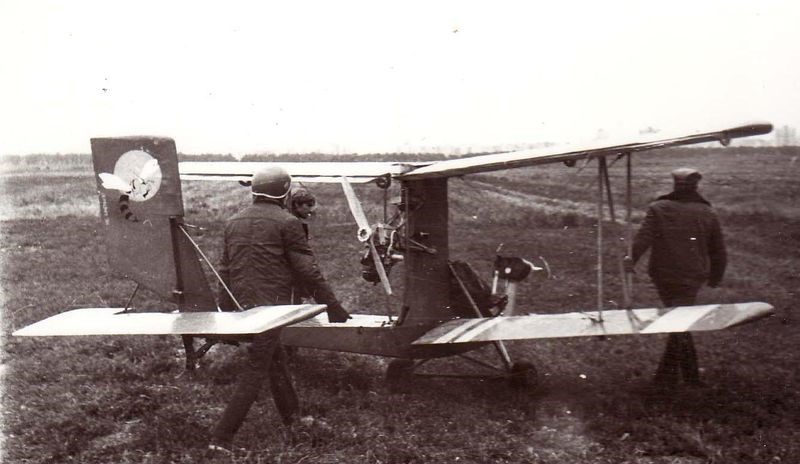
In 1980 a group of JAI students led by S. Shevko built the JAI-34 (Russian: ХАИ-34) biplane.
This model was designed as a biplane training aircraft and its design was influenced by the North American publication of the plans for the Wing-Ding ultralight aircraft.
The construction was led by students S. Shevchenko and V. Mielnik.
The JAI-34 was designed as a single-seater light aircraft with a biplane wing structure. The entire construction was made of wood, with the use of some metal structural elements. The wing featured an R-IIIA profile.
The control surfaces had a wooden frame with a percale coating and several layers of enamel. The landing gear was tricycle, with steerable front wheel.
Originally the JAI-34 was equipped with a Jupiter engine, but it would not fly, limiting its use to ground running. Later an Izh-PZ engine was installed with which only a few jumps were made, due to the lack of power. With this engine the climb speed was only 0.5 m / s and flying in a circle was a real feat.
Finally, a Vijr-30 motor with an angle reducer would be installed, which gave it about 28 hp. The fuel system included a tank in the flat center with gravity feed from the engine. The type of fuel used was A-76 and MS-20 oil.
The pilot sat in a forward seat in the open cockpit. Behind, under the wing, was the engine. The instrument panel equipment included US-250 speedometer, VD-1 altimeter, VR-10 barometer, KI-13 compass, 2TTsT-47 thermometer.
The JAI-34’s first flight took place in July 1984 with student N. Krikunienko at the controls.
The JAI-34 successfully participated in the first SLA-85 light aviation competition. The JHA command, led by B.Virski, received the “OK Antonov” grand prize awarded by this event for solving complex problems in the independent creation, professional orientation and organization of ultralight aircraft flights.
JAI-34 would participate in many other regional and national events.
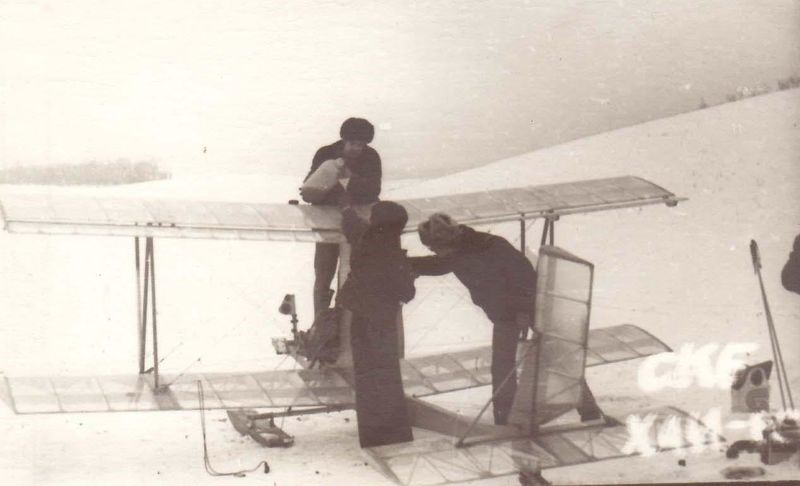
Refuelling JAI-34 for a ski train flight.
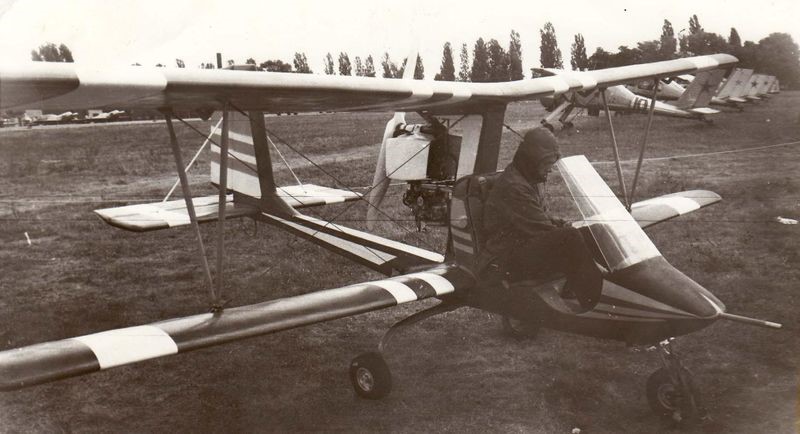
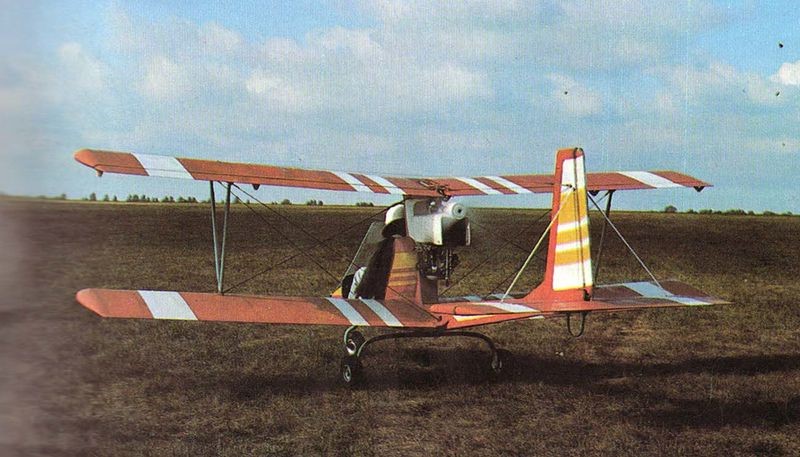
The JAI-34M was built by the JAI SKB “Experiment”, led by VA Mielnik and made its maiden flight in September 1985.
The JAI-34M featured improved lines and greater comfort for the pilot.
The JAI-34M received flight approval in May 1991 and by June 1992, when it was destroyed, it accumulated 26 hours and 19 minutes of flight time. This specimen was entered in the register of the Federation of Aviation Lovers of the Kharkov Oblast on May 23, 1991, receiving registration number 16009.
This example was originally designed to use an MT-9 engine, but later it was re-powered by an RMZ-640 air-cooled piston engine capable of developing 28 hp at takeoff, moving a 1.6 meter diameter propeller. Unlike the original model, the wing consoles were designed with a D-16T duralumin light tube structure.
The JAI-34M featured notable improvements in aerodynamics.
The JAI-34M was delivered to the “Vzliet” Sports-Technical Center, directed by Vladimir Leontievich Goryunov.
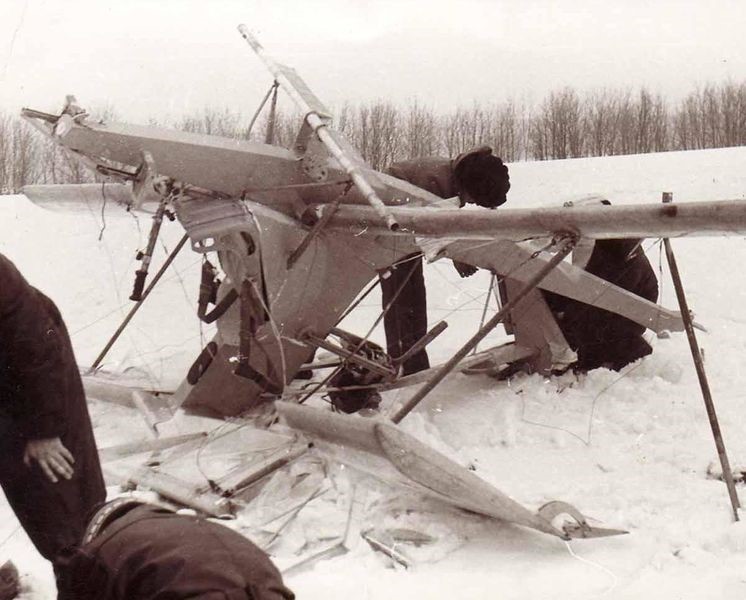
On 7 June 1992 at 12:08 pm the plane was destroyed in a crash at the airfield Tomarovka, Goryunov losing his life.
During a flight in good weather and during a third turn, at a speed of about 80 km / h, the aircraft lost speed and entered a circular spin. After making 1.5 turns, the plane hit the ground.
According to the people who were at the scene, the engine never stopped working. The impact was made at about 100-120 km / h and the pilot died.
Remains of the JAI-34 crashed in 1992.
The commission that investigated the accident determined that the cause was attributable to the pilot, but prohibited the Federation of Aviation Lovers from allowing flights in this model until the spin tests were carried out.
JAI-34 Powerplant: 1 x 28 hp Vijr-30 Propeller Diameter: 1.3m Propeller pitch: 600mm Wingspan: 5.81 m Wing area: 8.8 m² Length: 4.8 m Empty weight: 172 kg Maximum takeoff weight: 237 kg Maximum speed: 120 km / h Cruising speed: 90 km / h Crash speed: 62 km / h Range: 100 km Seats: 1
The JAI-31 (Russian: ХАИ-31) gyroplane was developed at the JAI in 1977. This original single-seat apparatus was designed for the development of scientific experiments and sport flights. The design and construction was directed Gennadi Grigorievich Jmyz.
The JAI-31 gyroplane was built on a platform composed of two floats made of wood, joined together with metal stringers on which the pilot’s seat, the rotor base and the vertical plane were mounted.
The control of the gyroplane was through the combination of the 6.2 meter diameter rotor and the rudder.
To take off, the rotor began to rotate manually and then towed by a speedboat.
The JAI-31 was continued in the second, improved, JAI-31A of 1978, which was mainly characterized by the absence of the vertical plane.
JAI-31 Rotor diameter: 6.2 m Empty weight: 60 kg Maximum takeoff weight. 135 kg Maximum speed: 50 km / h Take-off speed: 25 km / h Landing speed: 5 km / h Seats: 1
JAI-31A Rotor diameter: 6.2 m Empty weight: 65 kg Maximum takeoff weight. 130 kg Maximum speed: 55 km / h Landing speed: 5 km / h Seats: 1
 -1