Jannus 1915 Flying Boat

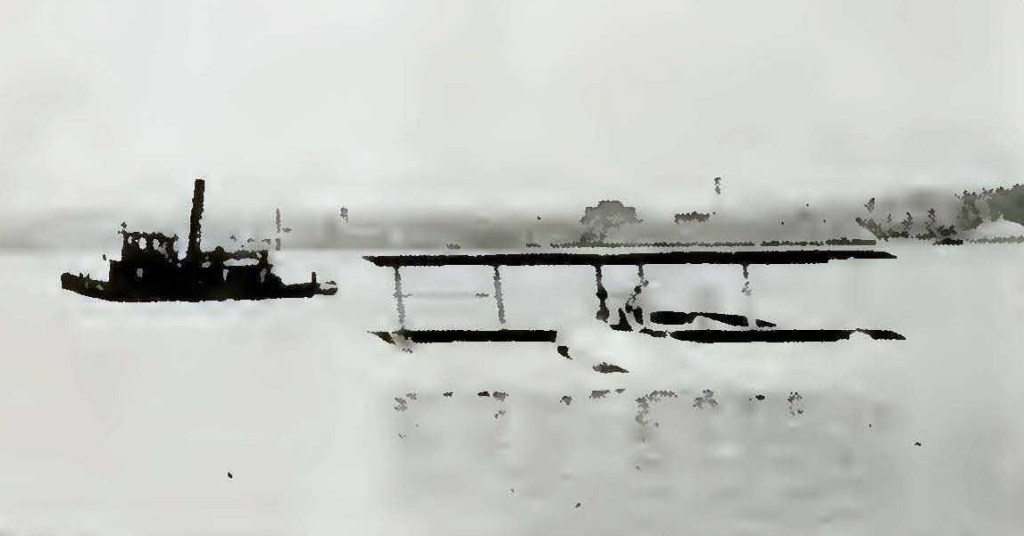
A new and efficient design for rough water, ready assembly and disassembly, inherent stability, wide range of flying speed, waterproof construction of wings, enormous margin of safety, comfort for pilot and three passengers, and a dry, clean place for them to sit, this 1915 model is ideal.
The rough water ability is obtained in two principal ways: first, all the wing attachments are independent of the motor and propeller shaft; and. second, the low centre of gravity. Of special interest are the tapering end floats that never pound or jerk the wings. These taper from three inches wide across the bottom to a foot across the top. The taper has the advantage of reducing the planing surface, which at high speed would be sufficient to pound the wings badly, but when called upon as floats are quickly displacing water at an increased rate, easily combating the heaviest side lurching or listing or yawing tendency.
The removability of the tail for shipment has many advantages in construction and in simplicity of shipment for compactness. The motor remains in the front half of the hull with all controls intact. The control cables going to the tail and rudder all pass through individual leads in a conduit that is made of heavy steel as a protection against the propeller breaking or throwing anything with sufficient force to sever them.
Between the conduit and the controls the cables are supplied with the Jannus type sister hook, which locks the cables together in a permanent fashion quickly, and without additional safety wire or other auxiliary being necessary.
The wings are assembled in their entirety before being attached to the hull and, when on, cannot fail to align properly if reasonable care is taken. Where desirable they can he put on half at a time. To April 1915 the best record showed a total load of 2.200 lbs. carried in flight at 22-55 mph with an indicated 60 h.p.
Tests in the lee of large vessels, along windward shores and in other extreme conditions of gusty wind and treacherous obstacles prove that the new struts and the staggered planes are serious contenders for the inherent stability honors. The pilots reported that in no case was there any rapid inequality developed nor did the machine make any appreciable variation from its course due to these unfavourable conditions.
The tests have been conducted by Mr. Fritz G. Ericson and Mr. Antony Jannus.
The designers did not stagger the planes in this model for other than structural advantage.
The internal construction of the wing is free from ordinary glue and is amply strong without any adhesives, although liquid marine glue is used in all joints to maintain rigidity under severe stress and to prevent rotting. All bolts go on each side of the beams, through end grain blocks that are brass covered outside of the fabric.
The pilot is seated in front, leaving a seat behind for three large passengers. The ample foot space is well above the ribs of the bottom and made in the form of a grating that is removable for cleaning the bilge scuppers or any other purpose.
The motor compartment is segregated from all other parts of the boat, so that no oil or grease can be distributed.
Janka Gyongyos 33

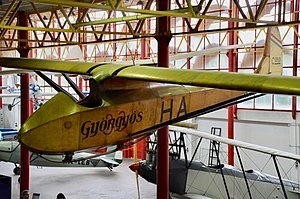
The Gyöngyös 33 was the first Hungarian designed sailplane and was named after its place and year of manufacture. It was designed by Zoltán Janka and built in the MOVERO (Aviation Section of Hungarian National Defence Association) workshops at Gyöngyös. His design target was to produce an aircraft that would out-perform the 1928 RRG Professor.

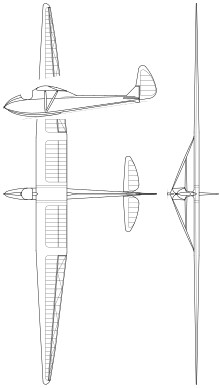
It was an all wood monoplane with a two-part wing built around a forward main spar and a rear false spar. The inner area of each part was rectangular in plan, tapering strongly outboard. The leading edges ahead of the main spar were plywood-covered, as was the whole wing at the inner-outer junction; the rest was fabric-covered. An aileron filled the whole trailing edge of each outer section. The two parts joined at a narrow centre-section on a raised fuselage pylon and were braced on each side with a V-strut from the fuselage bottom to the wing spars at the inner-outer junctions.

The Gyöngyös 33’s six-sided fuselage was formed by a wooden frame and was plywood-covered. The pilot had an open cockpit ahead of the wing leading edge with the wing pylon immediately behind him. A rubber-sprung landing skid below him ran from the nose almost to the trailing edge. The fuselage tapered rearwards to a cantilever empennage. The fin was small and ply-covered with a tall rudder which, like the all-moving tailplane apart from its leading edge, was fabric covered.

The first flight took place on 11 June 1933. A fortnight later the Gyöngyös 33 slope-soared for 5 h 43 m, gaining 1,140 m (3,740 ft) of altitude, a Hungarian record. On 27 June it set a national duration record of 10 h 7 m. In 1934 it made a 64 km (40 mi; 35 nmi) flight.

The Gyöngyös 33 is now on display in the Hungarian Technical and Transportation Museum, Budapest.

Length: 7.37 m (24 ft 2 in)
Wingspan: 18.55 m (60 ft 10 in)
Wing area: 19.3 sq.m (208 sq ft)
Aspect ratio: 17.8
Airfoil: Göttingen 549
Empty weight: 179 kg (395 lb)
Gross weight: 250 kg (551 lb)
Maximum glide ratio: >20 at 55 km/h (34 mph; 30 kn)
Rate of sink: 0.6 m/s (120 ft/min) minimum

Janes V-8

Charlie Janes converted Auster ZK-ATO to V-8 power as Auster ZK-ATO/V8 1.

In a conventional aircraft powered by a conventional low-compression aircraft engine, the airflow through the prop would have kept the engine turning, but the V-8 had a compression ratio of more than 9-1, and the reduction drive compounded the effect.

The NZ Civil Aviation Division had insufficient staff time available to process the modification and deferred to recommendations of an approved Aeronautical Consulting Engineer, subject to technical appraisal by the CAD.
Despite all the work and testing, the costs were prohibitive and the conversion was abandoned.

Jamieson Corp

USA
Formed late 1940s as Jamieson Aircraft Company Inc. to develop and produce the J-2-L1 Jupiter, a small, three seat low-wing monoplane with retractable landing gear and a vee tail. Name changed in middle/late 1950s, and in December 1958 flew prototype of a four-seat, single tailed development of Jupiter known as the Take 1. This was certificated in mid-1963 and limited production of an improved model, the Jamieson “J,” soon began.

JLT 210 / JLT 80

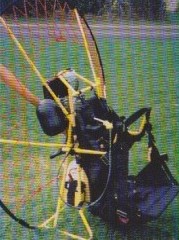
JLT paramotors were individually built tailored to the pilot. Both the JLT 210 and 80 can be adapted to trikes and electric start was otional.

JLT 210
Empty weight: 20 kg
Engine: Vittorazi, 13 hp
Reduction: 2.5-1
Prop diameter: 125 cm
Fuel capacity: 10 lt
Price 1998: F19,900

JLT 80
Empty weight: 17 kg
Engine: Vittorazi, 14.5 hp
Reduction: 4-1
Prop diameter: 125 cm
Fuel capacity: 6.5 lt
Price 1998: F21,900

JAI JAI-9

In the late 1930s, more modern gliders with improved aerodynamics were developed in various Soviet cities, designed to set new competition records. Among these models was the JAI-9 (Russian: ХАИ-9) single-seat monoplane glider designed by AV Kovalenko built by JHA students in 1937.

The JAI-9 wing presented a cantilever configuration with high aspect. In the JAI-9, for the first time, the TsAGI flaps were installed. It is worth noting the JAI-9 high wing loading.

The pilot was located in a cockpit closed by a transparent cover, which barely protruded in the contours of the glider’s fuselage.

The tests showed that the JAI-9 flew well and was easy to control in the air.