1980: Kraft Systems Inc., 450 W. California Ave, Box 1268, Vista, CA 92083, USA.
Built the Super Fli LSA
1980: Kraft Systems Inc., 450 W. California Ave, Box 1268, Vista, CA 92083, USA.
Built the Super Fli LSA
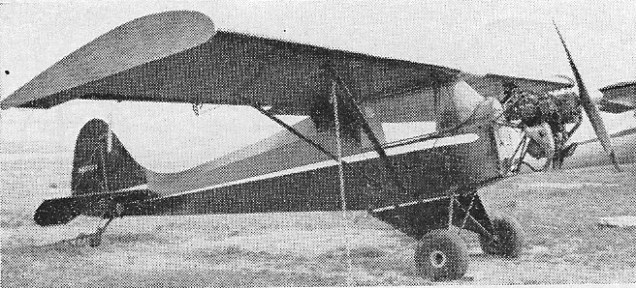
An original one-off built by L.A. Kraemer of Rapid City, South Dakota, the LK-1 Rapid Rambler was registered N6002V.
Engine: Continental A-65-8, 65 hp
Wing span: 24 ft 6 in
Length: 18 ft 3 in
Cruise: 95 mph
Seats: 1

Built by mechanic Stefan Kozłowski, it was the first aircraft built on polish territory. The machine was wrecked during the first flying trials in May 1910. The engine is a three-cylinder W-type engine, possibly a 45hp Anzani.

Span: 33’6″
Length: 29’6″
Weight empty: 660 lb


After a preliminary experiment using a Polikarpov U-2, Professor Sergei Grigorevich Kozlov, of the Nikolai Zhukovsky Air Force Engineering Academy, modified a Yakovlev AIR-4, in 1935, to produce the Kozlov PS (Prozrachnyy Samolyot — transparent aircraft). Fabric covering on the fuselage and wings was replaced with a transparent plastic material, called ”Cellon” or ”Rhodoid”, and the opaque structure was painted with a white paint mixed with aluminium powder. Trials with ground and airborne observations confirmed Kozlov’s theories, with the bonus of excellent visibility for the crew. After the initial success, the film was found to become opaque through dirt collection and the effects of the sun, diminishing the ”invisibility effect”.
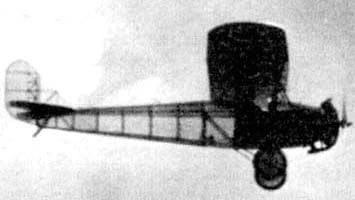
Kozlov proposed an invisible single-seat reconnaissance aircraft using the transparent plastic material, but doubts about structural strength of the material precluded development. Further studies into transparent aircraft were ordered from the experimental institute headed by Pyotr I. Grokhovskii but no more transparent aircraft were built using Kozlov’s methods.”
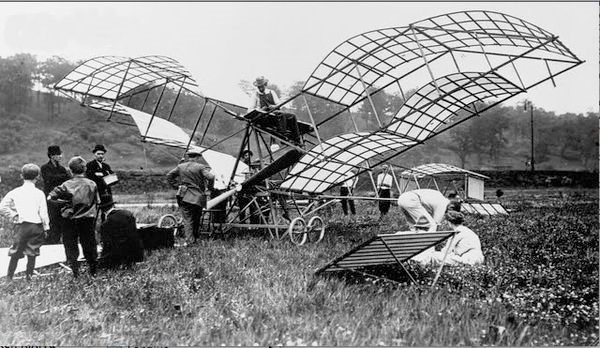
A machine built by Polish emigrant John Kowalski in Aspinwall, Pennsylvania, USA in 1910. This biplane is recognized to be the first Pittsburgh-built aeroplane flown, when on October 9, 1910, Kowalski, a marine engine builder with a great interest in aviation, crashed just after take-off.
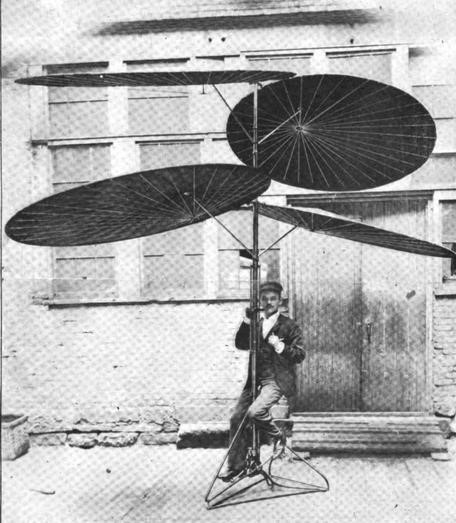
A patented experimental human-powered machine for aerial navigation built in Cleveland, Ohio, by Rudolph Kosch. The machine was published in the USA and in several magazines in Europe. In a French article from October 1896 the machine was identified as “un hélicoptère à ailes battantes” – a helicopter having flapping wings.
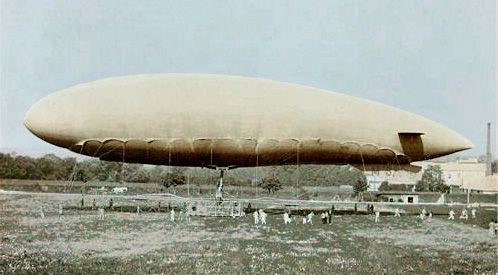
The Körting / Militärluftschiff M.III non-rigid military dirigible was constructed by the firms of Körting and Wimpassing (K-W 1) based on the Parseval-type. It first ascended on January 1, 1911. The “Körting” was Austria’s most successful airship before being lost on a routine aerophotogrammetric mission at Fischamend near Vienna. On June 20, 1914, moments after suffering a glancing mid-air collision with a Farman HF20 – a pusher biplane newly acquired by the military – the hydrogen-filled airship burst into a ball of fire and was dashed to earth. Nine men died including the pilot and observer of the Farman.
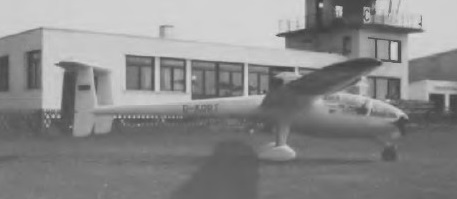
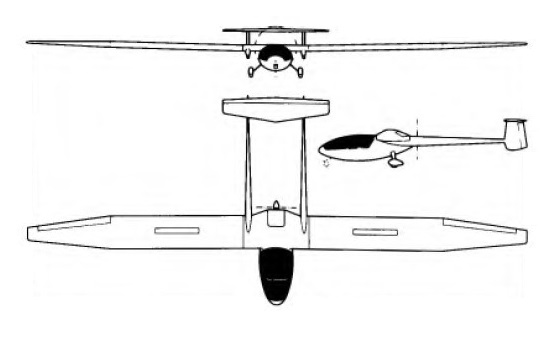
Having a twin boom pusher configuration and (on the second prototype) a conventional fixed, spatted main undercarriage, the Kora 1 is a side-by-side two seater intended primarily for training; it was designed by Messrs Schultes, Seidel and Putz, and the firm of Kortenbach & Rauh is best known for its range of furniture and other products for the garden and household.
The prototype Kora 1 made its maiden flight on 13 September 1973 and had a forwards-retracting nosewheel and the main wheels retracting backwards into the tail booms. The second prototype, which first flew on 9 April 1976, had a fixed main undercarriage to save weight and complexity, and was still undergoing flight testing at the beginning of 1978, at which time it had not yet been decided whether to start production, although orders had already been received for about a dozen Koras.
The power plant is a 65hp Limbach SL 1700EC1 air-cooled ‘flat four’ driving a Hoffman two-blade variable-pitch feathering propeller. The Kora is of all-wood construction, with cantilever high wings which have Schempp-Hirth air brakes in the upper surfaces. The pod-type fuselage nacelle has roomy side-by-side seating in a cockpit 47in wide, the canopy opening sideways to starboard. The twin tail booms end in twin fins and rudders which have the tailplane mounted on top of them. The fixed main undercarriage units on the second prototype consist of two spatted main wheels set on thin steelsprung legs cantilevered from the fuselage underside.
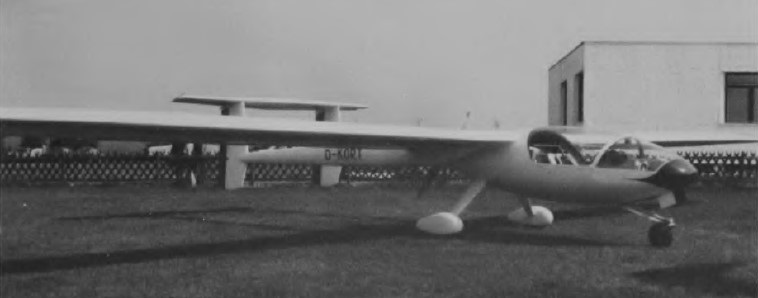
Second prototype
Engine: Limbach SL 1700 EC1, 48.5 kW / 65 hp
Span: 18.0 m / 59 ft 0.75 in
Length: 7.4 m / 24 ft 3.25 in
Height: 1.85.m / 6 ft 0.75 in
Wing area: 19.44 sq.m / 209.25 sq ft
Aspect ratio: 16.65
Wing section: Wortmann FX-66-S-1967161
Empty weight: 510 kg / 1,124 lb
Max weight: 750 kg / 1,653 lb
Water ballast: None
Max wing loading 38.58 kg/sq.m / 7.9 lb/sq ft
Max level speed at S/L: 110 kt / 205 km/h / 118 mph
Stalling speed: 35 kt / 65 km/h
Max rate of climb at S/L: 180 m/min / 590 ft/min
Min sinking speed: 0.85 m/sec / 2.79 ft/sec at 53 mph / 51 kt / 95 km/h
Best glide ratio: 30:1 at 59 mph / 54 kt / 100 km/h
The Korolyev RP-1 was a powered version of the Cheranovsky BICh-11 experimental tailless glider, designed together with Friedrich Zander (Tsander) and other Korolev’s friends from GIRD (ГИРД – Jet Propulsion Research Group).
It was planned to be a rocketplane (therefore RP index) and the Zander OR-2 rocket engine (500 N thrust) was designed especially for it. Development of the engine was very difficult, and Zander didn’t achieve success; furthermore on March 28, 1933 he died of typhus in Kislovodsk. The two RP-1 prototypes were tested in 1932-33 only as “ordinary” powered gliders, each with a 25-hp Scorpion piston engine.
The first of them was flown on June 8, 1932 – Korolyev himself was a test pilot. Totally 34 flights were made by him, but only 5 with the engine powered up.
Engine: 25-hp Scorpion
Wing span: 12.1 m
Length: 3.81 m
Wing area: 20.5 sq.m
The Korolyev SK-6 experimental two-seat, twin-boom glider of very compact design, made wide usage of Elektron magnesium alloy in the structure. Built in 1931 or early 1932, there is very little information about this glider. It never participated in any All-Union gliding contest and wasn’t among Korolev’s favorite designs. Only one photo remained which is identified as SK-6 glider.
It was designed (very similar project, anyway) in April 1931 as two-seat training aerobatic glider, but under the designation SK-7. The historian Georgy Vetrov guess it’s the same design. But why Korolev changed the designation – it is another mystery.
Calculated, for SK-7 project from April 1931
Wing span: 10.0 m
Length: 5.45 m
Wing area: 17 sq.m
Flight weight: 230 kg
Gliding ratio: 15:1
Rate of sink: 0.9 m/s

