Chicago IL.
USA
Airplane builder circa 1930-31.
Chicago IL.
USA
Airplane builder circa 1930-31.
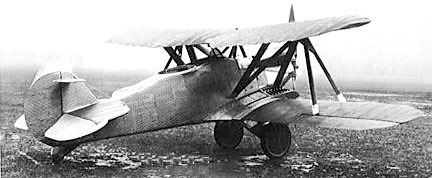
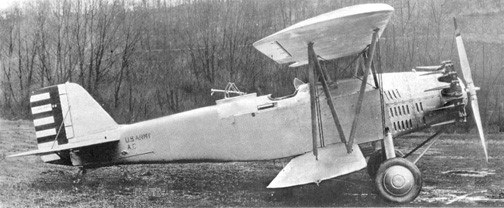
The Thomas-Morse TM-24 of 1924 was an all-metal, corrugated-skin pursuit improvement over the TM-23, but still had enough design problems to result in rejection by the Army after McCook Field tests (as P-380).
With bridge-truss struts and biplane tail, the sole example built was dismantled and stored away.
Engine: 440hp Curtiss D-12
Wingspan: (upper) 25’0″ (lower) 30’1″
Length: 20’5″
Useful load: 1500 lb
Max speed: 143
Cruise speed: 114 mph
Stall: 63 mph
Wing chord: 63″ upper, 52″ lower
Seats: 2
The one Thomas-Morse M-23 built, in 1923, for Army evaluation was a single place open cockpit biplane. All-metal, corrugated-skin pursuit design, it had inherent design and cooling problems despite several modifications. It was evaluated at McCook Field but rejected for its flight characteristics and high landing speed. It was dismantled in 1926.
Engine: Curtiss D-12, 440 hp
Wingspan: 19’6″ (later 23’0″)
Length: 16’8″ (later 17’6″)
Useful load: 788 lb
Max speed: 167 mph
Cruise speed 125 mph
Stall: 80 mph
Range: 280 mi
Ceiling: 20,150′
Seats: 1
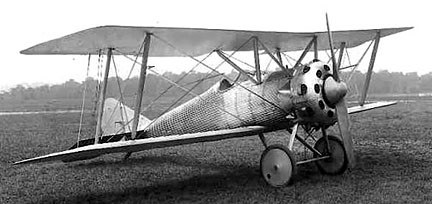
The 1923 Thomas-Morse S-9 Army trainer was a widened side-by-side cockpit in an all-metal corrugated fuselage, with wings from S-6 and tail from S-4C.
Only one was built but during Army flight tests at Kelly Field TX, it showed structural problems and the pilot bailed out; however, the plane reportedly glided to an “almost-successful landing” except for losing its wings when it went between two trees. It was sent back to Thomas-Morse, but never repaired.
Engine: 200hp Lawrance J-1
Max speed: 140 mph
Stall: 40 mph
Seats: 2
The sole 1919 Thomas-Morse S-7 was designed by W T Thomas, Agnew Larsen, and Raymond Dowd as a side-by-side cockpit two seater, advertised as “The Sociable Seater.”
Engine: LeRhône, 80hp
Wingspan: 32’0″
Max speed: 90 mph
Stall: 35 mph
Seats: 2
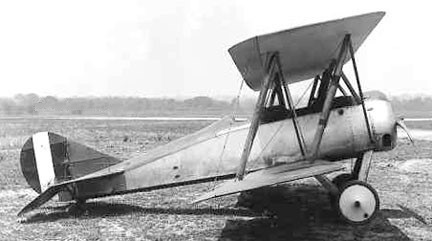
The Thomas-Morse S-6 of 1919 was Thomas-Morse’s only production with tandem cockpits and dual controls. The one built, NC98, was used in racing competitions, placed second in the 1919 Nationals.
Engine: LeRhône, 80hp
Wingspan: 29’0″
Length: 27’4″
Max speed: 105 mph
Stall: 35 mph
Ceiling: 19,500′
Seats: 2
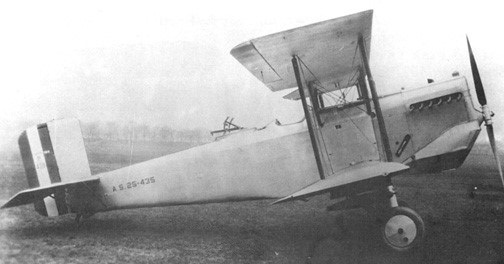
The 1926 Thomas-Morse O-6 is a metal-frame versions of Douglas O-2 built by Thomas-Morse under government contract. One went to McCook Field for testing as P-439 (25-435), and with a 435hp Liberty V-1650-1 was re-designated as O-6 (25-436).
Three production O-6 were built (25-437/439) with Liberty 12 engines.
The XO-6B of 1925 was a re-design of the O-6 with a 450hp P&W R-1340, revised wing covering and bracing, corrugated metal fuselage skin. One (25-440) was built as the prototype for O-19, McCook tested it as P-503.
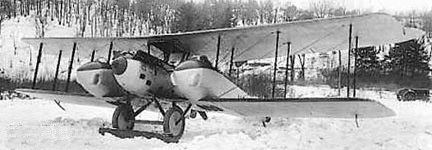
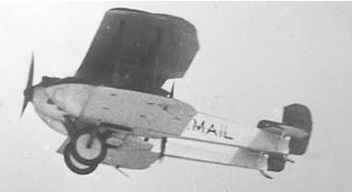
The Thomas-Morse MB-4 mail carrier of 1920 had a centerline tractor/pusher engine nacelle pod in the middle, and twin fuselages from surplus MB-3s on either side. The bad characteristics included one fuselage tended to take off before the other, no communication between cockpits, and excessive motor vibration.
One went to the USPO but was never used in service and scrapped in 1921. Three went to the US Army (AS64306, AS64373 and AS64374); the first one to McCook Field as P-172.
Engine: 2 x Wright-Hisso H, 300hp
Wingspan: 45’6″
Length: 25’5″
Useful load: 2010 lb
Max speed: 140 mph
Cruise: 122 mph
Single-engine cruise: 100 mph
Range: 600 mi
Seats: 2
Only one Thomas-Morse M-23 was built, in 1922, for Army evaluation. It was a single place open cockpit biplane.
Engine: Curtiss D-12, 425hp
Wingspan: 36’3″
Length: 20’0″
Seats: 1

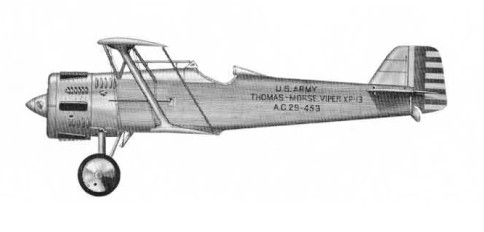
The XP-13 Viper prototype was one of several B. Douglas Thomas designs built in hopes of a production contract from the Army, following the successful Thomas-Morse MB-3 of 1919. Financed by the company, and named the “Viper”, it was officially purchased by the Army in June 1929 and designated “XP-13”.
The Viper was delivered to the USAAC for evaluation in early 1929. The aircraft was tested at Wright Field in June 1929 as P-559, then purchased by the Army and designated XP-13. The serial number was 29-453. Performance was satisfactory, but the Chieftain suffered with insurmountable cooling problems. Similar problems had been encountered with Curtiss-built fighters powered by this engine.
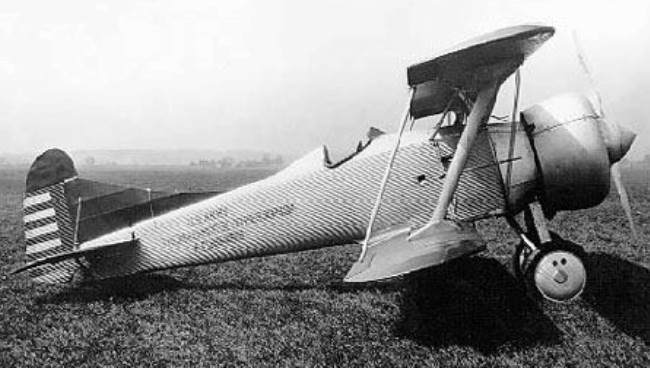
The XP-13 fuselage had a corrugated aluminum skin built over a metal frame. The wing was of wooden construction with fabric covering, but the ailerons were made of corrugated metal sheet. Tail surfaces were of metal and fabric, but the control surfaces were covered with corrugated sheet metal. Designed to use the 600 hp Curtiss H-1640-1 Chieftain engine, (a 12-cylinder two-row air-cooled radial with the rear cylinders directly behind the front cylinders rather than staggered as normal in a two-row radial) incorporating a system of baffles to direct cooling air over the engine, the engine would not stay cool enough. In September 1930 it was replaced with a Pratt & Whitney SR1340C Wasp of 450 hp in a NACA cowling, along with a revised fin and rudder. The designation was changed to XP-13A. The lower-power engine actually resulted in a speed increase of 15 mph, at least partly because of the weight savings.
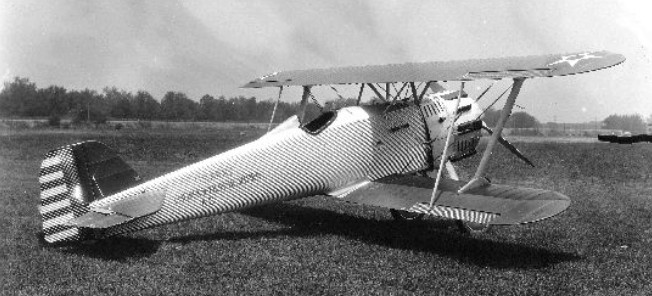
The airplane was delivered to the United States Army and tested at Wright Field, Dayton, Ohio, in June 1929 as P-559. The Army decided against production but the aircraft was purchased by the USAAC. The XP-13 Viper was the last fighter built by the Thomas-Morse Aircraft Corporation of Ithaca, New York. Thomas-Morse was acquired by Consolidated Aircraft, and the prototype was lost to an inflight fire.
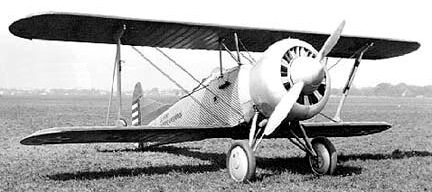
Variants:
XP-13
Prototype, serial number 29-453 with 600 hp (448 kW) Curtiss H-1640-1 Chieftain hex engine
XP-13A
The XP-13 modified with a 525 hp (391 kW) Pratt & Whitney SR-1340-C enclosed in a NACA cowling, along with a revised fin and rudder
XP-14
This designation was used for a proposed Curtiss version of the Viper with the Curtiss H-1640-1 Chieftain hex engine
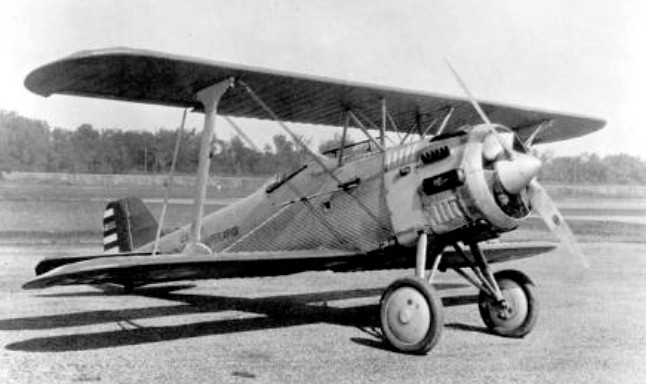
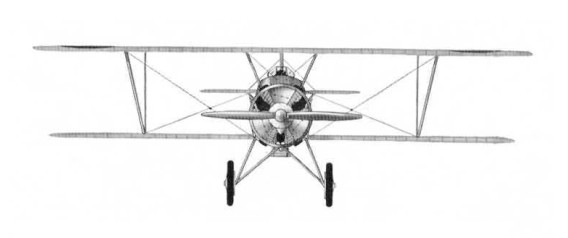
Specifications:
XP-13
Engine: 1 × Curtiss H-1640-1 Chieftain, 600 hp (448 kW)
Wingspan: 28 ft 0 in (8.53 m)
Wing area: 189 sq.ft (17.6 sq.m)
Length: 23 ft 6 in (7.16 m)
Height: 8 ft 5 in (2.56 m)
Empty weight: 2,262 lb (1,026 kg)
Loaded weight: 3,256 lb (1,477 kg)
Maximum speed: 150 knots (172 mph, 277 km/h) (at sea level)
Maximum speed: 169.9 mph at 5000 ft
Cruise speed: 113 knots (130 mph, 209 km/h)
Range: 168 NM (193 mi, 312 km)
Service ceiling: 20,775 ft (6,300 m)
Rate of climb: 1,700 ft/min (8.6 m/s)
Climb to 5000 ft: 3 min
Crew: 1
Armament: None
XP-13A
Engine: Pratt & Whitney SR1340C Wasp, 450 hp
Wingspan: 28 ft 0 in (8.53 m)
Wing area: 189 sq.ft (17.6 sq.m)
Empty weight: 2224 lb
Gross weight: 3194 lb
Maximum speed: 188.5 mph at 5000 ft
Climb to 5000 ft: 3.5 min
Service ceiling: 24,150 ft
Crew: 1
Armament: None

 All Aero