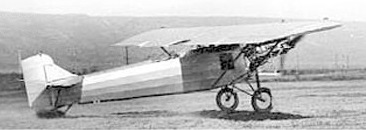
William Waterhouse was a respected structural analyst and engineer who “… undertook an assignment late in 1927 for the Mexican Government, which wanted to [produce] its own aircraft. Two monoplanes were constructed by Tijuana Aircraft Co, headed by Gov Abelardo Rodriquez of Baja California. Plans were furnished by the Mexican War Department and adapted by Waterhouse.
The planes, completed in early 1928. In test flights of the first, an observation type, a German BMW engine was used, but the second ship, expected to carry 380 gallons of fuel and make a non-stop flight to Mexico City, was scheduled for a Wright Whirlwind.”
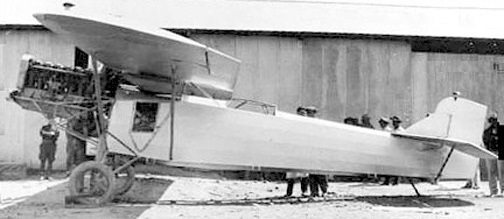
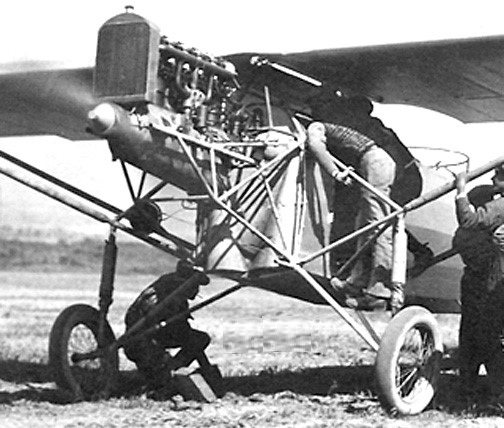
It was flown by Luis Farell Cubillas, who on 8 March 1928 took off from the Tijuana factory enroute to Mexico City. The temporary-fitted 185hp BMW IIIa quit between Hermosillo and Navajoa, and Farell crash-landed on mountainous terrain. He was uninjured but the BC-1 was destroyed.
Tijuana BC-1 BMW installation
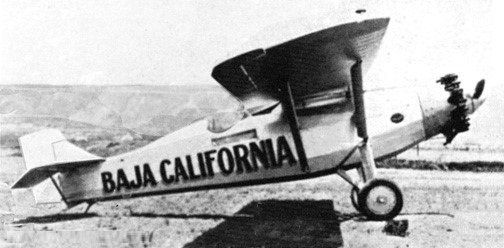
An article in Air Pictorial 27/2 by Jose Villela Jr, showed a photo of a parasol monoplane with a 185hp BMW, except the observer’s cockpit has been replaced with the pilot’s cockpit and power is a radial engine. That ship had “BC-2” on its Waterhouse-like vertical tail, and “BAJA CALIFORNIA” painted on the rear fuselage; photo caption: “Col. Fierro in ‘Baja California No. 2’ lands in the Canal Zone after his flight to Panama in 1928.” In his article Villela says, “Later Colonel Roberto Fierro in the Mexican-built ‘Baja California 2’ made the first non-stop flight between Mexico City and Havana in 14 hours, 50 minutes.”
The rear cockpit looks like it has a ring for a machine gun.
Tijuana BC-2
There was a later BC-3 described in Wagner’s article with a photo that has a family resemblance to the others, including the Waterhouse vertical tail.
BC-1 Engine: 185hp BMW Wingspan: 43’0″ Length: 30’0″ Max speed: 122 mph
William Waterhouse was a respected structural analyst and engineer who “… undertook an assignment late in 1927 for the Mexican Government, which wanted to [produce] its own aircraft. Two monoplanes were constructed by Tijuana Aircraft Co, headed by Gov Abelardo Rodriquez of Baja California. Plans were furnished by the Mexican War Department and adapted by Waterhouse.
The planes, completed in early 1928. In test flights of the first, an observation type, a German BMW engine was used, but the second ship, expected to carry 380 gallons of fuel and make a non-stop flight to Mexico City, was scheduled for a Wright Whirlwind.”
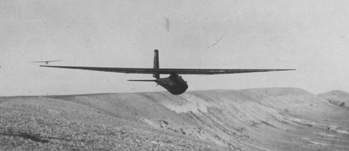
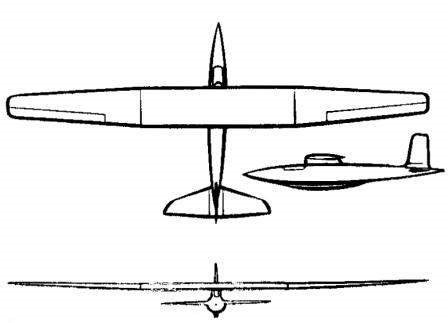
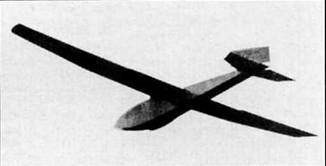
The “Zhar Ptitsa-2” glider was designed by MK Tijonrarov, V. S. Vaxmistrov, and A. A. Dubrovin as a record-setting single-seater monoplane. In general, it was an improved development of the previous “Zhar-Ptitsa”. The main differences were in their slightly larger dimensions.
The Tijonrarov / Dubrovin “Zhar-Ptitsa-2” (Russian: Тихонравов / Дубровин / Вахмистров «Жар-Птица-2») participated in the VI national glider competitions, along with the other members of the “Zhar-Ptitsa”, “Skif” and “Gamayún”.
In the course of the competition and piloted by KM Vienzlav, he set a new national record by reaching 34.8 km in return flight.
The “Zhar-Ptitsa-2” glider would be presented again in the VII national competitions, developed in 1930.
Zhar-Ptitsa-2 Wingspan: 14.5 m Wing area: 16.0 m² Aspect ratio: 13.1 Empty weight: 160 kg Wing loading: 14.4 kg / m² Horizontal plane surface: 2.3 m² Empennage surface: 1.15 m² Glide ratio: 20.8 Accommodation: 1
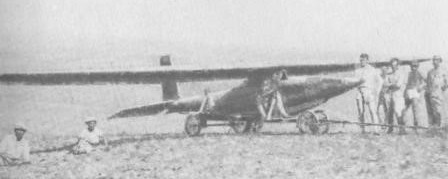
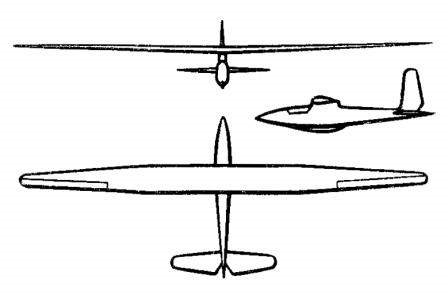
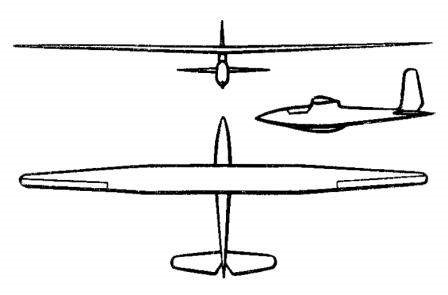
The Tijonrarov / Dubrovin / Vaxmistrov “Zhar-Ptitsa” (Firebird) (Russian: Тихонравов / Дубровин / Вахмистров «Жар-Птица») glider was designed in 1927 by MK Tijonrarov and AA Dubrovin in order to participate in the IV National Competitions Gliding, which took place in that year. Later this group would be joined by fellow student VS Vaxmistrov.
The “Zhar-Ptitsa” glider was designed as a single-seat monoplane with a cantilever wing in parasol. The structure was built in wood. The wing was fixed to the fuselage at three points on a 200 mm base pile, made as a continuation of the central structure of the glider. The centroplane had a rectangular shape and in the area of union with the fuselage it was covered with 3 mm plywood.
The wing consoles featured a single spar structure and plywood covering from the leading edge to the spar area. From then on, the covering was made of fabric. The fixation to the centroplane was carried out by means of two screws. Assembly of the glider at the flight site could be done in 10-15 minutes.
The fuselage was spindle-shaped with a tapered bow and tail. Its structure consisted of trunk-type frames linked together by light stringers.
The tail unit was of the conventional monoplane type with the rectangular empennage.
The landing gear consisted of a ski. On takeoff (towed), the aircraft was tied to the tugboat by means of a 100-meter, 5-mm diameter rope that ended in a 3-meter-long and 188-mm thick rubber band. A hook was located at each end. For takeoff, the plane was attached to a trolley that detached when it reached takeoff speed. After separating from the glider, the tow plane dropped the rope. The landing was made by landing on the ski.
The “Zhar-Ptitsa” was completed in the workshops of the Air Fleet Academy and presented in Koktebel by the trio of developers.
This glider was quite successful, to the point of becoming the “passport” of the next competitions. In order to participate in the tests, the glider pilots had to make a previous flight in the “Zhar-Ptitsa”.
The main deficiency of the “Zhar-Ptitsa” glider was its incorrect centering as a result of the increased weight of the wood used in relation to that of the project. To correct this defect it was necessary to place a weight of 10 kg in the forward part of the fuselage.
The official opening of the IV National Sailing Competition was held on 18 of September of 1927, but since dawn that day strong winds that prevented flying. However, later, the force of the wind abated and it was allowed to compete. The “Zhar-Ptitsa” piloted by KM Vienslav flew for 15 km, landing on the outskirts of Feodosia, setting a new record.
Only 10 gliders appeared at the V National Sailing Competition held in Koktebel between September 23 and October 2, 1928. During the development it was clear that the main results of the contest would be distributed among the “Zhar-Ptitsa” gliders and its derivative “Gamayún”. During one of the flights, VA Stepanchonok achieved an excellent altitude making spirals in the “Zhar-Ptitsa”, but the expected records were not reached as the glider was damaged when landing with a tailwind.
The “zhar-Ptista” would participate again in 1929 in the VI annual National Sailing Competitions. On this occasion, it was used mainly in training tasks for glider pilots and its mastery was a determining factor in being able to fly in the competition.
The starting point of the competitions in Koktebel was located on the top of the Uzun-Syrt Mountain and featured a piece of steel buried in the earth. Before the start the glider was fixed to this structure. For the launch, a rubber strip was used that at one end had a hook and at the other ended in two 5-meter ropes. The hook was attached to a piece on the glider, while 4 or 5 people began to pull the other end. After advancing about 20 – 30 steps, a good tension was achieved on the tape. At that moment the pilot, located in the cockpit, released the glider, which would shoot like a stone to get up from the ground up to about 25 – 30 meters high. This was enough for a pilot with some training to be able to take advantage of a current of air or a thermal to take the necessary height and perform the glide.
In those early days the important thing for the pilots was not to return to the starting point or even to the base of the mountain. The greatest attention was paid to being able to achieve takeoff after launch at 30 meters high and being able to glide to the base of the mountain without damaging the aircraft or themselves. Means to transport the devices did not exist there. The glider was climbed to the top of the mountain, on shoulders, with the help of volunteers who came to support the pilots and the spectators themselves.
These volunteers were also in charge of helping with the repairs that had to be carried out on the gliders. Generally, as a reward, these volunteer helpers were “paid” by allowing them to fly in the gliders.
During the IV National Sailing Competitions, one of these active volunteers was the Kiev Polytechnic Institute student Sergei Korolyov, who came to realize his childhood dream of flying. Sergei Korolyov took flight for the first time on board the “Zhar-Ptitsa”.
One of the most experienced pilots of the VMF military pilot school located in Kacha was Vasili Stepanchonok, who in 1930 proposed taking off on gliders towed from other aircraft and developed a variant of the towline. This initiative was supported by the school principal Robert Rataush. On 3 May 1931, for the first time in the USSR, there was a takeoff of a glider towed by a U-1 (copy of the Avro 504K ) airplane. The glider used in this flight was the “Zhar-Ptitsa”, piloted by Maxim Moiseyev. Three subsequent flights were made by Mikhail Nyuxtikov, Gury Gribakin and Robert Rataush himself. Initially, this type of take-off was considered a kind of trick, but its importance from the sporting and military point of view was soon understood.
Nyuxtikov had received this glider as a gift after his outstanding performance as a test pilot at Koktebel competitions in 1930. To carry out the take-off with a ttowplane, Nyuxtikov proposed to develop a wheelbarrow on which the glider was located and which would detach at the time of take-off. For the first time in the USSR this system was used and possibly it was also one of the first uses in the world. In the magazine “ Samoliot ” of 1931 the details of this truck used for the take-off of the “Zhar-Ptitsa” were published.
Zhar-Ptitsa Wingspan: 11. 5 m Wing area: 16.3 m² Aspect ratio: 12.9 Length: 6.93 m Height: 1.9 m Empty weight: 172 kg Wing loading: 15 kg / m² Elevator area: 2.6 m² Rudder surface area: 0.85 m² Spoiler area: 2.92 m² Accommodation: 1
After finishing his studies at the VS Air Fleet Academy, Vaxmistrov went on to work at the NII VVS, where he developed his composite aircraft projects known as “Zvenó”. Upon completion of AA studies, Dubrovin went on to work at Factory No. 39 in Moscow and later as principal builder at Factory No. 301 in Khimki.
Tijonrarov in 1930, with the degree of military engineer of the second degree, was transferred to the TsKB of Factory No.39 Menzhinski where he led a motorization group.
Before saying goodbye forever, this trio of aeronautical builders designed a new glider that saw the light in 1931 under the name “Skif-2” (Russian: Тихонравов / Дубровин / Вахмистров “Скиф-2”).
The main objective of the “Skif-2” was to test the Pr-652 wing profile in flight. The new wing using this profile had been designed by AA Dubrovin and BN Sherementiev in 1930.
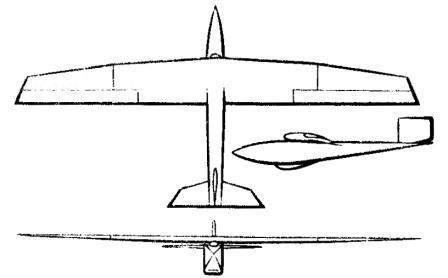
The “Skif-2” glider was designed as a single-seat monoplane with a cantilever wing in parasol. In general, it was an enlarged development of the successful “Skif”.
The structure was built in wood. The “Skif-2” incorporated a wing with double spar and wingspan increased to 17.2 meters, aspect ratio of 17.7 and a new Pr-652 profile. The wing was attached to the fuselage at three points on a central pile built as an integral part of the fuselage support structure. The centroplane had a rectangular shape and in the area where it joined the fuselage it was covered with 3 mm plywood. The wing was covered with plywood up to the position of the second spar. From then on, the covering was made of fabric.
The fuselage on the “Skif-2” remained unchanged and featured a spindle shape with a tapered bow and tail. Its structure consisted of trunk-type frames linked together by light stringers. In the rear part of the fuselage the tail unit was located was of the conventional monoplane type and in the lower part the landing ski.
The pilot was located in a closed cockpit, which had a removable celluloid cover and two small windows located at the level of the pilot’s eyes. The cockpit had so much space that the pilot could sit with his parachute. The cover provided the necessary clarity to allow the pilot to see the instrument records.
The “Skif-2” glider participated without great success in the VIII National Sailing Competitions held in Koebel . The new wing construction was 12 kg heavier than the base model, which affected the practical results of the glider. On the other hand, most of the flights were carried out without the cockpit cover, so the coefficient of aerodynamic drag rose from 0.094 to 0.115.
In general, the performance of the “Skif-2” was inferior to the “Skif”. The aerodynamic quality decreased from 22.3 to 20 and the descent speed increased from 0.7 m / s to 0.72 m / s. Due to the repair work carried out, the “Skif-2” was able to start racing late accumulating only a poor value of 20 flight hours.
Skif-2 Wingspan: 17.2 m Wing area: 16.7 m² Aspect ratio: 17.7 Empty weight: 200 kg Wing loading: 16.8 kg / m² Stabilizers surface: 2.6 m² Elevator area: 1.24 m² Spoiler area: 3.8 m² Glide ratio: 20 Descent speed: 0.72 m / s Accommodation: 1
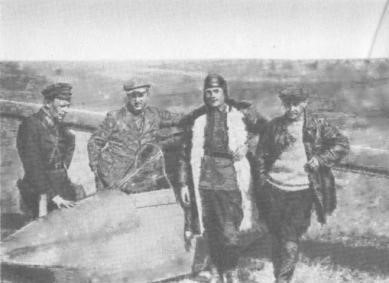
Dubrovin, Vaxmistrov, Yumashiev, and Tijonrarov alongside the Skif glider in 1929.
Despite being serving in the “Lenin” squad, Tijonrarov did not cease his constructive activity. During 1928, together with VS Vaxmistrov and AA Dubrovin, two new gliders were created, called “Gamayún” and “Skif” (Russian: Тихонравов / Дубровин / Вахмистров «Скиф»), both produced as a development of the excellent “Zhar-Ptitsa”.
The “Skif” glider was a development of the scheme of the “Zhar-Ptitsa” glider. It was designed as a single-seater monoplane with cantilever wing in parasol. The structure was built in wood. The wing was fixed to the fuselage at three points on a 200 mm base pile, made as a continuation of the central structure of the glider. The centroplane had a rectangular shape and in the area of union with the fuselage it was covered with 3 mm plywood.
In this model the builders decided to use a modified structure, which introduced a second stringer. The plywood overlay was extended to the position of this second spar. From then on, the covering was made of fabric.
The fuselage was spindle-shaped with a tapered bow and tail. Its structure consisted of trunk-type frames linked together by light stringers. Another significant difference from the design of the previous “Zhar-Ptitsa” and “Gamayún” models was the shape of the tail. The “Skif” featured new removable triangular-shaped surfaces with rounded ends. At the bottom of the fuselage was the landing ski.
The pilot was located in a closed cockpit, which had a removable celluloid cover and two small windows located at the level of the pilot’s eyes. The cockpit had so much space that the pilot could sit with his parachute. The cover provided the necessary clarity to allow the pilot to see the instrument records. The cockpit panel featured a speedometer, barometer, altimeter, lap counter and overload indicator. A thermometer and an angle of attack marker were located on the outside.
During the tests some vibration was noted in the rudder area, but it was soon resolved by reducing the area.
In 1929, during the VI National Sailing Competitions in Koktebel A. B. Yumashiev on the “Skif” glider set several national records.
On October 12, taking off from the south slope, near the afternoon, when the flights had already ceased, the pilot felt that the glider was staying well in the air and began to rise. When it exceeded 570 meters the barograph stopped recording. Yumashiev began gliding using the northwesterly wind and landed safely after covering a record distance of 13 km. This was the first time that a glide over a thermal flow with ascent over the plain was achieved in the USSR.
On October 22, Yumashiev would once again become the news when he reached a record height of 1520 meters on the “Skif”. After achieving that height, Yumashiev decided to try a new distance record, but his glider lost 600 meters in height quickly. With the remaining height, he managed to maintain a linear flight until reaching Dalnie Kamishi village, located at 27.2 kilometers.
The “Skif” glider would be presented again in the VII edition of the national competitions, held in 1930.
Skif Wingspan: 16.0 m Wing area: 16.0 m² Aspect ratio: 16 Empty weight: 170 kg Wing loading: 15 kg / m² Horizontal plane surface: 2.3 m² Empennage surface: 1.15 m² Glide ratio: 22.2 Accommodation: 1
Despite being serving in the “Lenin” squad, Tijonrarov did not cease his constructive activity. During 1928, together with VS Vaxmistrov and AA Dubrovin, two new gliders were created, called “Gamayún” (Russian: Тихонравов / Дубровин / Вахмистров «Гамаюн») and “Skif”, both produced as a development of the “Zhar-Ptitsa”.
The “Gamayún was designed as a record-setting single-seater glider and was obtained as a development of the “Zhar-Ptitsa” glider and was generally similar to it. The main difference of the “Gamayún” consisted in the increase of the wingspan. Other minor modifications included changes in the fuselage structure and variation in the centering to overcome the difficulties of the “Zhar-Ptitsa”. These modifications hardly brought improvements in the results.
These skills developed in Koktebel between 23 September and 2 October 1928 as 10 gliders were presented in the V National Sailing Competition. The “Gamayún” was one of the copies that were released in this contest. Already during the development, it was clear that the main results of the contest would be distributed between the “Zhar-Ptitsa” and the “Gamayún” gliders.
The “Gamayún” piloted by test pilot, major general of aviation, Andrei Borisovich Yumashiev, made several flights. In the competition he showed the best results, setting two national records: the one for a straight-line range of 14 km and the one for height above the take-off point of 375 meters. This flight lasted 1 hour and two minutes on the Uzun-Syrt path to Sorogol (near Feodosia). The landing at Sorogol was carried out in a small space between the coastline (one wing of the glider was left in the water) and some railroad warehouses. Yumashiev tried to fly in the opposite direction without success, but was forced to land in the market place to the great rejoicing of the local population.
With this flight the record attempts of that year would end.
The “Gamayún” participated in the VI edition of the national glider competitions. Piloted by Sergueyev, it was approaching landing when a gust of wind threw it abruptly upwards. As a result of these abrupt manoeuvres, the wings were detached from the fuselage. The fuselage fell to the ground, but the pilot was unharmed.
Gamayún Wingspan: 16.0 m Wing area: 17.0 m² Aspect ratio: 15 Empty weight: 153 kg Horizontal plane surface: 2.3 m² Empennage surface: 0.85 m² Ailerons area: 2.10 m² Wing loading: 13.4 kg / m² Accommodation: 1
Shortly before graduating, in 1925 at the Zhukovski Military-Aeronautical Engineering Academy, Tijonrarov, together with the first-year student VS Vaxmistrov, designed and built the AVF-22 glider and that Tijonrarov nicknamed “Zmiei Gorinich” (Russian: Тихонравов / Вахмистров АВФ-22 “Змей Горыныч”).
The AVF-22 “Zmiei Gorinich” glider was designed as a monoplane with a high trapezoidal cantilever wing of conventional design. The structure was built in wood with a textile covering. The large wings featured large ailerons on the trailing edge of the wing. The tail unit was a monoplane type with an integral rudder.
The fuselage was constructed of plywood with a rectangular cross section. In its side view, the fuselage was shaped like a wing aerodynamic profile. The tail unit was a monoplane type with a rectangular-shaped integral rudder and trapezoidal-shaped horizontal planes.
The landing gear consisted of a pair of skis in the lower region of the fuselage.
After graduating from the Academy, Tijonrarov was sent to serve in the “Lenin” Squad. Vaxmistrov and his glider were entered in the glider competitions held during August 1925 in Renske, Germany.
Specialists and the German press were greatly interested in the “Fire Dragon” (translation given to the name of the glider in Germany). On August 29, pilot Vladimir V. Sergueyev achieved a flight in the AVF-22 of 4400 meters. A day later the pilot LA Jungmeister managed to reach the height of 265 meters, which was a record for the time. On that very second day of racing, VV Sergueyev managed to fly the “Zmiei Gorinich” a distance of 11 km.
The glider “Zmiei Gorinich” participated in the III National Sailing Competitions held in Koktebel between September 27 and October 11, 1925. During its first flight in this contest the glider lost speed and fell, hitting the ground. The pilot received a major trauma to the neck. The glider could not be rebuilt.
AVF-22 “Zmiei Gorinich” Wingspan: 14.35 m Wing area: 19 m² Length: 6.96 m Height: 1.8 m Empty weight: 130 kg Wing loading: 11 kg / m² Elevator area: 2.23 m² Rudder surface area: 1.3 m² Ailerons area: 1.0 m² Wing elongation: 10.8 Accommodation: 1
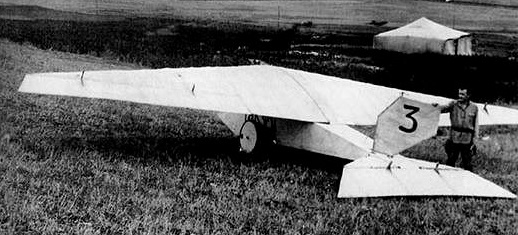
Tijonravov AVF-1 “Arap” at the First National Competitions of 1923.
In March 1923 the Society of Friends of the Air Fleet (ODVF) was created (in Russian: Общество друзей Воздушного флота (ОДВФ)) with the aim of supporting the construction of airplanes and aeronautical engines, familiarizing the population with aeronautics and with the study of airplanes, engines, gliders, parachutes, as well as the development of gliding. To this end and under the direction of KK Artseulov, the Center for Motorless Aviation was created within the ODVF.
Tijonrarov became interested in the construction process and began to combine his studies at the Academy with the projection of a glider that he called “Arap”. This was the first glider created within the Air Fleet Academy (AVF), for which it was officially designated AVF-1 (Russian: АВФ-1 “Арап”).
The AVF-1 “Arap” was developed by a group of academy students. The assembly was carried out at the “Aviarabotnik” factory in Moscow.
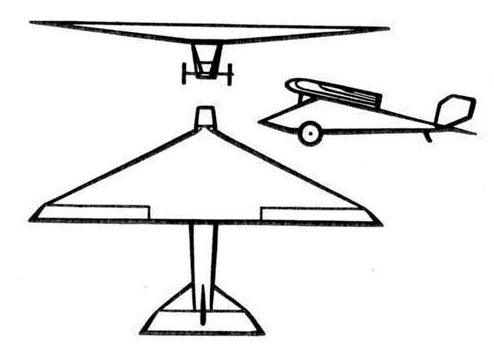
The AVF-1 “Arap” glider was designed as a monoplane with a triangular cantilever wing. The structure was built in wood with a textile covering. The wing profile was achieved by taking the shape of a Junkers monoplane with modifications to the shape and its structure had wooden stringers converging at a point on the wing root, joined with perpendicular ribs. Roll control was ensured by large ailerons on the trailing edge.
The fuselage, with a trapezoidal section, was made up of two flat surfaces joined by pieces of wood. Towards the tail section the fuselage closed towards a horizontal rib to which the tail was attached.
The tail unit was of the monoplane type. The large area horizontal stabilizer was located at the rear of the fuselage with a single large area elevator. The empennage functioned entirely as a rudder.
The landing gear was of the conventional type, fixed, with a tail skid. The two large wheels were located on either side under the cab, with a large light between them.
The cockpit for the pilot was located in the forward portion of the fuselage, under the wing.
The first flight was made on October 12, 1923. The AVF-1 was ready in time to participate in the First National Sailing Competitions, promoted by the ODVF and held between November 1 and 18, 1923 in the Uzun-Sirt mountains, Crimea.
Ten gliders appeared in this contest. The technical commission, chaired by Professor VP Vietchinkin authorized the flight of only 9, among which stood out the AVF-1 Arap of MK Tijonrarov, the AVF-2 Strizh of VS Pyshnov, the AVF-3 “Mastyazhart-1” of SV Ilyushin; the Maori of SN Lyushin and tailless glider BICH-1 of BI Cheranovski.
After tests that comprised flight for more than 15 seconds, the AVF-1 was one of the four gliders that were authorized to perform flights. In November or December 1923, piloted by VF Denisov, this flight lasted only 1 minute 5 seconds in which the glider reached 385 meters with a maximum height of 70 meters. On the second flight the “Arap” made a turn and destroyed the wing.
AVF-1 Arap Wingspan: 10.1 m Wing area: 15 m² Aspect ratio: 6.8 Length: 6.2 m Height: 1.9 m Empty weight: 70 kg Wing loading: 9.5 kg / m² Stabilizer surface 0.65 m² Elevator surface 2.5 m² Rudder surface area: 0.65 m² Spoiler area: 2.4 m² Accommodation: 1
Mikhail Klavdievich Tijonrarov (Russian: Михаил Клавдиевич Тихонравов) was born on July 29, 1900 in the city of Vladimir.
In June 1919 he voluntarily joined the Red Army, serving as a political agitator in the military commissariat of the Vladimir governorship. In 1920 he began his studies at the Institute of Engineers of the Red Air Fleet (Институт инженеров Красного Воздушного Флота) which from 1923 would become the Military Aeronautical Engineering Academy Professor N. Ye. Zhukovski (VVIA) (Военно-воздушная инженерная академия имени Н. Е. Жуковского), graduating in 1925.
After finishing his studies, Tijonrarov served in the 1st “Lenin” light bomber squad. From 1926 he worked in various aeronautical companies, including the bureaus of DP Grigorovich and Nikolai. N. Polikarpov. From 1930 he became head of the KB engine group at Factory No.39 Menzhinski.
In those years, and as a complement to his professional activity, he built around 10 gliders in conjunction with VS Vaxmistrov and AA Dubrovin, among which the AVF-1 “Arap” of 1923, AVF-22 “Zmiei Gorinich” of 1925, “Zhar-Ptitsa” in 1927, “Gamayún” in 1928, “Skif” in 1928, “Konsomolskaya Pravda” or “Zhar Ptitsa-2” in 1929, “Skif-2” in 1931. Many of these specimens competed successfully in the National Sailing Competitions held in Koktebel, Crimea.
Sergei Koroliov proposed to Tijonrarov to devote himself to the development of ballistic missiles propelled by liquid fuel. From 1932 Tijonrarov was appointed brigade chief in the Group for the Study of Reactive Movements (GIRD), which was responsible for the development of the first Soviet two-stage reactive engine.
Starting in 1938, Mikhail Tijonrarov dedicated himself to the research of liquid reactive engines, the development of rockets for the study of the upper layers of the atmosphere, but at the end of the 1930s, work related to the development of ballistic missiles with reactive engines they were canceled and Tijonrarov set about developing the rockets for the “Katiuskas”.
Between 1940 and 1943 Tijonrarov led a construction group, under the leadership of AG Kostikov, which was in charge of the development of the intercept fighter “302” with combined power plant. In this stage of the war he developed an intense work in the development of reactive rockets for the VVS.
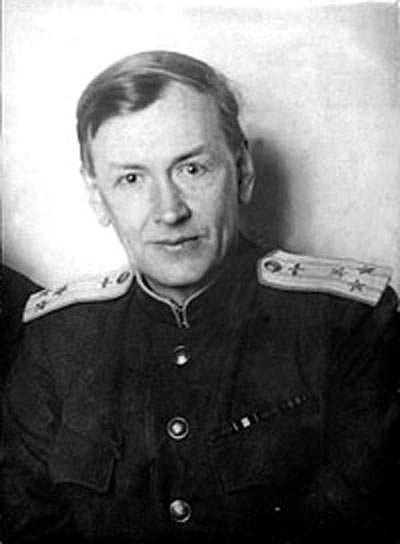
Starting in 1946, Tijonrarov was appointed substitute for the head of the reactive rockets group at Institute No. 4 of the USSR Academy of Gun Sciences. Between 1946 and 1956 Mijail Tijonrarov created within the institute a group for the development of a project known as BR-190 consisting of a piloted aircraft that took off vertically with the help of an R-1 rocket, reaching a height of 200 km.
Mikhail Tijonrarov in the late 1940s.
The next works of Tijonrarov’s group were devoted to the study of missile trajectory calculations.
In March 1950 at the NII-4 Tijonrarov gave a lecture entitled ” Rocket packages and prospects for their development.” In his speech he developed the above ideas and for the first time he spoke publicly about the possibility of using these rockets to locate artificial satellites in orbit, and even take people into space. The group’s work was directed to the development of a “package” made up of three R-3 rockets, designed to carry a 3-ton military payload over a distance of 3000 km.
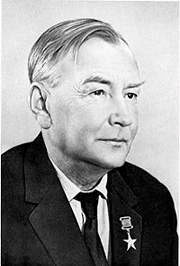
Under the leadership of Tijonrarov, the world’s first manned cosmic ship was successfully developed and launched for which he was awarded on June 17, 1961 with the title Hero of Socialist Labor , along with the Order of Lenin and the Hammer and Sickle medal.
From 1961 Tijonrarov was promoted to head of department and substitute for the main builder of OKB-1, which from 1966 became the Central Construction Bureau for Experimental Machinery Construction (TsKBEM). In the next few years the group under the direction of Tijonrarov worked on the project to develop a manned spacecraft to fly to Mars, several artificial satellites with different objectives. From 1970 he became scientific director of TsKBEM.
Miajil Tijonrarov died on 4 of March of 1974 in Moscow at the age of 73 years.

 All Aero